


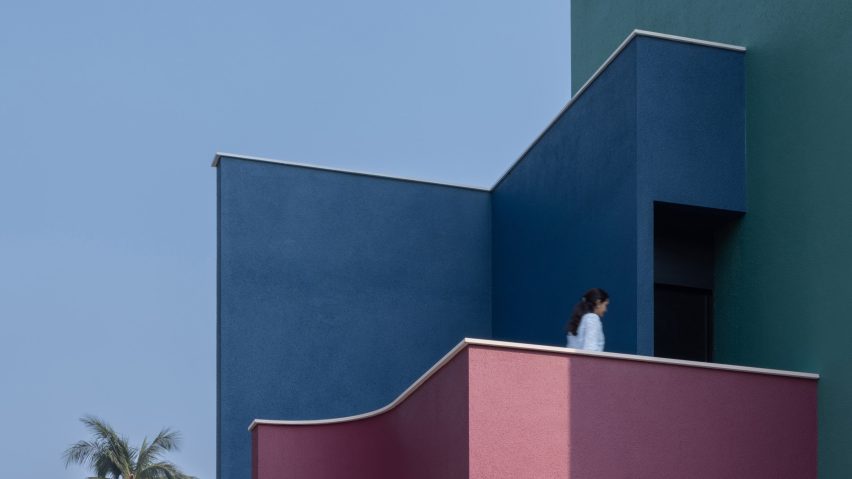
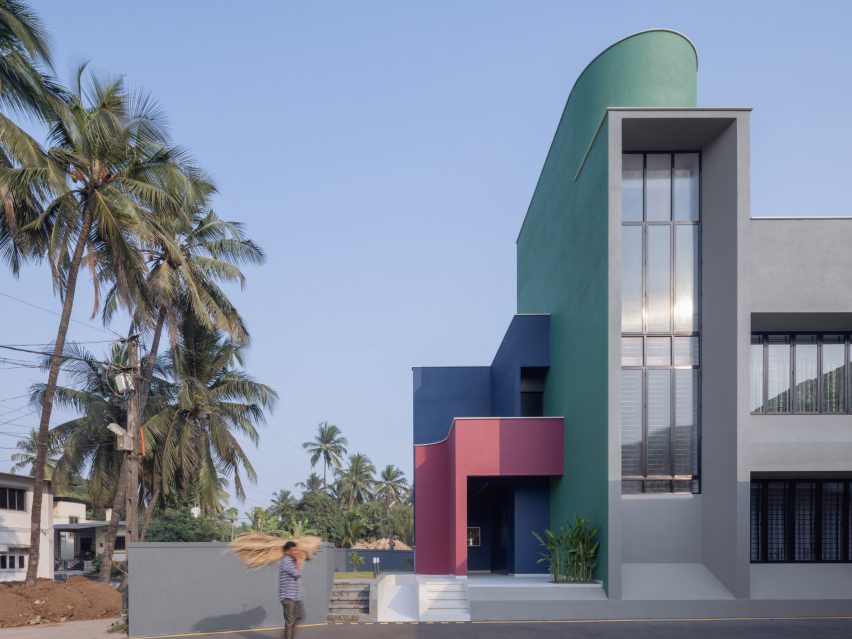
Local architect Neel Buddhadev has completed Villa Corsica, a house in suburban Mumbai defined by curved walls and bold colours that was designed in response to the city's tropical climate.
The 280-square-metre (3,000-square-foot) residence was designed in collaboration with architects Virtue – Architect Cleon Colaco & Associates for a multi-generational family with accessibility requirements.

"The core concept of Villa Corsica lies in rethinking the idea of a house," Buddhadev told Dezeen.
"It challenges conventional domestic architecture by treating the space as a sequence of framed experiences, almost like moving through a museum or sculptural installation."

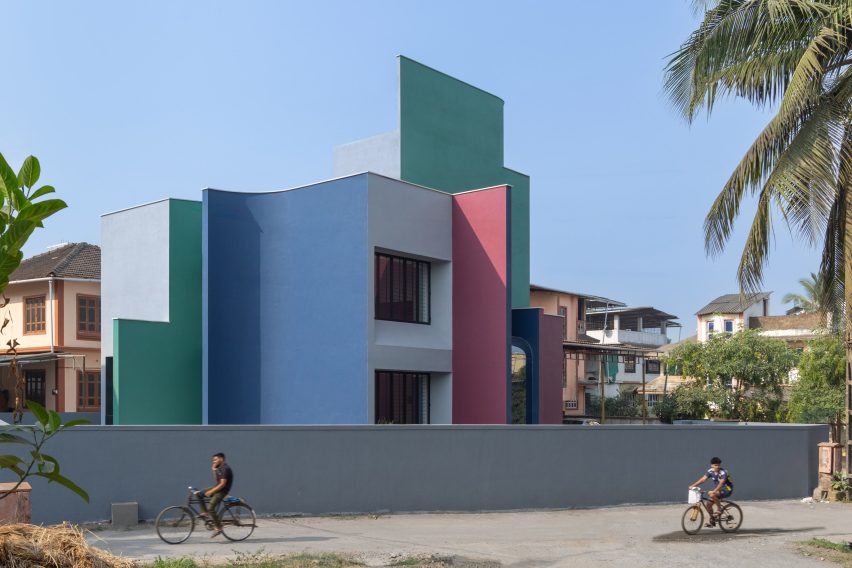
Designed in response to Mumbai's tropical climate, the house is organised around the path of the sun, with openings and circulation routes positioned to regulate internal temperatures.
Large openings and a balcony line the northern elevation to maximise daylight and cross-ventilation, while the more exposed southern side contains corridors and service spaces, reducing heat gain within the main living areas.
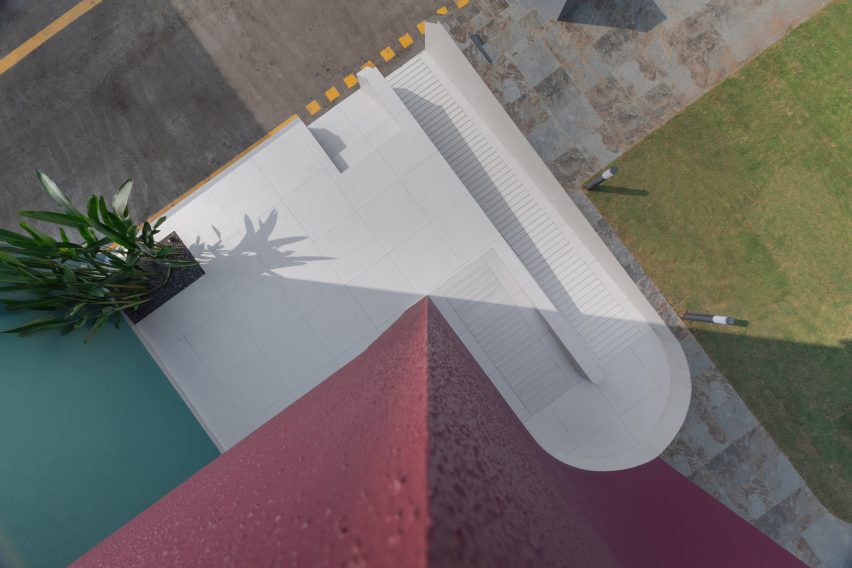
The house was constructed from reinforced cement concrete (RCC) and traditional burnt-clay brick, finished with cement plaster and protective paint, to endure the erosive weather.
Accessibility was integrated into the design from the outset, through a winding ramp that runs alongside the entrance steps, providing access for the owner's elderly mother.

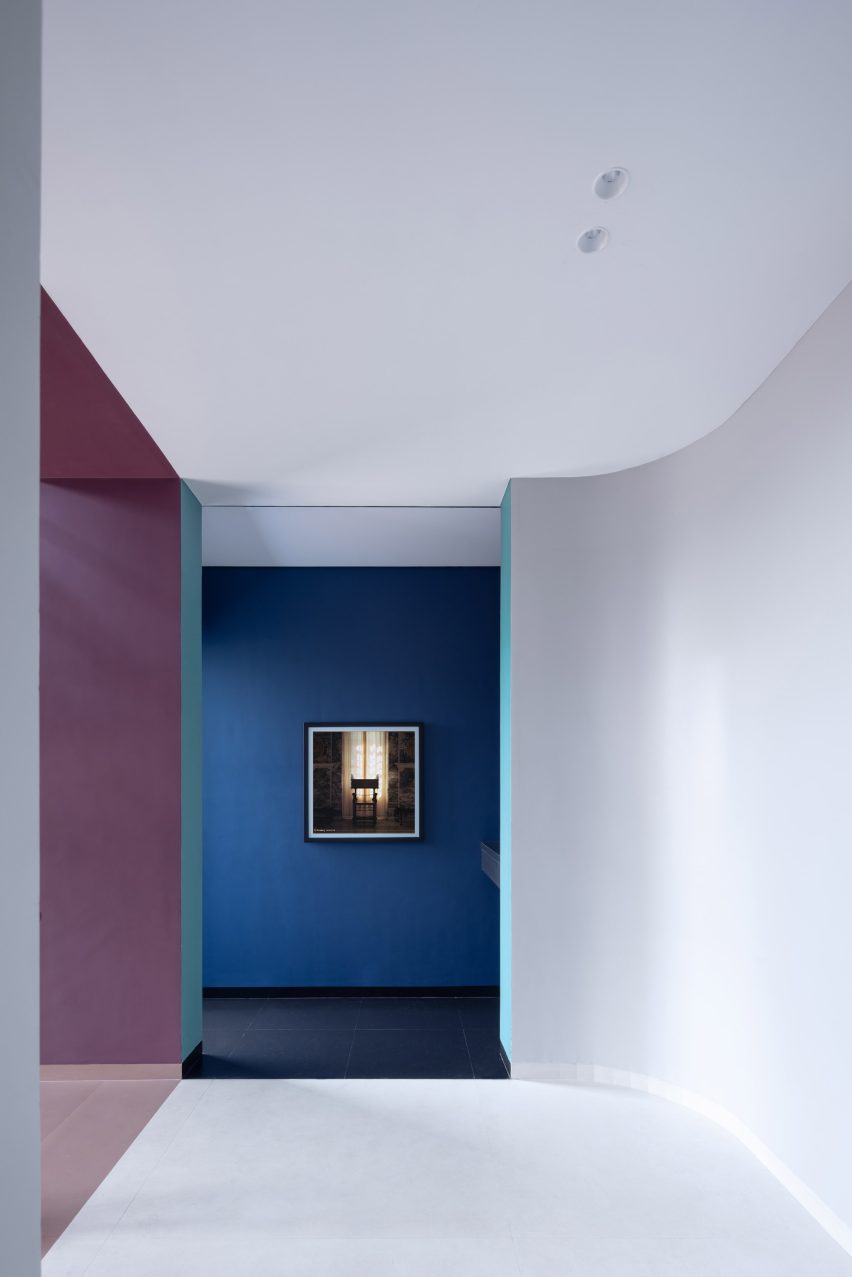
Visitors enter through a foyer concealed behind a bordeaux-coloured wall, which screens the front door from the main living spaces and creates a gradual transition into the house.
To one side of the entrance, a curved-eave window forms a skylit niche containing built-in seating and shoe storage, while a small recessed alcove on the opposite side houses the family's temple.
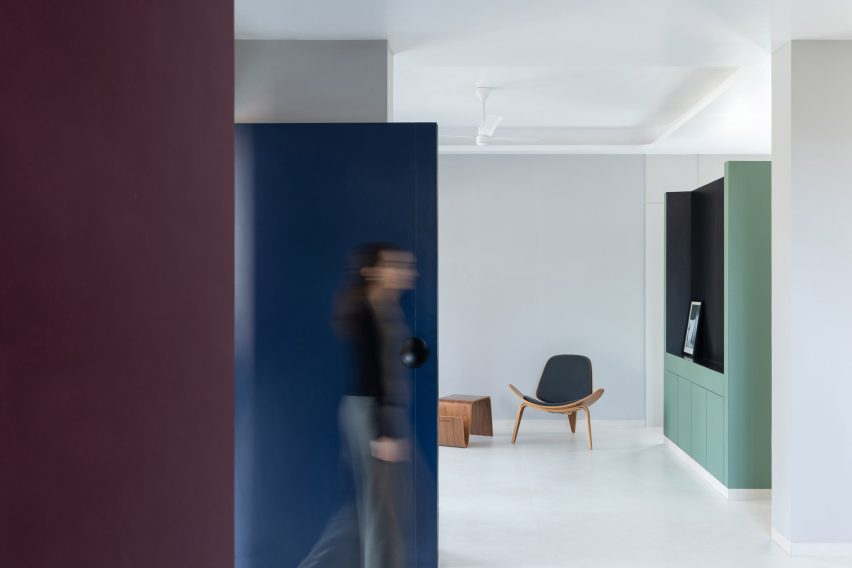
Artworks by French artist Sophie Dloussky were positioned throughout the interior and act as focal points within the otherwise fluid sequence of spaces.
Colour was used to distinguish different areas of the house. Paired with white flooring and grey window frames, the bold hues introduce contrast between individual rooms and circulation spaces.
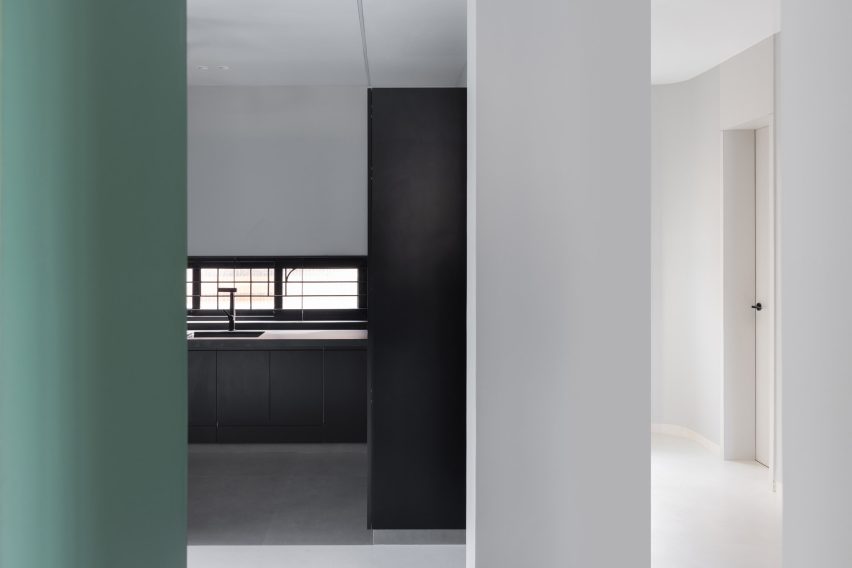
In contrast to the pops of colour in the living spaces, the kitchen was finished in a palette of black and grey tones.
"Colour acts as the primary architectural device in the project," said Buddhadev. "Rather than decorative elements, we opted for bordeaux, blue, green, grey and black to define the thresholds."
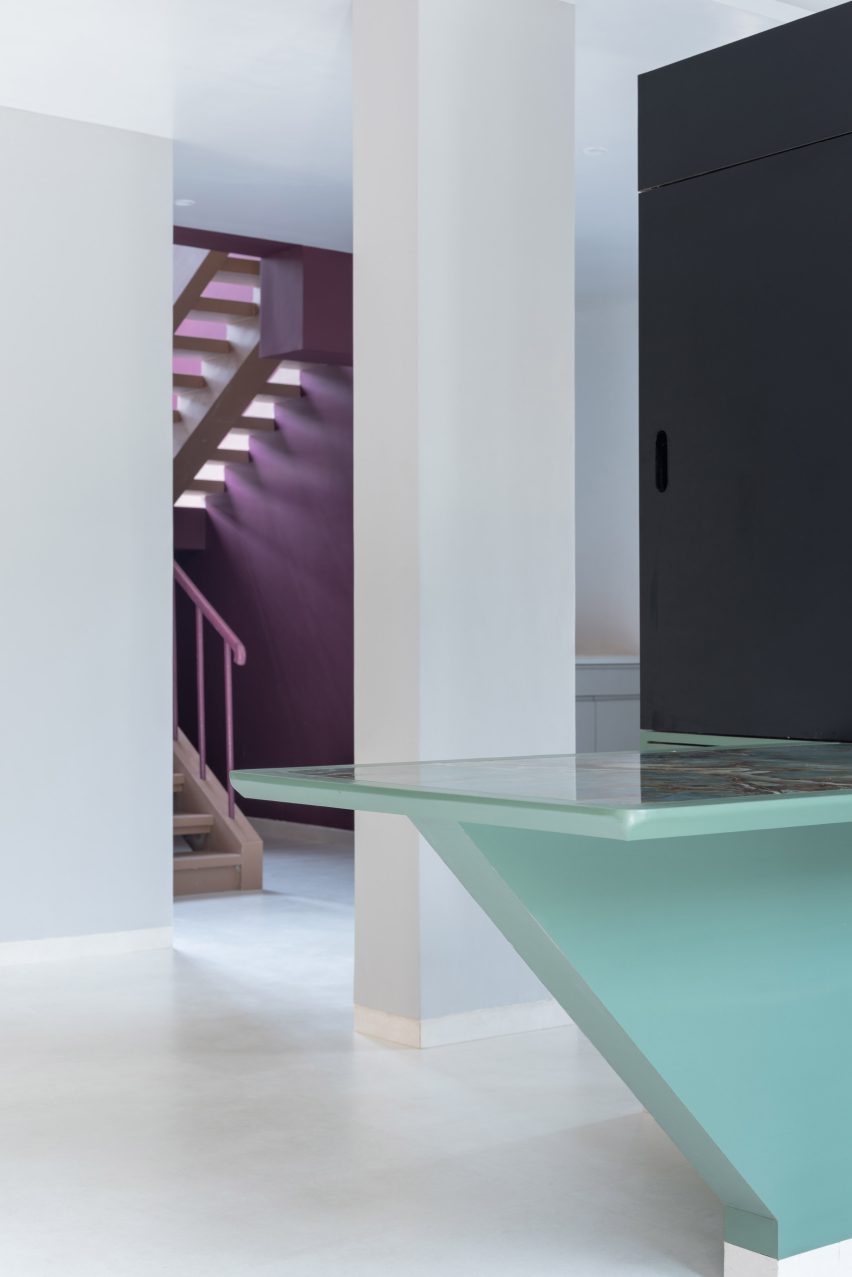
On the ground floor, a multifunctional partition separates the living and dining areas, serving as a television unit on one side and a dining table on the other.
The living room opens directly onto the garden through a floor-to-ceiling sliding door that frames views of a gazebo outside.
A bordeaux-coloured staircase clad in full-body vitrified tiles and supported by a mild-steel frame connects the ground floor to the upper levels, where each bedroom and bathroom is defined by its own colour palette.
"Every view is constructed and intentional," explained Buddhadev. "Walls curve where expected to be straight, colours intensify where neutrality is assumed, and entries reveal themselves only through movement."
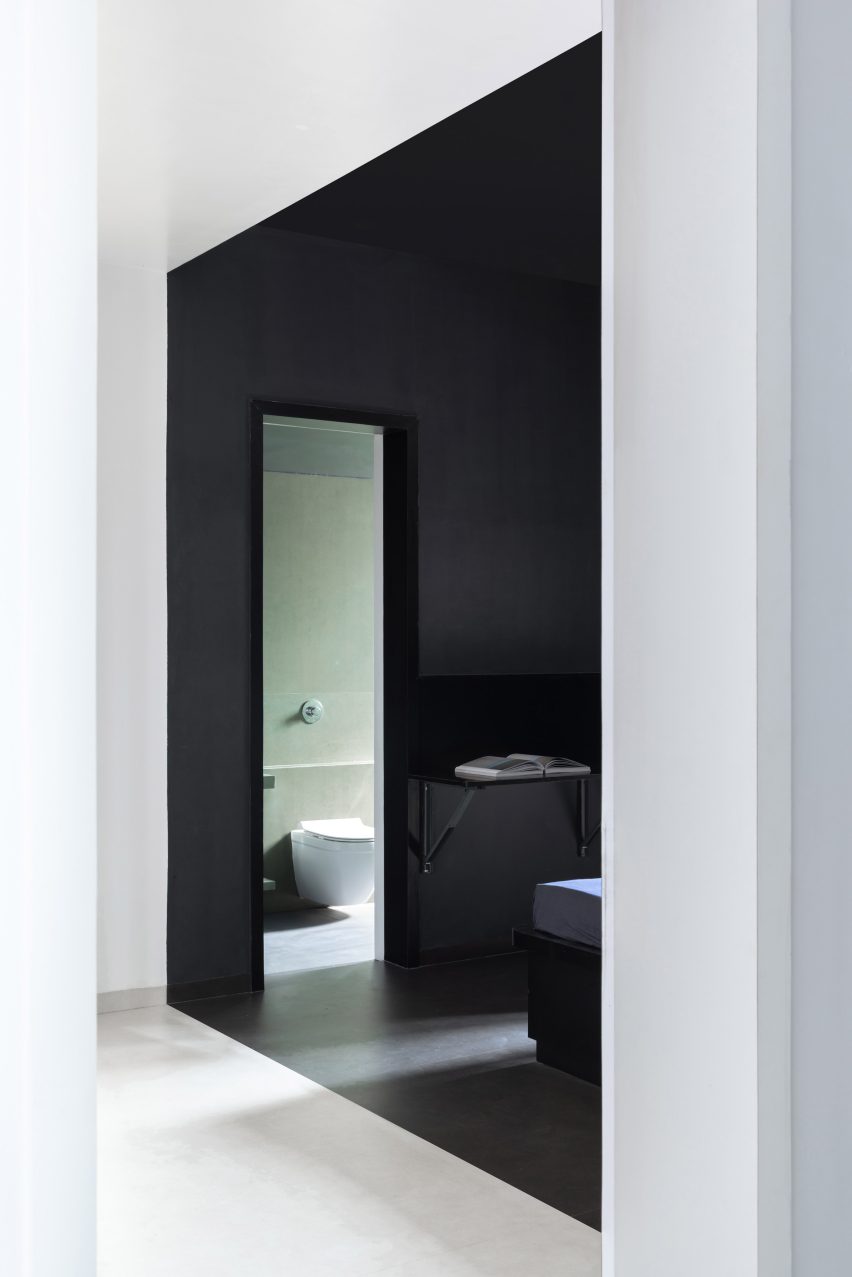
On the upper floors, bathrooms were positioned between the bedrooms and the exterior walls, creating an additional thermal buffer that helps reduce heat gain.
"During the design process, I drew from my family's background in creative advertising," said Buddhadev. "I reinterpreted scale, colour, alignment and abstraction to inform the architectural language of the house."
Among other sculptural homes recently completed in India are an anthill-inspired house by Kaushal Tatiya Architects, an art-filled residence by Spaces Architects Ka and a "cascading" vaulted home by Iki Builds.
The photography is by Karan Gajjar (The Space Tracing Company).