


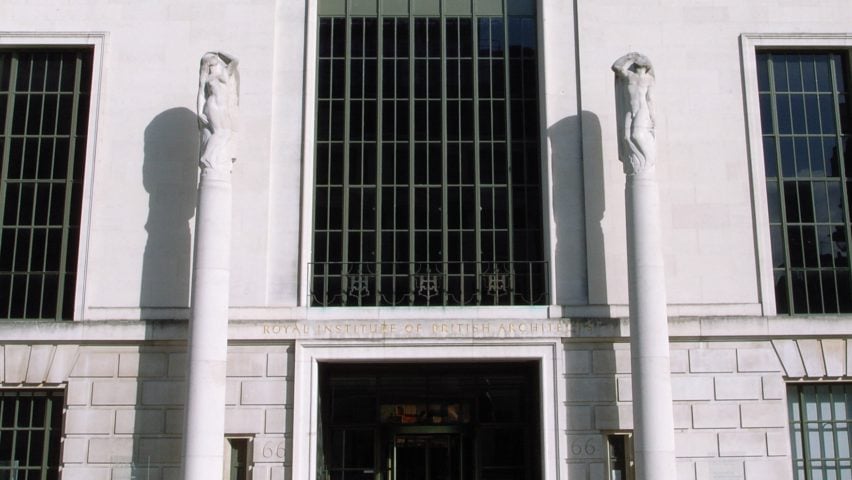
History suggests that the upcoming election of a new RIBA president will do little to address the issues plaguing UK architects, writes Neal Shasore.
It's time for the biennial non-event of the RIBA presidential election.
By now we're used to the well-meaning and, in most cases, impressive candidates issuing clarion calls for architects to "take back their institute", to "bang on the door of government departments", to "demonstrate the value of design", to "bring academia closer in touch to practice", to "embrace lifelong learning", to "tackle low fees and wage inequality".
As if the next president might solve, in a two-year term, questions that have bedevilled the profession for a century or more. The idea invests the office of president with an omnipotence of which other incumbents with that title could only dream.
Presidential elections by the membership were not typical before 1981
That old adage, "the definition of madness is doing the same thing repeatedly and hoping for a different outcome" sums up this repetitious cycle of anticipation, disappointment and apathy. Often ascribed to Einstein, presumably to lend the inanity some legitimacy, the phrase seems apt here.
Not necessarily because it's true, but more because it is an exemplar of what the historians Eric Hobsbawm and Terrance Ranger identified as an "invented tradition": "rituals or practices which seek to inculcate certain values and norms of behaviours by repetition, which automatically implies continuity with the past."
In fact, presidential elections by the membership were not typical before 1981. The oligarchy of the RIBA Council – invented much earlier in the institute's history to run it on behalf of the General Meeting of members – otherwise tended to choose by consensus one among a number of "vice-presidents" to assume the chair.
That convention was broken in 1981, when the council's choice of candidate, Andrew Derbyshire, was challenged by the commercially astute and media savvy Owen Luder, with Jake Brown later throwing his hat into the ring. Brown – who worked for the GLC Architects' Department – was a prominent member of the Salaried Architects Group (SAG), with a bold political vision of professional reform.
Luder won by a veritable landslide – just over 5,000 votes against Derbyshire's near 3,000, based on a 36.4 per cent turnout, thought by the Architects' Journal even then to be "surprisingly low".
This disruption to the status quo was considered dangerously subversive: one senior architect warned that RIBA "should not make it any easier for membership to produce a counter-nomination: We could get seven members from 'Wogga Wogga' land putting up a candidate." Fatuous – and borderline racist – but somehow unsurprising.
It draws attention away from scrutiny and accountability of the real power bases in professional practice
And yet the idea of a great democratic opportunity for the membership on a two-yearly basis has established itself as a vital sign of the institute – and the profession's – fitness for purpose. Each time, the trade press trots out the latest derisory electoral turn out – under 10 per cent at the last poll – as though there was once a halcyon time when presidential hustings would really matter and the whole profession would make its voice heard. They never did.
And yet it suits the RIBA to maintain this mythos: even the fictitious memory of universal franchise infuses the outcome of today's elections with a perceived importance utterly out of proportion with reality; it also distracts the membership and the wider architectural community from the real challenges the profession, the institute and the broader industry face.
More insidiously, perhaps, it draws attention away from scrutiny and accountability of the real power bases in professional practice. No such debate and discussion has taken place about the selection of the next chair of the RIBA board, for example. This is now a remunerated position, presiding over a board of trustees who hold fiduciary responsibility for the charity, and which sets the strategy and approves the organisation's budget.
The process of the appointment of the chief executive officer – and this is no comment on the incumbent – similarly passes without comment, except the odd jealous headlines about executive remuneration once the deed is done.
It is more than revealing that in the planning submission for the House of Architecture, the chair's office sits between the CEO and the president, and is by far the largest of the three rooms. The increasingly strange tendency for all three to take turns to introduce the RIBA's annual milestones – chair first – also shows that there's a hierarchy even within this triumvirate. The quasi-executive chair holds Portland Place's mandarins to account, but even then – just as in Whitehall – the "blob" keeps the machine whirring irrespective of presidential whim.
It was said in the 1981 presidential election that it was the first since 1924, just over half a century previous. That in itself seems to be a deliberately misleading half-truth.
Many of the profession's recurring issues are by-products of a poorly designed system
A hundred years ago the profession was – I can scarcely believe I'm writing the words – utterly consumed with the question of statutory registration of architects and an aspiration to protect the function of architects. This involved a debate about the unification of the profession (chiefly with the Society of Architects, established to lobby for statutory protection) before registration, or securing registration before attempting unification to maintain strict standards of entry.
Moreover, in the context of "overcrowding" in the profession (that is to say an oversupply and lack of demand for labour), salaried architects although "comprising the majority of those in the profession" were, one news article at the time noted, "the least powerful and the poorest paid", suffering from "intermittent employment, and of the present casual and inefficient system of entrance to the profession".
Things came to a head with the formation of the RIBA Defence League – registration, then unification – who stormed the council elections and dismissed the expert committee which had been convened to do the detailed work of amalgamation with the Society of Architects and prepare draft legislation.
This was followed by the establishment of the RIBA Emergency Committee in 1922 as a rearguard action. The unification-then-registration camp ultimately won out – then as now, shows of sector unity were more persuasive to parliament. The Emergency Committee's protagonists played prominent roles in securing the Architects' Registration Act of 1931, which protected the title "Registered Architect".
I should also point out that the RIBA had wanted to serve as the statutory registrar; its ambitions were killed off by Labour MPs who would not consent to giving a private chartered body of bourgeois professionals statutory responsibilities. The RIBA's private mission – even into the post-war years – was to ensure that its members dominated the Architects Registration Council (ARCUK, ARB's predecessor body) and voted en bloc in the RIBA's interests. Indeed, in its early days ARCUK was actually housed in 66 Portland Place.
You might dismiss this as all very interesting anecdotage but of no relevance to today. But I would counter that many of the profession's recurring issues are by-products of a poorly designed system. If you don't understand that history, you're less likely to be able to meaningfully intervene and shift it.
If we want leadership through plebiscite, I'd argue a short-term president is not what you need
There is, I'm afraid, next to no point in hoping that this, or any, presidential election in its current form can make much of a difference. Is it not telling that the none of the decisions to tear up the partnership with the V&A, to create a "Museum of Architecture", to fight the ARB on educational reform, and now the Repeal, Reserve, Regulate campaign, were on the ballot paper in any recent presidential race?
Naive ideals of direct democratic participation in a toothless election is a symptom of our current cultural fixation with democracy everywhere, all the time. If we want leadership through plebiscite, I'd argue a short-term president is not what you need; if we want meaningful democratic accountability, focus on the places where policy is formed and decisions are made. Neither require a profession-wide vote on who gets to be chief ribbon-cutter or give out the medals.
Forgive me, then, for an eye-roll about the current electioneering fault lines, whatever the noble intent of this year's candidates. By all means agitate for more accountability, for more ambitious strategy, for more joined-up and consistent policy: but if you think it's in the president's gift, please think again.
The photo is by Steve Cadman.
Neal Shasore is a British architecture historian specialising in 20th-century Britain and the founder of the School of Building CIC.
Dezeen In Depth
If you enjoy reading Dezeen's interviews, opinions and features, subscribe to Dezeen In Depth. Sent on the last Friday of each month, this newsletter provides a single place to read about the design and architecture stories behind the headlines.