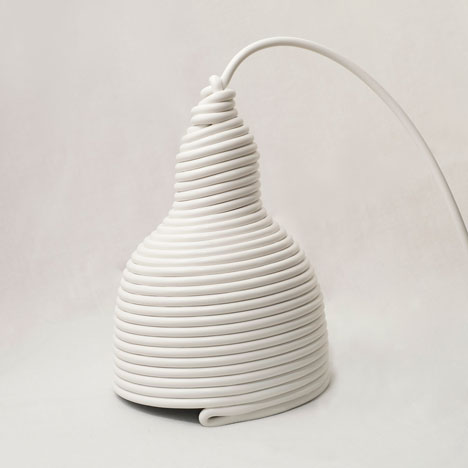
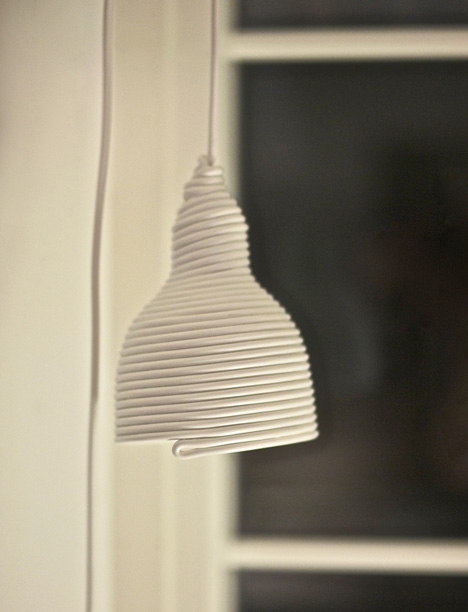
Product news: ten metres of electrical cord are coiled around to form the shade of this pendant lamp by Italian designer Nicolò Barlera.
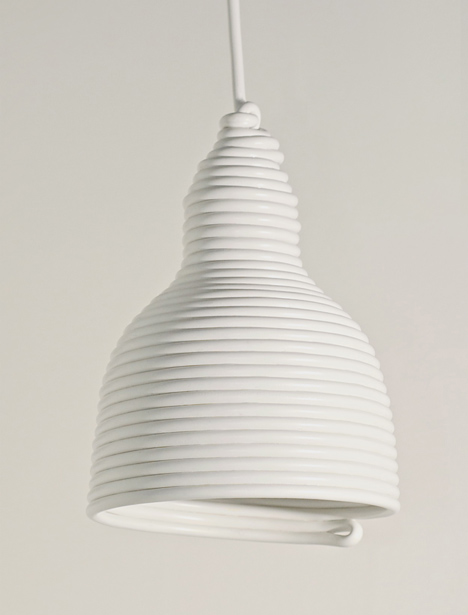
Nicolò Barlera used just the cord, plug and bulb socket in an attempt to minimalise the amount of parts used. "I found an easy and effective way to use fewer components," Barlera told Dezeen.
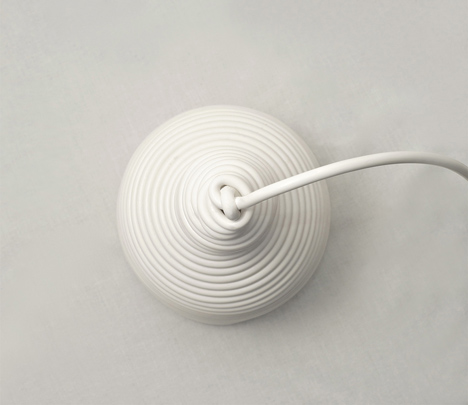
Electricity runs through the entire length of the spiralled cord before the power reaches the bulb.
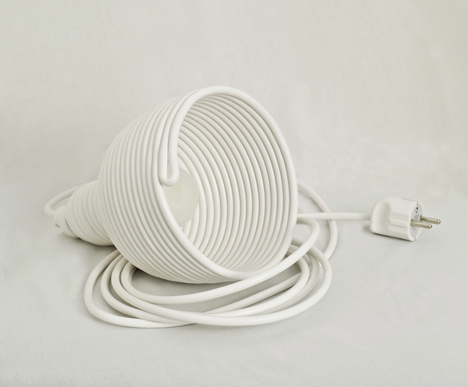
The pendant shape was formed by winding the cord around a mould then doubling it back.
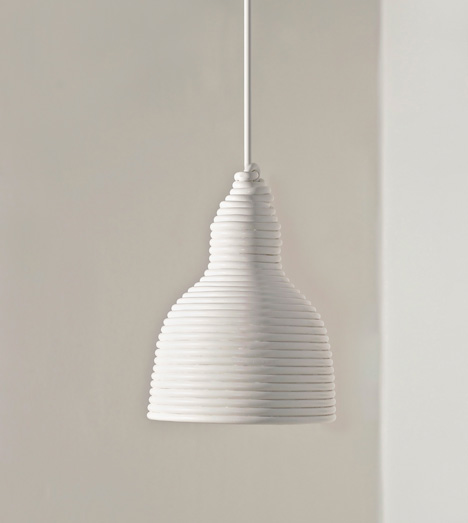
Barlera collaborated with designer Lorenzo Antonioni on the initial design of the Cordial lamp, then developed the project with Swedish design firm Kanter & Karlsson.
We've recently featured a lamp that looks light a car headlamp and an edible desk lamp that comes in four flavours.
See all our stories about lamps »
Photography is by Fredrik Andersson.


Coiling an electrical wire requires a much bigger amount of power, which make said wire much hotter than it needs to be and therefore less durable – and, most importantly, more dangerous. Even my 92-year-old grandmother knows that.
Actually if you conduct the experiment yourself you will find this effect doesn’t occur. It’s because you need much much much more wire than 10 or 20 meters of spiraled cable.
Hmmm, coiled wire… electromagnetic field… BZZZZ!!
Too bad it couldn’t be created without that rather unseemly loop on the bottom of the shade.
What, people like the loop? I would have preferred if the cable had been run up through the interior of the shade, making for a cleaner line across the bottom.
Just wanna say that I made a similar design this year’s spring but Dezeen have chosen not to post my work. The objects can be seen here: http://arhiforum.ro/proiecte/colectia-de-cablu
Congratulations Andi, I like yours better. Thanks for telling us about it and thank you Dezeen for listing the comment… not all comments go unedited I have found. hmm….
Andy, you design much much better. I love them and the way you are playing with the wires. You should have your own website, in term of credibility I mean.
Coil Pendant and Coil Lamp by Craighton Berman, 2011 / 2009, the latter of which is in the Art Institute of Chicago's permanent collection: http://studio.craightonberman.com/COIL-PENDANT http://studio.craightonberman.com/COIL-LAMP