Gisbert Pöppler completes colourful transformation of historic German home
Interior design studio Gisbert Pöppler has renovated a 1920s villa in Germany's Ruhr region, introducing a bold colour scheme and artisanal details that reflect its association with the Deutscher Werkbund movement.
Pöppler's Berlin-based studio was initially asked to refresh the villa's colour scheme and furnishings, but convinced its clients that a comprehensive project was required to restore the home to its former glory.

The property was built in Hohenhagen in 1921 by the garden city's founder, industrialist Karl Ernst Osthaus, who was a member of German design movement Deutscher Werkbund.
Pöppler's project involved reconfiguring the house to make it more suitable for modern living, while applying his signature use of colour and introducing elements that would reflect Osthaus' passion for art and craftsmanship.

In order to preserve the building's historic character, the heritage-listed brick facades were retained, but the interior, which had been gutted during world war two and had subsequently undergone poor-quality renovations, was completely overhauled.
The clients intended to use the house both as a residence and for business use, and therefore required spaces that were large enough to host receptions or small conferences.

"The house should be representative but not intimidating, it should be approachable and inspire a sense of engagement," Pöppler said.
"We connected three smaller rooms on the ground floor into one large garden hall because a lot of space was needed for a lot of people."

The south-facing salon now forms the main living space in the house. Arched openings connect the room with the adjacent entrance hall, which was raised by almost a metre to give it a more generous and airy feel.
A previously open staircase at the centre of the house was altered to create a tunnel-like stairwell that forms a distinct threshold between the public areas on the ground floor and the more private spaces above.

The staircase is lined with pink linoleum – one of numerous unusual ways in which colour was used to highlight key features throughout the interior.
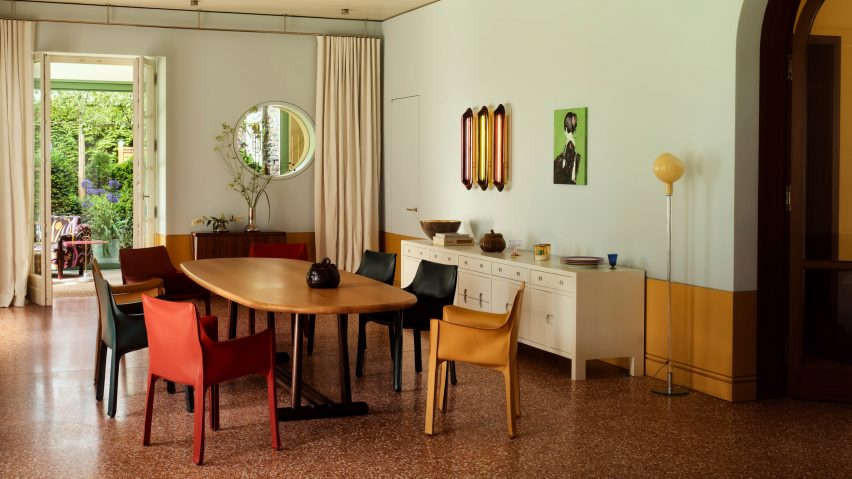
The main living areas include a drawing room with walls painted a bold shade of red, while the salon features a pale-blue hue that contrasts with a bespoke terrazzo floor featuring purple accents.
Wooden panelling painted in mustard yellow extends throughout the ground floor, uniting these spaces while also protecting the walls and breaking up the height to create a more intimate feel.
According to Pöppler, the use of colour "offsets the austerity of the house and has a playful feel." Other colourful elements include lemon-yellow kitchen cabinetry and a red lacquered vanity unit in the master bathroom topped with a light-blue glazed lava stone countertop.

Bold fabrics also feature throughout the house, such as the floral design from Svenskt Tenn that is used to upholster the Junior chair from Pöppler's own furniture collection.
Cashmere bedspreads are woven in blocks of strong colours, while the Baba armchairs in the living room are upholstered in punchy shades of blue and yellow.

Informed by the house's history and Osthaus' connection with some of the great artisans of the early 20th century, Pöppler incorporated quality craftsmanship wherever possible throughout the project.
The house's bespoke features include cabinetry crafted by carpenter Stefan Freudenberger and a washbasin and wall panels in the guest WC that were milled from a solid block of Greek marble.

In addition to the Junior and Baba armchairs, other furniture pieces from Pöppler's studio that feature in the home include the Patio breakfast table, with its colourful glazed top, and the five-sided Louis breakfast table.
The centrepiece of the dining area is the Belenus oak table, which can be extended by adding the curved La Luna elements at either end to provide seating for up to 18 people.
Pöppler previously transformed an old bookshop in Berlin into his own office, and the studio also designed an apartment in the city that incorporates a range of bespoke furnishings and fixtures.
The photography is by Ollie Tomlinson.