Can data centres ever be examples of good design?
With AI driving demand, vast data centres are increasingly in the news as people question the impact on local environments. Can architects help to make these buildings look and function better?
When was the last time that buildings animated the population of the United States as much as the current wave of data centre development?
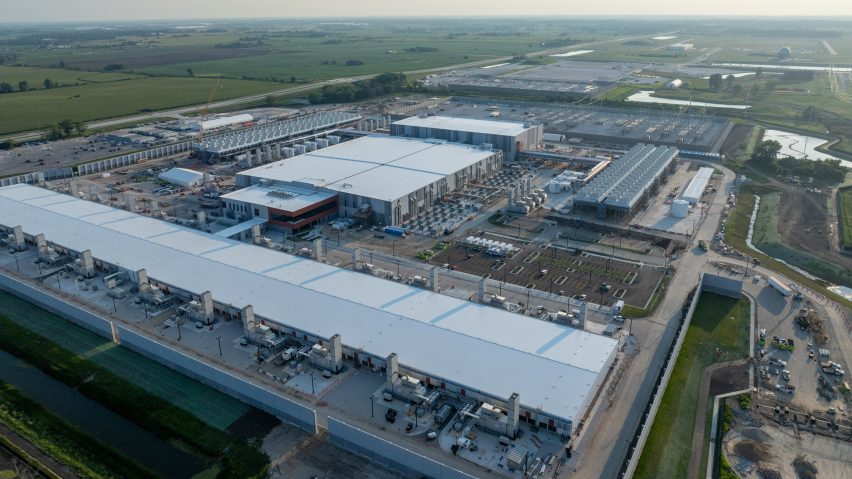
In the past two years, the huge, boxy buildings have provoked backlash across partisan lines as plans have been announced across suburban and rural America.
Housing the servers that power cloud computing and, now, artificial intelligence (AI), data centres are an important part of the infrastructure that supports the internet.
Usually located in sparsely populated areas, these nondescript buildings have been largely ignored as architecture, but this is beginning to change.
"Data centers are, in general, an example of poor design," Spanish academic Marina Otero Verzier, who won the 2022 Wheelwright Prize for her theories on data centres, told Dezeen.
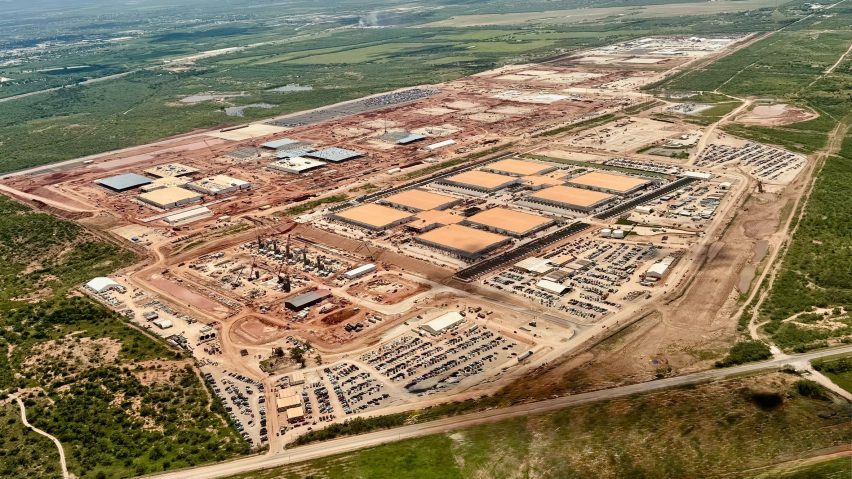
With growing public awareness of data centres' heavy land, water and energy use, pushback has been intense. Nearly 70 per cent of the US population opposes their construction. Yet the US is set to double its data centre building to keep pace with the boom in AI, with spending on data centre infrastructure projected to top $800 billion per year globally in 2026.
Architects are largely absent from the trend – something that Otero Verzier believes needs to change if there is any hope of these structures being positive, or at least neutral, contributors to the built environment.
"Architects should be involved in the design of the building – from the materials used to the metabolic relations it establishes with the environment and communities – as well as in thinking about their public nature as repositories of collective knowledge and their broader urban and territorial planning," she said.
"Architects have a ton of value to add to the data center conversation"
So far, that hasn't happened, and even some developers recognise data centres have suffered from a lack of design thinking.
Daniel English, co-founder and managing partner of Legacy Investing, a real estate firm that specialises in data centres, believes that architects were sidelined in the early designs of data centres, because the buildings were treated as engineering projects.
"Architects have a ton of value to add to the data center conversation, and I think that they got left out because it was possible to build buildings just based on efficiency," he said. "Data centres are so new that we're still figuring out what they look like."
However, he believes that now is the time to be giving more thought to how they look.
With construction already a huge source of carbon emissions, it may be that the best design when it comes to data centres is not building at all. But right now the market is saying build.
"It's not like we're not going to have data centers," said English. "The conversation today should be how to make sure that these are thoughtfully integrated into our lives."
"The architecture of the building does matter"
Until the AI bubble pops – as investors have warned – or an unlikely national referendum on the buildings happens, they look set up to keep going. So what role should architects play?
At present, architect involvement in data centre design often comes from corporate firms large enough to have a full data centre division. Gensler is one of the design-forward firms that is competing for data centre commissions.
It is currently designing a 7.5 GW hyperscale data centre in Utah for O'Leary Digital, and a cluster of five data centres for Menlo Digital in Arizona. At both sites, renders show facade treatments designed to improve the appearance of the buildings – striated facades to match the desert mountains in Utah and Corten steel in Arizona.
This move towards beautification or – in some cases, camouflage – represents one of the main ways architects are having an impact on these buildings.
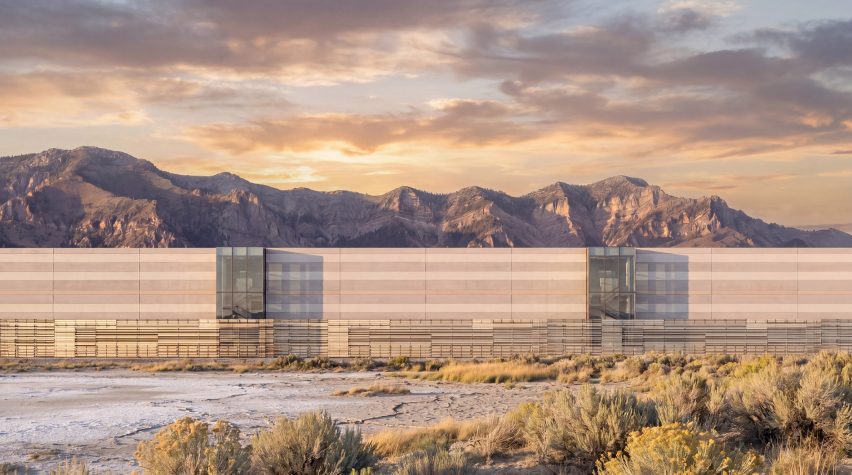
"I think with good design, with proper architectural gestures, you can either make these buildings blend in or stand out, and I think that it's going to come up more and more as these buildings need to become a little bit more local," Gensler critical facilities practice leader Rob LoBuono told Dezeen.
"The architecture of the building does matter," continued LoBuono. "We really do find that a well-designed building has a strong impact in the community, even if the current opinion of them is, you know, fluid."
Otero Verzier, for her part, doesn't believe that the role of the architect should be reduced to facades.
"The idea that the most architects can do is design a facade is quite sad and says more about the lack of ambition of the profession than about the reality of data centres," said Otero Verzier.
"If, as a profession," she added, "we want to be completely irrelevant, then we can focus on designing facades for data centres."
Integrating data centres into urban schemes
During the 2025 Venice Architecture Biennale, architecture studio Grimshaw presented an integrated urban plan based around data centre development, bringing the typology firmly into conversations around speculative architecture.
Informed by a real project with developer Goodman, the proposal positions the data centre development as "the catalyst of a mixed-use renewal precinct – next to homes, studios, shops and even an urban farm". The proposal would pump the data centre's waste heat back into the surrounding buildings.
"Close quarters aren't a liability; they're the key that lets resources circulate instead of being wasted," said Grimshaw in the brief.
Legacy Investing's English told Dezeen that it was already developing several data centres integrated into wider mixed-use schemes, while the architecture studios we spoke to were broadly positive about the concept.
Unsurprisingly, the biggest data centre developers don't seem to be paying much attention to the thinking coming out of architecture biennales.
Efficiencies and monumental boxes are, and will probably remain, the norm.
Corgan director of data centres Tom Kruger, said that integrating data centres within other structures and wider developments is an "exception and not the rule". He explained that concerns over security and power mean that remote locations are preferred.
"A big part of that is aiming for security and sound isolation," he told Dezeen.
A more realistic vision for mixed-use data centres probably looks closer to a contemporary tech campus than the Grimshaw model. Most of the architects Dezeen spoke with mentioned landscaping or parklands around the data centres, though they noted these plans run up against security concerns.
Both largely sterile and industrial in size, data centres represent a unique sort of infrastructure.
Rather than likening these buildings to warehouses or power plants, English compared data centres to parking infrastructure. He believes that they can be integrated into buildings or placed underground, and not just housed in standalone buildings.
"Parking to me is an interesting analogy because parking can be an entire building; it can be part of a building," said English. "In that way, compute can be part of a building; it can be a whole building."
Of course, parking lots have more often than not been blights on the urban and suburban landscape.
Elevated data centres
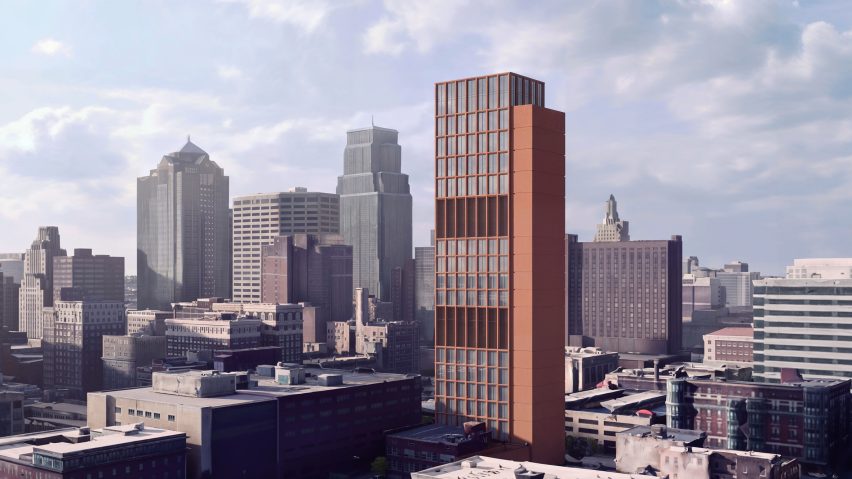
Recent projects, such as an SOM data centre skyscraper in Kansas City, show that some developers are pushing beyond the typical horizontal spread, especially where, like in this case, rural zoning laws have made developing sprawling hyperscale centres difficult.
However, architects Dezeen spoke to said building tall makes little sense, with the high price tags and sensitivity of the servers, the need for easy maintenance and the speed of building.
Most large data centres are built in areas outside of cities, with plenty of land – and land usage is a large part of the public's complaint.
Kruger, who has worked in the field for 16 years, said that he does see these centres becoming more "elevated" from an architectural perspective, though mainly through technologies that make them more energy efficient.
Other companies have proposed using older structures, as with Terawulf's plans to build a data centre in a decommissioned Kentucky smelter.
Microsoft has built data centres using mass timber in a show of healthier building materials. Meanwhile, their energy demands have revived talks of nuclear energy integration in the United States.
"Repositories of collective knowledge"
Otero Verzier envisions a more distributed future in which data centres are not commercial concentrations but public "repositories" of knowledge.
"As long as data centres start being designed with attention to the diverse ecologies of data – cold, hot, long-lasting, and temporary, open, public or private – to the limits and rhythms of the planet and its inhabitants, we can begin to develop more relevant architectures that do not necessarily look like closed-off boxes or bunkers, but instead take the form of public institutions.
If architecture can help reimagine the way these buildings look and function, through the largesse of developers concerned about buildings – or just concerned about their reception – perhaps the way they're used can change too.