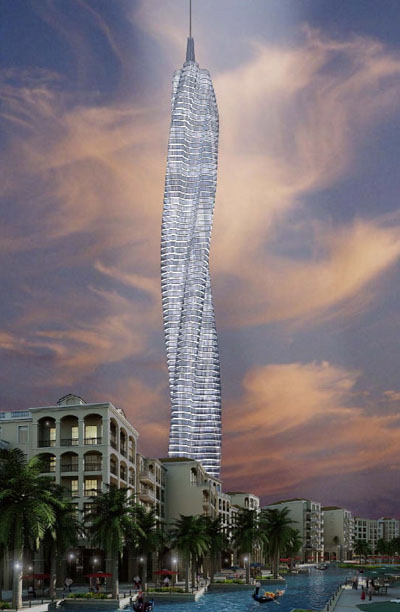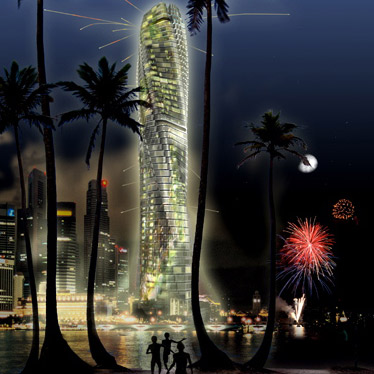
Italian experimental architecture company Dynamic Architecture has proposed a revolving sustainable skyscraper for Dubai powered by wind turbines placed between each floor.
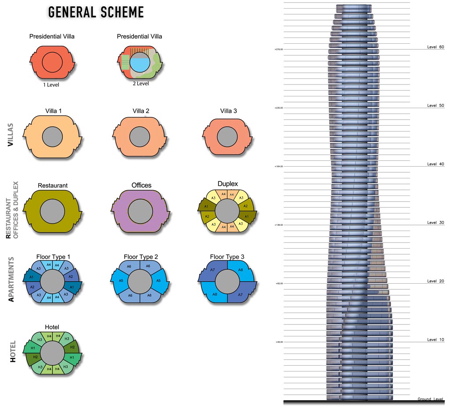
Each floor rotates separately, meaning the building’s profile will constantly change.

With 59 storeys and 58 turbines, the designers calculate the tower will generate enough surplus electricity to power a further five skyscrapers of similar size.
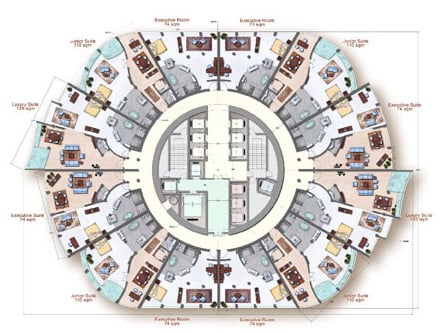
Above: hotel floor layout
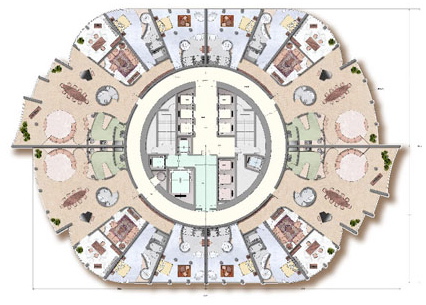
Above: apartment floor layout
>> see architect Glenn Howell’s proposal for a revolving, solar-powered residential tower in Dubai in our earlier story here
>> see more architecture in the United Arab Emirates and Qatar on our interactive google map
Details from the architects below:
–
Our Architecture employs wind turbines, positioned horizontally between each floors, which will produce energy to the building itself and will supply as well energy for several other buildings. A tower of 59 floors will have 58 wind turbines, making the building to be also a Power Station producing Green Energy in the city. Because if tomorrow is the time where we all are going to live the rest of our lives, we want it to be a really better place.
The Dynamic Architecture building, which will be constantly in motion changing its shape, will be able to generate electric energy for itself as well as for other buildings. Forty-eight wind turbines fitted between each rotating floors as well as the solar panels positioned on the roof of the building will produce energy from wind and the sunlight, with no risk of pollution.
The total energy produced by this inbuilt ‘powerhouse’ every year will be worth approximately seven million dollars. Each turbine can produce 0.3 megawatt of electricity, cmpared to 1-1.5 megawatt generated by a normal vertical turbine (windmill).
Considering that Dubai gets 4,000 wind hours annually, the turbines incorporated into the building can generate 1,200,000 kilowatt-hour of energy. As average annual power consumption of a family is estimated to be 24,000 kilowatt-hour, each turbine can supply energy for about 50 families. The Dynamic Architecture tower in Dubai will be having 200 apartments and hence four turbines can take care of their energy needs.
The surplus clean energy produced by the remaining 44 turbines can light up the neighborhood of the building. However, taking into consideration that the average wind speed in Dubai is of only 16 km/h the architects may need to double the number of turbines to light up the building to eight. Still there will be 40 free turbines, good enough to supply power for five skyscrapers of the same size.
The horizontal turbines of the Dynamic Architecture building are simply inserted between the floors, practically invisible. They neither need a pole nor a concrete foundation. In addition, they are at zero distance from the consumer, which makes maintenance easier. The modern design of the building and the carbon fiber special shape of the wings take care of the acoustics issues.
Producing that much electric energy without any implication on the aesthetic aspect of the building is a revolutionary step in tapping alternative energy sources. Furthermore, this energy will have a positive impact on the environment and economy.
This architecture is revolutionary even in the way it’s built. It is in fact the first building produced in a factory, apart from the concrete core. It’s produced of complete luxury units in a factory, including all plumbing, electrical, air conditioning and installed on the concrete core right on location.
This ready made implementation offers high quality finishing, high quality control and the use of a very few workers on site, with a real cost, life risks and time savings. Besides, this architecture, made of single separated floors offer higher seismic resistance than any other normal building. Dynamic Architecture is designed for better living even before it’s finished.
Thanks to the fact that it’s built in a factory and just assembled on site, the number of workers on site is reduced from 2000 to 90. The ready made technology allows a revolutionary implementation which is the quickest way to build a tower: building time is reduced from 30 to 18 months. The revolutionary ready made technology, plus the fact that it moves to the wind, allows the building to be 1.3 times more resistant to earthquakes.
–
Posted by Marcus Fairs


May 26th, 2007 at 1:10 am
As “SOLARTECTS” and wind and solar engineers building building integrated high rises in the U.S. and China I question the following statement:
“Considering that DUBAI gets 4000 wind hours annually the windturbines can generate 1,200,000 kilowatt hours of energy. (every year)
Comment: There are 8760 hours in a year. The 4000 wind hours would have winds blowing at different velocities. In order to produce 300 kw per machine the wind would have to be wide open at 25 to 35 mph. This is unrealistic in the United Emirates!
The design would be more realistic if the south side of the tower would also be a collector for PV electricity. This would contribute energy when there is no wind and with no moving parts.
Reinhold Ziegler, P.E. General Partner
Synergy International Inc.
June 5th, 2007 at 11:31 am
Amazing story. Does anyone know the name of the engineer who designed this?
HAD - Journal of Algorithm-Generated Design.
June 14th, 2007 at 10:28 pm
Looks like Turning Torso in sweden.
http://www.bizzbook.com/hamnen/php/INDEX.PHP?topratings=1&subdir=TurningTorso
September 18th, 2007 at 7:02 am
dynamic architecture
Is this environment is livable - because as we know architecture means creating a space for function.
As our earth is moving on its axis but we never feel the momentum because our body got adjusted to the earth movement (because we are born on this condition) we will feel disturbed because of small earth quake and it will affect our life.
Probably we might get adjusted to the dynamics of the structure but in due course we have to regulate its movements so that people get adjusted to environment of structure. But to do so we have to have working environment also with same concept so that they do not feel the change of environment.
In mean wile some malfunction happens in the dynamics of the structure .than that day every one living in the premises will be disturbed .if the dynamics of structure does not regulate within sort period than all the occupants in the building has to leave the premise for time un till The dynamics of structure is regulated
And as we all know we have some movable environments we are using to live or for reaching from one place to other. Our transportation system
People live and survive in this type of environment.
For very short period and for the cause they live in the environment. it
Maybe because they might have to reach some place or because they are working there. And if you ask them if they like to be there for any more time probably with out a reason they might not stay in that environment.
About a self generation of energy- it is good concept .I think we can generate energy with out the dynamics of architecture. We have some examples also which are built in Arab countries
About the construction technique explained can be best utilized .it will reduce the construction time. And with the prefab constructed units we can achieve quality. Also we can save valuable working hours on site
October 25th, 2007 at 6:08 am
its nice idea but can u plz explain about in what speed the tower wil rotate ……… i wont cerate some distrubance or what
November 15th, 2007 at 5:52 am
What utter fanciful nonsense! More like a third year student scheme than a realistic energy conscious commercial proposal.
a. As a sailor I know there is not enough regular wind in the UAE to make this work. Solar energy is (obviously) the most viable source of renewable energy out here.
b. As the floors rotate independently the appearance of the building will rarely if ever appear as a neat barley twist arrangement, but more likely a jumble of misaligned irregular floor plates.
c. Maintenance is a key issue and not a task that is performed consistently in the UAE. The Hyatt Regency gave up on their rotating restaurant for similar reasons.
Do we really need another extravagant ‘landmark’ in Dubai?
Disillusioned by the congestion, pollution and greed of this place.
Mike
February 16th, 2008 at 1:12 am
I am a Landscape Architect in the U.S……would love to be involved
with this project…and relocate to DUBAI. I’m assuming the Landscape Architecture firm has been selected.
Bob
April 29th, 2008 at 6:15 pm
good concept for a start, but, i have some questions?
1. why at all do we need to move the floors?
can’t the turbines between floors move themselves and transform the wind energy themselves…this will maintain the shape as well…
2. also, how are they going to manage the water/sewage pipeline systems, if each floor keeps on rotating on its axis?
3. finally, how will 1 single cylindrical pillar in the middle support so heavy floors and turbines combined…in conventional buildings, the upper floors are supported by the floors below them+the mesh of pillars…
June 19th, 2008 at 12:06 am
what kind off magnet are being used
June 26th, 2008 at 5:07 am
Here’s another architect jerking off in public. Can’t we just lock these guys in a room with their erector sets? There is no need to build these towers. They can be consigned to the realm of conceptual art–Bravo Mr. Fisher for your concept. Just please don’t build it. As for the idiots who are “investing” in Dubai real estate, they probably deserve to live in this dystopic fantacy land. It is because of projects like this that I support the wasteful and fraud-ridden space programs–it has become quite clear that many people of means do not actually like life on planet earth. Sun Ra said it best–space is the place. Hie thee to an off-world location, please, or alternatly buy yourself a transcendental upload asap. We earthlings will be grateful. ciela
July 1st, 2008 at 11:48 am
its very nice to have dynamic buildings,it will creat dynamic planning
July 1st, 2008 at 11:50 am
dynamic architecture creating dynamic planning
August 10th, 2008 at 8:35 pm
Great idea and its realy great that architects nowdays are giving due consideration to the issue of degrading environment and global warming. but i have one question: have the designers given any consideration on what will be the maximum speed of rotation?? because the people living in the building might get sick by the continious rotation. have they studied the “nausea” ??
September 30th, 2008 at 12:28 am
hi everyone, i can figure where the lifts will be. lets suppose the lifts will be in the main pole(cylinder), how do people have access to it if the platforms (floors) are in constant motion?and how about the fire exit?