June 16th, 2008

zaragoza-3.jpg

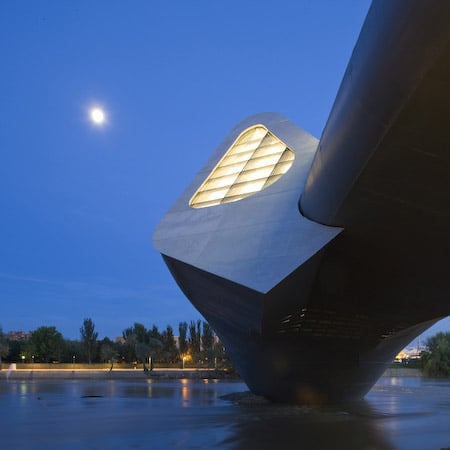
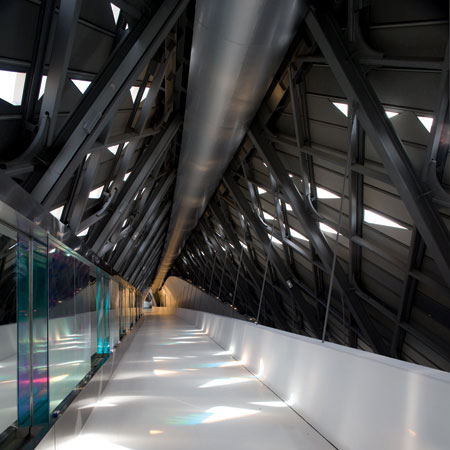
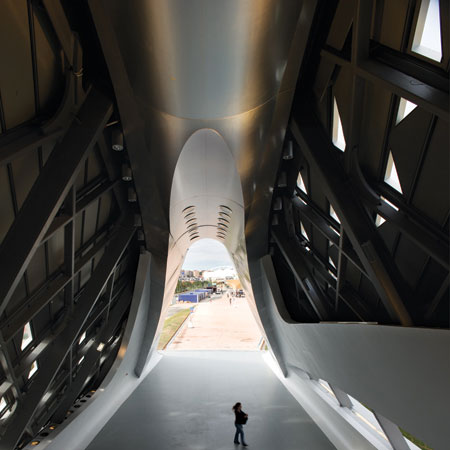
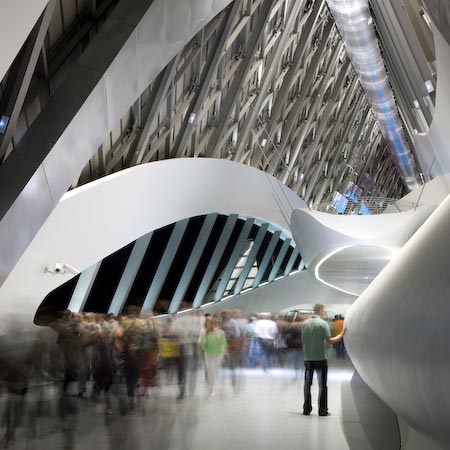
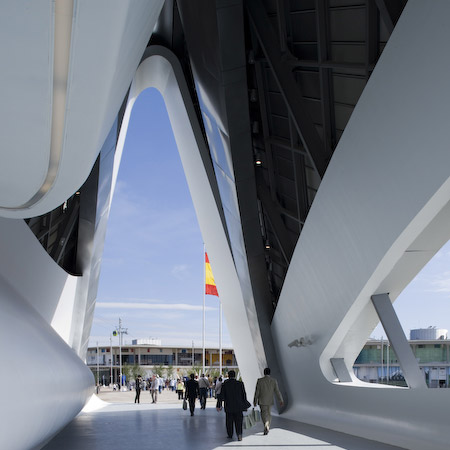
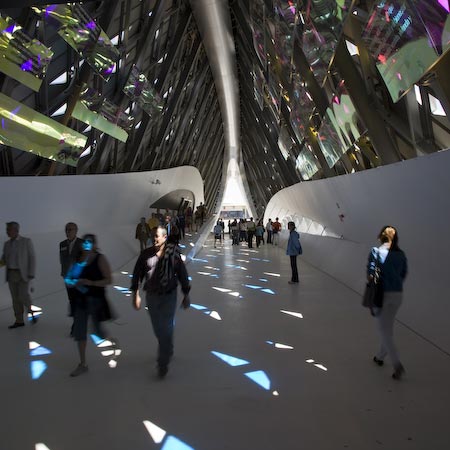
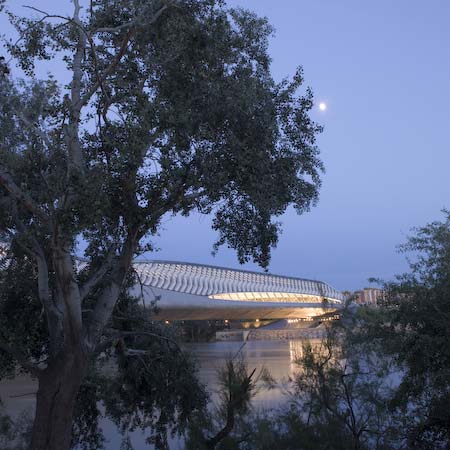
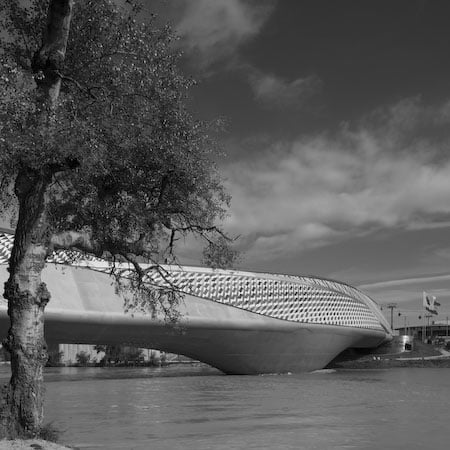
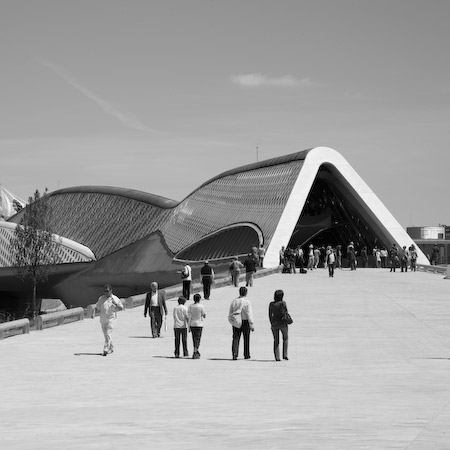
Photographer Luke Hayes has sent us these photos of Zaragoza Bridge Pavilion, a pavilion by Zaha Hadid Architects at Zaragoza Expo 2008 that doubles as a pedestrian bridge across the river Ebro in Zaragoza, Spain.
zaragoza-12.jpg

The pavilion, and the expo itself, opened this weekend.
zaragoza-8.jpg

Zaragoza Expo 2008 is dedicated to water and sustainable development.
zaragoza-4.jpg

Here’s some info from Zaha Hadid Architects:

ZARAGOZA BRIDGE PAVILION [ZARAGOZA, SPAIN] 2005-2008
zaragoza-1.jpg

PROGRAM: Interactive exhibition area focusing on water sustainability, integrating a pedestrian bridge to perform as gateway for the Zaragoza Expo 2008.
zaragoza-2.jpg

CLIENT: Expoagua Zaragoza 2008

ARCHITECTS: Design Zaha Hadid with Patrik Schumacher
Project Architect: Manuela Gatto
Project team: Fabian Hecker Matthias Baer, Federico Dunkelberg, Maria Jose Mendoza, Jose’ Monfa, Marta Rodriguez, Diego Rosales, Guillermo Ruiz, Lucio Santos, Hala Sheikh, Marcela Spadaro, Anat Stern.
zaragoza-5.jpg

CONSULTANTS: Engineers ARUP Associates
Cost Consultants: ARUP Associates / IDOM
Artists: Golan Levin and Zach Liebermann, Christian Moeller
SIZE: Total Surface 6415 m2
Exhibition Surface 3915 m2
Pedestrian Bridge 2500 m2
zaragoza-7.jpg

ZARAGOZA BRIDGE PAVILION [ZARAGOZA, SPAIN]

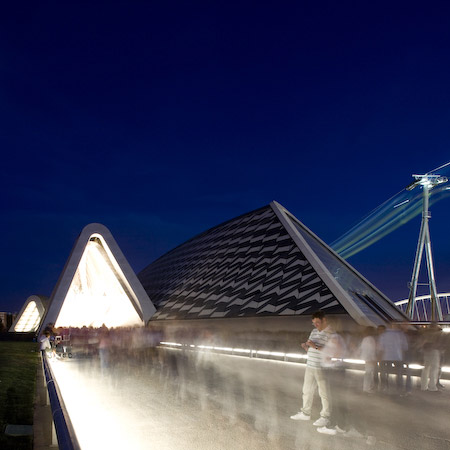
The Zaragoza Bridge Pavilion is organized around 4 main objects, or “pods” that perform both as structural elements and as spatial enclosures. The Bridge Pavilion design stems from the detailed examination and research into the potential of a diamond shaped section - which offers both structural and programming properties. As in the case of space-frame structures, a diamond section represents a rational way if distributing forces along a surface.
zaragoza-9.jpg

Underneath the floor plate, a resulting triangular pocket space can be used to run utilities. Floors inside each pod are located at the Expo principal levels: +201.5m (the soffit of the bridge is at +200m, flood protection minimum level of the Ebro River at the location of the Bridge Pavilion) +203m, +206m and +207.5m for the upper level.
zaragoza-10.jpg

The diamond section has also been extruded along a slightly curved path. The extrusion of this rhombus section along different paths has generated the four separate ‘pods’ of the Bridge Pavilion. The stacking and interlocking of these truss elements (the ‘pods’), satisfies two specific criteria: optimizing the structural system, and allowing for a natural differentiation of the interiors, where each pod corresponds to a specific exhibition space.
zaragoza-11.jpg

By intersecting the trusses/pods, they brace each other and loads are distributed across the four trusses instead of a singular main element, resulting in a reduction in size of load-bearing members.
zaragoza-13.jpg

The pods are stacked according to precise criteria - aimed at reducing the section of the bridge as much as possible where the span is longer (approximately 185m from the island in the middle of the river to the right bank), and enlarging it where the span is shorter (85m from the island to the Expo riverbank). One long pod spans from the right riverbank to the island, where the other three are grafted into it, spanning from island to left bank.

This interlocking of the pods has given the design many exciting possibilities. Interiors become complex spaces, where visitors move from pod to pod though small in-between spaces that act as filters - or buffer zones. These zones diffuse the sound and visual experience from one exhibition space to the next, allowing for a clearer understanding of the installation content within each pod. The identity of each pod remains thoroughly readable inside the pavilion, almost performing as a three-dimensional orientation device.

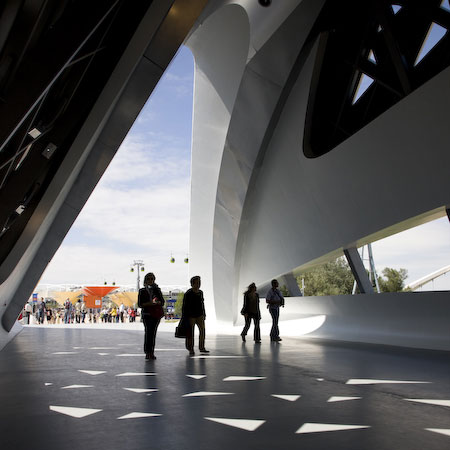
Spatial concern is one of the main drivers of this project. Each zone within the building has its own spatial identity; their nature varies from complete interior spaces focused on the exhibition, to open spaces with strong visual connections to the Ebro river and the Expo.

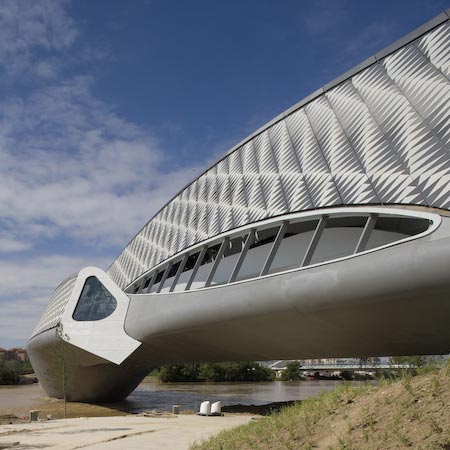
Natural surfaces have been investigated when designing the Pavilion’s exterior surfaces. Shark scales are fascinating paradigms both for their visual appearance and for their performance. Their pattern can easily wrap around complex curvatures with a simple system of rectilinear ridges. For the Bridge Pavilion, this proves to be functional, visually appealing and economically convenient.

The building’s envelope plays an essential role in defining its relation to the surrounding environment and atmospheric variations. The project has been designed to allow its interior to be thoroughly enlivened by the effect of atmospheric agents, such as the Tramontana wind blowing along the Ebro and, the strength of Zaragoza’s sunshine.

During the Expo, a single weathering layer will enclose the building to protect it from rain. This Shark scale skin will be generated by a complex pattern of simple overlapping
shingles. Some shingles can rotate around a pivot, allowing for temporary opening or closing of part of the façade. The pattern of shingles overlapping each other gives the Bridge Pavilion the widest variety of natural light via several degrees of aperture sizes: from rays piercing through tiny apertures - to wide, full size openings. Large apertures are located on the lower level, in correspondence with either end of the bridge, allowing for the greatest degree of visual contact with the river and the Expo.


Posted by Marcus Fairs

Subscribe to our Newsletter: Dezeen Mail

61 Responses to “Zaragoza Bridge Pavilion by Zaha Hadid”

  1. Rockstar Says:

    Stunning…Zaha at her best!

  2. bald skull Says:

    holy f**cking wow!! a stunning building.

  3. Fling Says:

    This is an interesting development on the interlocking rotating pod rhombus filter system that I have not seen before. Apparently if you introduce a 3d centrifuge with a dual cyclone, it collects 45% more dust and dirt particles that its nearest competitor, with no loss of suction.

  4. Jamie Says:

    Zaha is God

  5. roadkill Says:

    if it is to have crap like this why not as Calatrava to do his thing…. holly waste of money and effort….

    you guys are either students or just have generally bad taste all round!

  6. blabla Says:

    a bridge is a bridge is a bridge…it is a brigde…

    @jamie, ever tried to deconstruct your gods? it can be liberating.

  7. stirring Says:

    Fling that was brilliant!

  8. Dariusz Says:

    Wow.. over the top.. but I guess that’s the idea.
    Too much.. Wasn’t less is more at a point in time? hmm.. Mies, where are you?

  9. Archigod Says:

    Looks like a little bit heavy for a bridge, but why not. Another nice project from Zaha. I think i like the rendering much more…

  10. bald skull Says:

    WTF do you guys want then?, all you posters that dislike this. it’s the 21st century! do you want more golden gate bridges, or brooklyn bridges?
    the whole less is more ideal is so lame, the reason they did less and is cause they HAD to do less, there was no technology to build things like this all those years ago. the hype back then is the same as the hype of today, only now days, people are draw to the Zaha’s and not giving the finger to the arrogance of the Le Corbs.

    this thing IS stunning, it’s prob an experience just walking through it. you guys need to quit living in the past and get with the now.

  11. edward Says:

    I thought Spain was having economic troubles but maybe not of they can piss
    off money like this.

  12. itsme Says:

    wow!…much props to the interns who made all the coding on this amazing scripts. In the end the sketch only takes this so far!

  13. Tyson Says:

    Looks like 6 projects at once. Seems from these images that it probably has some fantastic moments, like in the second to last image where it looks a bit quieter and cohesive but generally the geometry looks unresolved/modeled quickly. Messy.

  14. gaque Says:

    there is something provocative about it, but its not in line with the exhibition’s theme of sustainability.

  15. Liu Chang An Says:

    Hadid is a genius. Who can do better than her?

  16. tim Says:

    I could rip on zaha all day long for her shallow forms but she gets her work done and it will be around for a long time, and that is imminently respectable.

  17. yulisri Says:

    she’s borrow dream into real world
    and combine art, architecture, science
    into the iconic sign of the place,,

  18. I-REN Says:

    Ugly thing - it is not about architecture

  19. MIRTEC Says:

    completely irrelevant structure..
    love to see it within a few years, full of junkies and pigeons.. smelling like piss.. does zaha consider this part of life too? or is it just about the image (take it quick, before the building gets old!!)
    think about that zaha-lovers

  20. Jeb Says:

    Is this architecture? yes!

    zaha is a 3d artist and her “art” has function and meaning so it must be “architecture”, maybe not in the old fashioned way or maybe exactly like to the old fashioned way. are the roman temples architecture? isn’t this just the modern version of ornament.?

    it is certainly not the way i would design a building, but to say it is not architecture, is just narrowminded! zaha for me is one of very few architects who get’s away with it. bravo!

  21. fi Says:

    superugly

  22. pangkcoy Says:

    what the hell! crazy! i love it! simply amazing!~

  23. mvb Says:

    Zaha won the competition to built this pavilion bridge and fortunately the other proposals lost the award. If you had seen them you would not critize Zaha’s bridge.

  24. WGA Says:

    Mirtec, I am sorry, but you are stupid. No offence…

    Honestly, what is the connection between these forms and taking a leak in this bridge? Or anywhere else? Why do you think junkies would come to this building, or if they would, what other kind of form do you think would keep them away? How these things are coming together in your head? Or you might tnink that architecture is the tool, the universal device to solve the problems of mankind? Pruit Igoe’s message: it is not. Or if still it is, it is much more about branding and the good old Bilbao-effect.

    You superficialy pick some elements of sociology, human beaviour and mix it, and create a syncretistic connection between them and architecture.

  25. bob Says:

    i agree with fling!

  26. sandy Says:

    Im not a fan of this form as a bridge because instead of embracing views along the river, she has created a covered walkway (in the images shown above at least), similar to an under-pass, losing the benefit of being a bridge. I would have liked to have seen external areas of some sort, to give the users the chance to stop and admire the surrounding area… as often happens on the Thames when visitors, photographers, children stop and view the banks from different angles.

    So in this sense a more traditional bridge would offer a lot more to the user than this horrible looking form does. If she could step away from everything having to be a ridiculous shape, then she could have probably come up with a far more interesting form, blending modernism with function! It is almost as though she refuses to have anything with any form of convention within her designs now and it is a shame because some of them are great shapes, but would benefit as designs with just a bit more thought!

  27. Lauer Says:

    is so GREAT!!!!! i lover zaha hadid designer !

  28. will Says:

    Another good example of how we continue to disconnect with our environment.

  29. MIRTEC Says:

    WGA,

    you don’t get my point..

    this thing cost billions of dollars, while spain suffers from poverty.. and yes: pigeons and junkies are everywhere.. and every guy pisses on bridges like this.. my only point is that people should look further than the beautifull images.. this kind of architecture is nice, but to build it it costs a lot of money and in the end people will piss on it.. it’s way to temporary to my opinion, but that doesn’t mean I don’t like the image itself.. that one is beautifull, but a rendering has the same effect and people can’t piss on that one ;-)

  30. Sullka Says:

    awful…..but well….that kind of design is “hot” or “in” nowadays….as someone pointed it won’t “age” well, in 20 years from now it would be like seeing today those futuristics glass fiber constructions from the 60’s. I remember I saw in some blog last year, pictures from Zaha’s Landesgardenschau in Germany (the building that was in the cover of Autocad some versions ago) it looks like a set from a Mad Max movie, leaking, graffitis, tall grass, etc…looked creepy and awful, and its only like 8 years old.

    I agree it must be quite an experience to walk there, but Im not sure if that only supports the case of building such a giant worm like form, totally out of context and probably overbudget.

  31. ax Says:

    that’s not a bridge. it’s a tunnel lifted 5 meters of the ground! i think this could be built in another place, with no water theme concept… maybe they will built in dubai another of these.
    And if the beauty it’s so relative, what remains of?

  32. Tyson Says:

    why are these discussions always about “how great zaha hadid is?” I mean clearly the firm is incredibly talented, but architecture criticism isn’t about “how good zaha hadid is or isn’t”…It should be about, “THE WORK.” 90% of these comments are a waste of time, why don’t we improve the discussion about this and say what you think is good or bad about “the work” and start talking about “architecture?”

  33. D_spot Says:

    zaha is hot.

  34. bauster Says:

    ia it just abridge or abuilding aswell..
    looks like abuilding not like a bridge, but should be a bridge or what…
    as a bridge over the ebro river it’s much too heavy.. or maybe the pictures present that wrong.
    why do they need a building (which really should be a bridge) to represent water? the structure,the cladding, the space itself maybe great but there is the surrounding which they nearly always forget to cope with.
    so what is the sense of that buildingbridgebuildingpavilionbridge what the f*

  35. Raoul Says:

    architec-STAR, they can build whatever they want, only must be a beatiful sculpture.

    i worked in cultural architecture and we know the people need a cultural image for appropriating of the space. A beatiful form is’t just that, a beatiful form.

    well is not so bad, nobody wanted the eiffel tower the first time, now everybody loves the tower, but it’s a sculture.

    P.D. sorry my english, is not my native language.

  36. spaceslug Says:

    “The pods are stacked according to precise criteria - aimed at reducing the section of the bridge”
    -right!

    personally i do not like it, but this is my opinion!

    one thing that seems really… kind of ended up in the wrong project is the strange flat pattern (a little contradiction there miss?) makes it look like cheap fake carbon imported from china!
    -can someone explain this please
    best regards
    Luke Skywalker

  37. MIA Says:

    ok. first of all O.M.F.G!
    THAT THING IS MAD SEXY !
    secondly, ok guys seriously. there r two kinds of architecture. One which relies on familiar and another which tries to recreate, and invent. It might look bla, but the bridge has a cool structural concept and idea, its new, so thats why i appreciate it.

  38. DMS Says:

    I want to flood it w/ river water and kayak through it.

  39. Gama Says:

    Most of the latest comments seem to express a rather conservative and narrow-minded discomfort with the hybrid (bridge & building) nature of the project, which instead is its real added value in architectural terms.

    No comment is worth spending on those who think that a curved space is gratuitous wackiness, even less on others who ignorantly think the fastest-growing economy in Europe is in fact poor.

  40. MIRTEC Says:

    well gama, you’ve got me thinking..
    but first: when your economy is poor, it’s more easy to let it grow (=logic), so that is not an argument: they are still poor.. but with the help of a union called europe they will manage for sure..
    in that case it’s a clever economic (touristic) trick to place a bridge like this over there (like they did with the museum in Bilbao)..
    It will atract lots of tourists for sure.. and it will be an exciting thing to experience too..
    expensive, but also ‘cheap’ (if you know what I mean)..

  41. Gama Says:

    Mirtec, have you ever been in Spain?
    Spain has already benefited of Europeans founds in the last 10 years, that’s how they managed to regenerate Bilbao and build the Guggenheim museum. It is now has the 8th biggest GDP in the world, and is the second worldwide tourist destination. Surely all this is due to their forward looking and innovative investment policy, in the economy as much as in architecture.

  42. M_NESIA Says:

    i think there’s enough places for ceveral kinds of styles to be built nowadays.
    the main thing is to see it built and test it ,that’s the only way we can improve , we cannot impose theories on things that are not there yet .
    am not against the(tried and tested) kind of thing , but sometimes it’s good to take some risks.
    we need designers like zaha,and others, just to push the envelope a bit and see what happens.
    cheers M

  43. Juan Says:

    I ‘ve worked on the engineering and construction of the facades. It is wrong that “Some shingles can rotate around a pivot, allowing for temporary opening or closing of part of the façade”. Only “smoke vents” have the possibility to go open…but we will hope that’s not needded.

    BestRgds

    juan

  44. Against Expo Zaragoza 2008 Says:

    I won’t recommend anyone coming to Zaragoza, a city that is becoming even more unhabitable thanks to this Exposition. This Expo has nothing to do with sustainable development; it has everything to do with unscrupulous businesses. Zaragoza is a torrid, windy city surrounded by the Monegros desert. It’s not a turistic place, and I’ll never be.

    Expo Zaragoza 2008 is unsustainable in terms of ecological, economic, social, environmental, legal and cultural. The Ebro river ecosystem is being destroyed: cutting down thousand of trees, irresponsible dredgings in order to allow ships sail, cutting the bottom of the Stone Bridge medieval archs, etc.

    The experience of previous universal exhibitions (and that of Zaragoza is not: it is `international’, ie, a second class exposition) and the most recent Forum in Barcelona, showed that these events are ruinous to the Treasury, but very profitable for construction companies and real state speculators.

    Politicians have been lying with a straight face for years, in order to get population’s support for this project. However, people is increasingly aware that they’ve been cheated.

    I could go on and on. Please visit http://www.expo-no.es , where there is a lot of information (mostly in Spanish, but there is also some in English).

  45. JuiceMajor² Says:

    Definately an interesting building. But the question is at the end of the expo, ‘Will it stay or will it go?’

  46. Gama Says:

    If you think it’s got 67 m deep foundations, i believe it will definitely and luckily stay.

    “against expo blah blah” : thanks for not going on!

  47. Chaos Says:

    not good, it is boring

  48. Név* Says:

    I believe this building looks much cooler in real, than in the renders - actually most of zaha’s renders are pretty crappy - , and I’ve been wandering about, how her newest designs will look in the middle east area after their completition.
    I especially love those interior spaces in the bridge, love to see the structure instead of some crappy “fluid” surfaces covering them.

  49. moya Says:

    yo hablo español y espero que si alguien entiende este idioma sea lo suficientemente inteleginte para conciderase mente receptora de mis ideas sobre la arquitectura…yo soy un genio incomprendido que no comprende para nada a zaha y su arquitectura, es verda que si me pongo mentalmente jugueton entrar a este pasadizo me da la sensacion de estar dentro de las vertebras que tiene una baca en el cuello y por supuesto que resulta entretenido y muy interesante ver como logra esta arquitecta tras una intencion dudosa, mas bien una intuicion poderosa acercarme a la naturaleza a traves del uso de elementos relativamente frios e inorganicos…ahhhhh…la forma…la forma y alguna vagancia tecnologica….es superficial, aunque siendolo sea de las buenas cosas superficiales, por que…el mindo es todo, como tambien lo es lo bueno…sigue asi

  50. moya Says:

    como hago para dar mi opinion que es tambien la de ustedes

  51. A Says:

    MANUELA GATTO rocks! congrats! looks great.

  52. Runningforasthma Says:

    ‘Most of the latest comments seem to express a rather conservative and narrow-minded discomfort with the hybrid (bridge & building) nature of the project, which instead is its real added value in architectural terms.’

    Look at Hadid’s early work, the tectonics, this project is a reversion back to those theme’s. I agree, it’s a very narrow and conservative view of the blurring of typology, which I agree adds real value to the project. It’s just another part of a the tradition of the promenade in architecture, it could ‘touch’ the water more lightly I think, but it’s still a elegant structure.

  53. texxeen Says:

    someone made a relevant arguement pointing out how the view from the bridge obstructs the view of the river, however, what we should aslo keep in mind is that context and concept (product) do not always have to share the same indiffrence. Maybe the idea here is for concept to contrast context. There are several modes of contextualism, Zaha just chooses to take a nondenominational approach on the issue. I mean, she litrally peed in calvaterra’s mouth with this one, and the sad part is that he swallowed it. Sick!

  54. Gama Says:

    Zaragoza in summer: up to 42 degrees
    maybe less views on the river, but the blessing of shadow

  55. kim Says:

    For all the “postmodern critics” here and there pessimistic whinge:

    This bridge is an update on the theme of habitable bridge like the Ponte Vecchio of Florence, the Rialto Bridge in Venice and the Chateau Chenonceau in the Loire Valley.

    To be more specific from those bridges you would not see the river, but use the bridge as a succession of program along an enclosed path.

    If the shark skin pattern works as it is specified in the text, it would be a breakthrough in this typology, making it the first environmentaly responsive habitable bridge.

    Please guys, read and be respectful about history and other people’s work… before whinging about your good taste and your fetichisms.

  56. cesarjaramatto Says:

    que fantastico es saber hacer cualquier cosa .gastar millones en algo que particularme para mi , no tiene sentido ,pero como es unas de las vacas sagrada de la prensa .ahi esta ………..me parece un muestrario y alarde tecnologico .el resto ya lo dijo moya says …disculpen mi criterio sin criterio

  57. thomas Says:

    This is a great CG than an architecture.

  58. Gianfranco Says:

    Althought beautiful, it doesn’t fit the surroundings…Unless she is about to built the rest of the city.

  59. Gama Says:

    ah, and why is that, Gianfranco, because it doesn’t quite look like a 60s apartment block?

  60. S. Captain Says:

    The majority of the -ve comments are from the losers whom I am glad are totally irrelevant in the big scheme of civilizations. Where would we be if CT Scanners, MRI machines, linear accelerators, Cars and airplanes were not invented?
    Get off your … and move on.

  61. Paul Trolly... Says:

    This is an exceptionally interesting work of bridge building, (my favorite area of architecture) as it seems to combine modernist building styles and gallery space with what we consider the main purpose of a bridge (gettin places over things!) I recall it was meant to have open sections to expose the chassis but it was impractical. Shame. It would make the thing less monolithic and solid… but its monolithic and solid in a good way! Good work.

Leave a Reply