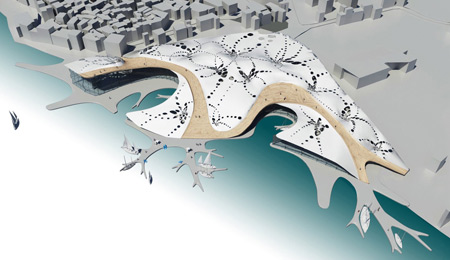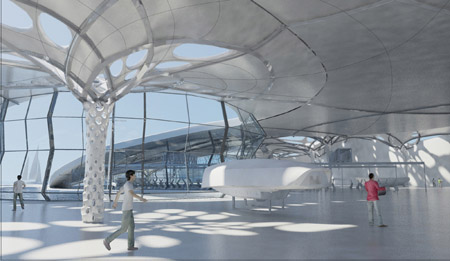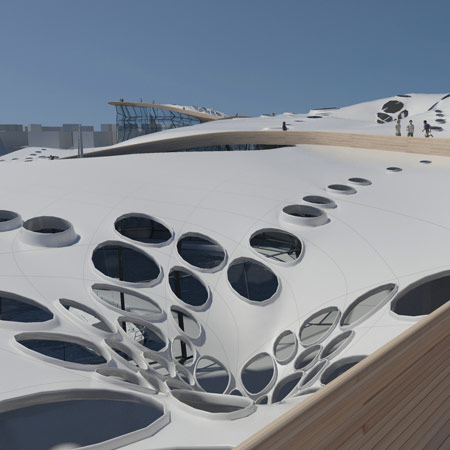
Three students from Studio Lynn at the University of Applied Arts in Vienna have designed a conceptual boat factory for the island of Cres in Croatia.
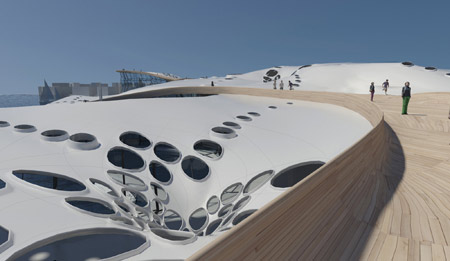
Called Factoreef, it has been designed by Julcsi Futo, Bika Rebek and Stefan Ritter, students on the course run by architect Greg Lynn.
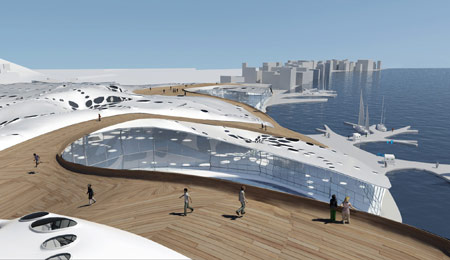
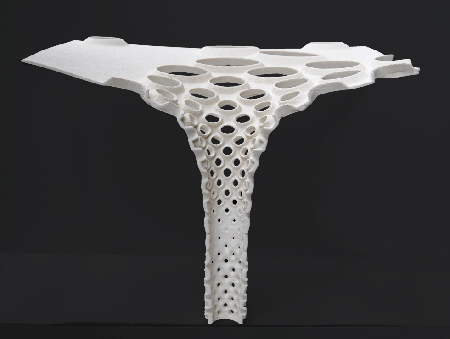
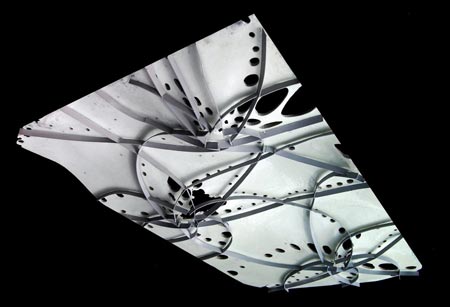
The architects describe the project as “a large scale, smoothly undulating roof held by an intricate steel truss structure”.

More info on the project’s blog.

The following is from Factoreef:
–
BRIEF
“factoreef” is a proposal for a boat factory in the mediterranean town Cres, designed by architecture students Julcsi Futo, Bika Rebek and Stefan Ritter. They are currently enrolled at Studio Lynn, an architecture course run by American architect Greg Lynn at the University of Applied Arts in Vienna.
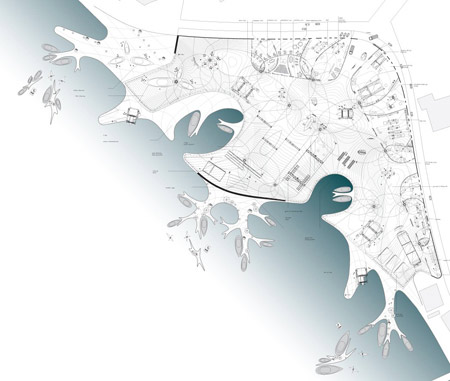
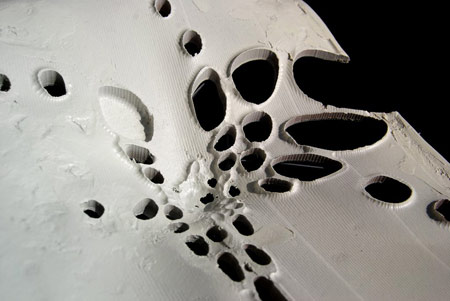
This project is a large scale smoothly undulating roof held by an intricate steel truss structure. It covers a single space partitioned only by structural elements. The promenade on the roof creates an attractive public ground for the touristic town Cres. Visitors get glimpses of the production happening inside and arrive to the see.
PRECEDENTS
We were interested in the contrasts of the dense interior versus the vast exterior space of the boat, and the soft sail towards the rigid body. The main contrast we want to work with is the way the hard boat hull rips the mellow waves as it hits the water.


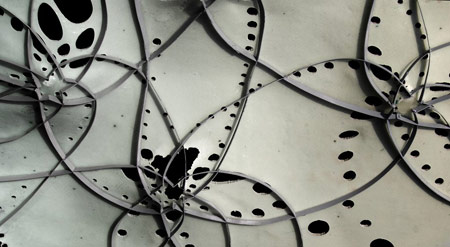
The aesthetic reference is the clean slick surface of the boat opposed to the barnacle like structure that is fine grained and intricate.
URBAN & MASSING
After analyzing various coastline typolologies we worked with the archipelago, which consist of a multitude of piers, canals, ponds and islands.
ORGANISATION
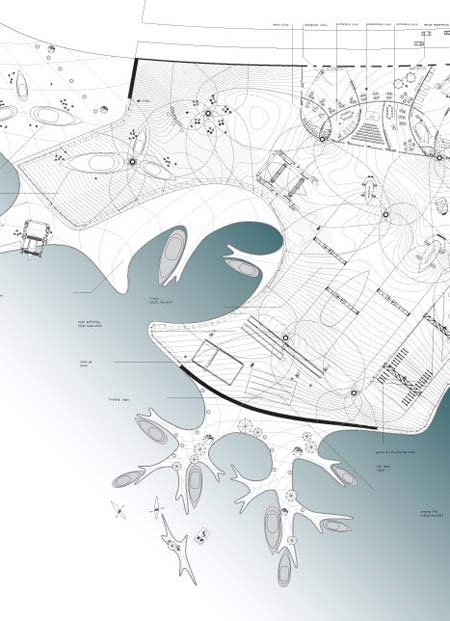
The layout of the plan is open, it facilitates efficient transportation of the boats from one machine to the other.
Tooling areas for the hull fabrication and finishing procedures that require separate spaces are detached in an enclosed stripe in the north, while the building opens up to the south, towards the sea.
BUILDING CONCEPT
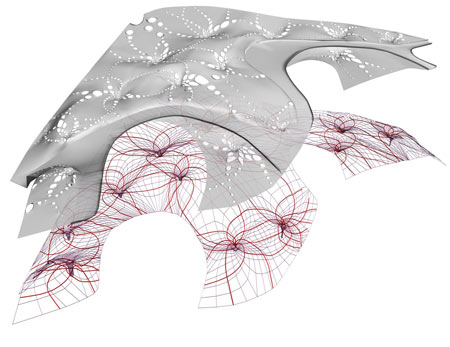
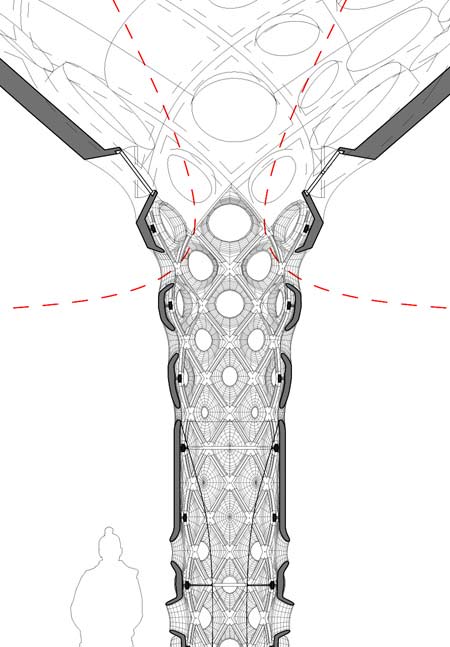
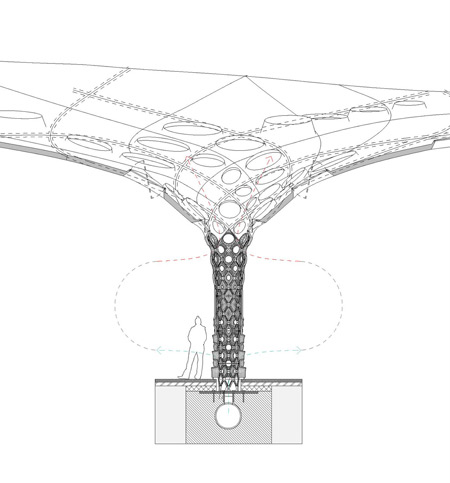
Cool air is provided by pipes running in the foundation. It is blown out from the lower part of the columns, where the openings stretching inwards support the air emission.
The cool air circulates through the building, as it heats up it is exhausted through the upper part of the column which has then reversed openings.
MOOD
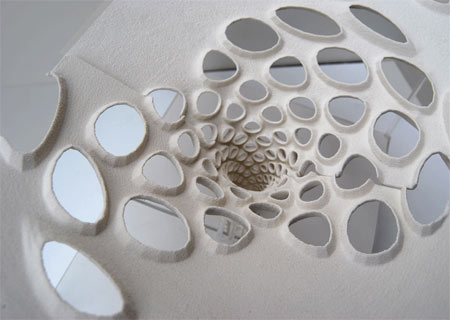
The whole structure is visible from the inside creating a dense atmospheric view. From the outside the monocoque roof only bursts into openings where the columns pierce through it.

–
Posted by Matylda Krzykowski


September 11th, 2008 at 2:53 pm
Hello Vienna,…
congrats to these students, really another fine piece of students work, not only investigating into formal qualities of the project , but integrating structural logic within the design,…double agenda so to say,..overcoming the duck!…i really appreciate the intention,…even if its not developed into its full extents,…
greets
a “linse”
September 11th, 2008 at 3:31 pm
This is interesting. Very interesting.
September 11th, 2008 at 3:53 pm
nice project.
studying at the school led by an architect who has a very particular style and language, is often that his/her students come out of it designing projects using the very same language… perhaps that is the point of it, but i am not sure….
i think a truly good teacher will manage to bring in each student his/her own visions and their own language.
it would be very interesting for me to see a student coming out of Greg Lynn’s studio, using ortogonal geometry (designing a box) but who can actually prove the validity of it…
September 11th, 2008 at 4:17 pm
wunderschoen maedls!
bessos from
another “linse”
September 11th, 2008 at 4:58 pm
nice project
i agree with bojana about teaching…
the project look interesting-amazing-appealing
but at the same time i have some doubt about this kind of language and
about his scale compare to the city…
and you know why the dock are usually straight and not curve?
anyway congratulations, impressive!
September 11th, 2008 at 5:04 pm
@bojana:
I can´t follow your argument. When I browse the project section of the website I see lots of different fromal, aesthetic and conceptual approaches.
Isn´t it the same stereotypic comment that comes up on each of these projects?
For my part, I really like the project and I think it is representing a very individual vision that is differing a lot from Greg Lynns work!
Well done U 3 !
Go for more….
o.
September 11th, 2008 at 5:19 pm
i’m rather sure the island of Cres doesn’t need this kind of thing.
another example of useless selfish use of idiot forms
September 11th, 2008 at 5:34 pm
it’s not about just using the same language, it’s about reflecting upon it and further developing it, questioning it.
why should a box be any more valid? in contrary, the organic integration of form, function, structure, symbol and building systems are the point and goals of this design.
the forms and aesthetics yield for a contemporary manifestation of our culture. the topic and program itself, a factory located in a vulnerable urban structure of a small seaside town, is part of that.
PS: on the studio website u can find some more boxy projects
September 11th, 2008 at 7:04 pm
i agree with bojana.
good project and nice execution, anyway.
September 11th, 2008 at 10:41 pm
@ bojana: are suggesting to go to a steak house to have a salad?
September 11th, 2008 at 11:48 pm
Heeey Stefan!
Looks very good! How are you doing? Extraordinary and sublime study! Looking forward to see more of the things you ar edoing now!
Keep in touch!
Greets! Chris
September 12th, 2008 at 2:56 am
breaking news: conceptual boat factorys win out over conceptual flying chinatowns. more at one…
September 12th, 2008 at 3:04 am
Hey Bika and Julcsi, beautiful project!
September 12th, 2008 at 4:23 am
While I respect your above comment, Bojana, I think it is too difficult to explore the ideas that a studio critic proposes without engaging with the materials, forms and spacial concepts that the critic is investigating. These are not just ‘incidental aesthetic languages’ but the very means by which we express and communicate architecturally within a studio. Stylistic overlap isn’t detrimental to good thinking.
It is perfectly valid to concern yourself with another discourse, (formal and otherwise,) within architecture after leaving the studio, but it is really a waste of time to try to be 200% different when you are trying to learn and communicate with your critic..
I think this student work is very poignant and sophisticated. Much more so than the UN Studio work in the VeniceBienale, or the disappointingly amateur-ish Ben Aranda/Lasch project (snoooze) . (see next story).
Greg Lynn Studio work:
Critiqued by many, mastered by few…
Beautiful work here. bravo!
September 12th, 2008 at 10:04 am
Klasse projekt! Bin stolz auf Euch…
Weiter so!
September 12th, 2008 at 11:01 am
I can not comment anything, until they realize this project..
September 12th, 2008 at 2:39 pm
nice work. But sinc I know the island very well, I would like to know where it could be situated (integration with sourounding
September 12th, 2008 at 4:34 pm
Who cares about where when how… My granma would have loved this project, thinking to put it on her bedside table.
September 12th, 2008 at 5:08 pm
toyo ito with ornament?
http://www.bdonline.co.uk/story.asp?storyCode=3082629
September 12th, 2008 at 7:23 pm
good ideas :\
September 12th, 2008 at 10:27 pm
Besides the matter that for a student project, (or not), it appears
to have a consistent appearance more than other professional ones. But like…. said… “Essence only occurs when appearance is inconsistent”… and here I miss some essence here… some trees, some life, some understanding of scale… some intensity…
Nevertheless congratulations, nice work.
September 14th, 2008 at 10:27 am
it makes a statement
September 15th, 2008 at 10:12 am
it looks like one of the blades for my blender
BRILLIANT!
September 15th, 2008 at 10:28 am
Great work guys!
The fact that this is a student project is largely irrelevant, as is harshly judging a project, any project, for its geometric regularity (box) or irregularity (non-box) alone. Can we please move beyond these shallow formal observations that ultimately betray, if anything else, aesthetic insecurities?
Instead, we should realize that we are in a moment where many approaches to design co-exist and are in dialog with each other (just look at the diversity of entries in this forum!), and that an active investigation of form, systems, technologies, uses of program, cultural relevance, and social and environmental applications are being tested in a variety of ways. Thus, we should evaluate this project not only as a creative endeavor but also as an investigation of the abovementioned.
As such, I think J, B, and S have presented a compelling proposal that attempts to address atmospheric qualities with environmental concerns. And its well presented.
September 15th, 2008 at 5:55 pm
…”Can we please move beyond these shallow formal observations that ultimately betray” …
I found betraying:
- the scale, -The atmosphere, -to believe on a picture w/o questioning it, - all it’s make up…, I find this project and many of his comments a betrayal in the very sense as described above…
Despite all the beauty, I am still missing any kind of essence or intensity… … … Is ghost that no even insists to be real…
September 15th, 2008 at 7:38 pm
not good, c’mon!
what are you guys talking about?!??!
September 16th, 2008 at 8:51 pm
boring boring boring
making a floral ornament, build some ugly columns in a 3d program, like a braid from fat farmers wife
a roof where you dont wanna walk.
sorry guys taht I dont fall on my knees like the others in this blog.but its no architecture for me.
September 17th, 2008 at 8:55 am
I think this project has many qualities.
First, it tries to bypass the problems that many boat factories encounter: of being totally private and detached from the city (even when they are in it: think of Venice’s Arsenale). The walk over the roof that leads directly to the piers and allows bystanders to see through is a good solution to this problem.
The enormous size of the project depends on the needs of the industry. Ship factories are massive by definition. This project can’t avoid that but nevertheless tries to avoid the one-block/one-box solution and presents a varied, nuanced solution.
As to the formal qualities: this floral/organic trend may not be your cup of tea
But it seems to me that this is not simply ornamental, as the holes pierced through the roof help ventilation and allow for visibility. And it can hardly be denied that the junctures between pillars and the roof are not precise and well-made.
If it is ornamental it is as ornamental as the Gothic. But I think we all agree that, architecture historians have since long demonstrated that the Gothic cannot be considered purely ornamental.
The symbolism is perhaps a little too literal: pillars and holes positioned as to simulate the formal configuration of an archipelago (with its obvious associations to the sea), but - personally - i can hardly find this a major drawback.
September 17th, 2008 at 3:40 pm
Great work, beautiful project, you are budding young architect.
September 18th, 2008 at 10:09 am
it looks really great!!
September 23rd, 2008 at 1:42 pm
I agree with another commenter that its logic is ornamental and it’s too carpet-like (undifferentiated) to convince of its function.