
A solo exhibition by British designer Max Lamb has opened at Johnson Trading Gallery in New York, featuring a new series of furniture cut from solid rock.
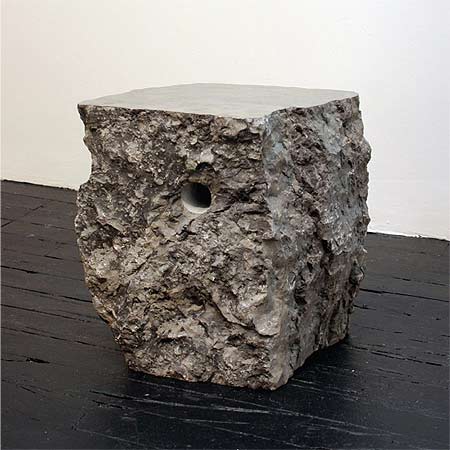
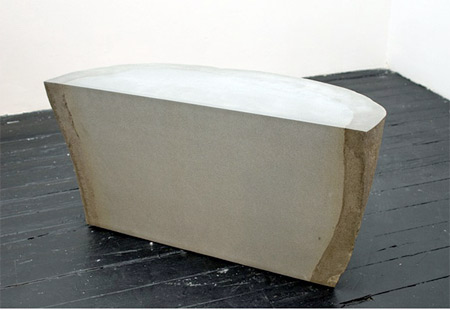
The rock chairs are made of a stone called Delaware Bluestone. Top image: Delaware Bluestone Chair (no. 1 ). Above: La Cernia Table
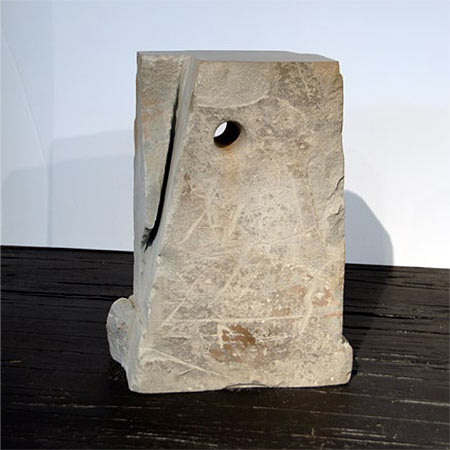
The exhibition runs until 7 November at Johnson Trading Gallery, 490 Greenwich Street, New York 10013. Above: Delaware Bluestone Sidetable. The following is from Johnson Trading Gallery:
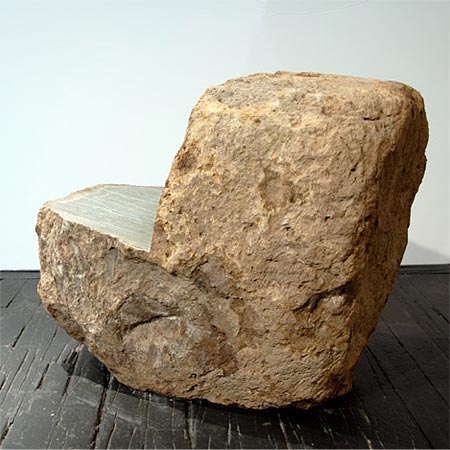
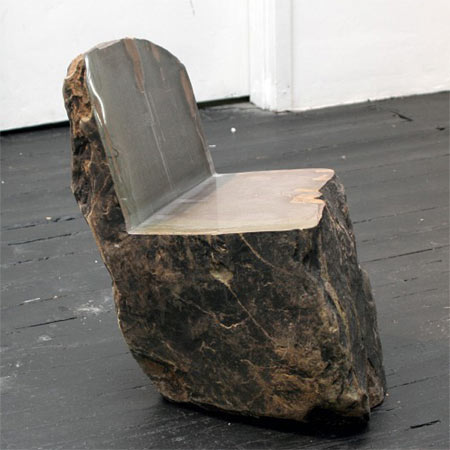
Above: Delaware Bluestone Chair (no. 4 ) Below: Delaware Bluestone Chair (no. 3 )
The following is from Johnson Trading Gallery:
–
MAX LAMB OPENS AT JOHNSON TRADING GALLERY FURNITURE IN STONE, BRONZE, PEWTER, COPPER, AND POLYSTYRENE
New York Show Marks U.S. Debut Combining High Tech with Hand Hewn
Johnson Trading Gallery presents the first U.S. exhibition of contemporary furniture by British designer Max Lamb.
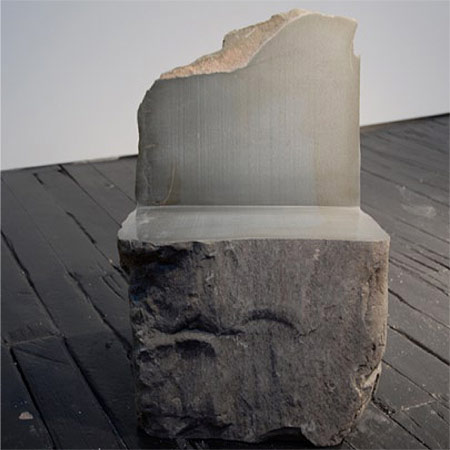
The exhibition features new commissions Lamb has crafted from New York bluestone, along with a retrospective of important limestone, pewter, bronze, copper, wool felt, and polystyrene objects, demonstrating why his work has captured the attention of the international design community. Above: Delaware Bluestone Chair (no. 2 )
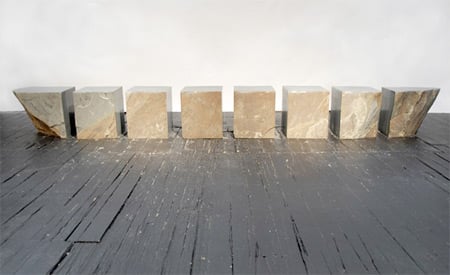
A series of films will offer an understanding of Lamb’s design philosophy and processes. The exhibition will be on view from October 8 through November 9, at Johnson Trading Gallery, 490 Greenwich Street, New York City. Above: Delaware Bluestone Slice Bench (no. 1 )
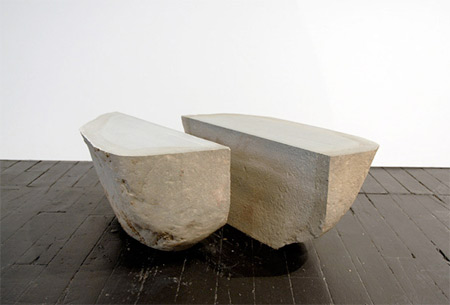
One of a group of dynamic young British designers who are leading the pack internationally, Lamb was featured as one of four Designers of the Future at Design Miami/Basel 2008. He is known for the creative vision he brings to contemporary furniture design, for his high level of technical skill, and for his drive, as he explains, “to explore and re-contextualize both traditional and unconventional materials, celebrating their inherent qualities, and to reconsider the function of all objects.” Above: Delaware Bluestone Twin Tables
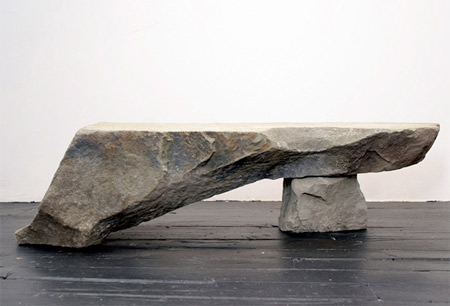
The new works in this exhibition, evolving from his previous collection ‘Exercises in Seating’, a consistent theme throughout his career, exemplify Lamb’s skills as a designer, a craftsman, and an artist. For this exhibition, Max has created new works in Delaware Bluestone. A naturally blue sediment stone with a strong historic connection to New York, it is visible throughout the city’s sidewalks and architecture. Above: Delaware Bluestone Bench, Below: Delaware Bluestone Table
Bluestone, found predominantly in the Catskill Delta, was created over 350 million years ago from run-off from the Acadian Mountains, which covered the area where New York City now exists. Lamb traveled from London to the Catskills to search for suitable and inspiring pieces of stone from which to carve furniture. He collected stones from four bluestone quarries and worked directly with one, combining hand-carving and machine-cutting techniques to create a collection of chairs, tables, benches and stools. His previous stone work in limestone and sandstone, exhibited at Design Miami/ Basel 2008, along with early experiments in carving Cornish granite, advanced his well-honed skill set and his understanding of how to work with this heavy and difficult material.
The retrospective work in the exhibit includes a large, hand carved Polystyrene Dining Table and eight Poly Chairs, White Bronze Poly Chairs, a Nano crystal-line Copper Stool, and a collection of turned Concrete and Felt Stools from Lamb’s Solids of Revolution project developed for the 2008 Designer of the Future Award.
ABOUT MAX LAMB
Lamb notes, “My recent work has been very preoccupied with processes and materials, and alternative ways in which these can be manipulated, exploring the potential of local skill-based industries, combining skilled hand-craft techniques with native materials, and sometimes juxtaposing these with digital processes and the hightech.”
Graduating from Northumbria University with a degree in Three Dimensional Design in 2003, Lamb earned early recognition for his talent, receiving the 2003 Peter Walker Award for Innovation in Furniture Design and a 2004 Hettich International Design Award. Before launching his independent design practice in 2007, Lamb worked with Tom Dixon, designing furniture for his Special Project series. His career began as a design consultant for Ou Baholyodhin Studio, London, designing furniture, graphics, interior products, restaurants, shops, exhibitions, and residential interiors.
In 2006, he earned a Masters Degree in Design Products at the Royal College of Art, focusing on furniture forms and establishing a precise, process-driven approach to design. A strong international sensibility cultivated in travel to China, India, Nigeria, Japan and elsewhere, and an appreciation for natural materials, born of his love of the outdoors, infuse Lamb’s work. His pieces have been exhibited internationally, including Tokyo, Stockholm, Milan and London, as well as in Miami and Basel.
ABOUT JOHNSON TRADING GALLERY
Johnson Trading Gallery is committed to commissioning and funding unique contemporary works from emerging artists, designers and architects, and to curating exhibitions of the finest 20th Century design. Paul Johnson made his name as owner and operator of Phurniture Inc., founded in 2001. His extensive knowledge and vast collection of historical design, as well as his attraction to contemporary artists that push boundaries, proved invaluable to his future as design gallerist.
Operating now as Johnson Trading Gallery, the space aims to showcase rare works by established masters such as Paul Evans, George Nakashima, David Ebner and Mario Dal Fabbro, in addition to simultaneously creating an outlet for current commissioned artists Aranda/Lasch, Steven Holl and Joseph Heidecker. The result: an environment that serves as a contextualized timeline of historical precedence and modern technology.
–
Posted by Matylda Krzykowski


October 9th, 2008 at 2:14 pm
i don’t know…
something tells me i should like these… but i don’t.
October 9th, 2008 at 2:26 pm
Gotta love when designers mock in our faces
October 9th, 2008 at 2:40 pm
can someone stop this empty headed nonsense?
A lot of weight (waste) but ideas light as feather
October 9th, 2008 at 3:08 pm
Looks like Fred Flintstone’s house from Bedrock.
October 9th, 2008 at 3:38 pm
flintstones are back!
you rock max!!
October 9th, 2008 at 3:39 pm
Scott Burton anyone?
October 9th, 2008 at 3:45 pm
I think about the material (stone is nice !) , then the form, function & emotional impact leave me indifferent.
I hate indifference
October 9th, 2008 at 3:59 pm
is the new boredom the boredeom.
October 9th, 2008 at 4:11 pm
I didn’t know u can use a rock for a chair
:D:D:D
October 9th, 2008 at 4:30 pm
thank you, thank you, thank you
it is nice to see some design that is still pure and humble
these rock.
October 9th, 2008 at 4:37 pm
This is not design! Anyone can seat in a stone.
October 9th, 2008 at 4:56 pm
Moylder: But note evryone does! These are beautiful, natural, heavy maybe yeah but who cares. It is using the resources we have around us, go back to nature kids!
October 9th, 2008 at 5:14 pm
I’m struggling to find anything positive about this work. Ill considered.
October 9th, 2008 at 5:21 pm
Tiffany called it.
October 9th, 2008 at 5:57 pm
I can see the use of materials…I understand the focus on process. What seems to be missing here is a challenge to either of these two aspects which should be acheived by applying some good design.
Max’s approach seems to consist of a two stage design process: 1 – pick a material, 2 – cut it into a shape. Why not rise to the challenge of doing something new within these constraints? This work has been so distilled into just material and a simple process that it has become regressive. It was the same with his felt work, the concrete blocks and the polystyrene.
This could have been so much more. Check out what Newson has done with marble for example. Perhaps Max should move on from experiments in seating to actually designing some seating. Combine his well-honed skill set with his design skill set.
I really worry that design work like this is somehow exempt from the levels of critic that would be applied to scupture simply because they are labelled as design.
Just my opinion. I hope to see better from him in the future.
October 9th, 2008 at 6:00 pm
I like these. Nicely understated.
Must have cost a lot in excess baggage though.
October 9th, 2008 at 6:17 pm
Just to add:
‘I really worry that design work like this is somehow exempt from the levels of critic that would be applied to scupture simply because they are labelled as design.’
And vice-versa: exempt from the normal parameters of design critic because they are gallery design editions ‘design-art’.
October 9th, 2008 at 6:19 pm
fuck of Mike!!!!!!!!!!!!!
even my little brother can do this!
October 9th, 2008 at 6:52 pm
Max Lamb has some big stones!
I love this guy.
October 9th, 2008 at 6:55 pm
Dear Mr Lamb (I’m sure you might be reading everyday about the comments everyone else post about your furniture)
Just ignore most of the comments above… it doesn’t matter if it is furniture or not… if it is too heavy to move your ‘chair’ around… all that is absolutely irrelevant… it’s the first time that I’ve felt compelled to write a comment on dezeen… this is not furniture… is art… no, sorry, is Art… with capital A… if only because of the contrast of smothness and roughness these pieces justify their existance… many thanks… these things are incredibly beautiful…
and don’t worry… sensibility is not that common these days… next time make them blobby and preferibly show a render (not the real thing) and you might get many more complimentary comments…
October 9th, 2008 at 7:56 pm
so easy, so unfair to pretend its design
October 9th, 2008 at 9:06 pm
I’m sorry to add that this isn’t exactly a ‘new’ idea. Then, again, I know how tough it is to come up with something ‘new.’
October 9th, 2008 at 9:06 pm
…and I should add that when I get to that place when I think something I’m doing is not new, I usually stop.
October 9th, 2008 at 9:47 pm
gratuitous….beauty is important, and those stones are beautiful, but design is something more, i m not referring to the function, but to the interpretation. Mr Lamb, u re only a stone cutter…. and u re just misusing your reputation.
And Dezeen, i really adore the blog, but try to be more critical or at least mention that such a project is controversial.
October 9th, 2008 at 9:58 pm
it’s too bad, I liked his work, but this time it looks like ‘permission of doing whatever’…
October 9th, 2008 at 10:26 pm
nice but is only a piece of cut stone but good idea
October 9th, 2008 at 10:57 pm
Horribly unjust criticisms here. The usual suspects just bashing away. Why don’t you all just get your own shit design blog and vet what you think is worthy of praise.
Seems you have nothing positive to say…ever
October 9th, 2008 at 11:43 pm
Working with stone can be great – check out Marc Newson – but this is just ‘LOL’
October 10th, 2008 at 12:06 am
‘musty,’ I DO know what you’re saying. I would usually agree with you. But, on this example, there IS a certain lack of history research (it appears) on the part of the designer. For myself, I try hard to find the best in most of these offerings, or I say nothing. But, in this case, I can understand the lack of appreciation by some. Surely, anyone who bothers to complete a project or line of products is worthy of admiration. But, at the same time, we’re doing no one any favor by simply abiding by effort alone. Ultimately, I respect all creative individuals who bother to whittle their way toward their goal. In this day and age it’s almost a rarity. But, just ‘doing’ doesn’t necessarily demand praise. My only recommendation to anyone watching this space is that they treat every designer with due respect simply for making a concerted effort.
October 10th, 2008 at 12:56 am
Musty…why so negative?
Medusa…knowing Max’s previous work, reading his profile, philosophy and the desciption of the work, I think any serious artist exhibiting this work would be coming under the same level of critism that has been expressed in this blog.
Stone is a nice material but I don’t see htis as ‘art with a capital A’ (barf). It’s floating in the (expensive) grey area between art and design where crap out-put remains somehow immune to any meaningful critique. There also nothing original here.
It can’t be critisised for it’s failings in design because it’s seen as art but at the same time it’s existence is justified because it’s seen as design. If Max really wants to show a beautiful example of material and process then he should look to sculpture…why does it have to be a shit chair or table.
It somehow makes me think of those chairs cut out of logs with chainsaws by lumberjacks.
October 10th, 2008 at 1:00 am
”Art… with capital A… if only because of the contrast of smothness and roughness these pieces justify their existance”
???
October 10th, 2008 at 1:05 am
Back to the Stone Age.
More that 2000 years of craftsmanship to get back to this.
Western people killed God, but kept the psychological pathologies. Minimalism is the ultimate ornament to their guilt, Consumerism becomes the New politic of the junk democracy.
This is decadence driven by bully designers.
Not suitability, just hard core nihilism.
October 10th, 2008 at 5:33 am
design is died ? great idea for a cemetery or a museum of design
October 10th, 2008 at 8:53 am
No me importa si es buen diseño o no !!PARECE QUE HUBO UN DERRUMBE EN LA GALERIA¡¡ Yo le pongo un 4 de calificacion, es un retroceso en el diseño inmobiliario
October 10th, 2008 at 9:09 am
sure your little brother could do it
but he didnt, and he certainly hasnt made a living at it, and he wont.
pessimist.
October 10th, 2008 at 11:15 am
I like Max as a person. And this why I would like to say this to him:
You are a very good insdustrial designer. Why did you decided to go into this path of Art-Design, when you can do incredible shelfs, bird boxes, chairs… that can be produced?
Did you fall into this because it is good money? Fame?
Honestly, I don’t understand it.
We liked you work better before.
Be true to yourself !
October 10th, 2008 at 11:24 am
I agree with John Smith… Maxs’ approach in selecting material and then ‘doing something to it’ is certainly a good approach yet he seems to lack to ability to push things further and creating a new shape using the abilities of the material. Good process. Shape needs a bit more thinking-doing. Look at the grandmaster Grcic. Who would have said 5 years ago that concrete can look amazing at home… That’s where I would like to see the stones of Max…
October 10th, 2008 at 1:13 pm
next we’ll be seeing rock wheelchairs…
October 10th, 2008 at 2:22 pm
they’re kind of growing on me though…
October 10th, 2008 at 3:37 pm
bravo max your works are great
October 10th, 2008 at 5:05 pm
Wow….didn’t expect to see so many reaction on a piece of ‘art rock’
October 10th, 2008 at 11:57 pm
Damn – this design/art thing really pokes the rattlesnakes…
Message to Assume:
“You are a very good insdustrial designer. Why did you decided to go into this path of Art-Design, when you can do incredible shelfs, bird boxes, chairs… that can be produced?”
Do you work with producers? Do you know what a pain in the ass it is? Do you know that they only give you between 3-6% for your hard work? or rather – you ask for 6, they give you 3. Yes 3%.
So okay – you design a nice bird house. Take you a couple of weeks. Then three trips to Itlay to meet some guy says he can produce it. They sell 100 for 100 euros. Gives you 3%. Yes that’s right they sell fifty. But it’s a good birdhouse – everyone love it. One year they sell 100. You get three percent. Work it out. It’s real.
Or – you design a chair. Some guy says he will ‘produce it’ for you.
He sell six. You get three percent.
Believe it this what happens. Not me. Not my chair. Someone else chair. And yes they sell six. It’s real. A company. With a receptionist and fax machine.
Everyone loves the chair – all press love the chair. But they sell six chair and you get 3%. This is not business.
Why why why do the industrial design community think there is some kind of righteous cause involved in ‘mass’ production? You make chairs!. everyone thinks everything gets made in millions in china. It doesn’t. Most they sell a handfull and the designer gets his miserable 3%. It’s insulting. Totally insulting. And then you meet your friends and you’re all proud that you got your bird house into ‘production’ – but really inside you’re thinking – why… I end up with less cash than I started…. and I’m a bit older…and now I have to teach in that stupid university with the lazy students instead of making new stuff in my studio with a beer then selling it to some guy who seem to like it (the rock not the beer) and I go and make more stuff – maybe out of cheese and ham next time – whatever.
Please now – quick poll – designers : step up if you have designed something that has directly made you money from production – extra points if you give an example of working with an Italian manufacturer and they actually paid you. Let’s burst some bubbles and let this guys make some money instead of following the way of the 3% ninja.
The first guys to respond win a rock. I’ll post it. (EU only)
October 11th, 2008 at 10:24 am
It’s a great idea, this work could break the waves on the beach…boring…New Zealand Rocks !!! (Flight of the Conchords).
October 11th, 2008 at 10:18 pm
-
Message for ‘upon this rock’:
Yes, 3% and sometimes some fees.
A lot of designers (perhaps your friend with the chair) have had a fruitless experience with some Italian manufacturers, especially with the first few endevours. I believe this is quite common.
It can be that for one design you might have to work for a year without seeing any results but, if it works you could be getting 3%, on a product which sells for say €150, that sells a couple of thousand a month, for let say 20 years. Or maybe you will get 3%, on a product which sells for say €5000, that sells 500 a year, for say 10 years. Sorry if this seems like design industry 101 class.
Maybe I can offer a few bits of advice from a patronising old fart; Very importantly, pick a manufacturer with very good distribution. Design something well so that it will sell well, with longevity (obviously). You can’t just design for yourself but also for the market (that doesn’t mean selling out). Your manufacturer has to also have the track record and the resources to actually achieve cost effective production so that it sells competitively – there are a lot of manufacturers who can do the R&D but can’t actually properly produce or sell the stuff.
This is how most of the design industry have made a living for the last 100 years or so. Jasper Morrison’s lighting designs for example have probably sold and sold for years and will continue to do so.
Apart from a select few, like Ron Arad for example, I think it’s only been in the last 5 years or so that many designers have been working with galleries, selling limited editions. I can see the appeal; make, sell, make, sell, give 50% to the gallery, make a few grand very quickly. Hey, you get to do pretty much what you want and make a name for yourself. I’m sure your aware that it’s the huge financial boom in the art market which allows designers to get on the gravy train.
I’m not saying this is a bad thing but according to a recent survey in a popular design magazine around 35% of design graduates aim to work in the editions / design-art market. I personally find this very worrying.
I think that the reason people are reacting so badly in this comments section is that a lot of this type of work masquerades as furniture (objects with purpose) but are not suitable as furniture and will probably never actually be used…and that undermines a lot of what Design used to (and hopefully still does) stand for. Whoops…that probably sounds like I have a righteous cause.
October 12th, 2008 at 4:27 am
Great discussion about working in Gallery oriented Design/Art vs. doing Mass Production design.
I certainly understand the value of Design Art scene. I think it is exposing some really fantastic work of extended intellectual quality. It has opened a theoretical branch in furniture design much as has always existed in Architecture. This is great! A lot of hot designers out there these days.
On the other hand, it think that Max Lamb is an overwhelmed young designer who has allowed Design Art to make him Lazy about his design. I don’t think that Design Art will survive if it is an excuse to make such simplistic crafty and generally non-skilled work. Lets not kid ourselves about this work being a meeting of High tech and Low-Materials. What is the understanding of High Technology? A CNC Saw making straight cuts? Hello.
Bullshit point number one presented by Paul Johnson, the curator.
Second problem: the work is ugly. I’m sure the curator and Artist will get excited reading this comment and laugh together with pseudo intellectual glee- but really I think should check themselves, challenge themselves and stop using the title of Design Art to do ugly work involving little skills (just big funding checks) geared to middle aged buyers who are basically looking for Pottery Barn, but desiring the excitement of big price tags and ‘Limited Edition’. Barf.
Lazy curator, Lazy artist. You guys can do better! We know it! Take a break and do something hot.
ONE LOVE TO DESIGN ART. (Don’t let this project spoil the field .)
October 12th, 2008 at 10:59 am
after financial jungle, after economic crisis, it’s a trend
http://www.stoneforest.com/?Table=Product&do=view&id=35
October 12th, 2008 at 10:52 pm
Yeah,
What is so High-Tech about this work?
Paul Johnson says: that the exhibition combines “High Tech with Hand Hewn”(above) . Really where is the high tech? A 20th century-era Saw? Oooh! an electric Saw!!
There has been much recent discussion in design about the meeting of the High-Tech with the past due to the major changes happening in product design where designers are beginning to use digital processes as an entirely new “medium” rather than merely a tool for efficiency. This matched with a new romanticism about the past has generated an enormously fruitful and much-talked about genre in Design and Design-Art. Is Max Lamb really part of this? Or is his gallery using exciting words which describe real changes in other places in design to describe this project by Max Lamb which really doesn’t push any technical boundaries? When we put marble in our bathroom I visited the workshop where they cut the rock. No one was particularly rightious about their use of the saw to cut the huge pieces of marble.. where does this Lamb guy get off?
I don’t think there is anything particularly skilled about this project. I wish he had harnessed a high Tech process and applied it to an old rock, though! That would take some skill. That would take some dedication.
This project is depressing and a good example of how an excessive market has killed skill, and a sense of what is good and bad.
I can’t wait till the Financial market melt down weeds out these excessive, excessively rationalised and downright boring projects. This is an example of too much funding to someone so young. Give him time to develop an idea next time.
October 13th, 2008 at 10:25 am
found the scott burton ref:
http://www.moma.org/collection/browse_results.php?object_id=80883
else their is so many coments – all is said…
October 13th, 2008 at 11:33 am
hight tech of a prehistoric period… or may be in the next future with the differents crisis in the world
October 13th, 2008 at 1:04 pm
Thanks Michael , the Scott Burton’s sculture in front of Moma is more dynamic that is quite interessing for a rock seat
October 13th, 2008 at 8:36 pm
I’m not here to discuss Max’s work. Love or hate it – or indifferent. I would if possible like to throw the floor open to any persuasive voices (such as the 3% Ninja) on why why why graduates should be persuaded to move into mass production rather than the ‘art’ market.
Dezeen – could please open a forum where this kind of thing can happen in private?
……………………………………………………………………………………..
Message to the 3% ninja
I’m responding respectfully as you are obviously experienced designer, and I think it’s very healthy advice you give to young designer, particularly to suggest to choose a company based on their distribution network rather than the glossy photo shoot products. But I need to continue bursting some bubbles – and I would like to strongly disagree with your proposal of how it works ‘in the industry’. (n.b. I would love you to really be the 3% ninja and explain more about how to achieve this rather than end up teaching in a college.)
Point 1 : You make an unfair comparison between life of a graduate and the world of Jasper Morrison suggesting that he be a role model for young graduates. This is fundamentally wrong, as Jasper Morrison is shall we say a ‘celebrity designer’ at the top of his game. Most designers, in fact most people, are mediocre in their life goals – and therefore to suggest that normal persons products might be sold in the numbers you propose at the price you propose is, I’m sad to say, unrealistic. To suggest Jasper as (super) normal is like proposing that anyone of us could be a pop star – or Ron Arad.
Therefore, I maintain, most people end up designing several average products for several average companies. And following several years involving unpaid ‘business trips’ to Italy which finally result in some fat guy explaining that ‘sales have not been great’ they end up with less money than they started and have to take up teaching job to make ends meet and or web design. If there were higher cuts paid to designers (a design fee as well as higher royalty) it could be possible to make things business.
Please please someone (else) step up and say that this is not true (anyone from Jaspers office?)
Point 2. Longevtity:
Your advice to create a product with a long life span (so as to maximize profit) is faulted.
Sadly the idea of designing something ‘really well’ is more complex today than before. Fashion and changing taste is much more complex than choosing a wood that will last a lifetime in furniture design that will look ‘ugly’ to tomorrows children. I think that’s a good thing. Taste and beauty should be highly personal and different from person to person and I don’t think you should have your parents taste. However this does mean that products have a short life span – and your suggestion to design a product that lasts ten years is fundamentally faulted. Again you cite Jasper Morrison products as having such longevity – yet looking to the Air Chair today (of which he states he is embarrassed to see littering the cafes around the world) they look highly dated and also mostly run down. The condition of the now scuffed dirty plastic alone I’m sure means that they will be in the thrift stores come next year. ( book ‘Eternally yours’ by Brian Eno for issue on longevity)
For young designer to design a product that has a healthy profitable life span of more than 2 years is so rare as to be negligible. Your prediction of a product selling ‘500 a year, for say 10 years’ is rare beyond recognition – are we talking chairs or medical equipment or bed? The reality for most young designers is – product sells few hundred for first year then stops. Please again someone declare opposite.
point 3. I’m curious about the poll that shows 35% of design students are working towards the limited edition market. I doubt that any credible poll could reveal the complexity of a students goals (or graduates goals) in this changing climate and is totally dependent on the questions asked – eg. most graduates if asked would agree to work for a gallery waving money at them as much as if a company wanted to produce something of theirs. I doubt anyone is too idealistic (what ideal?!?!) to aim for the traditional route in the face of real offered money. Please 3% let us know where you saw this.
I would propose that it’s going to be a few years yet before we find out if its worth being a ‘design artist’ from financial point of view, and will need a few case studies. But I would not suggest to an enthusiastic graduate that ‘better the devil you know’ is a particularly interesting way of life for a creative person.
October 14th, 2008 at 9:57 am
sorry for my english
I had discussions with design experts : how to promote design without design industry in a country . Starck will not be STARck with less than 5 french design manufacturers so french designers need to go to Italy…but some majors doors are closed to young designers…because the STARS closed them. There are some exceptions: the Bouroullec brothers works with the Swiss Vitra ( 80% of their bizz)and they had media success but no commercial success with Capellini in Italy. So this trendy italian company sold some Boulroullec’s products to a famous french gallery than increase the prices and sold it easily to art design market….but the times are changing right now with the deep financial and economic crisis and the art design market will become smaller.
October 14th, 2008 at 10:09 am
After 7 years of green , art index is now red (very bad) since june 2008, so the actual financial and economic crisis will impact art market and art design market 2 or 3 months before after the beginning of the economic crises so before the end of the year… Right now famous french design galleries change their stategy …
October 14th, 2008 at 11:07 am
well, fuck the tide, i think this is cool. i also see on designboom that this rock collection is a component of the whole collection, not the entirity, so i think this post is slightly out of context..
but nice work max. dont worry about the slagers off.. i like the fact that YOU can cut and polish stone and make it work… most other designers would not have the touch, confidnece and indeed profile to make this a successful exhibition.
dont over analise, its design intended for art consumers not american households.
October 14th, 2008 at 6:10 pm
Just went to the gallery website and viewed the entire show with all the films
it is an incredible body of work, that really shows Max’s skill.
Part designer, artist and craftsmen, this work has everything it needs.
people should really view all the films and see the process
everybody has there own opinion and I think this work is intelligent,
skilled and beautiful!
October 16th, 2008 at 1:33 pm
this guy is getting comissions faster than he gets ideas. he might reject some exposure every now and then or he will risk throwing it all away. it’s not even healthy to pop un every 3 weeks with a new exhibition, and it’s the result itself to pay the price of overstress. congrats anyway (he is exhibiting, we are criticising) but take some time to filtering ideas. anything counts, but no one eats broken glass.
October 16th, 2008 at 1:40 pm
Just a few questions:
I would love some of there for my kitchen, do they stack?
I like max’s stuff usually and I love the use of materials here but he’s use of simplicity has gone too far. This panders to the people in the design world who like to talk/write without knowing about design.
Sorry Max
October 16th, 2008 at 10:35 pm
I agree with many of the criticisms above especially those about a general lack of ‘craft’, skill and a developed idea. It is simple work and that isn’t a compliment.
However, I do feel a bit sorry for this Max fellow, who I’m sure is reading these comments. I do think he is out of bright ideas just now which doesn’t mean he is a bad designer. As someone above said, “he is receiving investment faster than he is producing ideas.” But this is normal and you really cant be so hard on someone in that position- what would you do? Tell the Gallerist that you aren’t ready for his trust and USD? Hell no! “Fake it Till You Make It” is the phrase that says it best, I think.
What I would like to bring into the discussion though, is the responsibility of the Currator to his artist. I think he is largely the person who should be given the blame for this generally flat, poor exhibition. I think he has not measured his artist properly and injected too much promotion, pressure, investment, trust into someone who isn’t ready.
It is an understandable state: Lamb was generating alot of revenue for him previously, and ofcourse the Gallery gets used to the revenue and wants more. The danger is though, that you will burn out your artist and leave him tarnished by bad work and a slew of negative public comments like those above.
This predicament is a common curratorial pitfal in the art world too. It is funny to see how the ‘Art-mirroring world of High Design’ will absorb moments like this since the Design market is so new (I really think it only began in 2005 with the first Design Miami) and it has never been through an economic downturn. Just to say, this situation where a gallery burns out its artist is common in the world of Fine art, and it will be interesting to see how it plays out in the world of Design Galleries.
Shame on you currator! You must remember to rotate your crops and allow the soil to re-fertilize itself. In the mean time, show us something totally new from someone we don’t already know and let Lamb get his bearings again..
October 17th, 2008 at 4:48 pm
What bothers me about the text-brief from Max Lamb and his Gallery is that it rides on the wagon of advances in digital design-
This project doesn’t employ high-tech. This is Bollocks. He is using a saw on rocks.
What this project employs is loads of money to make it happen. There are very interesting experiments happening via digital processes (Including Johnson’s own Aranda/Lasch as a good example. But please- don’t corrupt the language by saying this is an experiment in the meeting of high tech and the rough-hewn.
October 19th, 2008 at 8:03 pm
Brilliant!
Can’t see why people are slating it!?
October 23rd, 2008 at 2:13 pm
I agree with some of what has been discussed here. This project has a feeling of being ’spoilt’, a bit like a child. I think it is the combination of the very, very simple (lack?) of arresting craft or concept combined with what we assume to be very high-prices gives it this ‘bratty’ feeling.
Following the recent financial fall out, it does feel out-of-date, in a way.
It will be interesting to see what new work is presented at December’s Design Miami.
December 1st, 2008 at 10:45 pm
Tom – it’s Delaware Bluestone, not slate.