April 9th, 2009

squspan_zeytinoglu-expo_503705.jpg

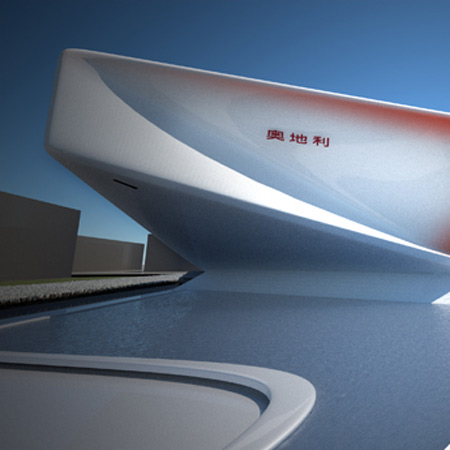
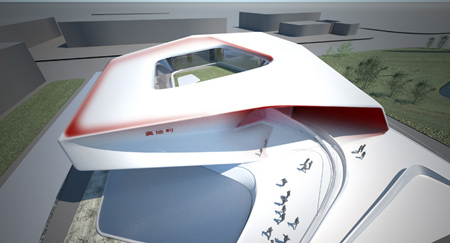
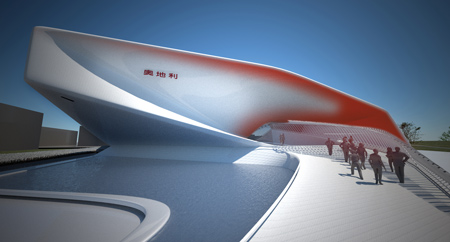
Vienna practices Span and Zeytinoglu have won a competition to design the Austrian pavilion for Expo 2010 in Shanghai, China. 
span_zeytinoglu-expo_5036fc.jpg

The pavilion will present Austrian music, ranging from the Baroque period to contemporary VJ performances.
entry_rgb.jpg

“The embodiment of the sonic conditions within the space manifest the architecture of the pavilion,” say Matias del Campo and Sandra Manninger of Span.
mainhall_rgb.jpg

Here’s some more information from the architects:

SPAN & ZEYTINOGLU WIN THE COMPETITION FOR THE AUSTRIAN PAVILION AT THE EXPO SHANGHAI 2010

A jury of nine members today announced that SPAN (Matias del Campo & Sandra Manninger) & Zeytinoglu, Vienna, won the architectural competition for the design of the Austrian Pavilion at the EXPO Shanghai 2010
forest_rgb.jpg

The Topology of Sound

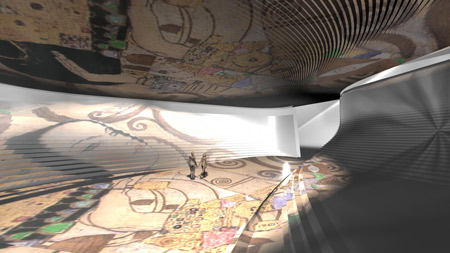
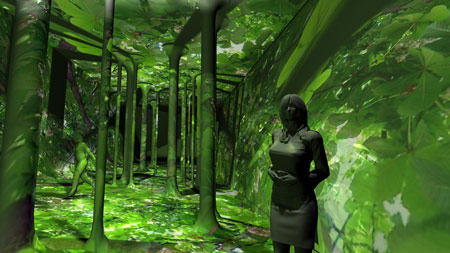
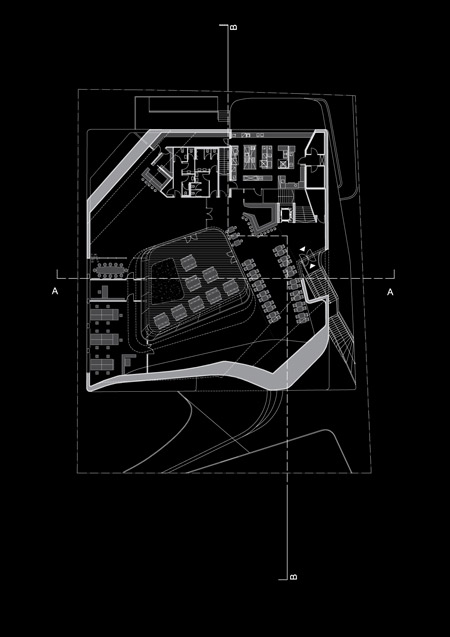
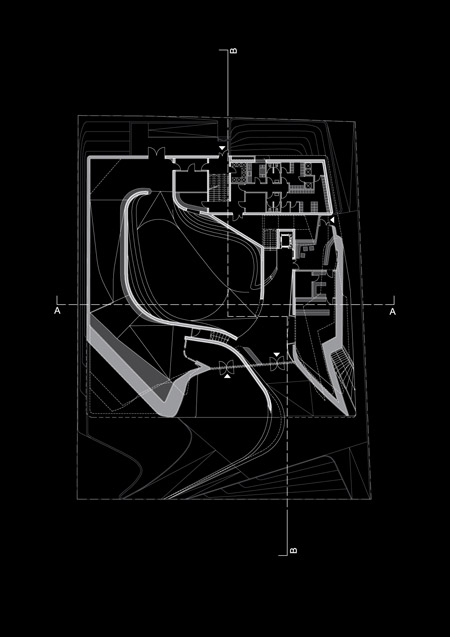
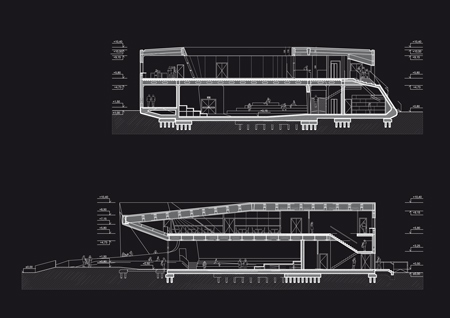
“The main driving force behind the design of the Austrian Pavilion for the EXPO in Shanghai 2010 can be described as acoustic forces, or more accurately as music. Music as a concept that reflects continuity in terms of architectural articulation that seamlessly connects the various spaces within the program. The embodiment of the sonic conditions within the space manifest the architecture of the pavilion, which resonates to the rhythm of the Video Jockeys (VJs) performance – the conductor of the atmospheres within the main space. The rich history of Austrian musical tradition makes it possible to create a performance program reaching from Baroque Music, to the classic area to the Modern age to contemporary acts. The space unfurls from within the topological body, from the main space, the audience chamber, to the exterior epidermis. This process creates pockets, pochés that include the rest of the program such as Shop, Restaurant, Office, and the VIP Area. Each one of those programmatic areas includes qualities co notated with the quality of living within Austrian conurbations: Music, Culture, Culinary expertise, urban textures, opulent landscapes and lavish foliages.“ (SPAN)
og.jpg

Vienna based Architecture Firm SPAN, headed by Matias del Campo and Sandra Manninger, is driven by a compulsive desire to speculate about architectural opportunities in the presence of animated matter, organic entities and their underlying geometrical and mathematical presence. Their award winning architecture designs are informed by specific sources within the fields of mathematics, geometry, botany, biology and life sciences. The manifold inspirations are fused into projects applying the most advanced digital design tools and casted into form by computer controlled machinery, making SPAN one of the most innovative architecture practices. Their activities include Architecture Design, exhibitions and lectures as well as teaching in various countries and institutions, such as the University of Applied Arts Vienna, the Bauhaus Dessau and the ESARQ in Barcelona.
eg.jpg

Zeytinoglu Architects:
After having won the competition for a new courthouse in Graz, Arkan Zeytinoglu opened his studios in Vienna and Klagenfurt in 1995. Today, the headquarter in Vienna, consisting of 15 staff members, does not only provide architectural and interior design services, but also covers environmental development and acts as general contractor for both private and governmental investors. The variety of national and international projects realised during the past years ranges from office buildings to private housing, hotels and restaurants, with a special focus on hotel design.
sections.jpg

The jury that selected the winning design was comprised of the following members:

Prof. Will Alsop – (SMC Alsop),
Dietmar Steiner – Director Architecture Center Vienna (AZ W)
Bettina Götz – architect, Artec, Vienna
Christian Knechtl – architect, Knechtl Studio, Vienna
Dr. Thomas Angyan – Director Wiener Musikverein.
Peter Rantasa – Mica, Vienna
Mag. Gudrun Hager – WKÖ
Prof. Richard Trappl – Confucius Institute, University Vienna
Mag. Gabriele Tschürtz – BMWFJ

Customer: BMWFJ und WKO
Management: EXPO Office Austria

More Dezeen stories about Expo 2010:

.
150-xpo-danish-pavilion-by.jpg

Danish pavilion by BIG

150-m4sq.jpg

Polish pavilion by Wojciech Kakowski, Natalia Paszkowska and Marcin Mostafa
150-p05859_fp226559sq.jpg

UAE pavilion by Foster + Partners

150-heatherwick20studio20co.jpg

British pavilion by Thomas Heatherwick


Posted by Rose Etherington

25 Responses to “Austrian pavilion at Expo 2010 by Span
and Zeytinoglu”

  1. differentguy Says:

    I like it…congrats!!!!!

  2. jh Says:

    ‘…making SPAN one of the most innovative architecture practices’.
    i guess they really like themselves (not sure how innovative this is to be honest. looks like an old zaha).

  3. MELOGY Says:

    Does this nice building have secret little chamber at the basement?

  4. will Says:

    Love it!!

  5. M+M Says:

    “Their award winning architecture designs are informed by specific sources within the fields of mathematics, geometry, botany, biology and life sciences.” – wow – this are really serious guys …. never heard of them before

  6. a.bibi Says:

    why is it, that at dezeen most of the commentars are always negative…

    like it, nice shape… looking forward to see it built…

    and not everything which is organic is zaha…. with this statement you could say fosters and rogers are the same….!

  7. slater Says:

    Does anyone know what the plan for the 2010 Expo area is after the Expo is finished? I drove by two years ago while on vacation in China and the site is HUGE! Hopefully the master planning has thought ahead…I assume they have, I’d hate for that area to not be used to it’s full potential.

  8. Jeremiah Says:

    I like the form and the contrasts between the interior and exterior; not sure if I entirely buy into the method described for coming up with the design… This may just be an issue of presenting the process in words alone… Sometimes I’m a far too visually oriented person.

  9. IMO Says:

    i don’t see the innovation here.. seems to be just another image that SPAM produces. Lets wait and see how much it changes during errection. Guess it will be all CNC milling since these images lack information about materiality.

  10. rodger Says:

    what a ridiculous project type.
    that said, this building works really well, nice innovative formal solution, until you step inside, then it devolves into ridiculousness.

  11. jessica3000 Says:

    from the design to the color concept
    … we like to repeat our cliches …

  12. dk1 Says:

    Personal opinion, but I sometimes think all this exploration of “organic forms” would be better off left to the field industrial design. Not that I don’t like pretty objects, but buildings following this train of thought come off as hollow to me. Elegantly articulated verbiage aside, what this building tells me is that somebody in their firm knows Rhino (or any other equivalent 3D program) fairly well. They may state that the form was driven by all sorts of influences, but looking at the plan there seems to be little concern given to program, structure, or the inhabitants. All have been squished in to fall in line with that pretty shape.

    In the end, if this thing is built, what they’ll have is a seemingly interesting object with the potential for some pretty interesting interior spaces. It will most likely get a big “wow” response, initially, but beyond that it will have no depth. If they had created an interesting organic form that actually evolved from real factors like structure, program, and the human experience; than that it might have been innovative.

    But to be fair, these are just competition images. The realty will probably be far different.

  13. Mayan Says:

    I see this project as the perfect example of mistaking innovation by whatever shapes, while this design is simply about putting together some recycled ideas— must had a lot of fun shopping…
    the name of Austria looks sad and lost..
    where are the other proposals?

  14. Q Says:

    nice vaccum cleaner =D congrats

  15. sunshine design Says:

    what kind of gentleman mr. del campo must be to be always mentioned before ms. manninger ? where are explanatory diagrams ? any ideas how about the functions after shanghai expo ?

  16. Lu Says:

    well done!
    I love the design, and i dont think this is hard to be built at all.

  17. Lu Says:

    I love the a proch to the building and the interior result. structurally this type of tilting project has already been done before. so i dont understand people based in what saying that this is hard to be constructed.

  18. archcritic Says:

    fresh and amazing^^^^^^hater

  19. WMD Says:

    I quite like the proportions and scale.

  20. gue Says:

    wannabe type of design, may spam be some kind of adepts in lynn or zahahism. In contrast to latter, though it’s a pavillon with no distinct program, there seems a total lack of reference between spaces and what could referred as design, which becomes quite obvious in the interior renderings and the Good modelling work is contrasted by an akward mapping of a Climt pattern. And for the boring staircase with a lift leading upwards to the restaurant on top, this is just another evidence of bad handling the few requirements a pavillon brings with. The dividing of interior should definitely been worked over again.

  21. DIgggadooo Says:

    :D

  22. paul Says:

    zaha?

  23. R.Trelles Says:

    I absolutely love it! its so clean and wonderful. And the red characters ad to it.

  24. kolomb Says:

    Any statements about the acoustics of ”The embodiment of the sonic condition” ?

  25. Techguy Says:

    You can view info about all the pavilions at the Expo 2010 website.

Submit a comment

See our comments policy