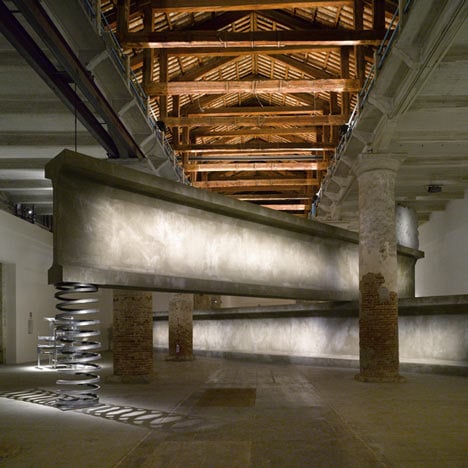
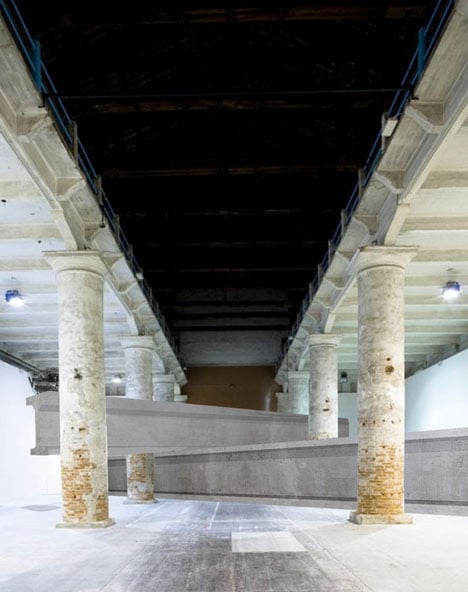
Venice Architecture Biennale 2010: two enormous girders slice through the Arsenale exhibition at the Venice Architecture Biennale thanks to Madrid architect Antón García-Abril of Ensamble Studio.
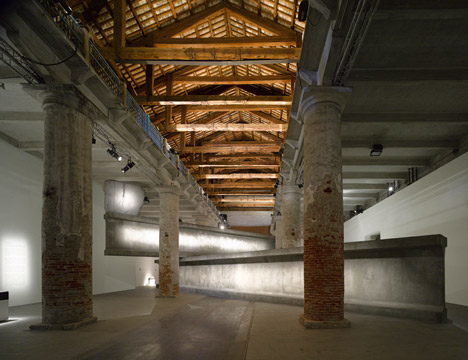
Above and top photographs are copyright Roland Halbe
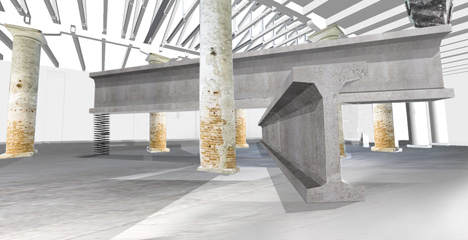
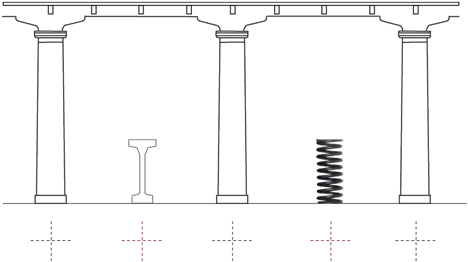
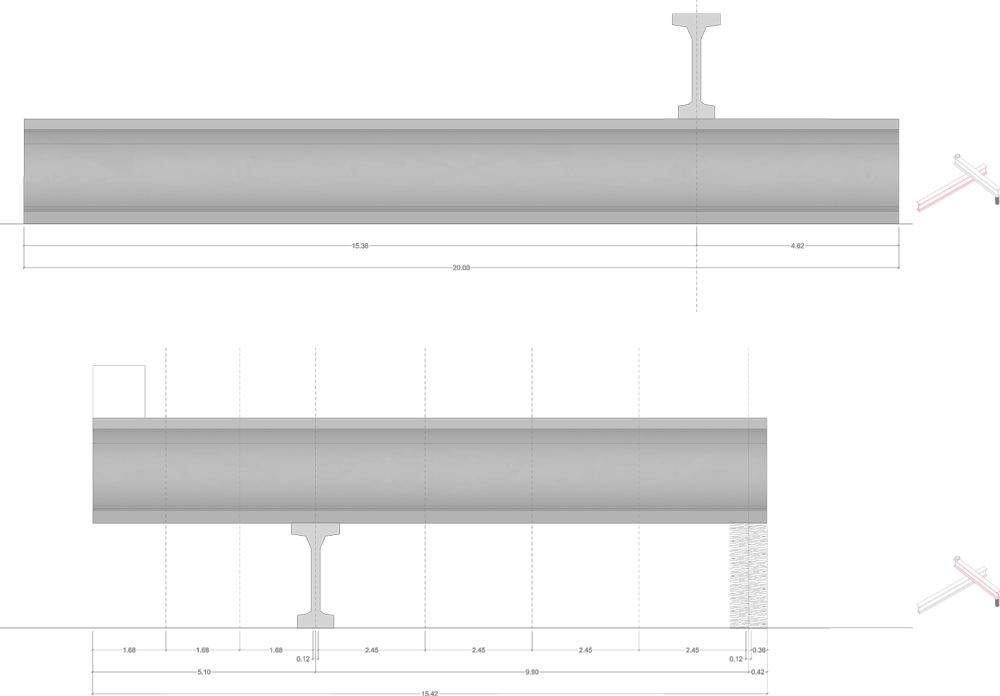
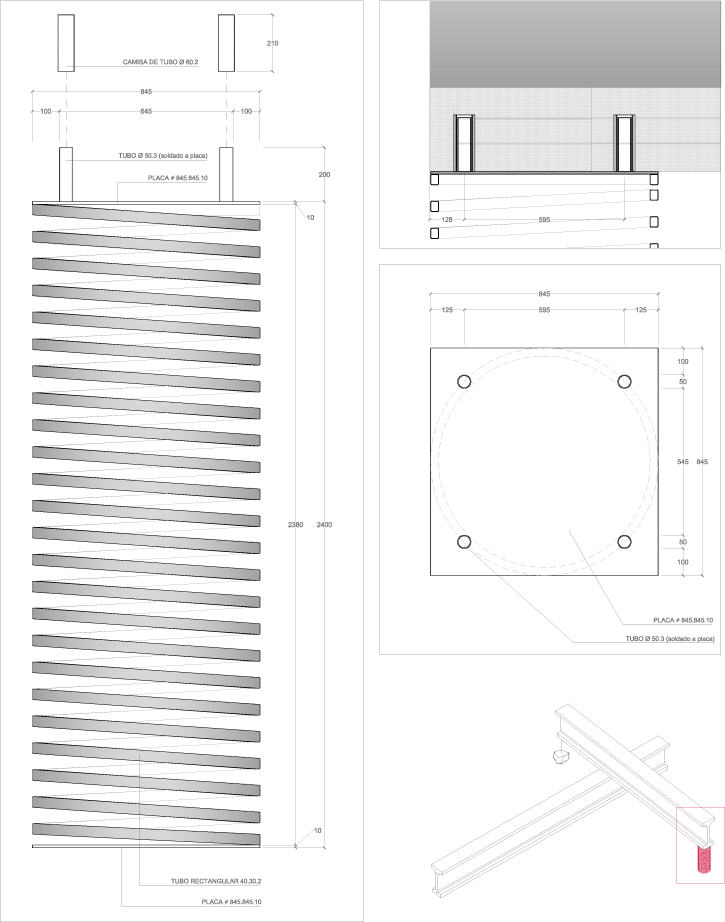
Entitled Balancing Act, the installation comprises one girder balanced across the other, supported at one end by a metal spring.
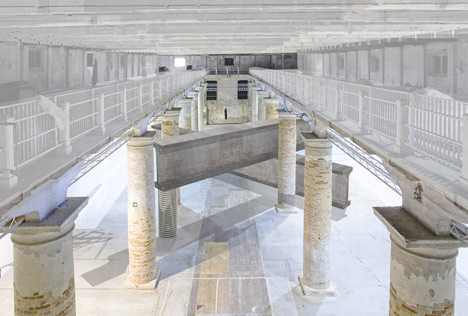
A rock perched atop the other end acts as a counter-weight.
The installation forms part of the exhibition People Meet in Architecture, directed by Kazuyo Sejima of SANAA (see our earlier Dezeenwire story).
The Venice Architecture Biennale continues until 21 November. See all our stories about it in our special event category.
.

.
See also: Trufa by Anton García-Abril, a house cast in the earth and hollowed out by a cow.
.
.
The text that follows is from Ensamble Studio:
BALANCING ACT
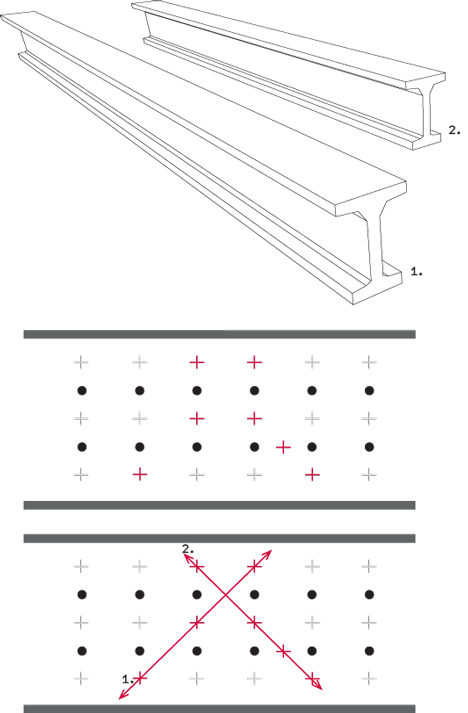
Balancing Act is a play of balance. Two structural lines in the longitudinal space of the Arsenale buildings, which operate as a reagent to modify the original space.

.
The interference caused by generating a diagonal incision, cuts on the bias the previous line marked by the old structure. The harmony between the two structures now contiguous forms a space from the two systems that meet, face and compare each other.
.
.
Click above for larger image
The Arsenale will be a complex compositional series, an architectural “fugue”, in which different spaces follow one another, and in which the dissonant balance of the Balancing Act is just one chord.
.
Click above for larger image
Project: Balancing Act
Location: Venice Biennale
End of building construction: August 2010
Author of the project: Antón García- Abril
Collaborators: Ensamble Studio:
Débora Mesa
Ricardo Sanz
Alba Cortes
Juan Ruiz
Tomaso Boano
Federico Letizia
Quantity surveyor: Javier Cuesta
Sponsor: Positive City Foundation
See also:
.
![]() |
![]() |
![]() |
| Emergency Exit by Kurant and Wasilkowska |
The Russia Factory by Tchoban, Khoroshilov and Revzin |
All our stories from Venice Architecture Biennale 2010 |


is there actually a cable above the spring? that kind of ruins the whole thing, but it's a nice idea. i like how it combines consideration of engineering and feeling of space.
I've read a review about the Venice Biennale that is was very light in content. Which was at the same time liberating and somewhat disappointing. For this project the lightness definitely irritates me – some gimmick-like entertainment is hardly worth the effort to travel to Venice for.
its more disappointing that the girders are made of a timber frame and plaster or something like that and then painted to look like concrete. Impressive at a first glance but on further inspection…. can't imagine richard serra creating a sculpture that pretended to be corten steel! However the video of how Antón García and his family live in the heremoscope house and follows spain through the world cup is very nice part of the exhibition. As the models and the other videos
It's a nice, interesting idea but, please, please will designers/architects/artist etc stop using such pretentious descriptions. Finding out more of the background to works gives us interesting insights but, "The harmony between the two structures now contiguous forms a space from the two systems that meet, face and compare each other."
Really?
Plus (as Fergus noticed) if it ain't real, it ain't real.
why the spring? surely the point of a counterbalance is to do just that, it completely takes away from the potential drama of the work in that you subconsciously know it could never fall and therefore there is no need for the counterbalancing rock. i just don't get it
It would be more interesting if there were another spring instead of the rock and it touched the celing… it would appear as though the column was in constant tension and compression by the two spring forces.
Most interesting. The tower is a bit Brutalist with all that heavy concrete and the tiny dashed bands of clerestory windows — sensible for theater and music rehearsal spaces, however. Nice tension between wide open and very closed. Doesn't seem Valencian, but maybe that doesn't matter: depends on the context.
someone remember the reference of the project of the linear city, in the same room of this? the one explained by a video and a plastic on the left end corner of the room… i looked for it on the web without succes, could someone help me finding it?
It would be more interesting if there were another spring instead of the rock and it touched the celing… it would appear as though the column was in constant tension and compression by the two spring forces.