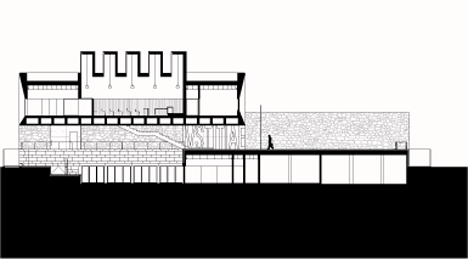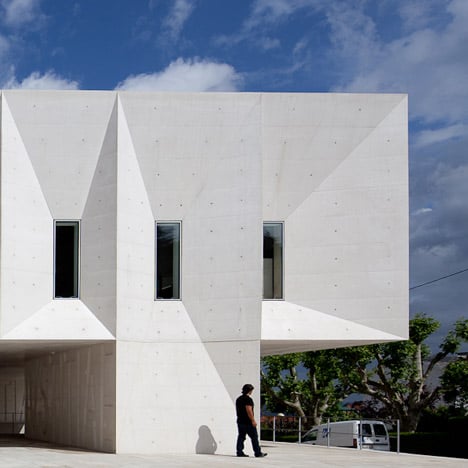
Palácio de Justiça de Gouveia by Barbosa & Guimarães
Photographer José Campos has sent us these photographs of the recently completed law courts in Gouveia, Portugal, by architects Barbosa & Guimarães.
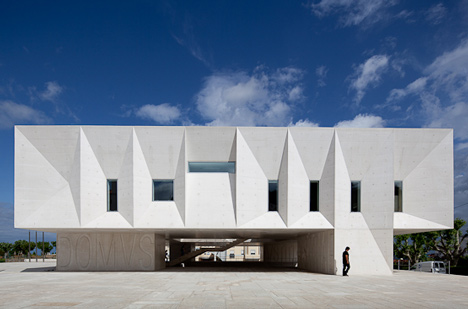
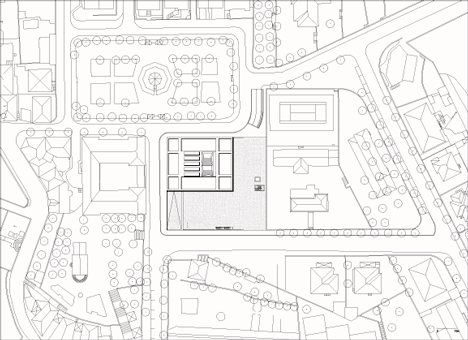
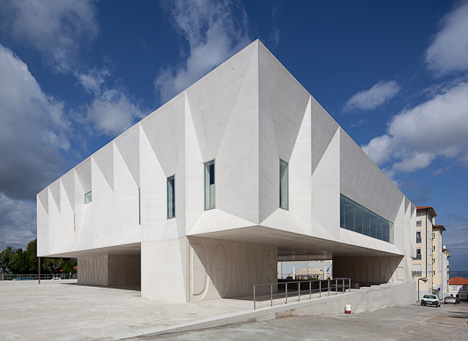
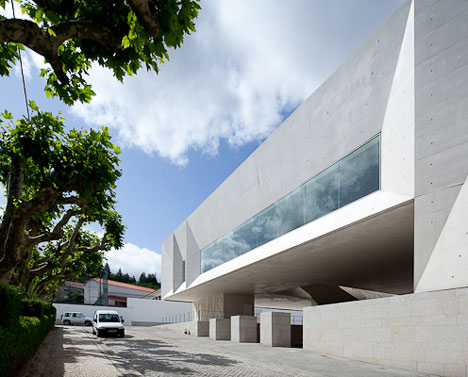
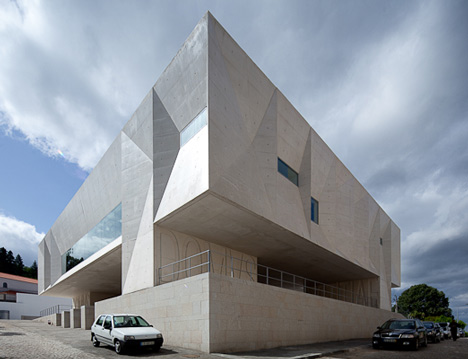
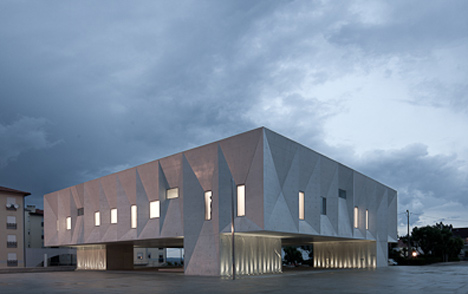
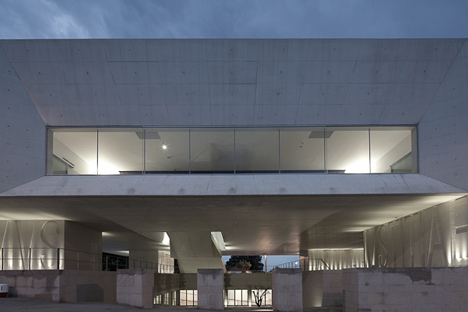
Located between two parks, The Gouveia Law Courts are set upon four chunky pillars.
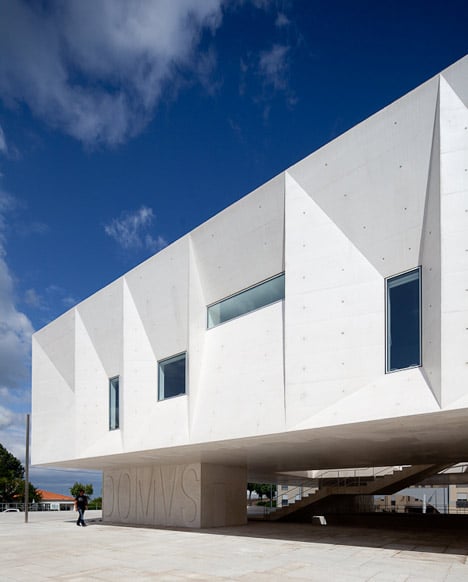
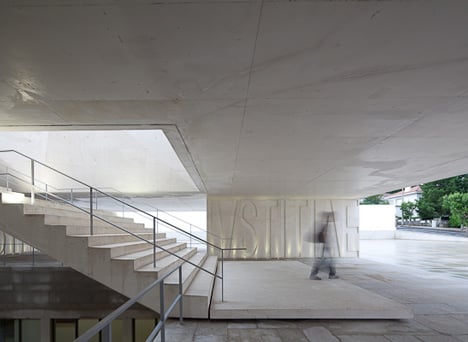
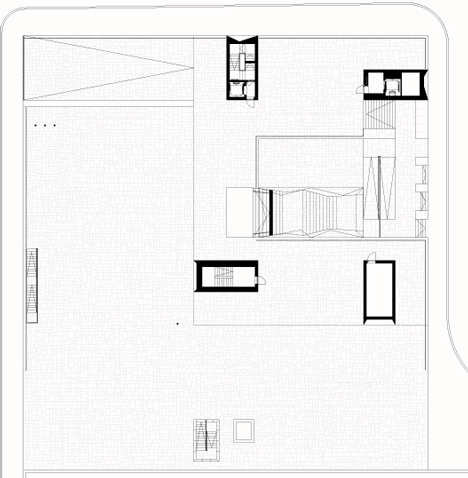
The courts are accessed by a wide central staircase that brings visitors from the plaza into the heart of the building.
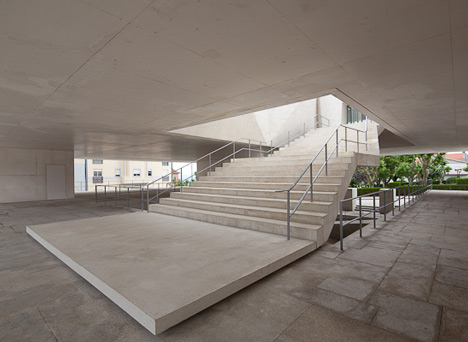
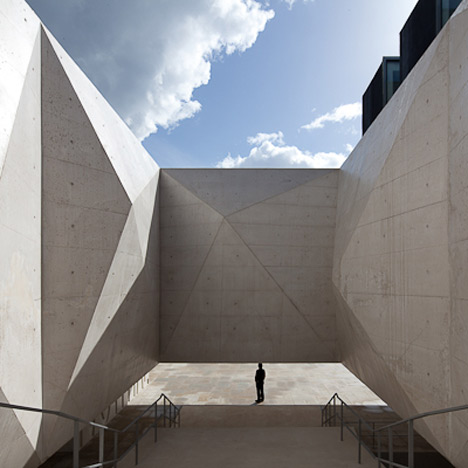
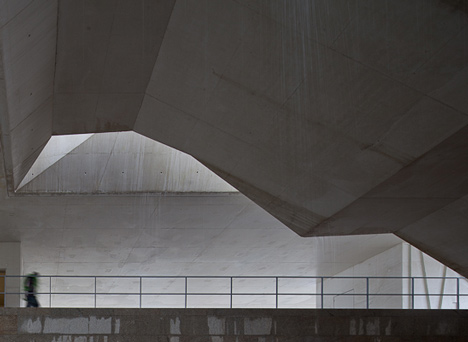
This stairwell is open to the sky and framed by the faceted concrete walls of the surrounding building.
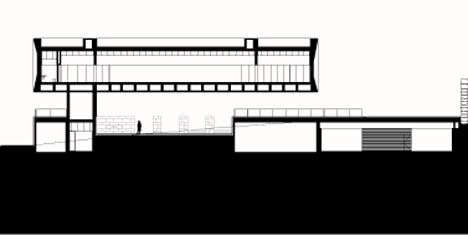
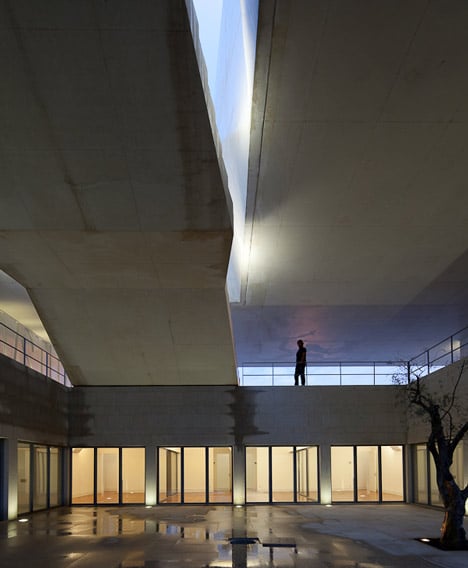
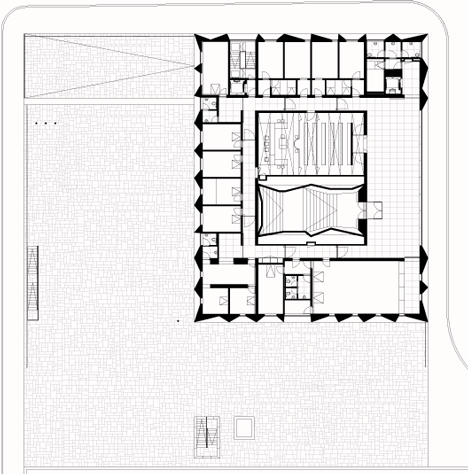
The registrars' offices are located in a courtyard below this staircase.
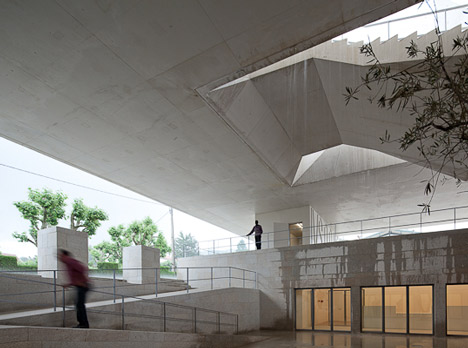
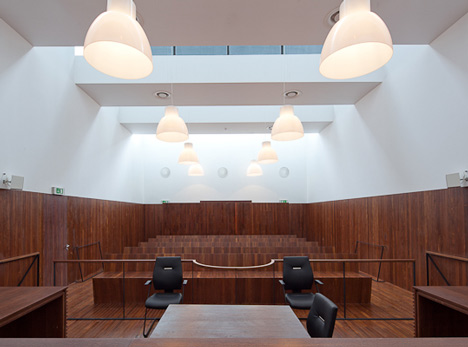
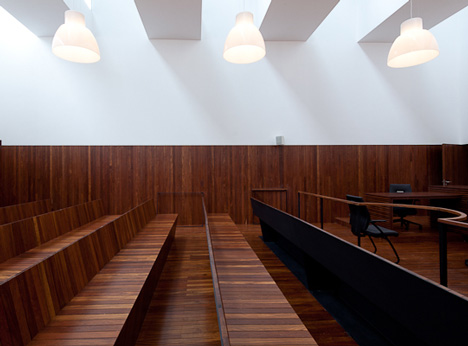
Internally, the courtroom is naturally lit through a series of skylights and offices overlook the park to the north.
More stories about projects in Portugal on Dezeen »
More photography stories on Dezeen »
Here are some more details from the architects:
Palácio de Justiça de Gouveia 2002 - 2011
Gouveia, door for entry to the Serra da Estrela, is going to be served by new Law Courts. The land set aside for construction is located between the public gardens, at the end of the Rampa do Monte do Calvário, replacing an existing building. The project takes advantage of the demolition of the existing building, which occupied the whole of the plot, to design a new Plaza, with a scale and dignity to receive the Law Courts.
In dialogue with the granite walls that define its surroundings, the Plaza takes on the form of a bottling of stone, upon which the Law Courts rest.
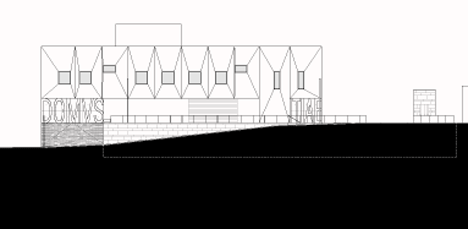
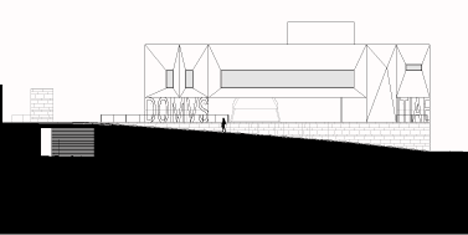
The building, set on four pillars, ensures transparency and connection between the two gardens that delimit it to the north and the south.
The dignity and symbolism that a building like the Law Courts should always have is achieved at the cost of the monolithic and singular character that the volume of white concrete acquires, above all in the expression of its compact elevations, with empty spaces deeply excavated, as if suspended over the Plaza.
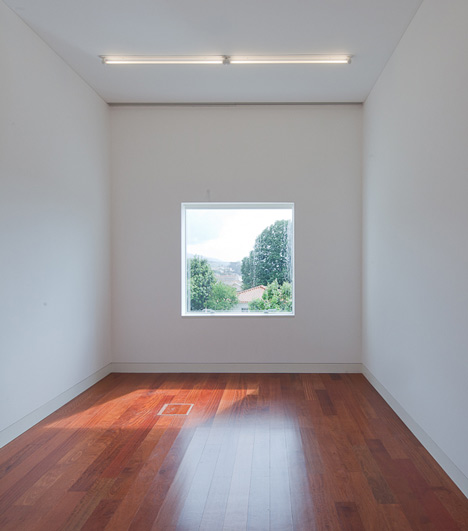
A staircase of generous proportions opening onto a patio honours access to the Court floor.
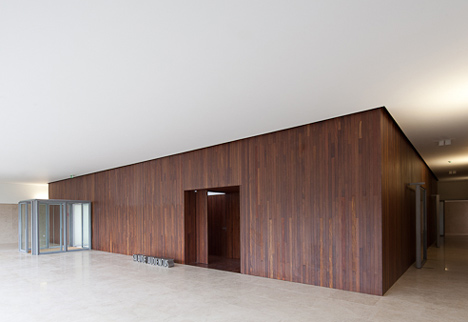
The lobby/foyer crosses longitudinally the entirety of the building, communicating directly with the garden to the north, establishing a relationship of closeness with the tops of the existing trees through a horizontal empty space.
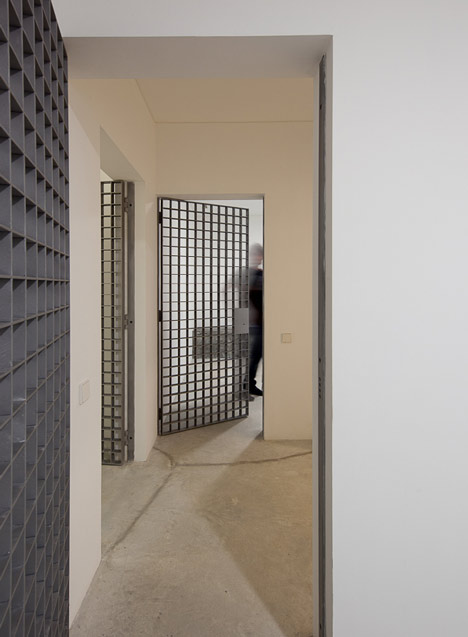
In the volume, the courtroom stands out, with a set of vertical skylights that subtly light the whole space.
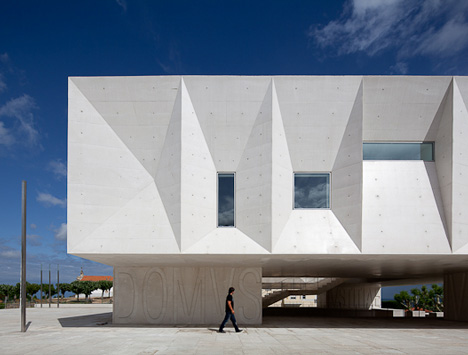
The registrars services, which operate independently, are installed in the filled part of the building, open to an interior patio which communicates directly with the north garden.
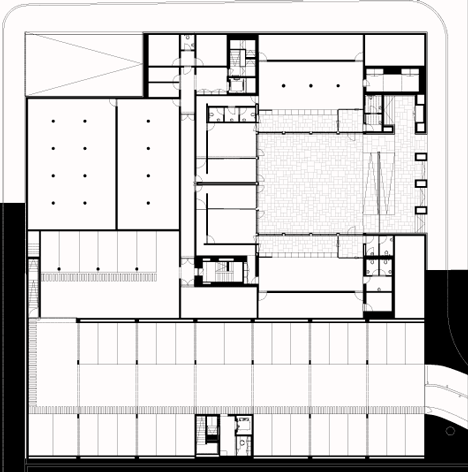
The project foresees a public car park, hidden under the plaza, with access from the adjacent streets.
Ficha Técnica
Local: Gouveia
Dono da obra: Instituto de gestão financeira e infraestruturas da justiça
Concurso: 2002
Projecto: 2002 - 2004
Obra: 2008 - 2011
Arquitectura: Barbosa & Guimarães, José António Barbosa, Pedro Lopes Guimarães
Colaboradores: Miguel Pimenta, Cristina Chicau, Henrique Dias, José Marques, Luís Monteiro, Paula Fonseca, Susana Machado, Teresa Aroso, Raul Andrade, Pablo Rebelo
Estabilidade e estruturas: Alberto Teixeira
Empresa construtora: José Coutinho s.a.
Instalações hidráulicas: Luis Veloso
Instalações eléctricas: Rga. Paulo Oliveira
Instalações de rede de gás: Rga . Arnaldo Monteiro
Director de obra: Rafael Luzio
Instalações de avac: Rga . Arnaldo Monteiro
 v
v