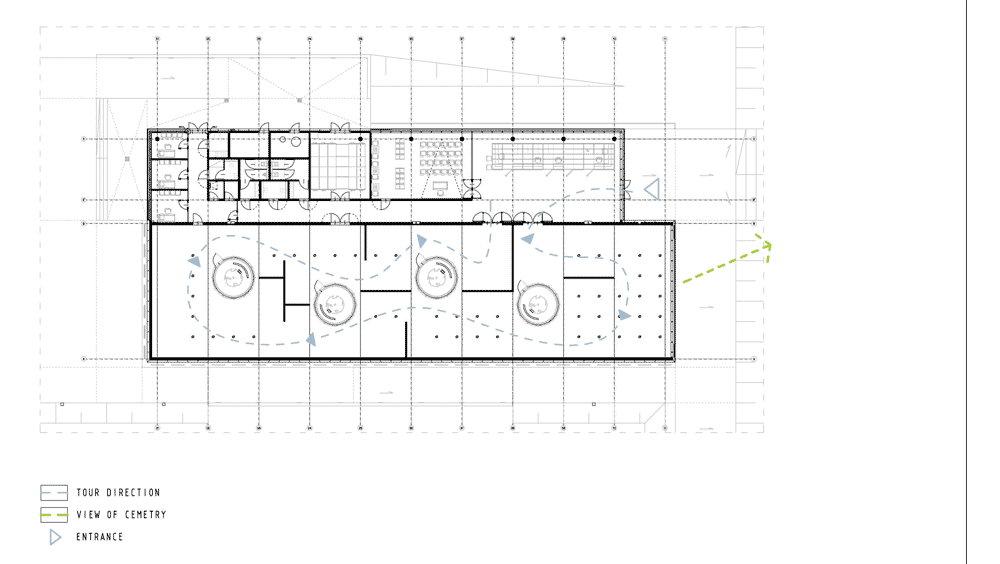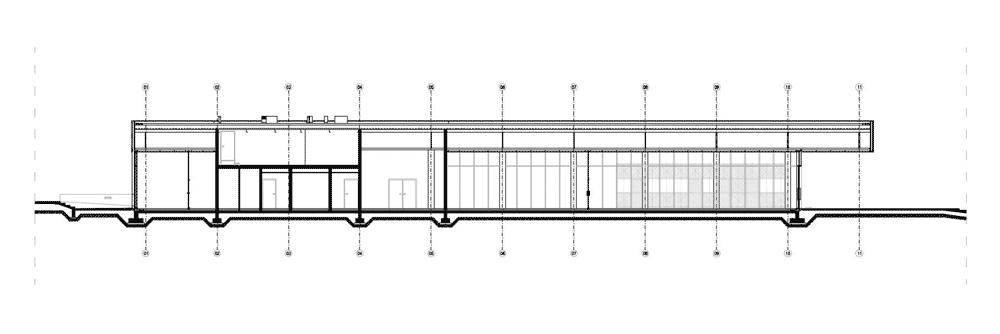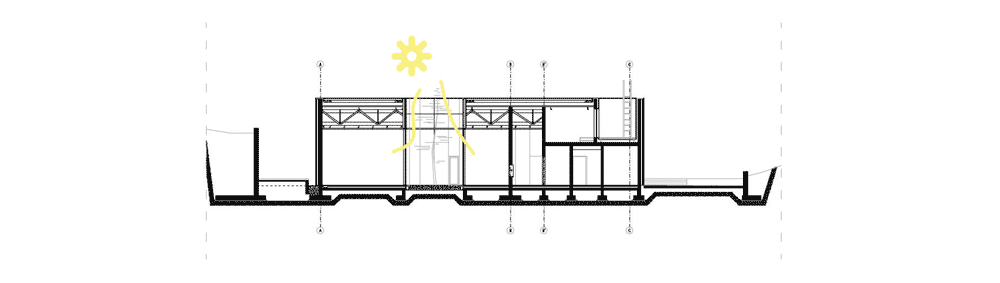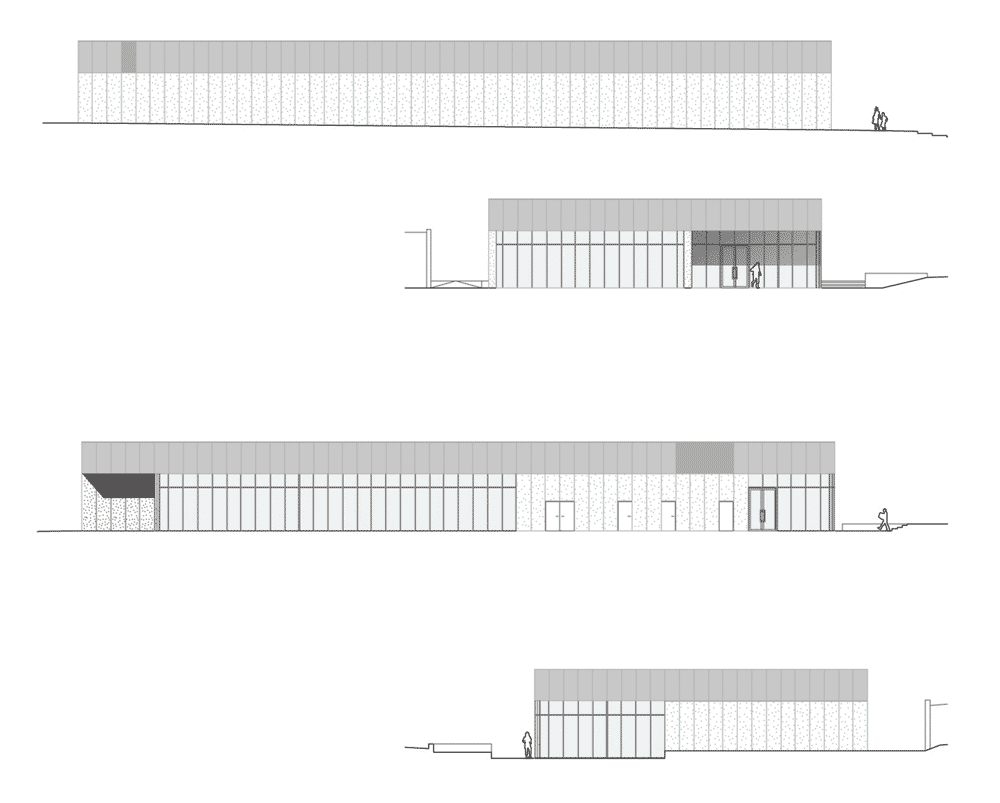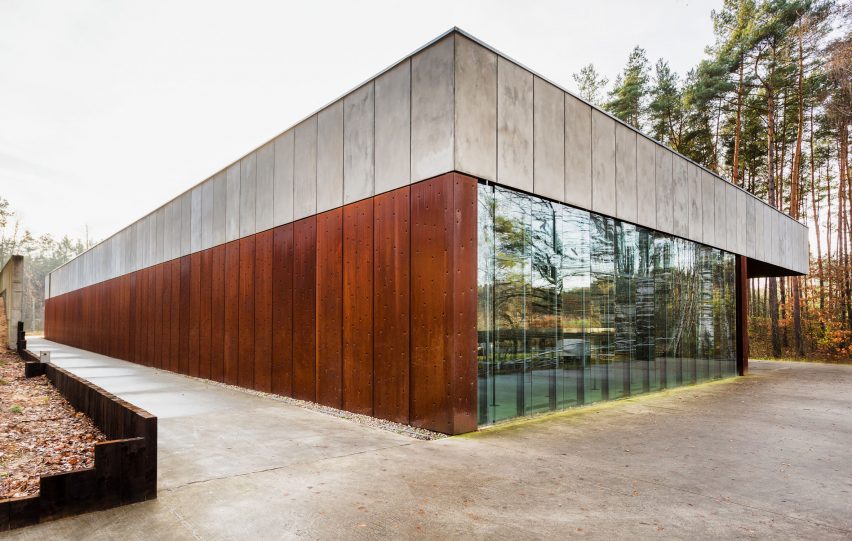
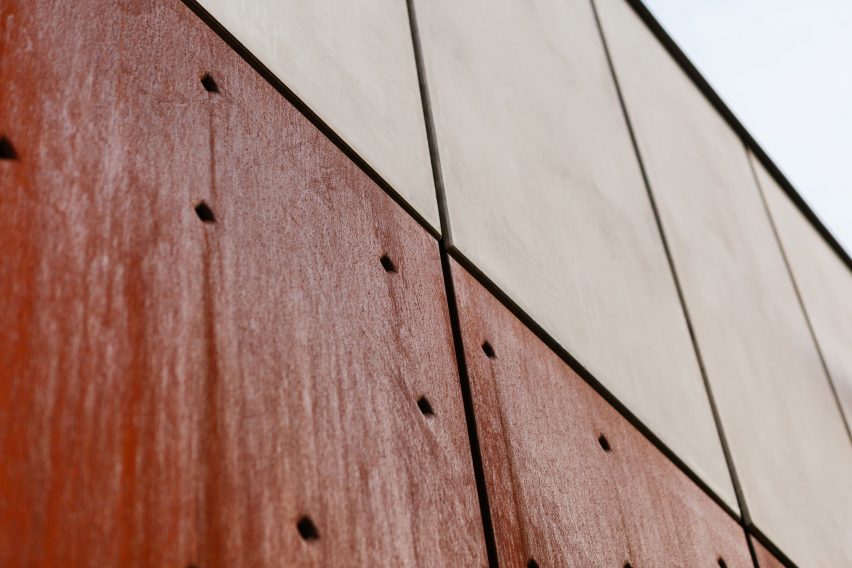
Each bullet-sized hole piercing the skin of this museum by architects WXCA in Palmiry, Poland, represents a Polish civilian murdered there during the holocaust.
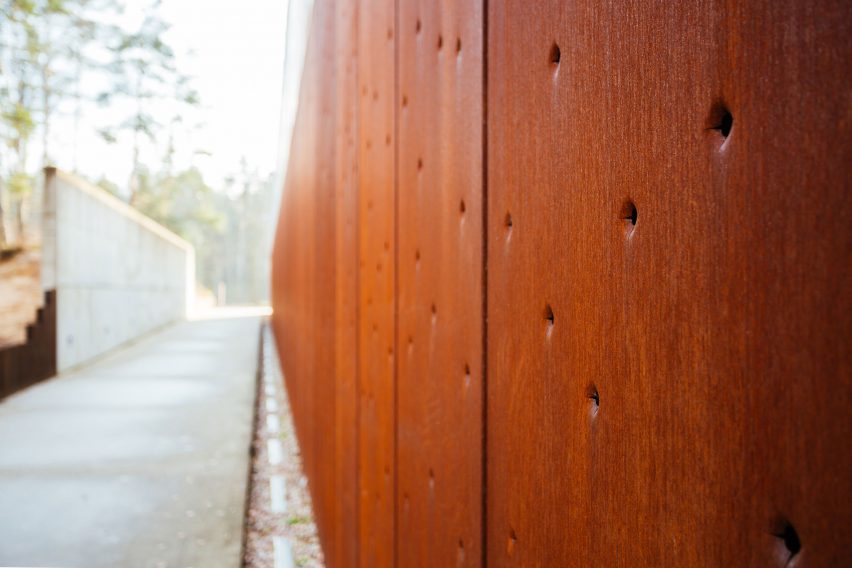
The punctured panels surrounding the exterior of the Palmiry Museum are made of rusted steel.
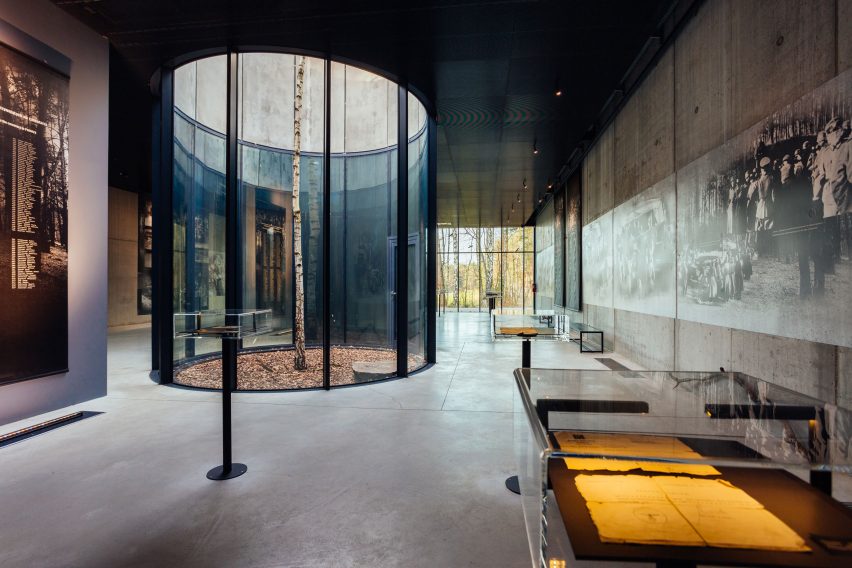
The museum showcases photographs, documents and memorabilia connected with victims of Nazi executions during World War II.
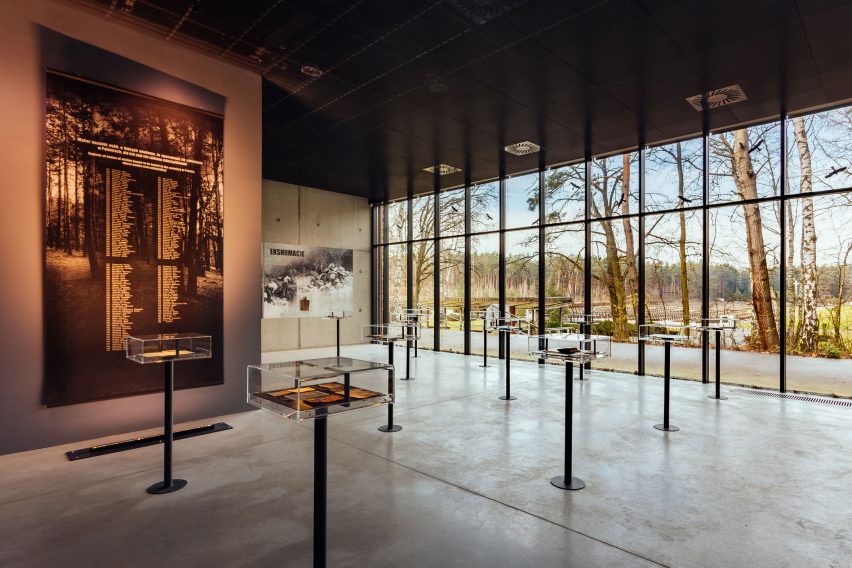
A glass wall at the rear of the building overlooks a cemetery where each of the 2252 memorialised victims are buried.

More stories about museums on Dezeen »

Photography is by Rafał Kłos.

The following text is from WXCA:
Museum – A Place of Memory Palmiry
The Palmiry Museum Place of Memory lies in a pine-birch forest surrounding the cemetery.

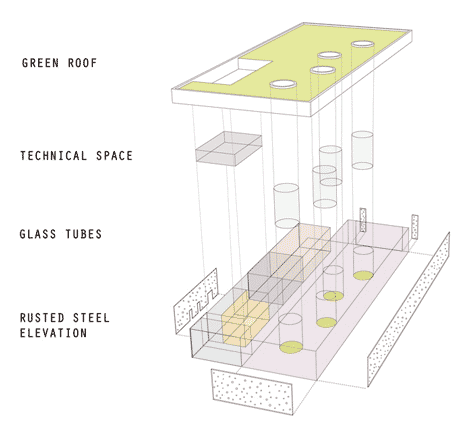
The building is a part of the Kampinos National Park, with glass and steel walls, and a green roof.

The exhibition space lies among trees – witnesses of past tragedies.
During the Second World War, in Palmir woods, Nazis murdered over two thousand Polish civilians including intellectual elite.

The building, ascetic in form and materials, tells a story, and forms a background for the exhibition.

The exhibition part is surrounded by a wall with holes symbolizing bullets.
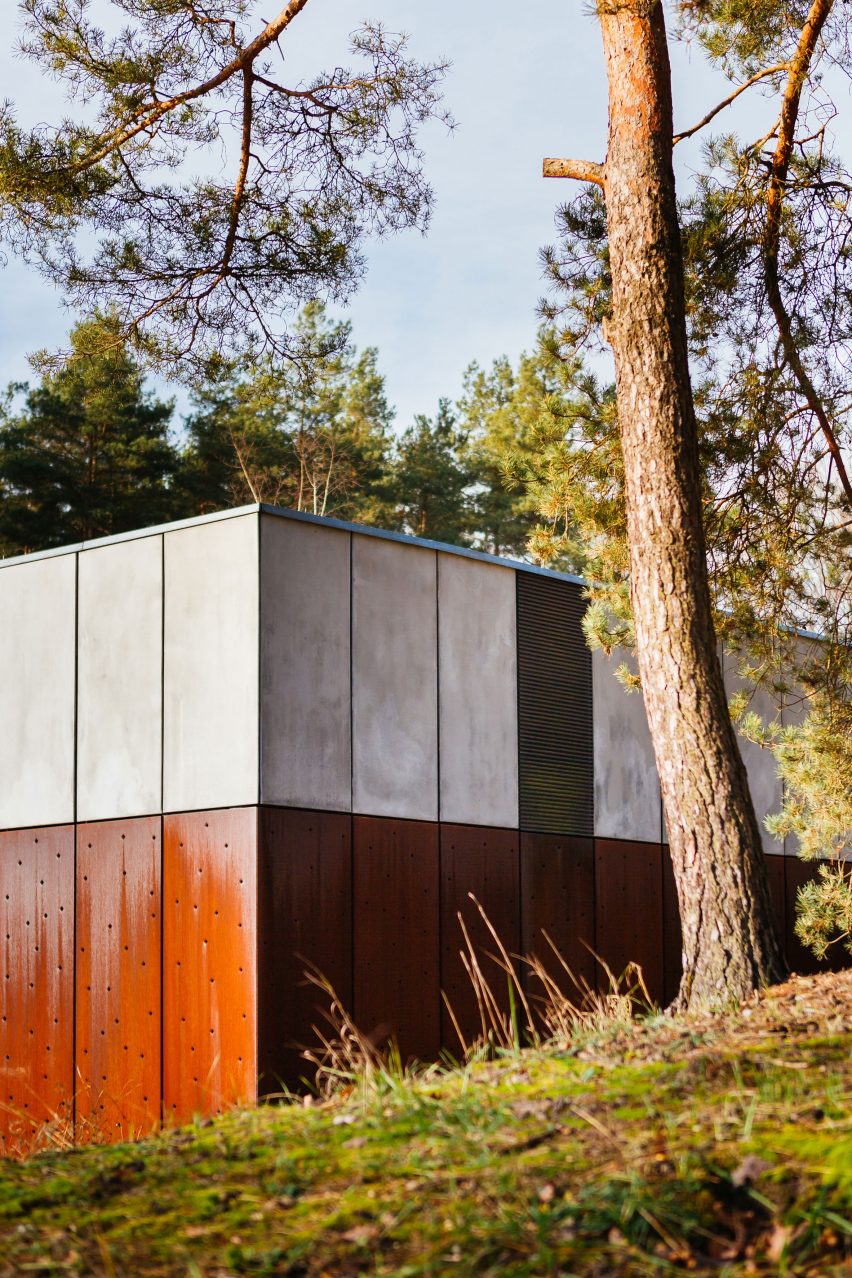
The relation between the building and the surroundings is stressed by greenery inside the building and the patios.
Click above for larger image
The facility opens to the cemetery and three crosses.
Click above for larger image
The idea was to create an architecture of remembrance.
Click above for larger image
Architects: WXCA
Location: Palmiry, Poland
Design: 2009-2010
Click above for larger image
Site area: 8738 sqm
Total area: 1133 sqm
Usable floor area: 998,30 sqm
Volume: 4400 m3


Such a great project, so pure….
Bleak and powerful. I love it.
I love how the exterior is stark and serious, while the inside feels spiritual and uplifting. A great job.
This is too clean for me.
Those bulletholes are a bit too literal if you ask me, and why only bulletholes in the wooden parts?…if you go there, go all the way and also 'shoot' in the glass and concrete.
'shoot' in the glass. thats not very clever!
Slightly contradictory don't you think?
that is not wood
I disagree H-J. Had they bulleted the entire facade, it would look like a wrecked mess. At least here, there's a sense of control to the holes. Specifically, the fact that they're only in the rusted, 'old' materials (rusted steel, not wood) instead of the clean, 'new' materials seems poetic of past versus future.
The interior seems slightly underwhelming, but the overall is intriguing and poetic.
So it's rusty steal instead of wood, I think it's too much and not necessary to put fake bulletholes in the facade as a historical reference, maybe they could dig up some corpses too and spread them around the premises, if people really didn't realize what went on there…that might help too.
I wouldn't say they're fake. They're real, punctured holes. Plus, they've got a certain function – they visualize the number of victims. I wonder what was the process of making those though.
But I recon one may consider that way of communicating the numbers a rather blunt delivery.
would you prefer something soft and passive? A violent expression for a violent act – poetic symmetry.
I think the idea of the holes is a good one, even if it is literal. It is poignant and gets the point across is a new and creative way. It also provides a real sense of being tangible, visitors can touch the holes and engage with them, creating a personal presence with the architecture and the memorial of those it commemorates. Much like the Vietnam memorial which beckons you to touch and create a personal connection. I like the texturizing and the materiality; it gives the sense of these being fading and rusting memories that need to be refurbished and preserved. Well done. As a whole, I am not a fan of the building, it seems a little too boxy and a missed opportunity for shape and form. But the detailing is great and the thought to views is a solemn reminder of the purpose.
The bullet holes are very innovative, and it gives you a sense of scale; but I would have hoped to also see some attempt of preserving the *names* of the victims, you know? To help the visitors remember these casualties were persons, and not just statistics. That is an all too contemporary debate in my home country, Mexico –off topic, I know. My apologies
The neraby cemetery, designed in 1948 by Romuald Gutt and Ewa Śliwińska memorialises the victims. On each grave a name is written on a cross or other religious symbol. Large number of graves in parallel rows is a very touching view. http://pl.wikipedia.org/w/index.php?title=Plik:Pa…
The Museum building with it's purity seems to be a background for the cemetery what I consider as a good solution.
Thank you kindly for pointing this out :)
At first glance I too though there was a lost opportunity to create something with shape and form, that the memorial was staid and boxy, too simple. But on retrospect, it seems that the architect, contrary to memorial practices here in the US, had designed a building that made the architecture secondary. If one really thinks hard about the subject, one realizes that this is a structure where the subject becomes the focus, and that the building becomes nothing more than a shroud. Certainly the architects could have drawn some large scale, ornate temple of sorts but I think that in doing so, they would have defeated the purpose of the memorial.
the best thing is the architects got for project (whole with consultants) in Poland only around 25000 dollars. . lol
sounds fair if you consider Polish cost of living…
Simple, emotional and highly symbolic.
Very poetic, and the glass tubes with trees are beautiful.
poetic no! dont be so pretentious. Cool yes!!
Very lovely project, the contrast between the old and new material representing past and future, the bullet holes are very symbolic, but i wish somehow the bullets could pierce through to the inside of the building so we can see them from the inside as well… could’ve been an interesting lighting effect…
Nicely poetic, if grim, treatment of the place with bullet holes. Was just about to echo Dasha, above, by saying I wish there was glass behind the steel allowing the holes to create a pattern of sunlight inside the building, though. I can’t believe they didn’t do that.
With all due respect to the cause, is building a modern tourist attraction at the heart of a National Park a good idea? For deacdes cemetery alone fit there well, such new museum doesn't seem to. Will parking lots, restaurants, etc. spread in this area soon? Hopfully not.