web tracker

Semi-Rigid Car by Emergent

Semi-Rigid Car by Emergent

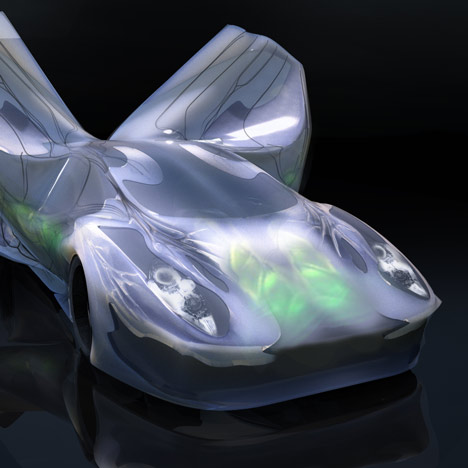
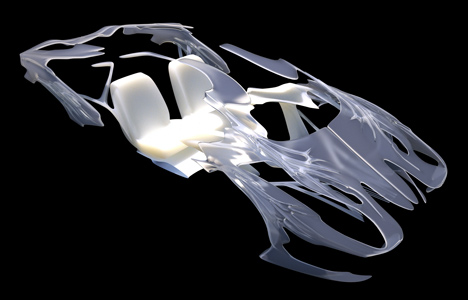
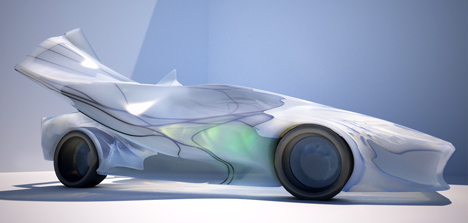
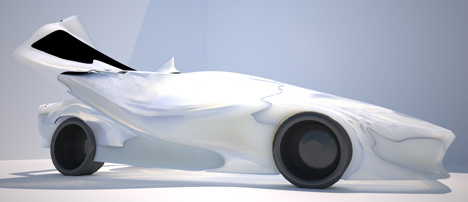
This concept car by Los Angeles architects Emergent is made of cartilage and makes its own fuel from algae.
Semi-Rigid Car by Emergent

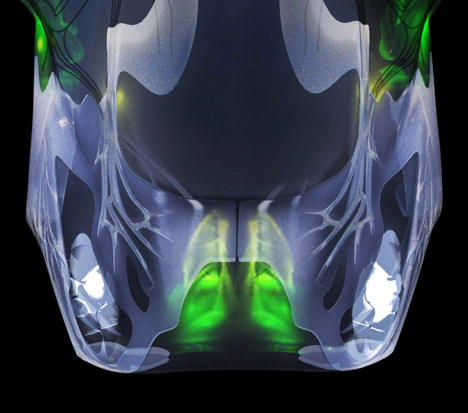
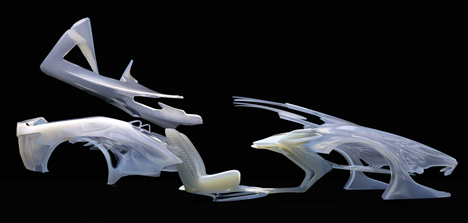
The bio-engineered car would be grown instead of manufactured, with doors and bonnet made of synthetic skin and the chassis capable of folding up like a limb so the vehicle can be transported easily.
Semi-Rigid Car by Emergent

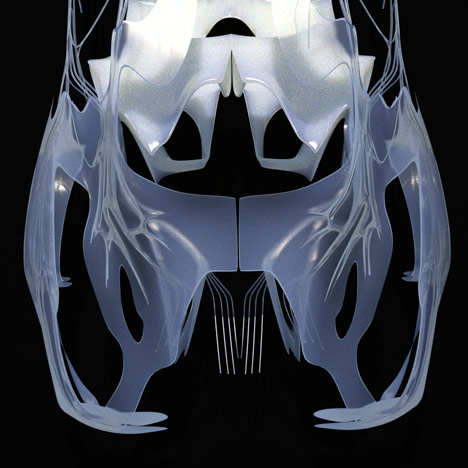
The Semi-Rigid Car, designed to explore futuristic manufacturing processes, would be 3D-printed in one piece from a mixture of organic materials as well as polymers, rubbers, resins and silicone.
Semi-Rigid Car by Emergent

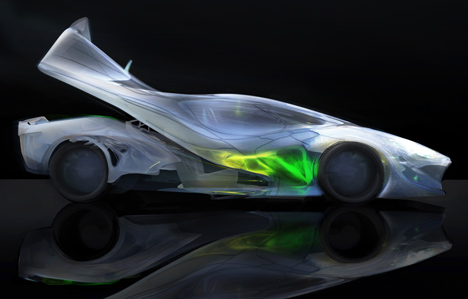
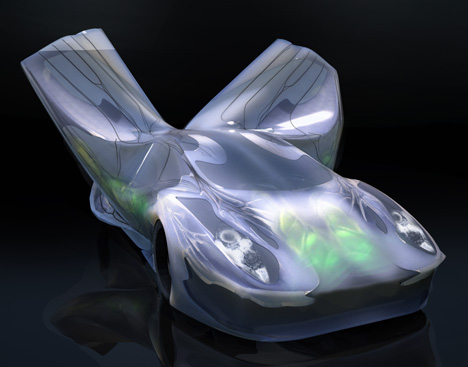
Doors would be controlled by tendon-like mechanisms, curling back in response to chemical signals emitted by the owner.
Semi-Rigid Car by Emergent

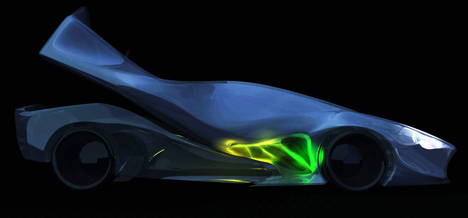
Algae tanks inside the car would provide fuel with LED lighting inside the tanks allowing production to continue at night, causing the semi-transparent bodywork to glow.
Semi-Rigid Car by Emergent

The following details are from Emergent:


The Semi-Rigid Car

Concept cars in the history of the automotive industry, though often produced for brand marketing purposes, constitute, arguably, an avant-garde. The evolutionary development of that industry has always depended on the deterritorialization of domesticated forms of transportation through the introduction of mutations into the system. There are several biases in concept car design, of course, ranging from those which focus on advanced material applications, drive-train, fuel, safety, and other performance dimensions, such as in Formula One, to those which focus on contemporary body styling on a relatively indifferent, if not conventional chassis.
Semi-Rigid Car by Emergent

These biases are also evident in contemporary architecture, in the current split between discourses of synthetic materiality and effects (formalism) vs. approaches based on the behavior of physical matter. In car design, however, this split has not become so academically entrenched, and the vast majority of successful concept car designs leverage crossovers between formal features and material behaviors. It is this kind of synthetic thinking which drives our design for the Semi-Rigid Car (SRC), and our hopes for architecture.
Semi-Rigid Car by Emergent

Multi-materiality

The SRC is an experiment underwritten by the recent revolution in what we call ‘multi-materiality’ in rapid prototyping. With the invention of 3D printers which not only print in multiple materials simultaneously, but in gradient mixtures of these materials, fabrication as we have understood it is transformed. No longer based on tectonics or assembly of parts, fabrication has suddenly become a new form of alchemy.
Semi-Rigid Car by Emergent

Variable opacity, color, ductility, and rigidity are all in play, all at once, opening up radical possibilities for embedding structure, energy systems, and visual effects across a continuously changing material matrix. The mechanical appearance and behaviour of steel, glass, sheet metal, and fasteners is replaced with a new language of blending based on compositing synthetic and biological materials, not in layers, but in new molecular arrangements. The combinatorial range of capacities and aesthetics of polymers, resins, rubbers, silicone, cartilage, and cuticle puts into question the tired frame-and-infill model of design, which is based on extreme disparity of material capacities within hierarchical assemblies. In terms of automobile structural design over the last century, and its oscillations between vector frame and unibody (monocoque) models, the paradigm of multi-materiality offers alternatives away from both mineral logic and machine logic.
Semi-Rigid Car by Emergent

Synthetic Cartilage and Actuated Skin

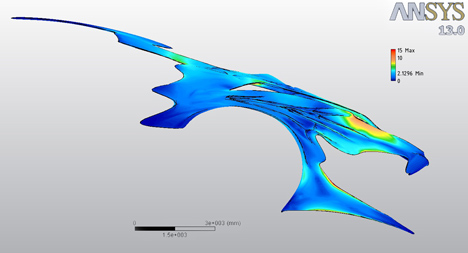
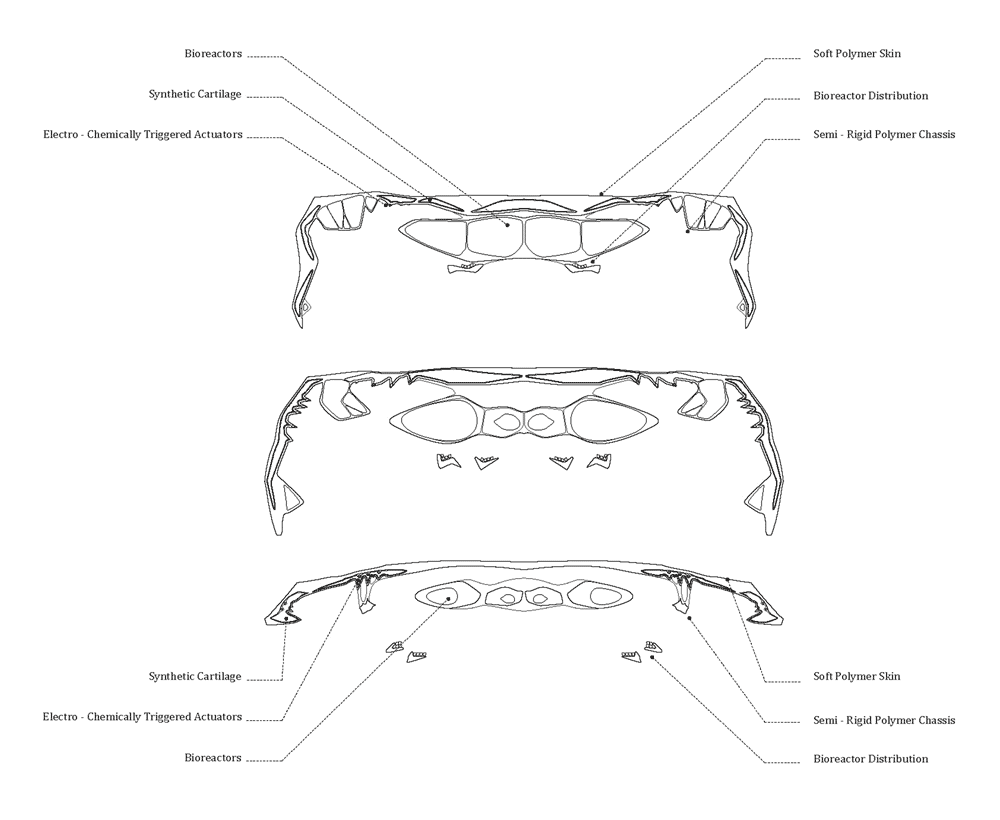
The multi-material range from soft to semi-rigid to rigid is applied across the discontinuous chassis and across the skin of the car. The base material, silicone, varies in thickness and density across the body, sometimes transforming into zones of semi-rigid synthetic cartilage. Similar to a shark skeleton, which is all cartilage, zones of semi-rigidity can occur as bundles of strands or plate-like formations.

The “crumple-zone” model of crash safety in unibody construction, where front and rear zones self-destruct in order to absorb impact forces, is replaced by the lively springiness of the semi-rigid construction. The car instead flexes and bounces back from impact. In addition, pressurized air pockets within the skin are triggered upon impact with other cars or pedestrians, integrating external air-bag technology in a way that would be impossible in a sheet metal body.
Semi-Rigid Car by Emergent

Thickness variability of the base material generates variable opacity creating transparent zones for viewing out as well as deep atmospheric views inside the body of the car. The thickest zones are embedded with fluid reservoirs containing algae colonies, forming a photo-bioreactor for the production of bio-fuel. This fuel, similar to vegetable oil, is a renewable resource, and more importantly, produced by the car itself. The introduction of LED lighting into these reservoirs enables 24-hour biofuel production, and creates a deep glow through the silicone-like gel matrix at night.
Semi-Rigid Car by Emergent

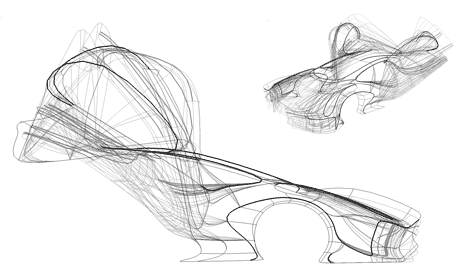
In contrast to the conventional mechanical movements of doors and hoods, involving frames and hinges, openings in the SRC are boneless and hinge-less (or better, giant living hinges). The ‘doors’ are slabs of synthetic skin, triggered by tendon-like actuators which respond to the pheromonal signature of the car’s owner. When they open, they quiver and curl, exhibiting behaviours which could not possibly involve sheet metal and hardware.
Semi-Rigid Car by Emergent

Click above for larger image

International distribution of the SRC from factory to point of purchase will not involve the unsustainable system of shipping completed cars. The flexibility of the semi-rigid chassis will allow the car to folded or rolled up for transport so it will spring open and settle. The higher degree of rigidity required for driving will be reached by pumping a gaseous catalyst into the hollow chassis which will cure an internal pre-preg polymer lining.

Finally, the wheels fuse rim and tire into a continuous gradient of rubber to rigid resinous biopolymer. Replacements can be 3D printed.


See also:

.

Mutation by Ora-Ïto
for Citroën
Vision EfficientDynamics
by BMW
GINA Light Visionary
Model by BMW

One Response to Semi-Rigid Car by Emergent

  1. Brennan says:

    That's all very nice, but is there actually any proven technology behind this?

    I mean, algae-powered power stations are different from algae derived biofuels, which are something entirely different from having actual algae in your car to try and power it (which, I'm not a scientist, but would be an incredible challenge given the sheer volume of necessary ecosystem)

    It's good to see people dream, and the renders are fabulous, but if there is actual data I'd love to read about that too.

    • oldschool says:

      i agree… seems like this would be waayyy more expensive that regular cars. The tech seems pretty far off and this comes off as flights of fancy without real data behind it…

    • Degs says:

      Dreaming and provoking new ideas should always be incouraged positively & rather delicately in my opinion. A rather idealistic approach – which sounds even more appealing. Somehow I'd be more interested as to how they'd market this kind of vehicle. Would be very elitist & very expensive because how else would the big corporates in this world satisfy their lust on sales. Not to mention a gigantic budget spent on R&D. Personally, I'f there were to be any viability – I'd reconsider either public transport or the arms trade.

  2. michi says:

    that's soo 2005!

  3. Dan says:

    As a designer, I'd prefer to see this argument supported by a new car form that celebrates its revolutionary material and construction method, not a rehashed Murcielago.

  4. lordrabbit says:

    I love this part:
    "Algae tanks inside the car would provide fuel with LED lighting inside the tanks allowing production to continue at night, causing the semi-transparent bodywork to glow."
    So, the LEDs make the algae grow which produces the fuel which powers the LEDs which makes the algae…

    So much for the second law of thermodynamics. Explain to me why I should listen to people who got an F in Physics but an A in Maya tell me how we are going to solve the worlds problems. Do the designers attach the eco-spam out of anxiety about presenting the project as an empty form-fest?

    • johnny says:

      I agree, they are not really designing anything. they have plucked a concept out of nothing, which i have no idea if it works, and i dont think they do either. If there was no such thing as computer renderings this would not be a project, it would be a sketch on the back of a napkin left behind in a coffee shop.

    • Chris says:

      Hehe, I kind of agree with your sentiments. Science fiction doesn't usually get pressed into hard labor I guess.. Maybe some eco boffins can figure out the rest someday.

  5. disgruntled says:

    Wow, the first two comments seem a bit stuck in todays technologies.

    I think it’s awesome when people design for unrealized/unproven technologies. Design like that provides impetus for R&D.

    Cost too high? That shouldn’t limit design or R&D; remember how much a DVD player used to cost?

    • felix says:

      by the time the technology exists to build this car, we won't need a car

      and what impetus does design like this provide for R&D? all they have done is put technologies that don't exist into the form of a car. no engineer is going to look at this and think "boy here's an opportunity that i hadn't thought of exploring"

  6. IMO by the time we have that kind of technology, we're NOT going to need cars. Humans would modify themselves so they could run 55 mph, breathe underwater, etc.

    I'm all for conceptualizing new ideas, but this is not an exploration in new technologies, but an exercise in science fiction.

    I have less respect for the guy who dreams of something (seemingly) impossible, and more for the guy who actually makes all the hard work of figuring out how to solve it.

    Arthur C. Clarke's fiction is pretty dry, and his characters were dull and two-dimensional. But his genius was in trying to think of the ways to actually solve the technologies he was using in his narrative –the space elevator, manned missions to Jupiter, aerobraking, etc.

    But that's an all too common defect among architects —let another schmuck figure out how to turn their crazy dreams into reality ;)

    • Aarn Zermeno says:

      Nevertheless, by the time we'd have 'that' kind of technology already developed we'd accept that perhaps it was neccesary to observe some kind of leads like these in order to figure out some of our likely potentials, this could be just it.

      Yet I think this 'exercise' was made in this sense; plain question is: Would them who know which ones could be some of the solutions, need really any cool practical ideas?

      At starters I almost derided too, but I deem it just as some inspirational sort of suggestive vision.

      I see yours as one of those the sharpest reactions about, despite of the blunt concluding paragraph.

  7. PS: Bio-engineered cars, but we're still stuck with WHEELS? c'mon… :P

  8. Sceptic says:

    This is real… science fiction.

  9. Dan says:

    A concept car is exactly that: A car with a concept, usually a novel one. This, however, is pure hyperbole of someone who clearly has not the slightest idea about the technology involved OR the design of cars. And when it comes to dreaming about a possible future I personally think this is a very average vision at best, sorry.

  10. douchebag says:

    THIS IS PLAIN IDIOT!!!

  11. This means our manicurist (with help from bio engineers) will be able to turn our fingernails into this brand new Porsche. Yes please.
    But just don't consider any nail dramas!

    • dainty10 says:

      Actually nails are made of keratin (like skin, but more of it) and not cartilage like this design is proposing.

  12. ryan says:

    1) Clearly the imprecision of maya is apparent both in building design and auto design– just because there is some sort curvature analysis doesn't mean it correlates to intelligent surfaces. Use rhino, alias, or if you are feeling like linking in some datasets and having the hole thing ACTUALLY work, then some catia/solidworks

    2) The concept and form do not seem to be intrinsically connected in any way other than the transparency of the surfaces enabling views of the algae… I think Lordrabbit said it well: " Explain to me why I should listen to people who got an F in Physics but an A in Maya tell me how we are going to solve the worlds problems. Do the designers attach the eco-spam out of anxiety about presenting the project as an empty form-fest? "

  13. joe pang says:

    i am very dissapointed that emergent release this project to public without spending time critically thinking the material and fuel system. to me is just a loose fantasy with skills in animation with empty grand agenda.

    They argue automobile is a genuine expression of physical attibutes of matters and performance however if you talk to the car designer this is not the case.

    Algae fueling a car? that tiny 2liter tank can only power your ipod at most.

    When a project cant justify both its statement and feasability, it a total failure.
    I am fine if this proposal is done by pixer however if emergent quote themself as desiger who is trying tackle real world issues- they have the ethical responsibility to the public and the holding credibility of the industry.

  14. Robert says:

    Maybe architects should stick to figuring out how to make buildings more sustainable before jumping into automobile design. Quite honestly the form itself is pretty elementary too, no? It's basically a Lamborghini with goo on it. Am I missing why this is even worth talking about?

  15. zoinked says:

    Ill just use my teleporter please.

  16. benjamin says:

    although the car seems unfathomable, i don't think emergent is making any claim that it will work. rather, they are using the idea of the concept car to project their opinion of architecture, not he automotive industry.

  17. sagoo says:

    Ridiculous !!!

  18. Tomás says:

    And what if it is science fiction.
    I finally see in a concept car, a new concept. It will probably lead to something else and I think that’s the way of making things if you want to make new things.
    It is true that it looks like a Murcielago but I think designers did it deliberately to associate the project as a car that most of people love.

  19. pizzaface says:

    i doubt i'll want to go anywhere when i have my real life robot sex doll at home by this time

  20. Hercule Poirot says:

    Algae stink. I don't want my car to smell like yesterday's fish. And certainly not look to have the look of it.

  21. Nevertheless, it's interesting to consider how society would respond to bio-engineered appliances. Would that mean I'd have to keep my car until it dies? But what if it starts to show the effect of old age? would there be retirement garages for senior automobiles? If I kill my car due to reckless driving, do I get to go jail for murder?

    Or maybe these guys just really liked Pixar's Cars ;)

  22. Aero1 says:

    RIDICULOUS and really ugly. Either design something worthwhile that works or something that looks nice or preferably both. This is the worst of both worlds.

    AWFUL

  23. jpx says:

    So yea! lets not produce ideas anymore because the technology is not readily available!

    man! i astounded that there are so many people out there that do not dare to try something out for the sake of the exercise…live a little! it is these ideas that spark an idea in someone else that thus brings along exciting new possibilities to life. If we stop exploring, or just solve problems with what is readily available, will we not come to a point of stagnation?
    It is creative power and the guts to do something unimaginable that can bring the idea to life — along with the right people, after all, design today should be a collaboration across all fields…be it math, science or literature. Rather than automatically putting ideas down, which i see so much of on this forum, lets figure it out and see what is plausible or what can aid in the research for "X".

    • felix says:

      in order to make progress there needs to be pruning of ideas. not everything is valuable, nor do we have the resources to try everything. some ideas are better than others, are more feasible, promise better results. criticism is a method of finding good ideas by removing bad ones. this is a bad idea.

  24. cliff smiley says:

    I used to think Tom Wiscombe/ Emergent had real potential. It turns out all he wants to do is be the next Jacques Fresco.

    JPX, I sympathize with your perspective on this – we do need problem posers, but having been on the periphery of this world for a while, one starts to see projects like this for what they are. I don't believe that Emergent has either the interest or the capacity to further the technology proposed here; its just an intellectual gag posing as a something profound. There are too many designers that hide behind big ideas and never do any of the hard work; to me it seems like a lot of obviously talented people are simply too lazy to advance their work beyond the aesthetic dimension.

  25. Joris says:

    Some good and silly idea's in the text, and some good and silly comments too. The problem with this design presentation is that it looks like a mashup of (indeed) a lunchbox-PE-plastic murcielago with a James Cameron Abbyss vibe to it. It looks like a movie production design. When one leaves out the algae thing, it becomes a more interesting idea of feasability of printing cars.

    Maybe also another proof that architects are not great designers though. In essence, the car design is nothing special and the energy solution is a tad bit silly.

    Maybe it was just intended for fun and generates more attentention than anticipated…

    • mvsuriano says:

      Joris – using this as proof to make a broad-brush statement that "architects aren't great designers" is ridiculous. Architects may cross into territory that is foreign from time to time, but it appropriates mutual perspective (good or bad) to the fields involved.

  26. thedesigner says:

    The shape kinda alien, so scary shape:(,even the concept using alga maybe quite interesting.

  27. mike says:

    lol to this. lol.

  28. Nick Austin says:

    Almost as good as my solar powered deep sea helicopter.

Leave a Reply

Your email address will not be published. Required fields are marked *

*

You may use these HTML tags and attributes: <a href="" title=""> <abbr title=""> <acronym title=""> <b> <blockquote cite=""> <cite> <code> <del datetime=""> <em> <i> <q cite=""> <strike> <strong>