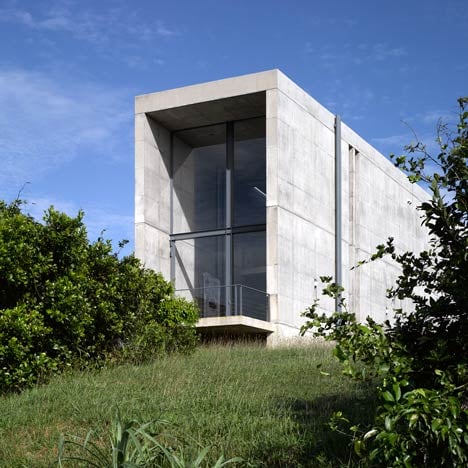
House in Sri Lanka by Tadao Ando photographed by Edmund Sumner
Japanese architect Tadao Ando has completed a concrete house on the edge of a cliff in southern Sri Lanka, writes Yuki Sumner.
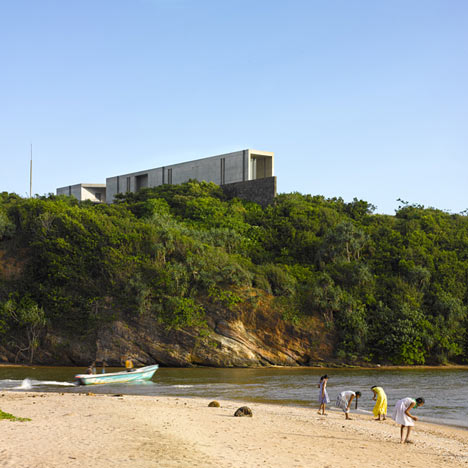
Designed for a married couple, the three-storey house incorporates a glazed study for the husband and an artist’s studio for his wife.
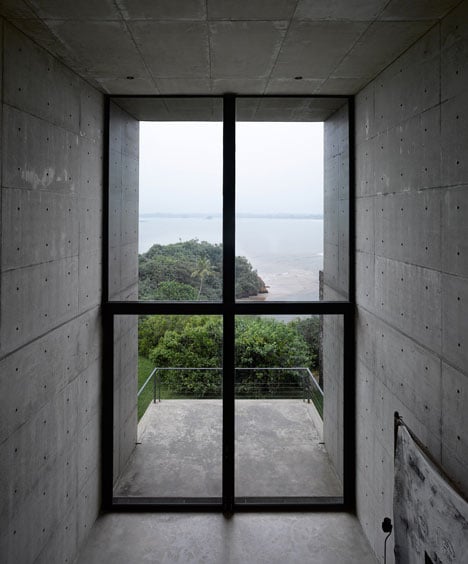
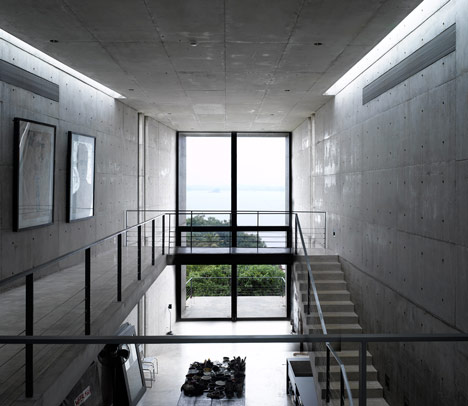
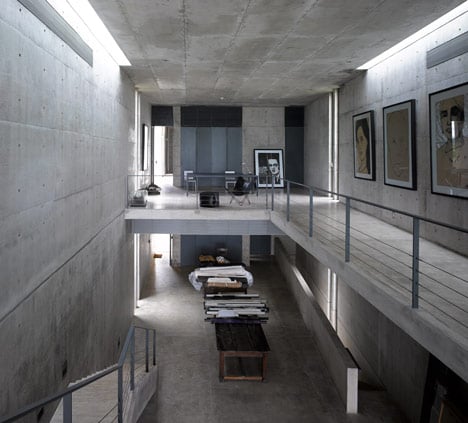
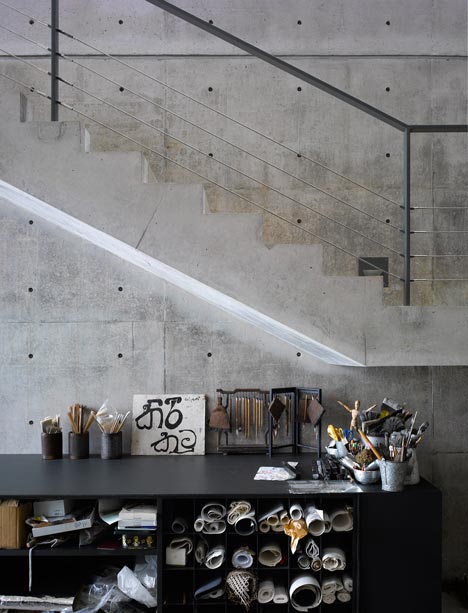
Light floods into this ground floor studio though a two storey-high window, which is divided into four by a large steel cross.
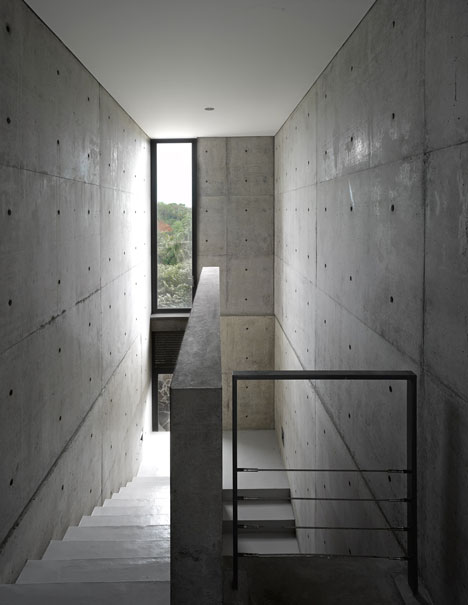
A staircase wraps around this room and leads up to a first floor mezzanine.
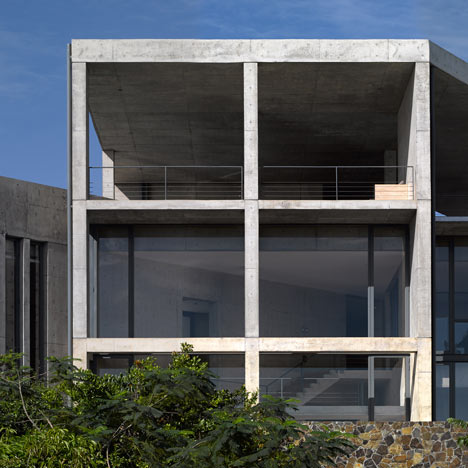
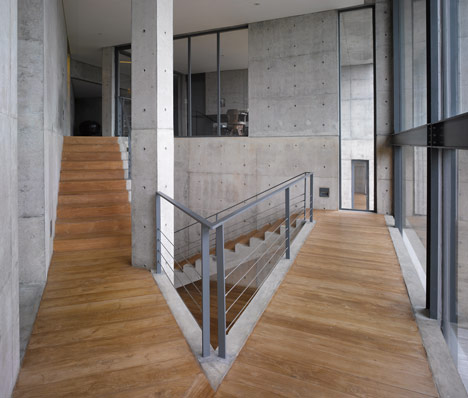
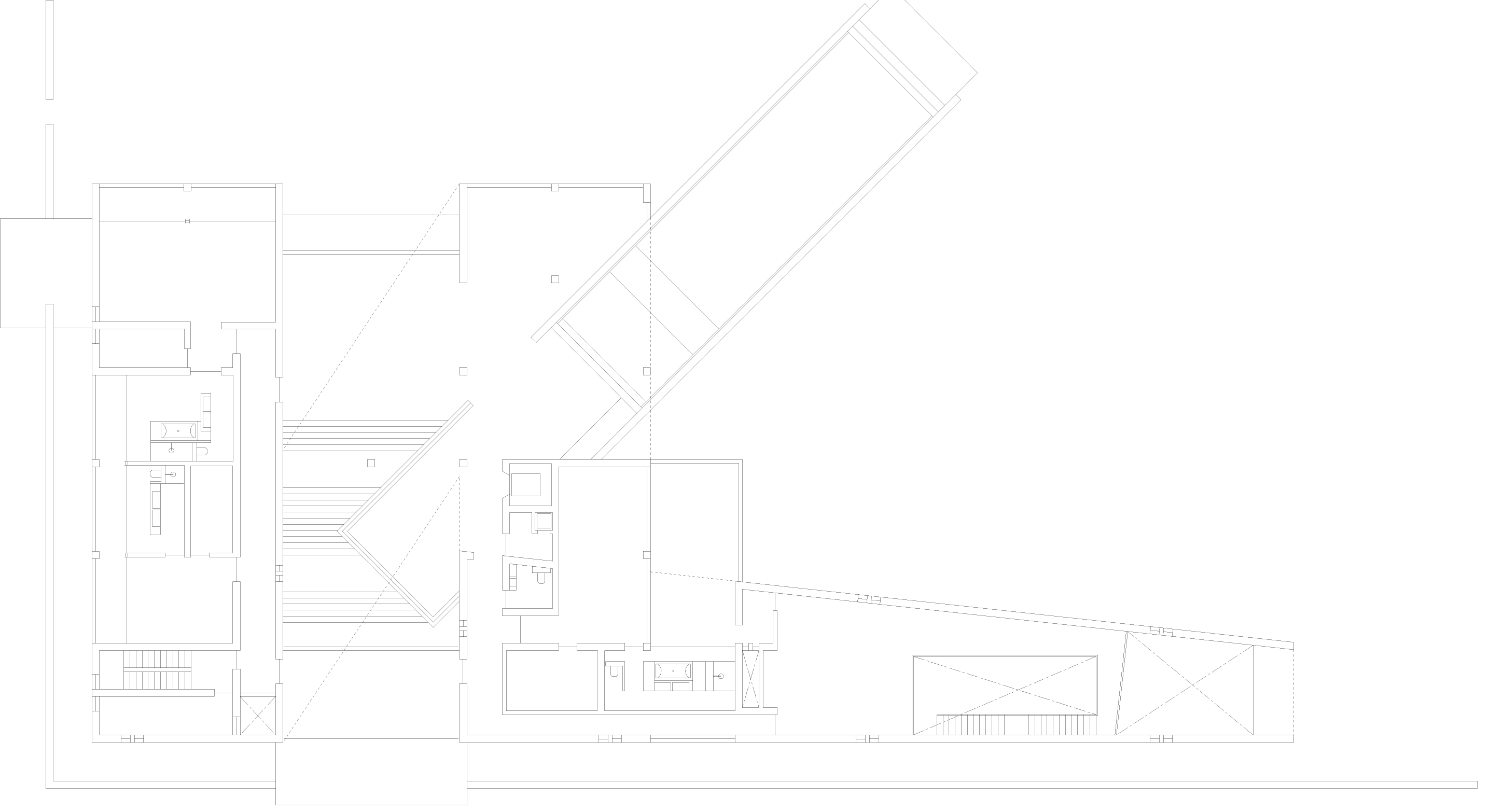
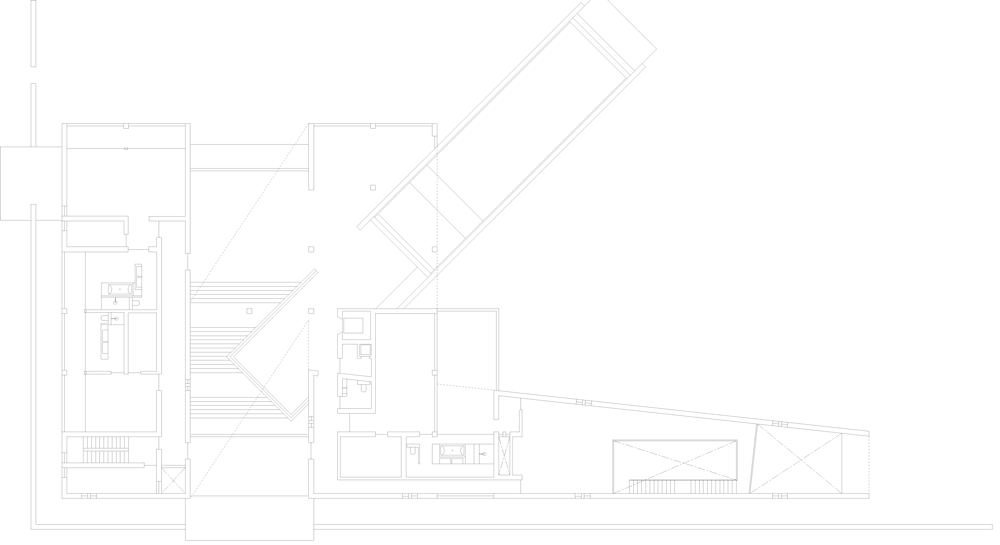
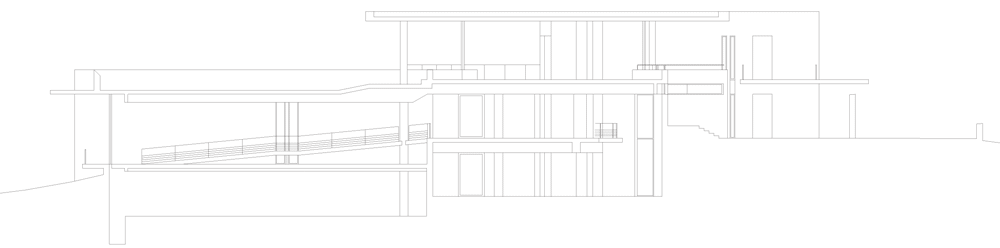
The glazed study is located on the first floor and is accessed via a zig-zagging staircase, which ascends from the 20 metre-long living room.
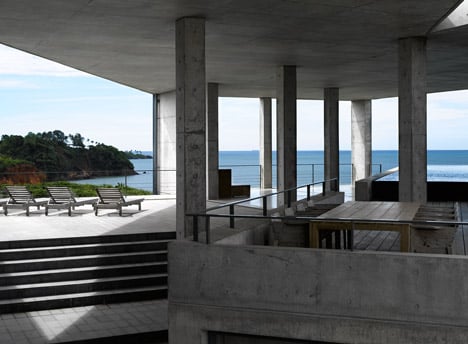
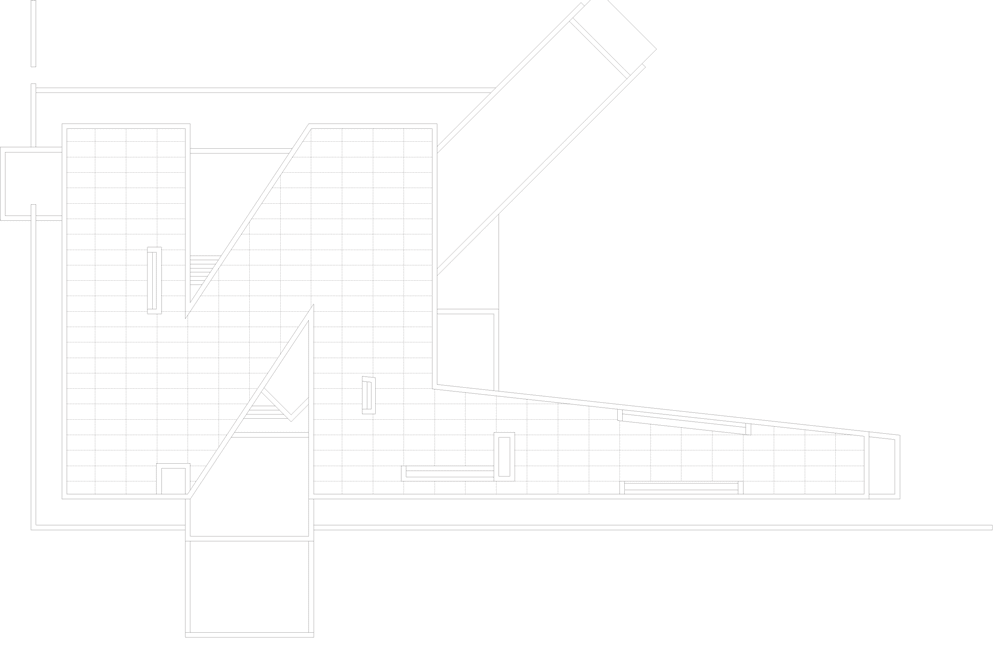
Outdoor terraces also step between the ground and first floors, while an infinity pool projects over the living room roof.
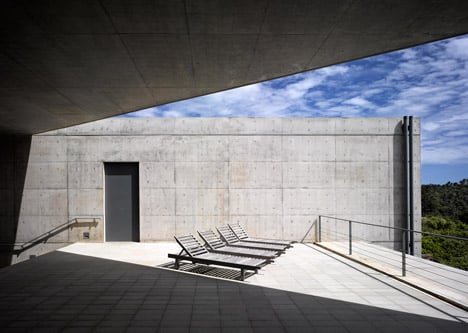
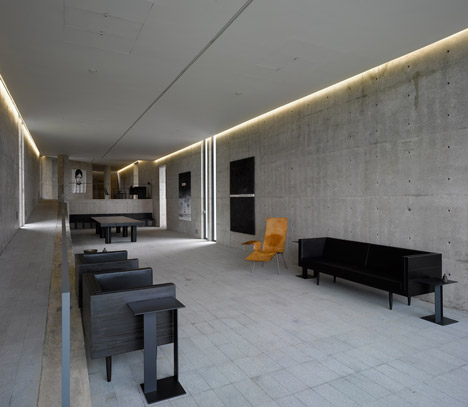
Furniture throughout the house is monochrome, including a teak and cardboard table designed by Shigeru Ban.
Tadao Ando also recently completed a misty water feature in London - see our earlier story here.
Photography is by Edmund Sumner.
The text below was written by Yuki Sumner:
The House in Sri Lanka, or so called by the Japanese architect Tadao Ando who designed it, is set against a paradise on earth.
White sandy beaches, dotted with coconut palm trees and huts draped with leaves from these trees, weave in and out of cliffs in Mirissa, located at the southern tip of Sri Lanka. Crocodiles and water snakes splash in its rivers, black monkeys, wild elephants and even leopards roam freely on its land. Local fishermen languorously wait for fish to swim towards them on wooden sticks firmly wedged into the sand along the edge of the sea.
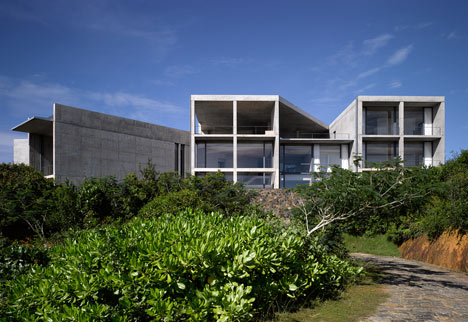
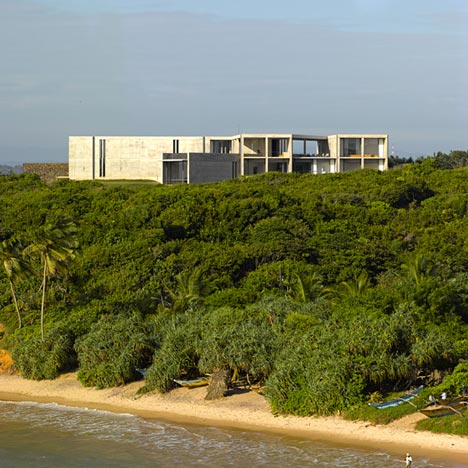
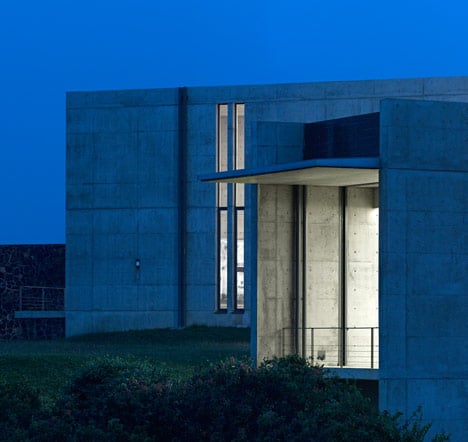
The name of the house is perhaps enough to suggest its majestic presence: clad in exposed concrete, the house perches on top of a cliff, as if it were indeed a leopard whose claws edge towards the Indian Ocean.
The house was a gift from a husband to a wife. Sri Lanka has been the Belgian couple's home for the past 30 years. The inscription on a slab of stone placed outside the house gate at the end of a meandering private road is almost too romantic for me. It says: “To Saskia.”
Pierre Pringiers is an industrialist who has successfully built up a regional tire-manufacturing firm into a global business that now supplies over 40% of the industrial tires worldwide. He wanted his wife, Saskia, an established artist, to have her own studio.
Pierre tells me: “One day I asked her if she were to choose her favourite architect in the world, who would it be? She said Tadao Ando.” The iconic images of Ando’s Church of Light, built in 1989, had made a deep impression on the artist.
With this house, Ando has evidently taken a slightly different approach from his previous work, which tended to be introspective, with only small gaps for light to seep in.
Here, the architect abandons the house to the elements of nature. Saskia, who finds inspirations for her artwork in “the sky and the sea of this tropical island,” wanted to see nothing but the sky and the sea from the house. Ando says he “aimed to create an airy architecture like many of the native houses.”
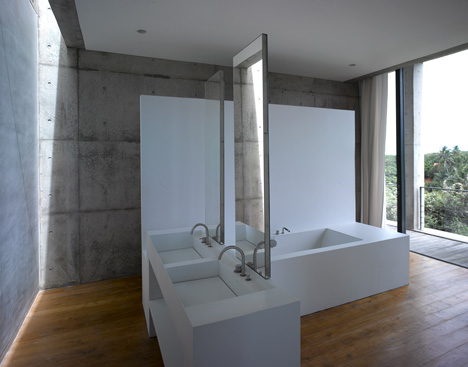
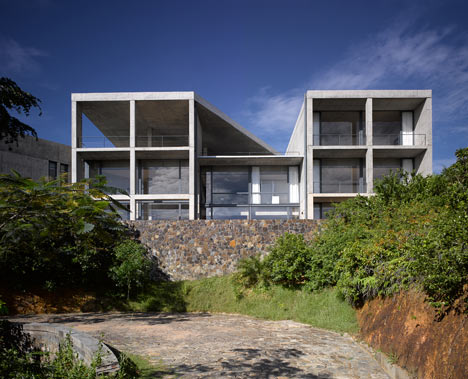
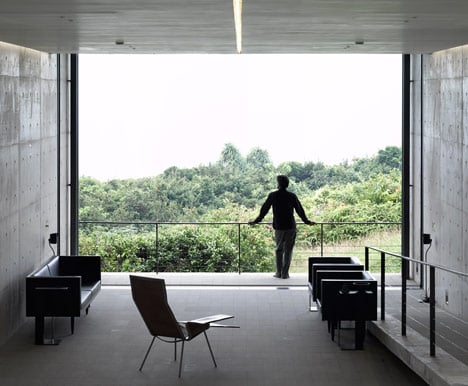
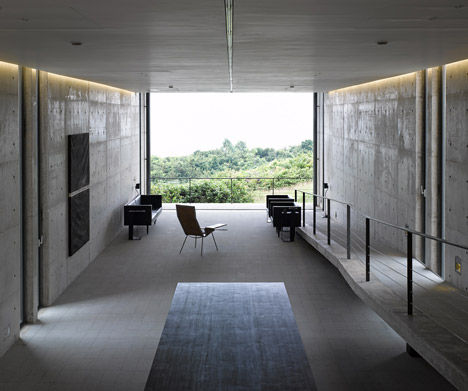
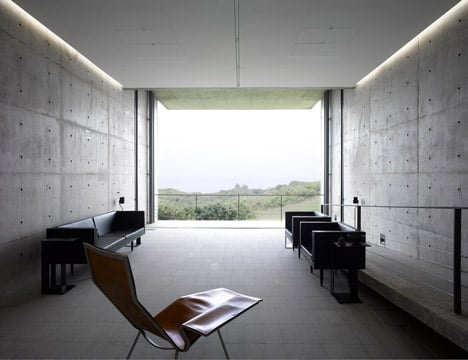
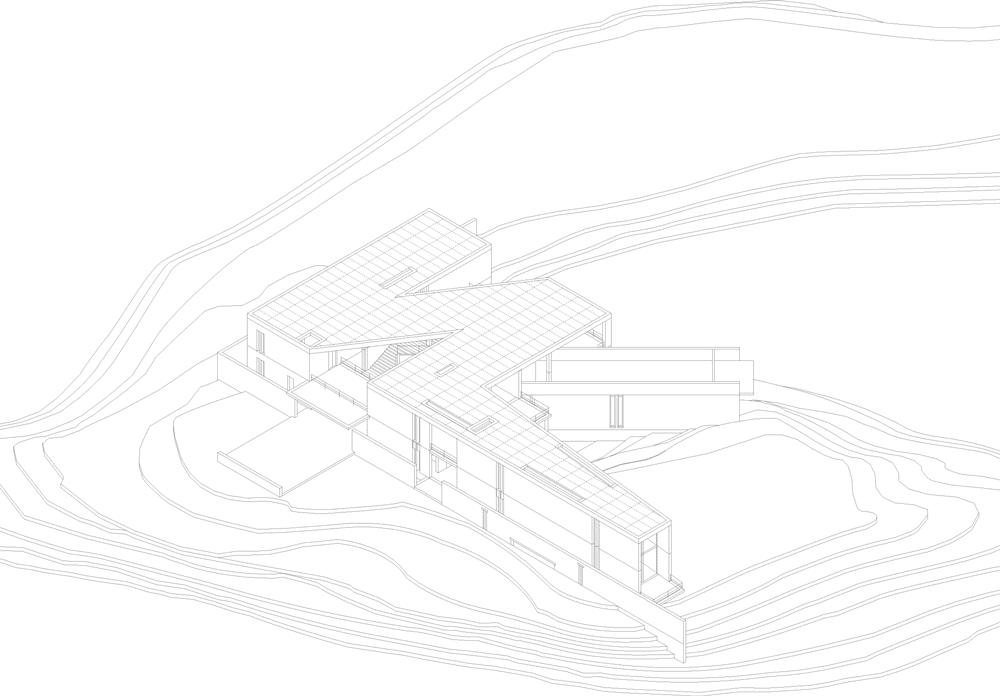
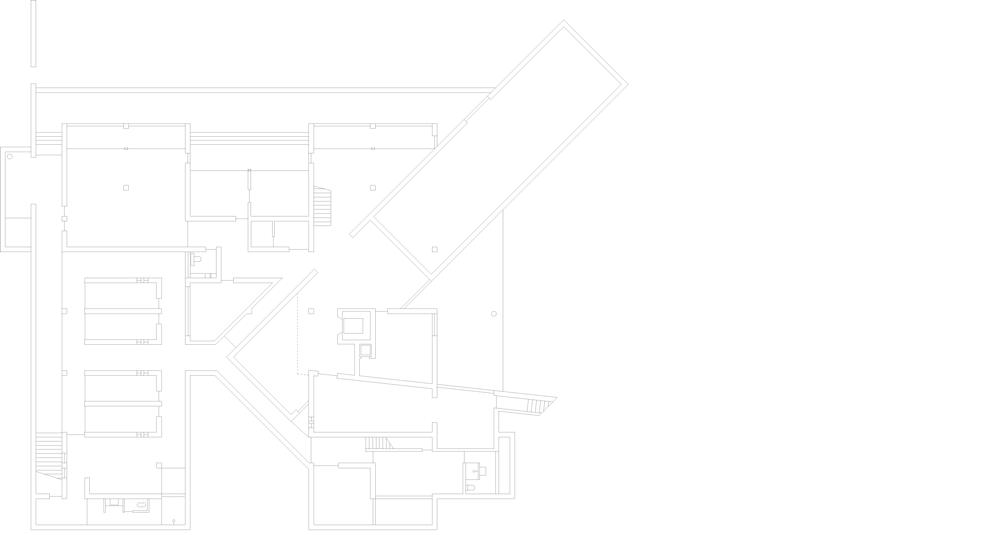
The architect has parcelled the house, which threatens to take off, into four different sections. One box contains the reception, kitchen, master bedroom and Pierre’s “mediation room,” while the one parallel to it contains four guest bedrooms, each one complete with a sea view and an en-suite. Another box, containing the elongated living room almost 20 meters long, dynamically slices through these two parcels of concrete at an angle. The window at the end of this box can be made to roll down and dematerialise into the ocean below.
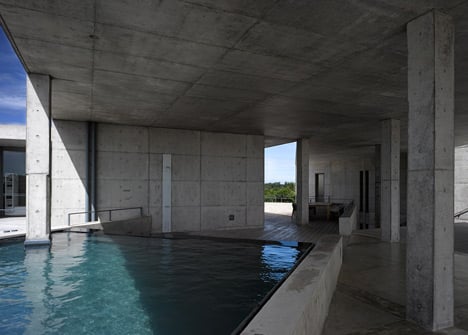
The interstitial spaces, or what we call ‘ma’ in Japan, created by the criss-crossing lines, are cleverly filled in. A grand stairway from the entrance patio gently unfolds onto a large airy loggia, the sprawling of which is accentuated by an infinity pool jutting out at an angle in one corner. The pool sits atop the living room, which means that it is as long and expansive as the room below it. There is the feeling that the parcels in this house have been left open.
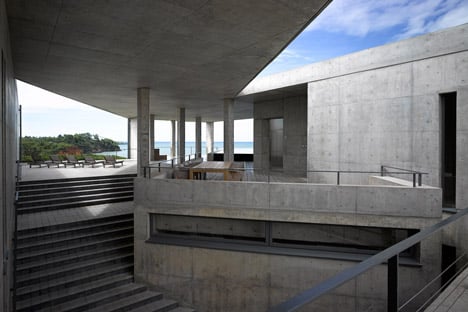
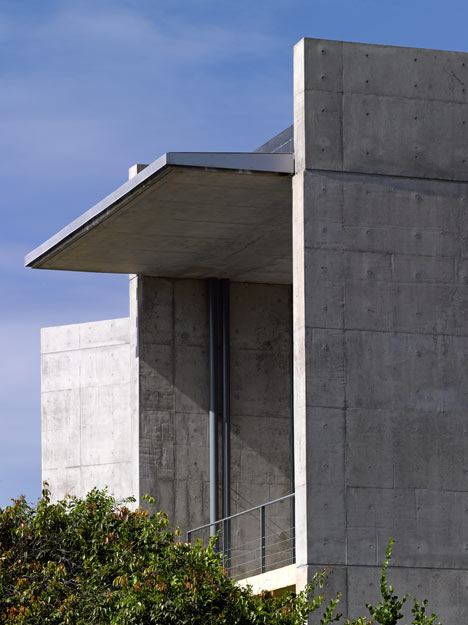
And indeed, the panorama from this open loggia spans nearly 360 degrees, over the Indian Ocean to the front and over the jungle at the back. Solid square columns of concrete hold up the horizontal rooftop, which is also made of concrete, while a mixture of timber and stone floors subtly divide the area into smaller, more manageable sections.
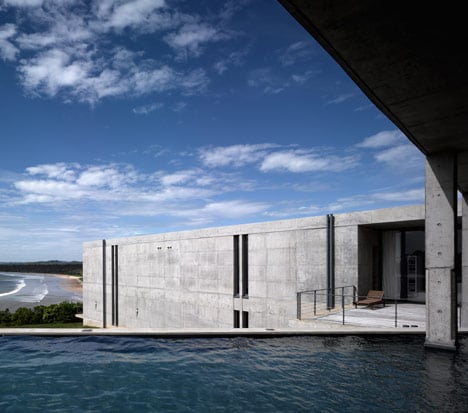
From this loggia, we can see Geoffery Bawa’s Jayawardene House in the distance. It was the last project that the singularly most revered architect of Sri Lanka had worked on. You begin to understand then that this house is Ando’s nod to Regional Modernism, the likes of which was embraced by Bawa.
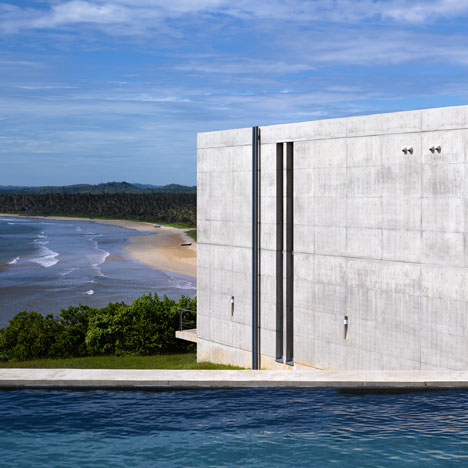
Where should the focus of a house with no apparent end be? Pierre’s study is snugly fitted right in the centre of the house, created inside the interstitial space on the ground floor. It is a room made of glass, playfully reached via the living room through a zigzagging ramp, which wraps around the triangle void created by a well of intersecting angles.
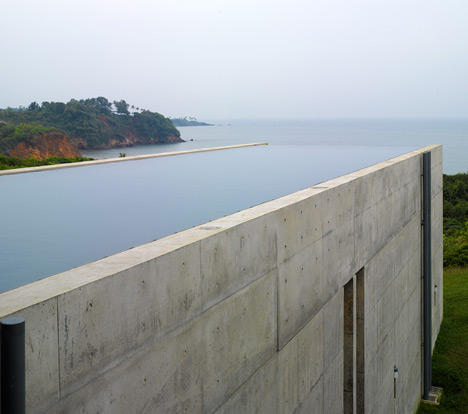
Hundreds of miles away from Japan, we can still witness the perfect detailing Ando is known for. Never mind the fact that the architect had actually never set his foot on site; every nook and corner of the house is still cleverly accounted for. The near-invisible room is not, however, the anchor of the house, even if it is placed at the centre of the house. The tour of this sprawling house ends with Saskia’s studio, the raison d'être of the house. The studio is purposefully set apart from the rest of the house.
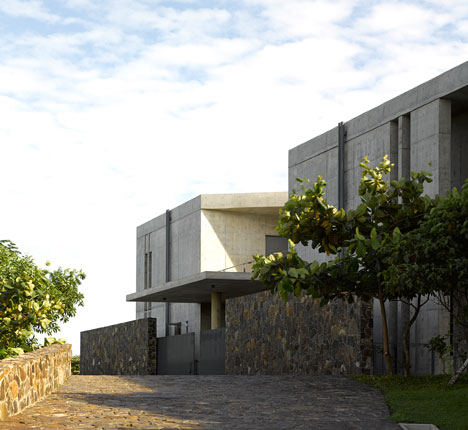
A circuitous route from the upper level down to the lower level of the studio, complete with a floating steel bridge at the middle of the room, adds to its heightened religious feel. Saskia’s studio has a resonance with Ando’s Church of Light, except that it is set in reverse. Unlike the living room, the large window at the end stays put and is fitted with a steel framework that forms a large cross.
Here, the cross is made not with light but with shadow. Furnishing in the room, as in the rest of the house, is monochrome, complimenting Saskia’s paintings, as well as Ando’s play of light and shadow. Top Mouton, the design company based in Belgium responsible for the interior fit out of the house, knew not to bother with soft furnishing in Ando’s house.
Jacob Pringiers, one of the couple’s grown children, has some of his collection scattered around the house. Shigeru Ban, another Japanese architect who ended up designing a house for the client’s other son nearby as the result of Ban’s meeting with the industrialist on a tsunami relief project, has custom-made the couple’s dining room’s table with a teak top and cardboard legs, all painted suitably in black.
Saskia’s artworks are hung on the wall. The artist paints directly onto unstretched canvases, which are then stored rolled up like the Japanese emaki. Interestingly, the sky and the sea of Sri Lanka are always painted in dark grey in her work.
Click above for larger image
The darkness comes perhaps from the artist’s own acknowledgement that paradise is not what it seems. In 2004, the work on the house had to be temporary halted after the area was badly hit by the tsunami.
Click above for larger image
Her husband immediately put an effective rehabilitation programme together, drafting, for example, the Belgium army to set up the emergency housing for the locals who lost homes. In the end, he was able to raise enough funds to build 700 permanent houses, as well as a new community centre and a Buddhist temple, a new village, in fact, tucked away in the hills, away from the threatening sea.
Click above for larger image
David Robson, who recently published the monograph of Geoffery Bawa, writes that Regional Modernism “rejects the banalities of mass consumerism but welcomes the positive achievements of globalization, while seeking to support and revalidate local cultures.” The House in Sri Lanka similarly stands at the juncture where regional and global forces meet.
Click above for larger image
Its success comes from a collaboration of people from all over the world. Two Japanese specialists, Kiyoshi Aoki and Yukio Tanaka, flew out from Japan to oversee the entire process of casting concrete, which required the position of every plughole to be exact. Such skills, heretofore unknown in Sri Lanka, have now been passed onto the local engineers and builders.
Click above for larger image
PWA Architects, the local architectural firm, played a vital role as a mediator, relaying messages to and fro Japan. The project architect Hidehiro Yano from TAAA made many trips to Sri Lanka to check on the progress and be the eye of Ando.

Click above for larger image
Although it was Pierre and Saskia who approached Ando, it was apparently Ando who made the final decision to work with them. It took Ando nearly three weeks to reply yes to their request, and only after insisting that the client write an essay about who they were and what they liked about the architect’s work.
Click above for larger image
Ando has always insisted that as an architect, he is merely designing a box, that it is the client who puts the soul into it. In Pierre and Saskia, then, the ex-boxer-com-visionary architect has finally met his match. The result of the match is a tour-de-force of concrete, as uncompromising and defiant as the humanistic idealism that is behind it.