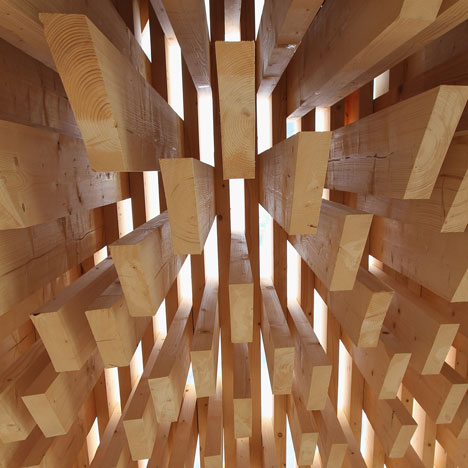
Visitors to this year’s Design Miami/ fair could climb into the hollow belly of a wooden pavilion by architect David Adjaye.
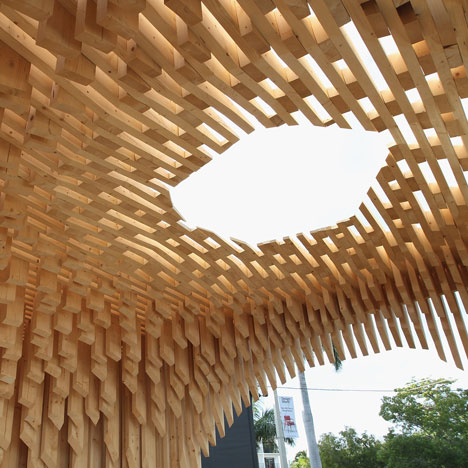
Adjaye was commissioned to create the installation after being named Designer of the Year by the festival back in September.
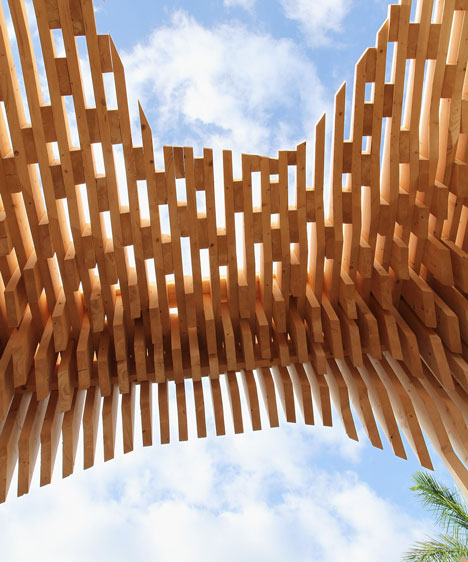
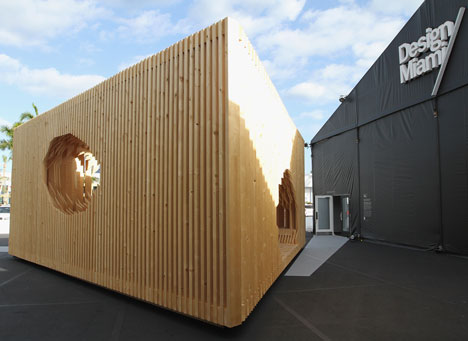
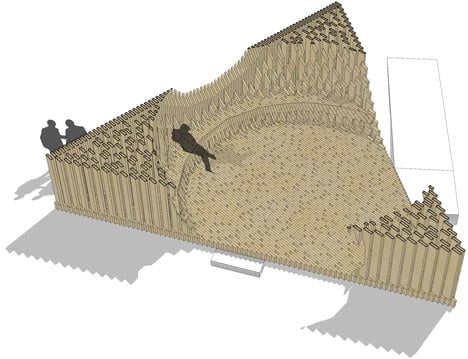
The temporary triangular structure was located at the fair’s entrance and comprised a framework of timber blocks slotted together.
The central hollow punctured the pavilion on every side to create oval openings framing views of the surroundings and sky.
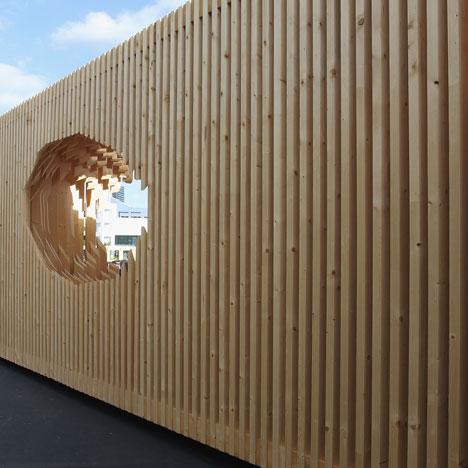
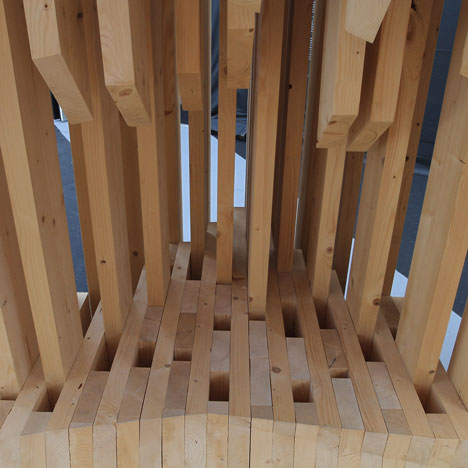
A secondary timber framework also slotted inside the structure to form a bench.
Previous pavilions have been completed by designers including Zaha Hadid, Marc Newson, Maarten Baas and Konstantin Grcic, whose network of hammocks you can see in our story from last year's festival.
Photography is by Alexander Tamargo.
Here's some more text from Adjaye Associates:
Genesis Pavilion
Design Miami/ Commission, 2011
Designed to provide visitors with an immersive experience, Genesis is a complete environment, which integrates enclosure, aperture, views, respite, meditation and community.
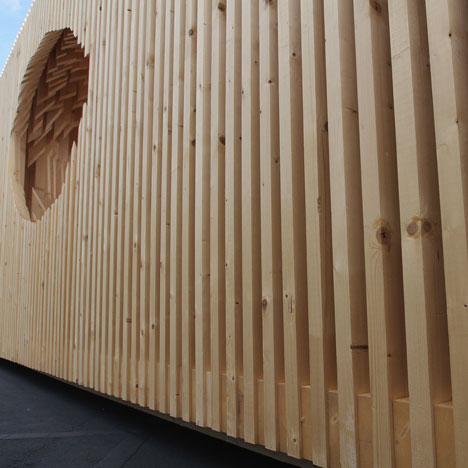
Like a giant piece of architectural furniture, the Design Miami/commission has enabled Adjaye to combine structure, seating, window and doors into a single gesture for the first time.
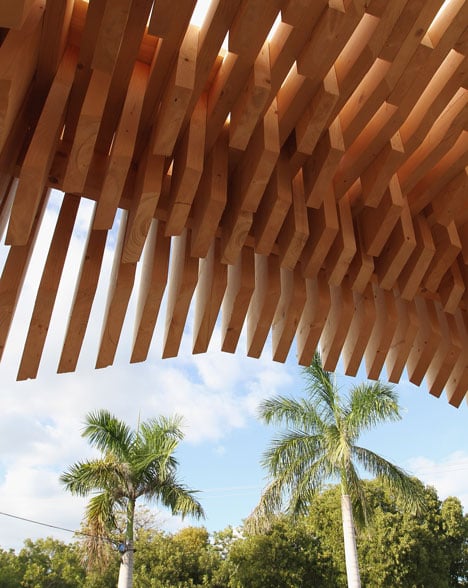
The pavilion is a triangular prism measuring 10m x 10m x 10m x 3.6m, located at the entrance to the fair. It leads visitors to the courtyard space upon arrival, ushering people inside.
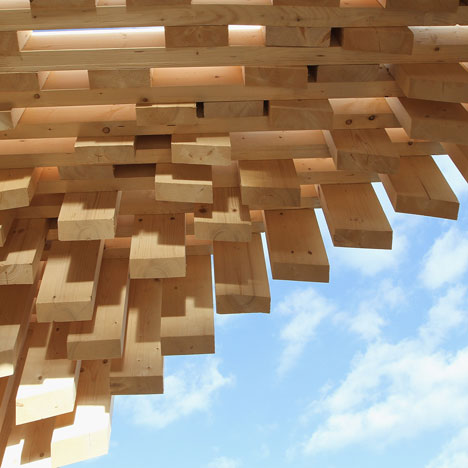
It is also the point of departure, and is a final gathering space as visitors leave the fair, with its curved window offering strategic views of the galleries.
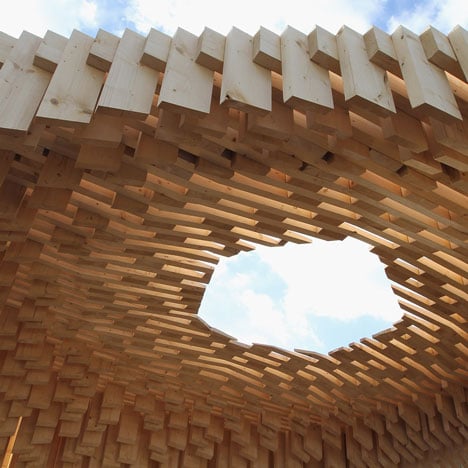
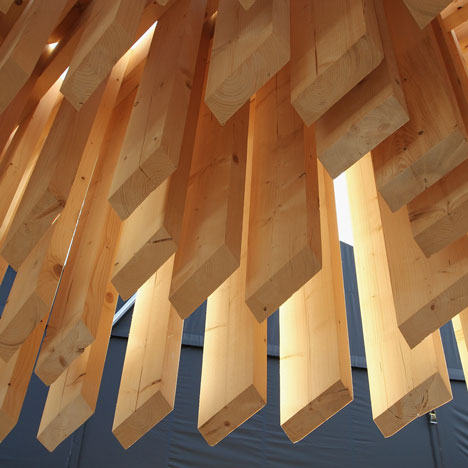
Comprising a series of timber frames that form the roof, flooring and walls, these elements work together and through compression, provide the overall structure.
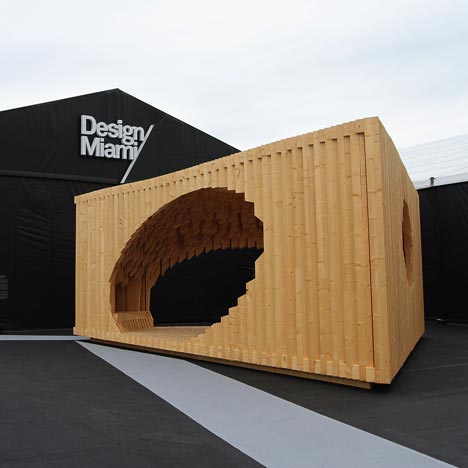
The internal space is formed by carving out an oversized ovoid shape from the centre.
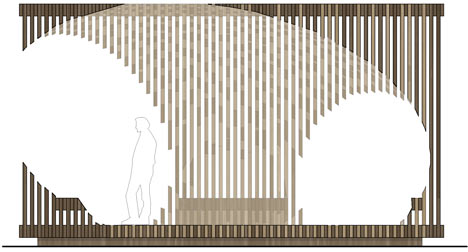
This distorted shape is set at an angle and abuts the perimeter to form the exit, entrance and window.
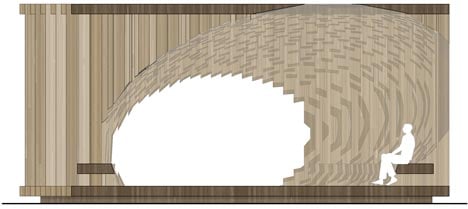
The seating is established by a secondary subtraction from the interior – which repeats the distorted ovoid, creating a platform along the cut-away timber frames.
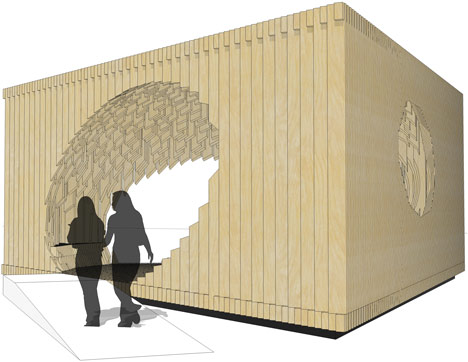
While compressed and joined together with additional filler pieces, the timber frames are not completely fused.
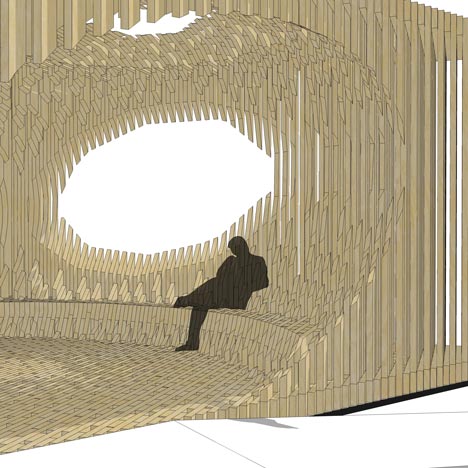
This allows light to filter inside from the exterior and roof, providing a dynamic filigree of light and shadow.
Light is further brought inside via an opening in the roof, which acts as a dramatic light well.


yep really amazing use of bits of wood
i dont see how you can live in this
Yep, Gordon Matta Clark did that in the 60's to real buildings – then it was a revolutionary idea. This is just wasting trees.
love this guys vision…disorder on order
this is a pavilion. an open one. so you cannot live in it, nor was this the purpose of the design. The pavilion genre is perfect for experimenting (remember the folies). The carving is interesting as a concept as well as the interpretation of cave-shaped geometries via straight pieces of construction elements (here wood). A way of rationalizing the structural logic. Also the fact that he plays (due to the method of constuction) with the open-closed binary, affecting the natural light, the air circulation as well as the visual connection to the interior.
Vasi, thank you for using a lot of words to describe absolutely nothing. A pavilion is the ultimate vehicle of an architect's self-indulgence. And to be honest, this particular pavilion shows nothing we didn't know already, and the built version reveals little more than the ever so ordinary 3d model. I second Tom Ford; a plain waste of trees.
I think someone needs to go read Dieter Rams’ 10 principles of good design.
1. Innovative? Nah.
2. Useful? Gimme a break.
3. Aesthetic? Perhaps if you like 2×6′s.
4. Understandable? Perhaps it is a place to sit?
5. Unobtrusive? Nothing like blocks of wood in a parking lot to get their point across.
6.Honest? “Provides visitors with an immersive experience” Blah.
7. Long lasting? Jury is out on this one.
8. Thorough? I guess they spent some time building it.
9. Environmentally Friendly? I bet they drove Ford Excursions to haul all the wood they needed.
10. Little design as possible? I’m going to stop writing now…
Pierre, trust me, you don't like it.
Wow, people need to chill the hell out about this. Here is the reality of the situation:
Design Miami- 'Here is a bunch of money to design some pavilion out the front of our show..go nuts'
David Adjaye- Great! Loots do some wooden cave thing, the intern can work out the details cos we should probably put our efforts into the actual buildings we are working on.
Result: I nice but maybe not that ground breaking pavilion. Sure, it might be a little wasteful but in the grand scheme of waste in architecture, considering entire new cities are being deserted in certain parts of the world right now, then this is a tiny drop in the ocean of waste. Lets be realistic.
And besides, if Design Miami gave you a whole lot of money to design a pavilion would you really be like "Dieter Rams 10 principles blah blah"? Why not indulge a bit?
Lighten up!!!!
Thank you! Your comments are quite apt. That is the one thing I hate about architects. The culture of our profession is to criticize and judge everything. Nothing that any other architect does is EVER correct, beautiful, etc. We all must complain. My response to most architects: If you could have done it better yourself, THEY WOULD HAVE ASKED YOU TO DESIGN IT! It's quite pathetic actually to read how many architects on various design and architecture message boards are so negative.