Engineering Temporality by Tuomas Markunpoika Tolvanen
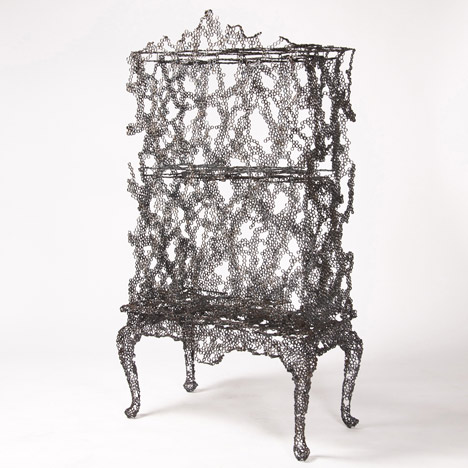
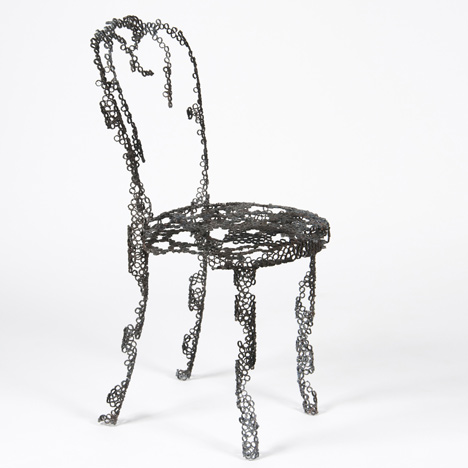
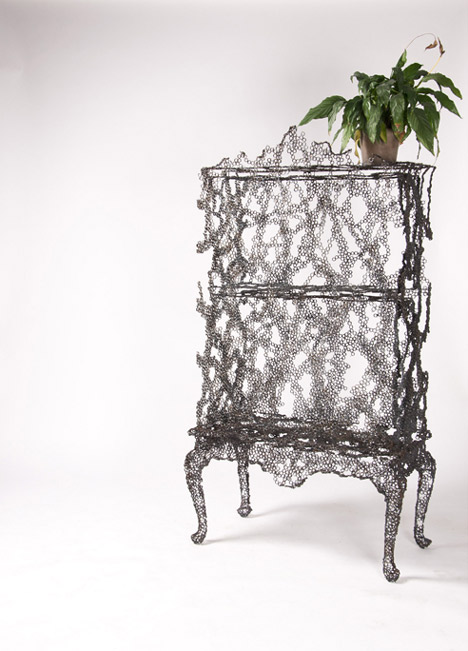
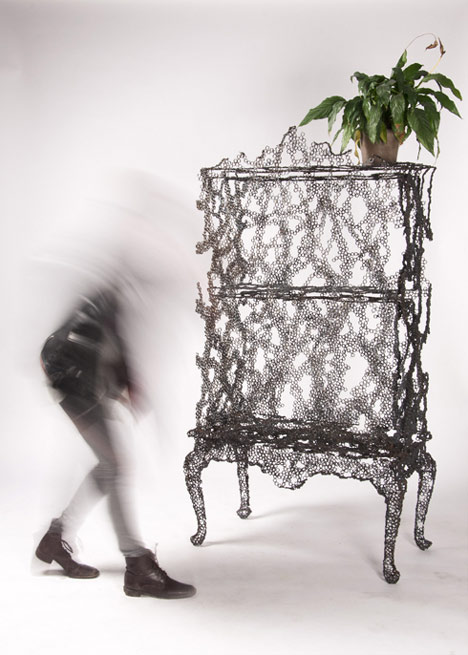
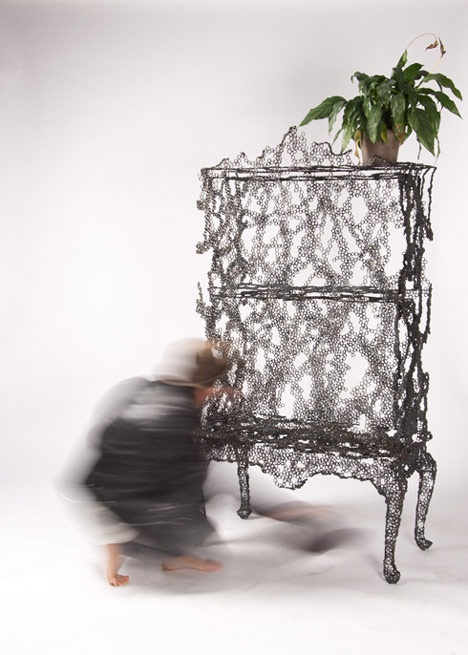
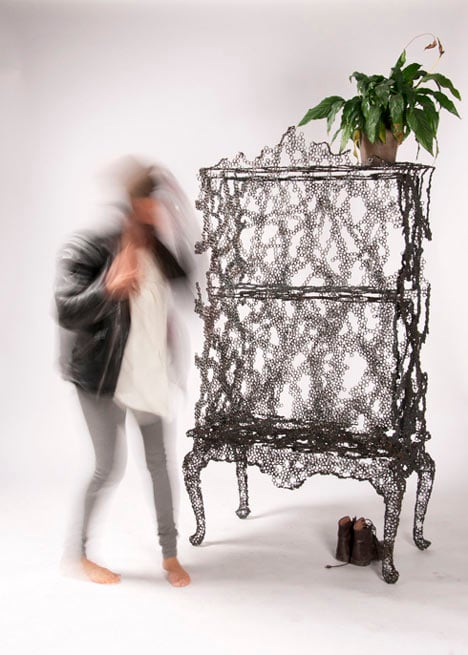
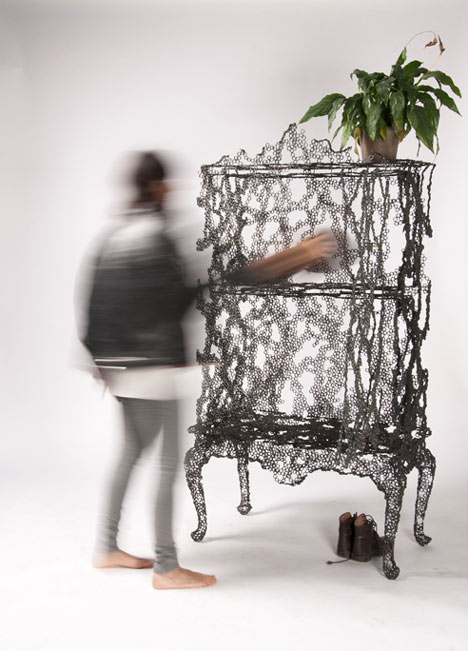
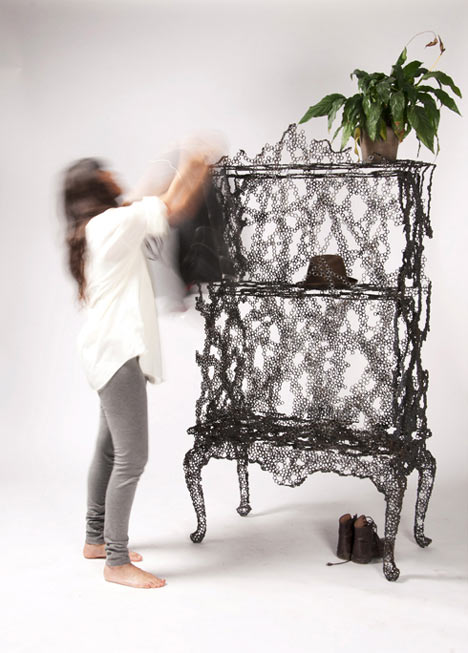
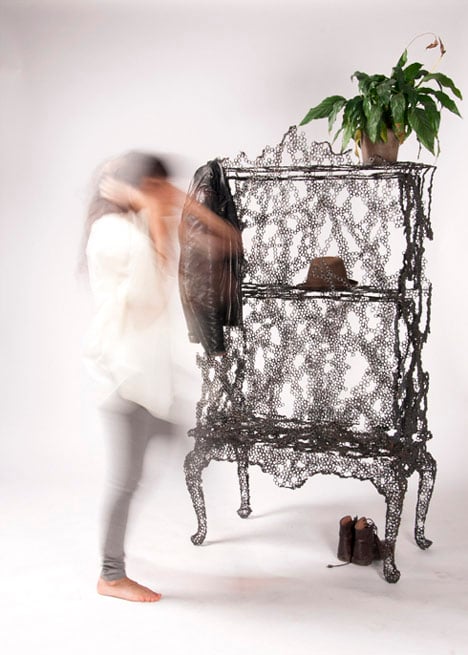
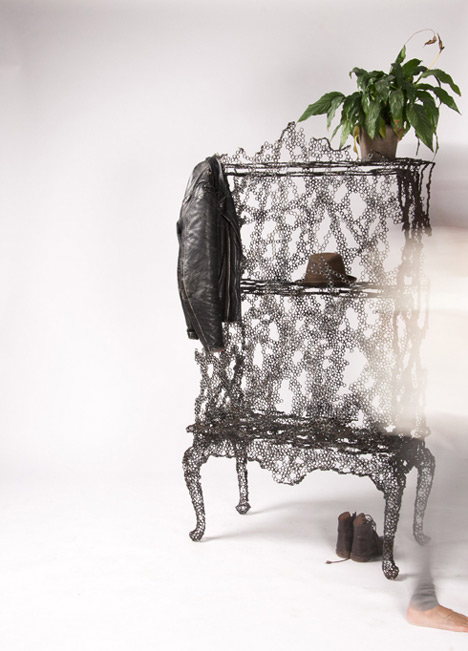
Design Academy Eindhoven graduate Tuomas Markunpoika Tolvanen has covered pieces of furniture in a fine web of steel rings before destroying them with fire to make functioning objects that resemble fuzzy fading memories of the originals (+movie).
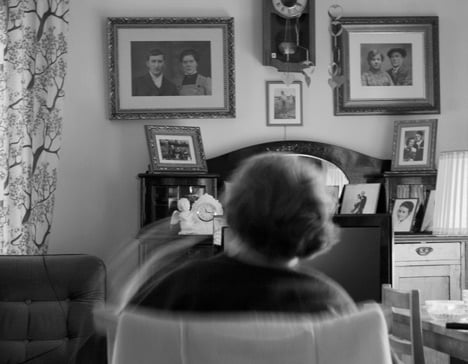
Calling his project Engineering Temporality, Markunpoika Tolvanen was inspired by his grandmother's disintegrating memories as she struggled with Alzheimer’s disease.
He completed the project while studying on the MA Contextual Design course under Louise Schouwenberg, one of three Masters tutors who recently resigned over a dispute with the school then rejoined after claiming victory.
See all our stories about Design Academy Eindhoven »
Here's some more information from the designer:
Engineering Temporality
Tribute to human fragility and material culture
The topic for my thesis spawned out from a personal agony within my family: my grandmothers declining health. Once a strong and bold woman, now only a fainting image of her past. Her Alzheimer’s disease is unravelling the fabric of her life, knot by knot, and vaporising the very core of her personality and life, her memories, and turning her into a shell of a human being.
I felt the urge to connect design to the human emotional sphere and to values that reflect how we are as human beings, by trying to create a bridge between the metaphysical and the material world using design as medium of expression.
Material Culture
The use of language in Western contemporary culture implies that memories are often conceived as possessions: we ‘keep’ memories alive or ‘preserve’ them, as if our memories were materialised objects. These objects become mementos and our personal possessions which we are responsible for. When objects impregnated with memories are created, they become precious and irreplaceable because of the transference of memories into that object.
Fragility
We have a tendency to facilitate the notion of fragility into objects that have special meaning to us, which enhances our ability to care for them; this can be expressed psychologically, metaphysically or through material fragility. Nevertheless, fragility tends to transform objects more valuable, more precious and beautiful by their virtue of expressing the transience of life and our temporal nature.
Temporality, Care and Dasein
According to philosopher Martin Heidegger temporality is what defines us as human beings. Dasein (meaning ‘Being-there’) is a temporal mode of being. Dasein unifies the past, the present and the future and Heidegger refers to them as the ecstasies of temporality. Our existence as a being (as Dasein) reveals itself as authentic care. My interpretation of Heidegger’s philosophy is that through care we define more profoundly who we are as human beings.
Beauty
In the same way as human life is fragile, transient, and flawed, design should reflect these same values thus bringing more care into our surroundings, revealing Dasein. The notion of beauty migrates into objects when we consider them symbolically comparable to us.
Design
To enhance the active engagement in the caring process towards objects, I created objects that are enmeshed in the notion of fragility through physical and psychological virtues that reflect temporality.
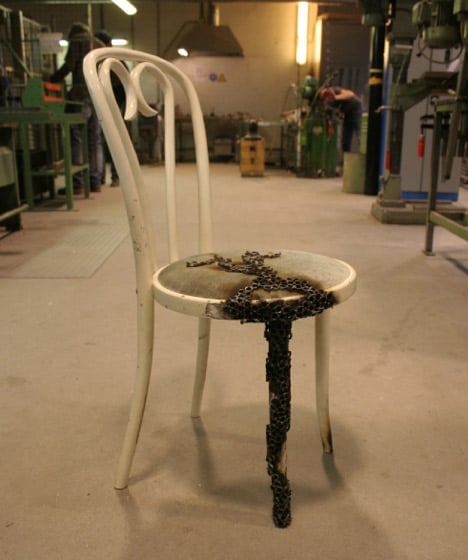
The selection of the material for my final objects was done according to what I regard as being an common structural material in furniture industry; tubular steel. I manipulated the tubular steel by cutting it into small rings. Connecting the rings back together to form a semi covering layer over an existing object was a method of capturing the physical space the object occupied.
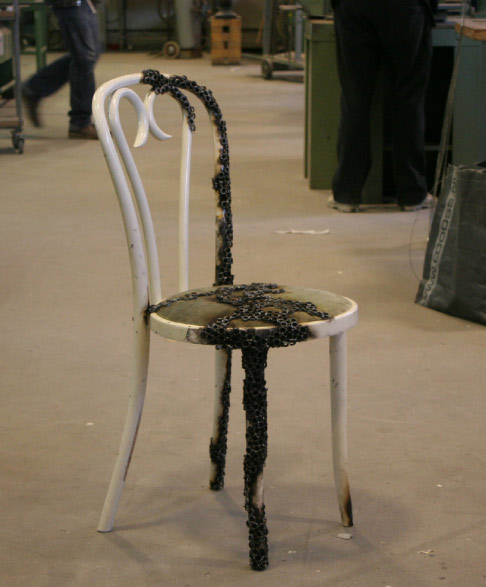
The vanishing of the original objects is done with fire; a primordial force used as a method for recreating the original object. The object goes through a horrific physical transformation and a metaphysical bond between the object and memories is forged into existence.
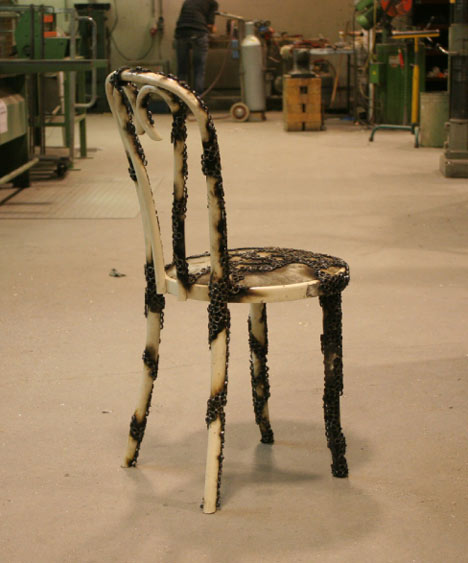
My pursuit was to give an object a memory, create tension and stage a play between the perfect, anonymous mass produced structural material and the imperfect of human being. The shell that is left caresses the vanished object, the memory of it, referring to the past.
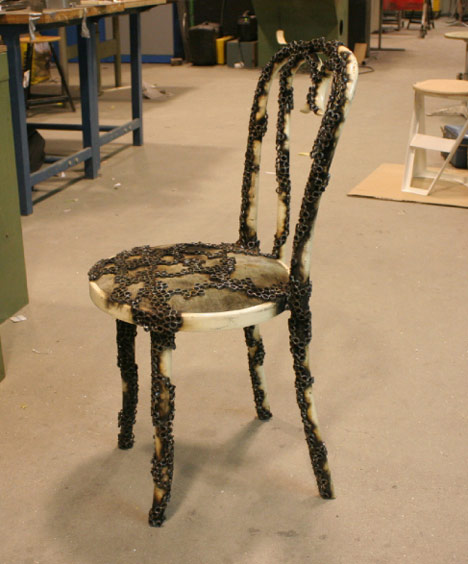
The intentions of my thesis are to translate human fragility into a design object and introduce humanistic, more profound values into the field of design where functionality, aesthetics and mass produced perfectness are the paramount. This has been my aspiration — make design a metaphysical experience that overlooks functionality. This is not to say that functionality in objects, or in design, should be disregarded. For me it’s about elevating the tedious functionality of everyday objects.

“Temporality reveals itself as the meaning of authentic care. The primordial unity of the structure of care lies in temporality.” - Martin Heidegger