


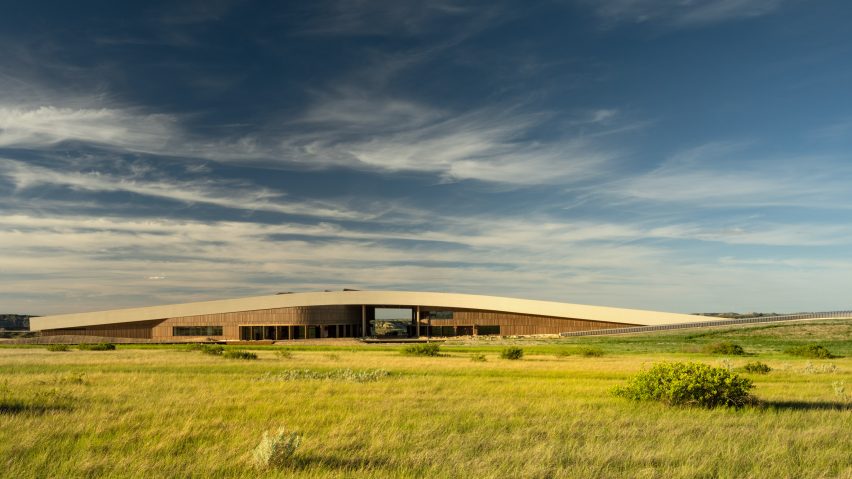
Architecture studio Snøhetta has laid a hill-like green roof over timber-and-earth volumes for a building dedicated to American president Theodore Roosevelt, connecting it to the rolling landscape of North Dakota, USA.
Located on a butte outside of Medora, North Dakota, the Theodore Roosevelt Presidential Library (TRPL) looks out over a national park that also bears the name of the 26th president of the United States.
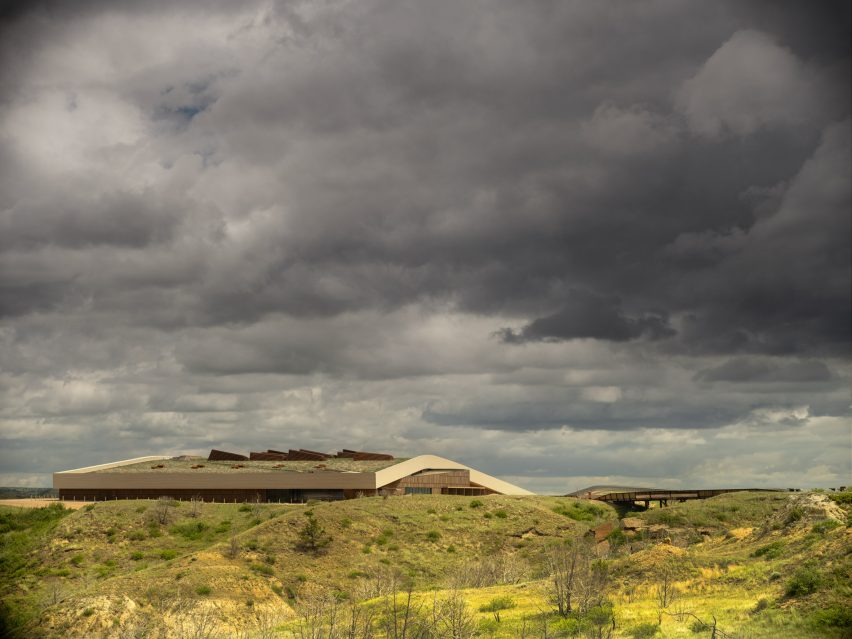
The 95,000-square-foot building features a green roof that crests over the interior volumes, connecting with the ground and conforming to the hills and prairies of the North Dakota Badlands, with its ravines, gulches and buttes left over by ancient erosion.

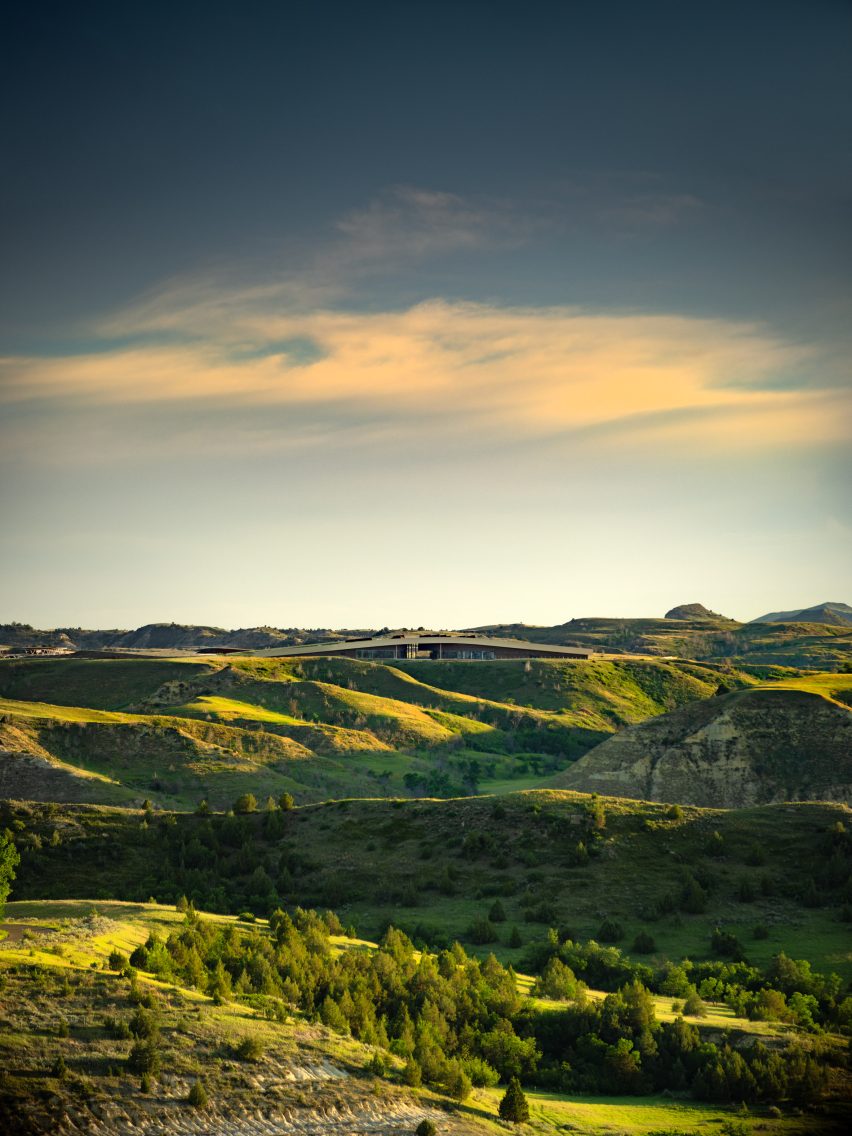
According to Snøhetta, the structure was designed to conform to the site, while also standing out. The team did not want it to appear "alien", but wanted to give it a presence that mirrored the ancientness of the rolling hills.
"It's a fairly prominent location, and we didn't want to create an alien creature that seemed as though it had flown in," Snøhetta founding partner Craig Dykers told Dezeen.
"Although it does have that quality – it feels like it came from somewhere else, but it's always been there."

Though Roosevelt was from New York, he travelled to Medora during a period of mourning.
Dykers and Snøhetta partner Michelle Delk spoke with Dezeen while waiting for a train carrying president Trump to visit the site for its 1 July inauguration, following a similar train route that Roosevelt would have taken in the early 20th century.
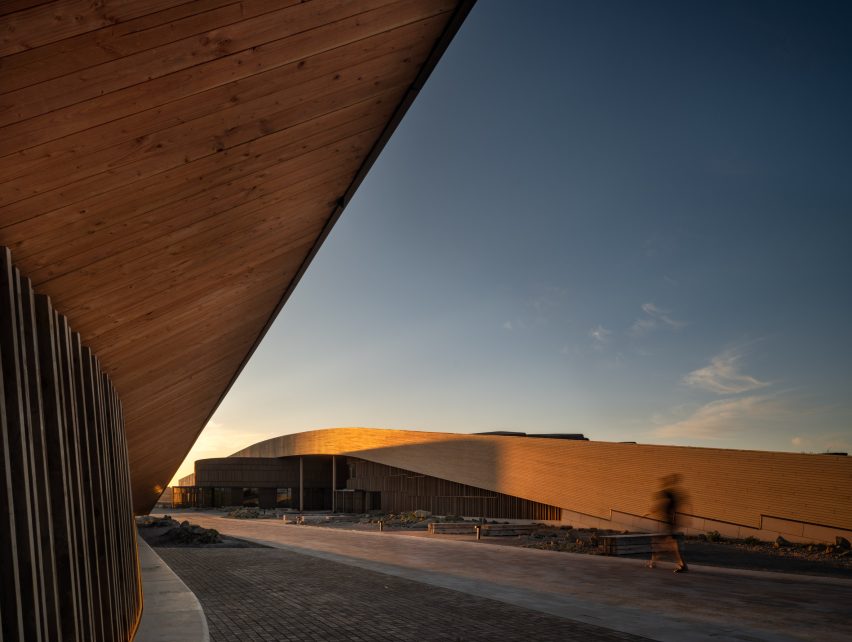
The building features two interior volumes separated by a breezeway and covered by the massive sloping roof. Dykers likened the whole scheme to a leaf laid over two pebbles. The smaller volume holds a theatre and classrooms, while the larger block contains the gallery spaces and a cafe.
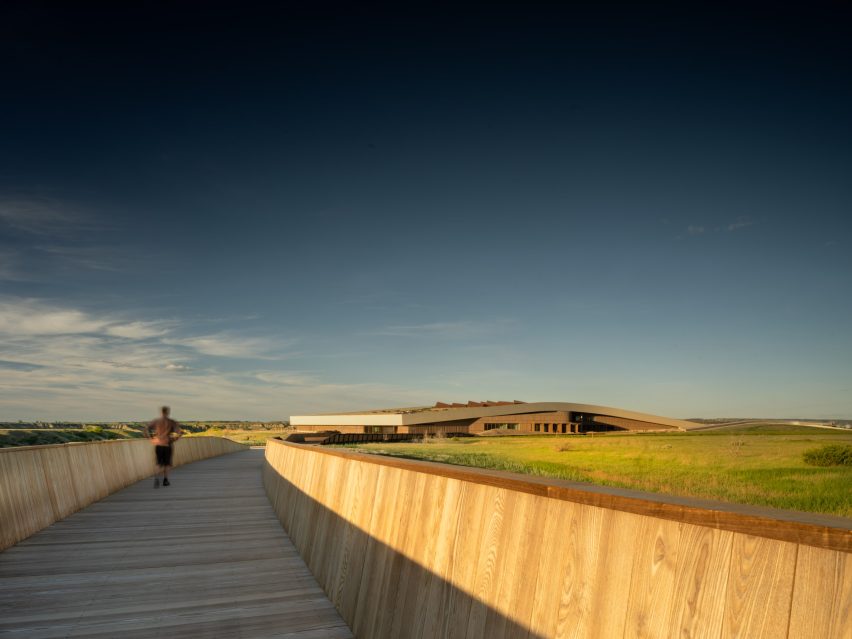
Originally, the building was meant to be more central on the site, but the team pushed it to the back of the site, near a steep drop-off. This allowed for the views of the terrain, framed at multiple instances through the programme, in the breezeway, from the walkable green roof and through the strategically placed windows in the galleries.
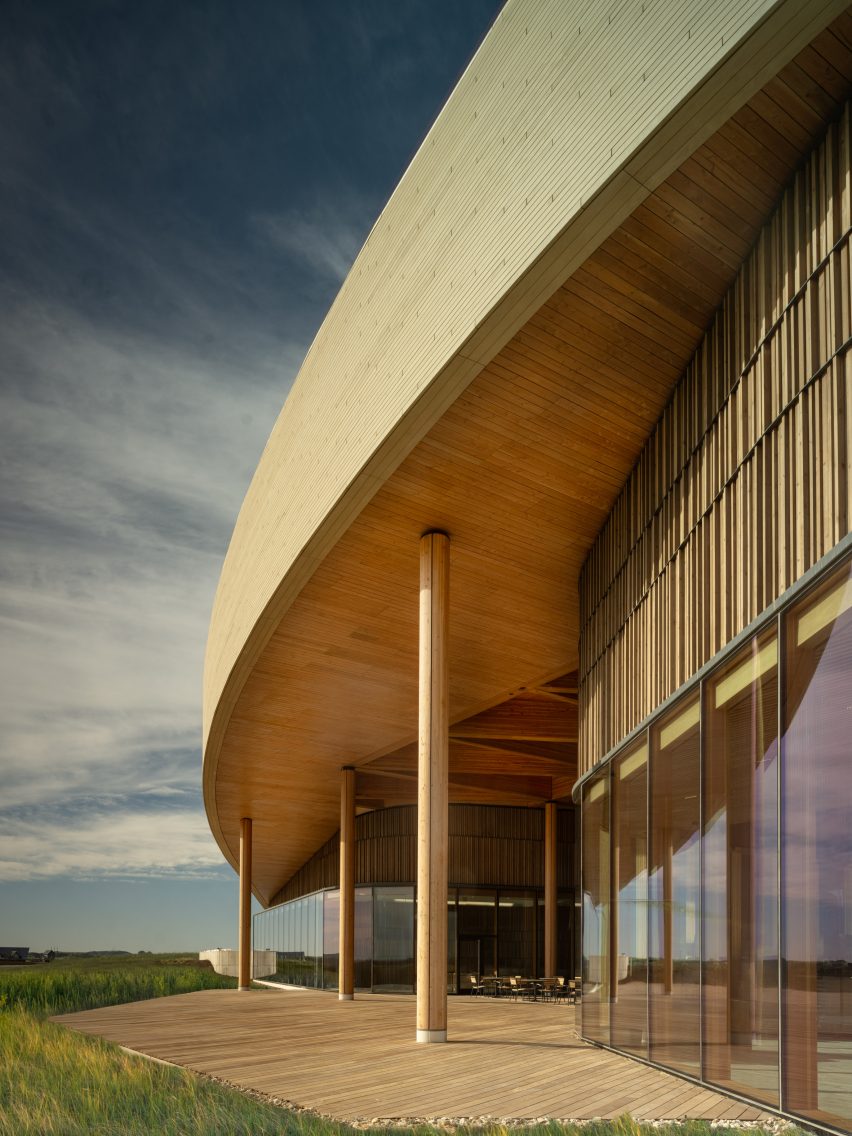
Dykers told Dezeen the combination of the roof, the local materials and vernacular building forms, as well as the decentering of the building in the landscape, allows the massive structure to appear smaller and more relatable
"It's easier to make small things feel larger, but it's harder to make large things feel small," he said. "The library is the landscape, and the landscape is the library."

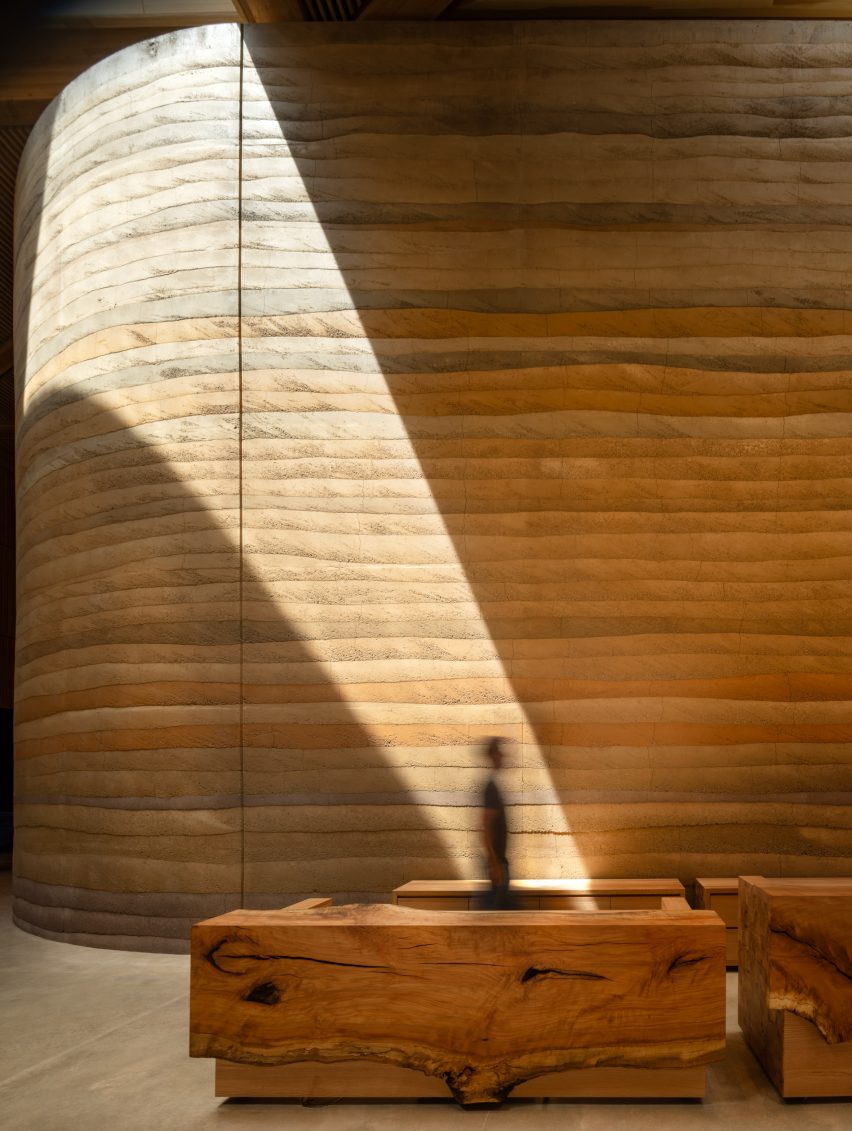
The sloping green roof has a panelled wood soffit, while the breezeway features monumental rammed-earth walls, featuring soil collected from the area, and in profile mirrors some of the striations on the local topography.
Using computational models, the team was able to build a structure it said relates to some of the pre-industrial building models, both of the local Indigenous people and early European settlers.
"The earth and soil on the roof is like a sod house that's recognisable by everybody," said Dykers. "So all of those things are very familiar in a building that is completely unfamiliar to them."
"Essentially, we designed it the same way a person who's lived here for generations would," he continued.
Dykers also mentioned the wooden screens used to protect the breezeway from wind and the orientation of the building to allow the most efficient lighting from the windows on the facades and through the skylights, some of which are distinguished by Corten-steel mounds on the green roof.
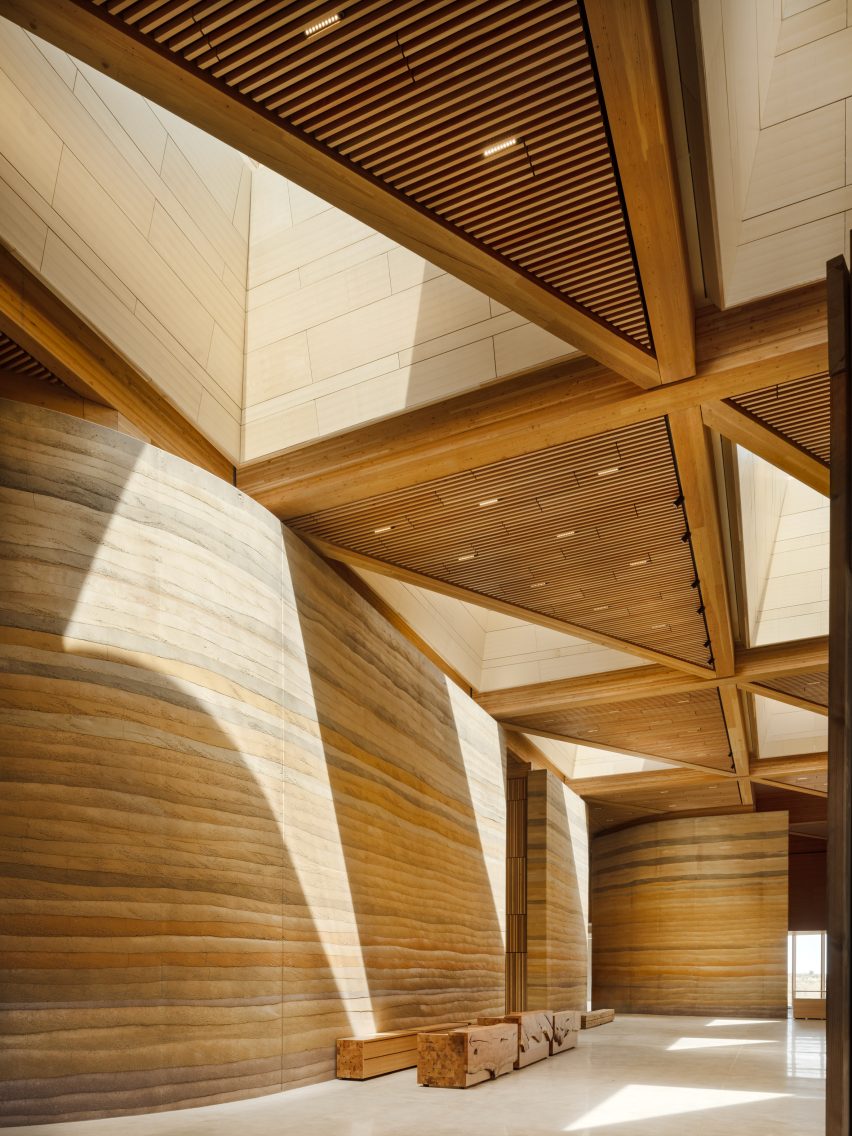
Inside, the structure features exposed mass-timber structural elements, with some walls covered in gypsum to accommodate the gallery programming.
The entrances were offset from the pathways leading up from the parking area, provoking a sense of slowing down and traversal similar to the experience of exploring the Badlands.
"We tried to capture a slowing down and inviting people to really read this landscape," said Delk.
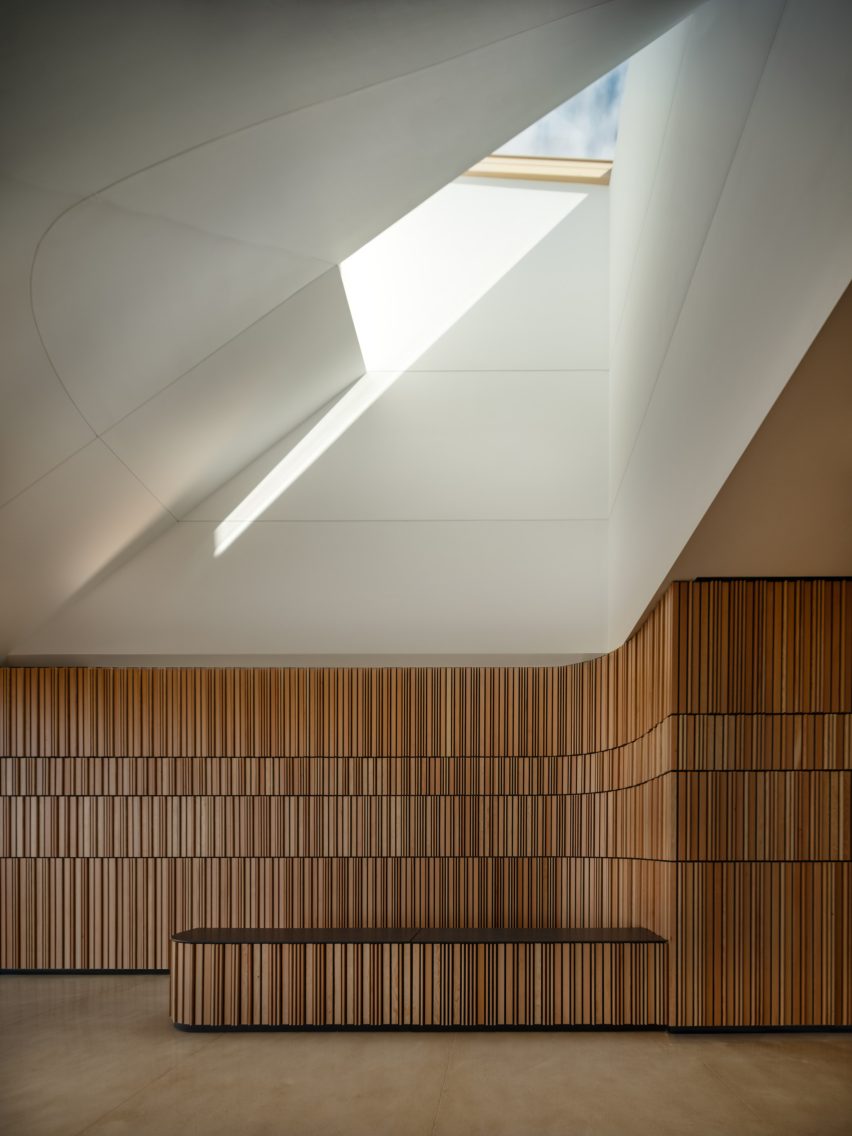
Additional skylights filter in through light wells that connect to the circulation through a hexagonal grid ceiling that reveals the concrete elements also used.
On top of the use of low-carbon concrete and mass timber, it features solar and geothermal power elements and wastewater recycling.
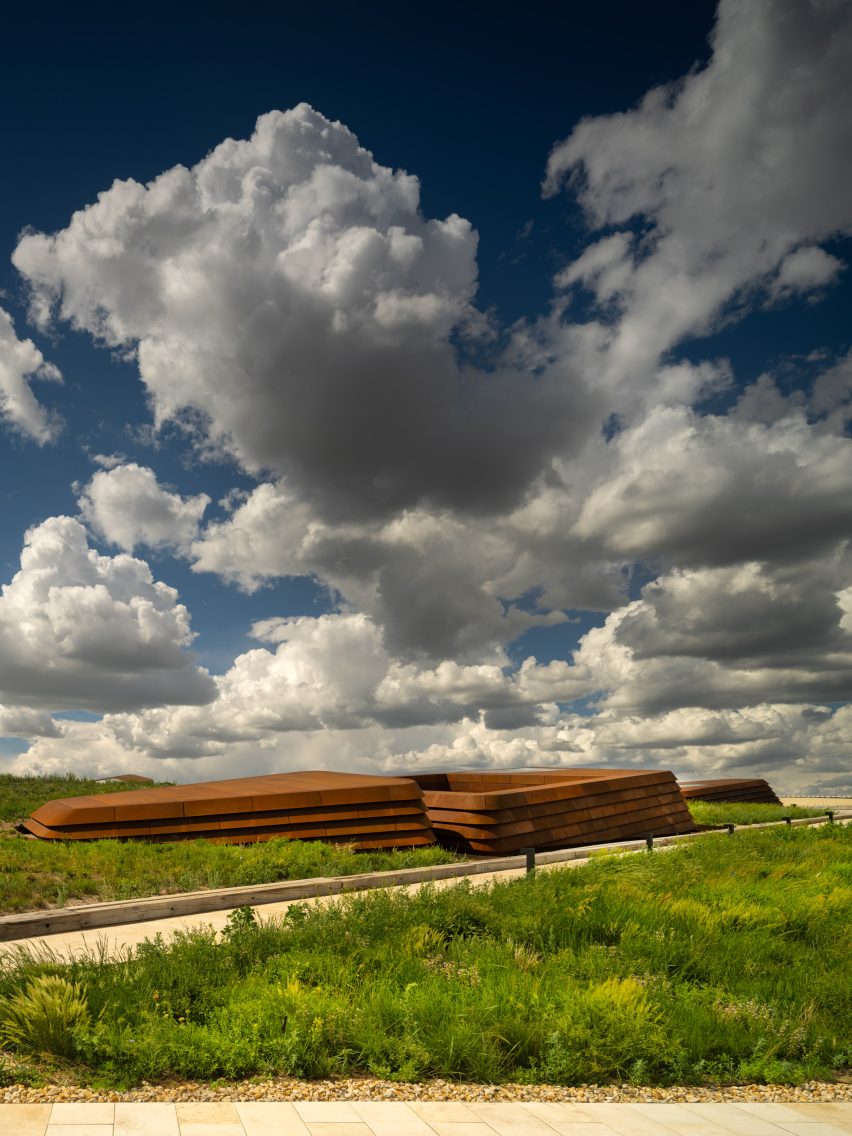
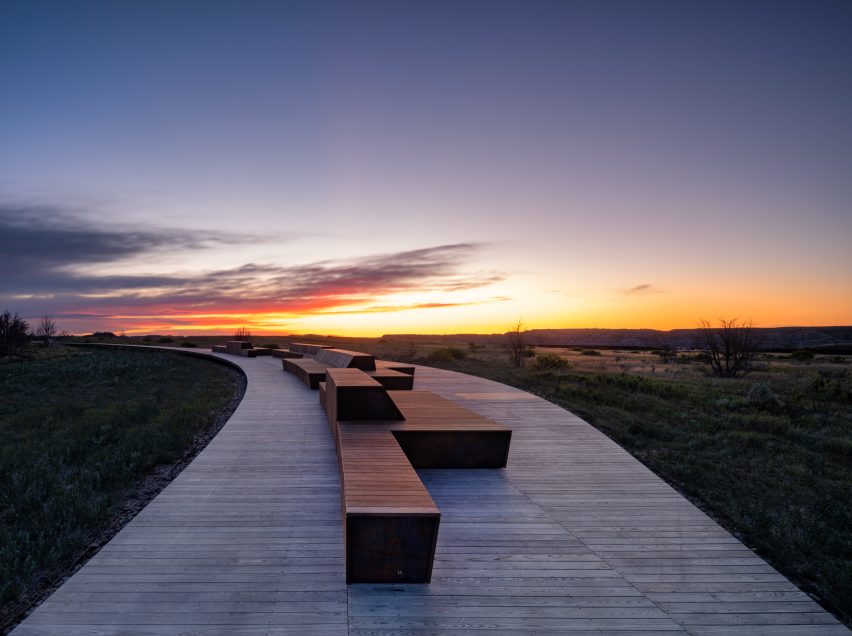
The rooftop also features plants gathered locally through Snøhetta's Native Plant Project. A series of planked and partially walled walkways and platforms branching out from the building allow visitors to view the landscape up close.
"It allowed us to preserve and protect much of the grasslands and work ultimately towards restoration," said Delk.

Unlike the recently completed Obama Presidential Center, TRPL is not an official presidential library administered by the government – it was funded by a group of private donors.
Lacking the external symbology of many memorializing buildings, the structure emphasises Roosevelt's centrality to the preservation movement in the US. At the same time, some of the exhibition spaces provide history and context to the historical figure.
Working with the descendants of Roosevelt, Snøhetta tried not to lionize the man, but rather to give visitors a canvas.
"He had a very challenging history regarding racism and in terms of Indigenous and tribal peoples, but he did quite a lot for his time, and in that sense, he helped build a platform for others in the future to do even better than what he was able to succeed with," said Dyker.
"One of the things this library is working on is trying not to lionize him as an individual to point out his imperfections, as well as what he did positively," he continued.
"We were able to build an incredibly advanced, environmentally sensitive building in a place that most people thought would never happen, and so it opens the door for people from both sides of the political spectrum to talk to each other."

The completion comes during the lead-up to America's celebration of the 250th anniversary of its Declaration of Independence. Other architectural items timed to the 250th celebrations include a list "irreplaceable" at-risk places across the country by World Monuments Fund.
The photography is by Nic Lehoux.
Project credits:
Project lead, design architect & landscape design architect: Snøhetta
Lead architects/designers: Craig Dykers, Michelle Delk, Matthew McMahon, Aaron Dorf, Kurt Marsh, Dan Marty, Prince Langley
Architect of record: JLG Architects (Johnson Laffen Galloway)
Landscape architect of record: Confluence
Contractor: JEDunn