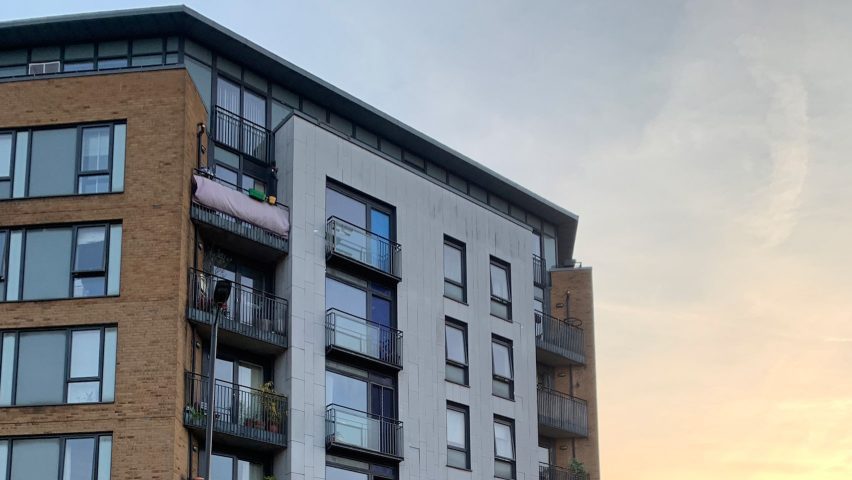
"If no one ever sits there, is a balcony still a balcony?"
Our cities are full of apartment blocks dotted with pathetically sized balconies too small to be of any actual use, writes Jessica Furseth.
If no one ever sits there, is a balcony still a balcony? I found myself pondering this question as I was walking the perimeter of the Isle of Dogs in East London, an area where new blocks of flats seem to pop up like mushrooms.
These river-facing balconies should have made a great place to sit on that lovely summer evening, but save for the occasional lone smoker, they appeared deserted. There's a simple explanation, of course: the balconies are just too small.
Developers know they can charge more for this ephemeral idea with only a tokenistic gesture towards it
You know the ones – they are absolutely everywhere in most major cities around the world. They're cut into the face of a housing block, or sometimes hanging off the wall, measuring little more than a metre deep and two across, often facing a loud and dusty road.
That's just enough space for you, during the initial property viewing, to step outside and exclaim, "Oh there's a balcony!" This is the best moment you'll ever have out on that thing, because it's too poky to be of any real use.
They fit a drying rack, maybe a bicycle (my ex had a bike stolen off his balcony three floors up, which was frankly impressive). You can just about squeeze in that dinky table and chair set from IKEA, the Tärnö that's advertised as "a perfect size for the balcony".
But this isn't Paris, where people survey the cityscape below over croissants and coffee – this is Hackney, where balconies with dirty railings are choking in the road dust from Mare Street, empty in the gorgeous sunset.
And yet, we continue to build them. The pandemic really impressed upon us the benefit of private outdoor space, as a place to enjoy fresh air without risk. It's not about the virus anymore, but perhaps some fear of the commons lingers.
Size notwithstanding, balconies do carry a lot of outdoor feelings – there's a sense of breathing space, and outdoor seclusion is a little exciting. Developers and estate agents know they can charge more for this ephemeral idea with only a tokenistic gesture towards it, whose practical uselessness is only revealed once we've moved in. By then, the money has already changed hands.
Even Juliet on her namesake balcony was close enough to speak to Romeo
Long before the pandemic pressed the issue of separate balconies, the idea was a feature in evolved societies: people should have decent housing, and if they can't have a garden they should at least have a veranda.
But while a concrete box on the 20th floor will provide air, it gives people none of the social functions of the garden. Even Juliet on her namesake balcony was close enough to speak to Romeo.
"At 100 feet, the balcony loses all social connection with the ground," writes Alistair Cartwright, an architectural historian at the University of Liverpool. "One cannot imagine calling up for a lapel pin and a loaf of bread to one of these postwar balconies, as the destitute poet Albert Llanas is said to have done to an old acquaintance in 1920s Barcelona."
Today, urban conversations about terraces are primarily about light and air, not connection to our neighbours and communities. National standards leave the details to local policies, but according to the London Housing Design Guide from the mayor of London, "private outside space is desirable in all circumstances". The total size depends on the number of occupants, but a balcony should always be at least 1.5 metres deep.
The guide does say that this space can be added to the inside of the house in exceptional circumstances. I would have loved that when I lived in Haggerston, east London, where I had a balcony I'm pretty sure was slimmer than regulation.
It faced a narrow courtyard like in the Alfred Hitchcock film Rear Window, and the sensation of surveillance was a strong deterrent from enjoyment. Adding insult to injury, that terrace also cut into my miniscule living room, and I would have far preferred to have that space inside instead.
Another option is to trade private outdoor space for more public amenities
In New York, the balconies are even tinier than in London – a report by Curbed found several examples at just 45 centimetres width, and not even IKEA can help you with that. Architect and zoning expert Walter Marin grew philosophical when asked by Curbed to comment on this level of stinginess, speculating that New York balconies may not actually be about spending time out there, but more like a cold plunge. The point is to step outside for a moment and take a deep breath, before heading back inside.
Even as people admit to getting little use out of their diminutive balconies, I've found my suggestion to get rid of them altogether a hard sell. ("It's not great, but it's fine," my boyfriend Tom said about his ridiculous terrace, a trifle defensively.)
But there are alternatives. On a recent train journey out of Waterloo station I noticed how balconies facing the rail tracks were enclosed to protect them from noise and dust. Part of the new developments in Nine Elms, south London, these glazed, ventilated winter gardens are a way to enjoy such space year-round, wasting nothing.
Other countries are also building these enclosed terraces. A walk past new waterfront developments in Tallinn, Estonia, for example, will showcase dozens of buildings with balconies featuring a glass pane that can be opened or closed depending on the weather. A tiny balcony thus becomes a light-filled bonus room in winter, when the temperature can stay below freezing for months at a time.
Another option is to trade private outdoor space for more public amenities. Maybe you don't get your own balcony, but there's a roof garden, or a new park nearby. In south London, Lambeth Council requires new developments to have at least 50 square metres of shared amenity space, in addition to 10 square metres of private balcony space per flat.
Many London councils have similar rules to Lambeth where, if amenity space can't be provided on-site, the money can go to an off-site provision. The challenge, as ever, is ensuring that what gets delivered is of sufficient quality – there are also far too many bleak, concreted plazas permanently in the shade.
It might be better to put that square footage back inside homes where it can be of use
I gave up on tiny balconies for good after my Hitchcock situation in Haggerston. These days I prefer going to the park – even though I share it with innumerable dogs and runners (both off-leash and equally prone to bumping into you), I far prefer the greenery and feeling of open space.
Private terraces for all is a nice idea, but it doesn't seem to be working for people; we're just not using our tiny balconies. Yes, we need outdoor space, but they aren't meeting our needs.
It might be better to put that square footage back inside homes where it can be of use, and turn our focus towards making better communal outdoor space. If given a choice between a useless balcony where I'm alone with my drying rack, or a green garden shared with my neighbours, I know what I'd choose.
Jessica Furseth is a journalist based in London. Her writing has appeared in The Guardian, Vox, Time Out, Huck, The Cut, Atlas Obscura, Vice, The Independent, and elsewhere.
The photo is by Jessica Furseth.
Dezeen In Depth
If you enjoy reading Dezeen's interviews, opinions and features, subscribe to Dezeen In Depth. Sent on the last Friday of each month, this newsletter provides a single place to read about the design and architecture stories behind the headlines.