


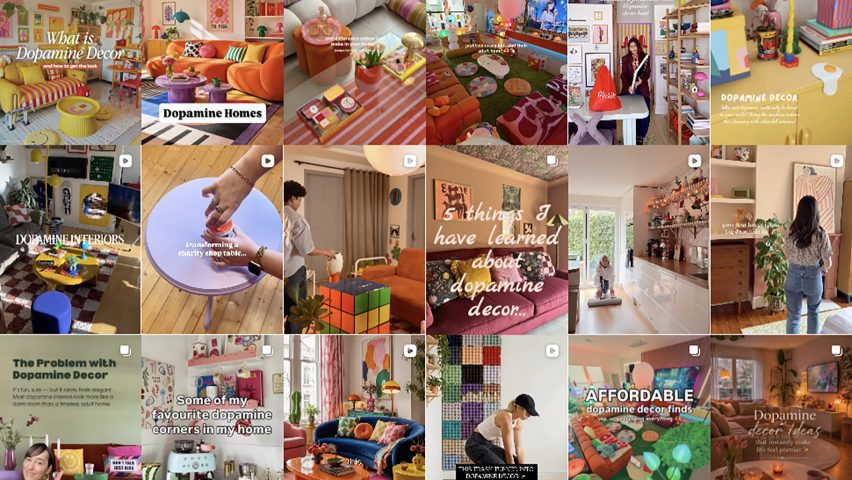
The "dopamine decor" interiors trend is taking social media by storm, but it's just another disingenuous dressing-up of superficial style as life-improving experience, writes Julie Lasky.
For some time now, the internet has labeled a maximalist decorating trend that embraces candy colors, fuzzy textures and whimsical furnishings "dopamine decor". The reference is, of course, to neuroscience, and supporters claim that the style, which, like many interiors ideas, has its roots in fashion, produces a genuine emotional uplift.
The look is energetic and often charming. Seen on social media, it leaves a stubborn pink glow in the mind as one moves on to a cake-fail video.
For every white-paint-loving minimalist, there has always been a Barbie with a hot-pink dream house
Books celebrate it, too. In April, Rachel Varney, who has an Instagram called The Shoestring Home, published Dopamine Home (Mobius). The publicist described it as "the ultimate mood-boosting guide filled with color know how, creative hacks and cost saving tips and tricks". The central image on the bubblegum-pink cover is of a squiggle-based glass coffee table supporting a ceramic fruit bowl shaped like a bunch of bananas.
And now, Maitri Mody, a New York-based designer whose Instagram is called Honey I Dressed the Pug, is coming out in late August with Dopamine Design: Creating a Home That Makes You Happy (Ten Speed Press). Her goal is to teach readers that they are not chained to conformity but can break away and pursue their own idiosyncratic, ecstatic visions.
"For years, design trends worshiped minimalism," Mody writes, in prose that has the rhythmic cadences and offbeat assertions associated with generative AI. (A detection tool backed me up on that suspicion, though Mody denies using AI to write the book.)
"White walls, neutral furniture, and barely-there decor dominated Instagram feeds and Pinterest boards. But let's be honest – minimalism isn't for everyone. It's a look, not a feeling. Dopamine design flips the script. It's not about following rules or trends. It's about creating a home that celebrates your quirks, your story, and your joy."
Let me pause here to raise an eyebrow at the description of minimalism as "a look, not a feeling". Even its haters describe it as cold, which is most certainly a feeling.
I also object to the use of the color white as a straw man. For every white-paint-loving minimalist like, say, John Pawson, there has always been a Barbie with a hot-pink dream house.
Dopamine decor is said to have influenced the look of food packaging in real life
Let me add that I met Mody in person a few years ago, while she was exhibiting a checkerboard-patterned kitchen with cabinet pulls that looked like carrots, and found her very nice. It is not my intention to whimsy-shame anyone. But given the commoditization of health in everything from peptides to bathing culture, I find it icky to glibly invoke brain chemistry in the marketing of style.
Dopamine decor claims to celebrate individuality, though it's driven by repetitive social media images. It is aimed at adults, though its tutti-frutti, cutesy-naive examples look incontrovertibly juvenile.
It purports to stimulate happy brain chemicals, at a time when, in the US, public health movements are being eviscerated by deranged officials. "'Dopamine decor' can boost your mood," the Washington Post declared last year, like a snake-oil salesman. Well, so can a bucket of tiramisu, until the sugar high lets you down.
The most disingenuous thing about this trend is the pretense that images on a screen or in a book represent plausible experience. The photos are filtered, cropped and disjointed. They whiz by, just like an endorphin rush. Dopamine decor is said to have influenced the look of food packaging in real life, but food packages are quickly thrown away.
What are the long-term effects of living with frenetic decorating choices? Do they lose their happy juice over time? Do they get on one's nerves? Do they drive one insane?
Yes, said Ashley Couto, who wrote an article for Business Insider magazine last year with the headline: "I redid my space with color and 'dopamine decor' designed to bring me joy. It worked at first, but I already hate it."
A style touted as authentic and livable can't seem to shed its performative, Instagram-y nature
This would not surprise Andréa de Paiva, a Brazilian architect who specializes in the relationship between neuroscience and building design. In a cautionary article about dopamine decor on the website of her organization, NeuroAU, she writes: "Instead of thoughtfully enhancing the environment to support well-being, these spaces risk overwhelming the senses, potentially leading to fatigue, distraction, or even stress rather than joy and motivation."
De Paiva urges designers to be responsible with terminology, especially when it comes to applied science: "Titles like Dopamine Design or even NeuroArchitecture can be intriguing and marketable, but they should not be used as buzzwords to sell incomplete or oversimplified ideas."
Still, you don't need to be a brain surgeon to recognize that a style touted as authentic and livable can't seem to shed its performative, Instagram-y nature. According to Marianne Plaisance, a graphic designer and photographer featured in Modi's book, some of her YouTube followers thought her space looked AI-generated.
She took it as a compliment.
Julie Lasky is New York-based a journalist and critic specialising in design, architecture and urbanism. She was previously deputy editor of The New York Times' weekly Home and Garden section, the editor of Change Observer, editor-in-chief of ID magazine and editor of Interiors magazine. She is also a part-time assistant professor at Parsons School of Design.
The image is a screengrab taken from Instagram.
Dezeen In Depth
If you enjoy reading Dezeen's interviews, opinions and features, subscribe to Dezeen In Depth. Sent on the last Friday of each month, this newsletter provides a single place to read about the design and architecture stories behind the headlines.