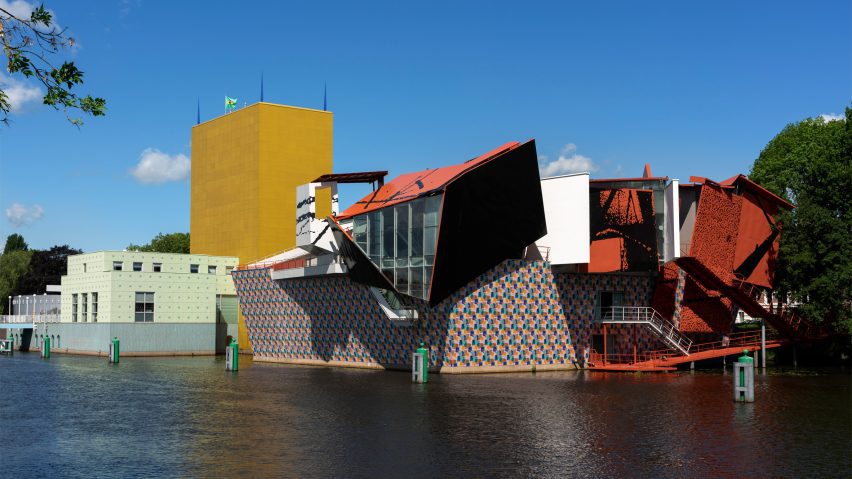
Groninger Museum "deserves to be more famous" says artistic director Roos Gortzak
With a renewed focus on contemporary art, Groninger Museum artistic director Roos Gortzak is seeking closer connection between the extraordinary postmodern building, she says in this interview.
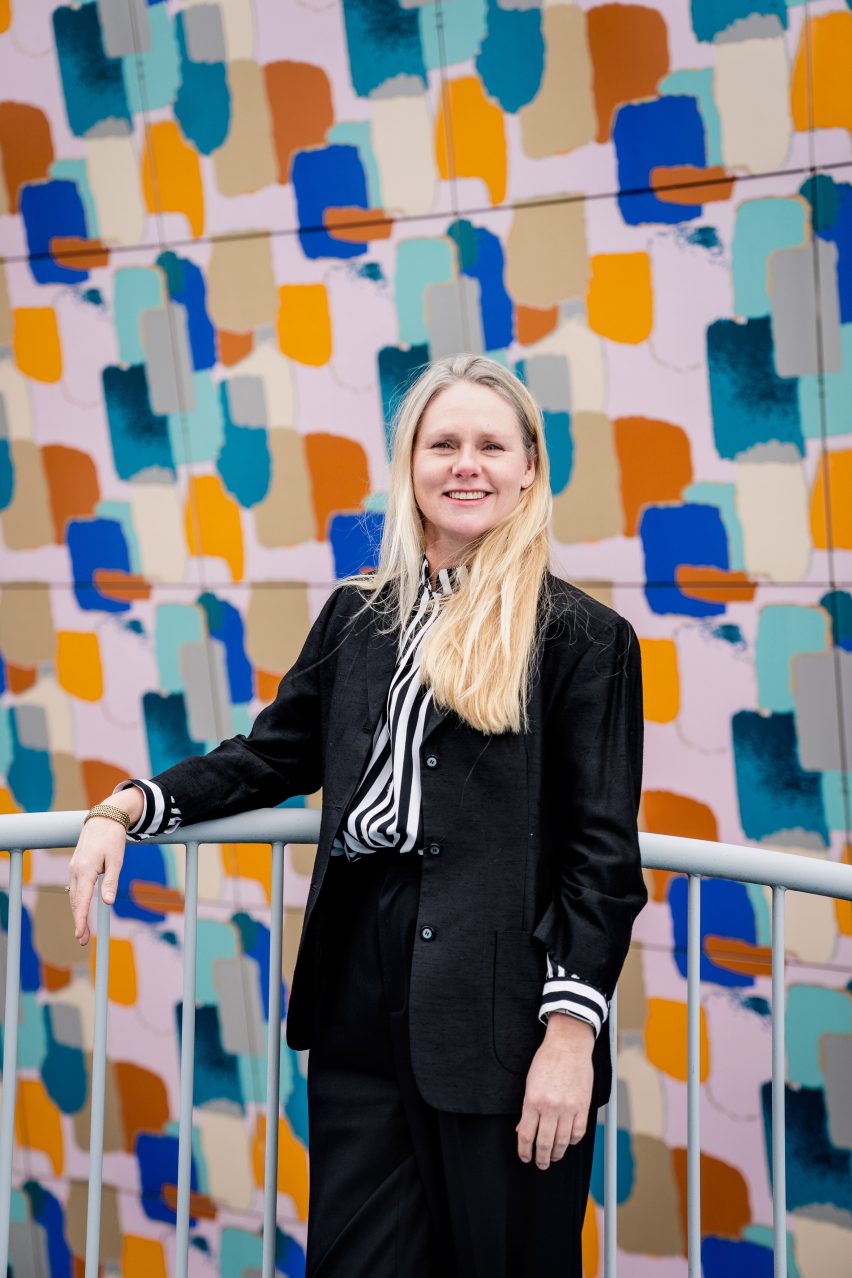
"I think you always have to start as a curator with where you're at – so I would never have made the same artistic course somewhere else as I'm doing here," Gortzak tells Dezeen.
"Some museums are so neutral that maybe you could kind of be anywhere, but with our building, there's no way to get around the building."
Opened in 1994, the Groninger Museum in Groningen, the Netherlands, is totally unique.
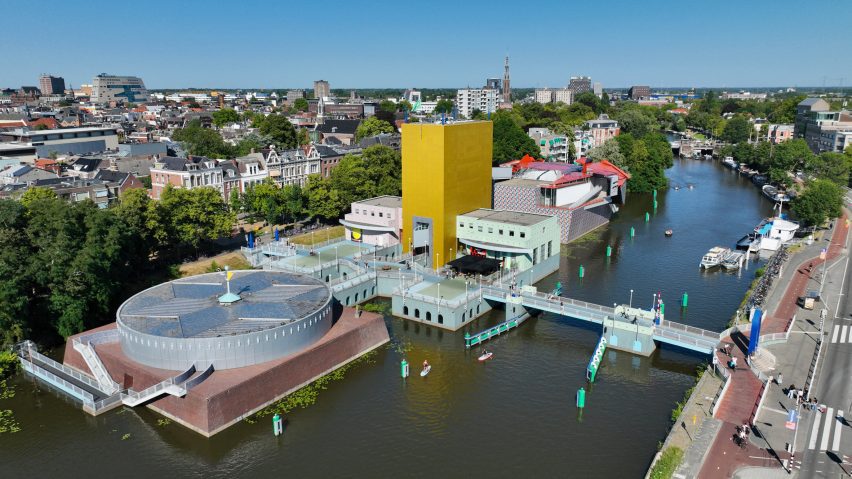
In a classic postmodern twist, it was conceived as three bridge-connected pavilions, each designed by a separate architect given plenty of creative freedom.
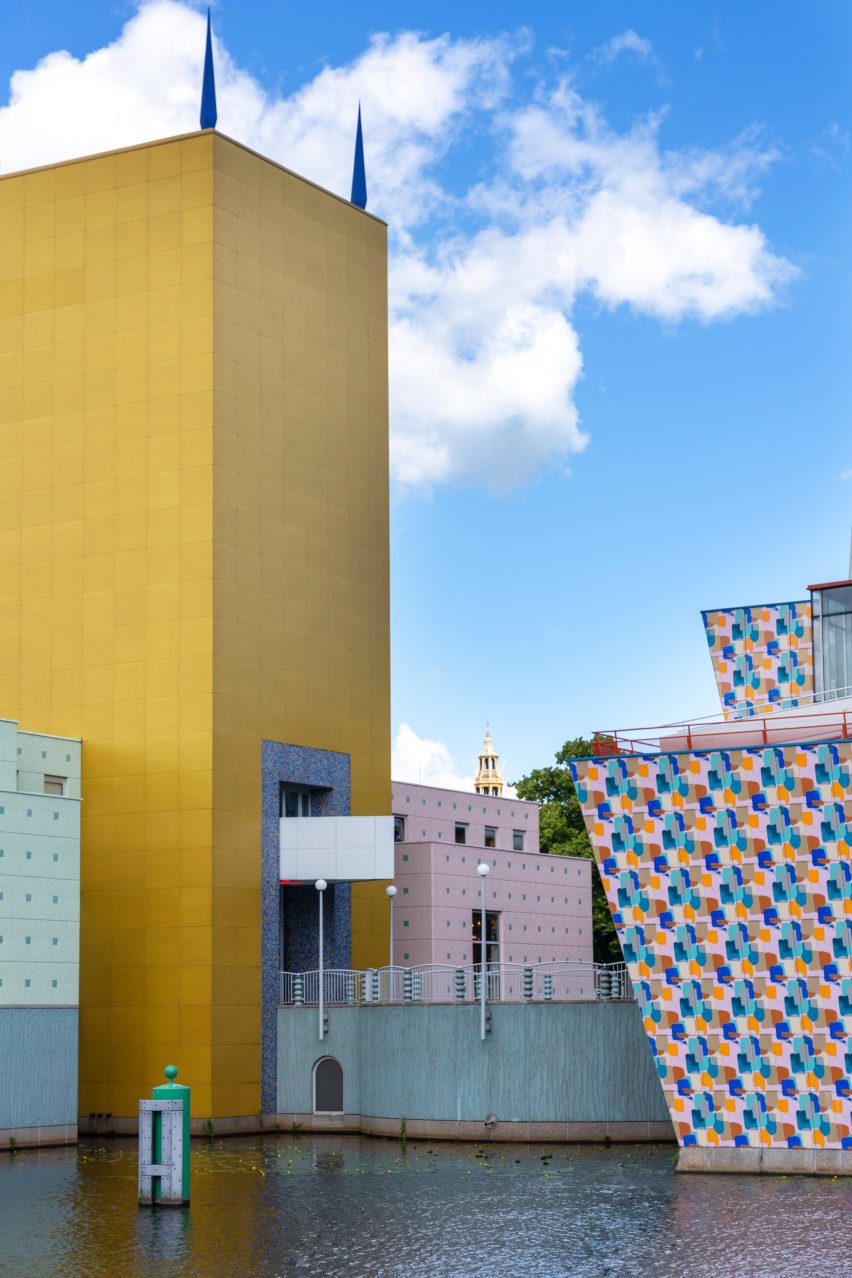
Italian designer and architect Alessandro Mendini, coordinating the project, erected a windowless yellow tower at the centre flanked by two volumes, one pink and one green.
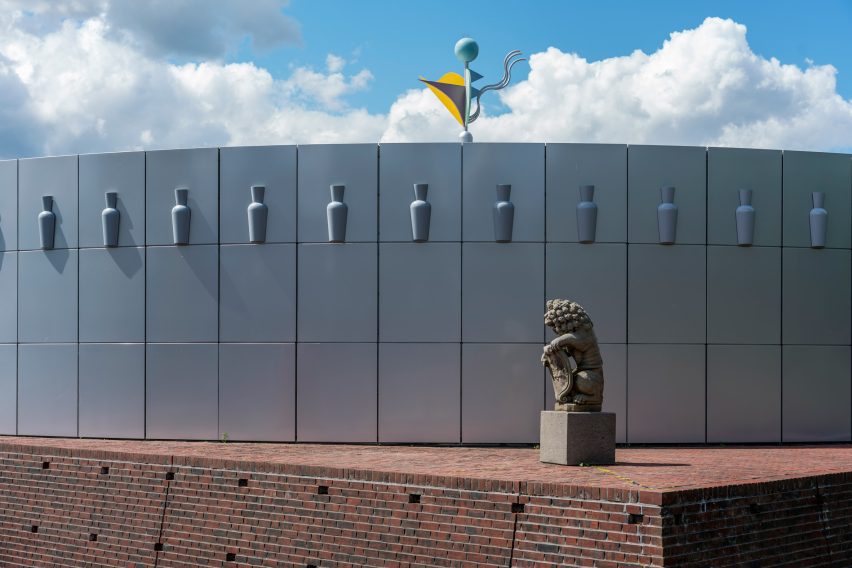
On one side of this central structure lies a shiny metal cylinder designed by French designer Philippe Starck, sitting atop a fort-like brick plinth by Memphis Group member Michele De Lucchi.
And on the other, a madcap deconstructivist building by Austrian firm Coop Himmelb(l)au, bursting with colour and bursting out of itself.
"Very resonant with our times"
Despite its eye-popping architecture, and despite occupying a prominent spot in Groningen on an island in the canal linking the main station to the city centre, the museum has had nothing like the impact of Frank Gehry's Guggenheim Bilbao, which opened three years later.
"It totally deserves to be more famous," Gortzak enthused.
"I'm never that interested in fame in and of itself," she added. "But I think there are so many important values that should be shared within these times, where people are more afraid of life in general, and of neighbours who might vote for other parties, and how do you find each other again, how do you connect?"
"I think all of these things are within this building, which I find exciting, and that's why I think it deserves indeed to be more well known, and be an example for many other museums."
It's a "very difficult moment" for museums generally, she added, with many facing declining visitor numbers and intensifying funding pressures.
"There's many ways to spend your free time, and also many ways to inform yourself, and so I think it's not self-evident to go to a museum," said Gortzak.
"I don't think that's a bad thing, but it's something you have to take into account developing new stories for museums," she added. "It's very important to think about how you can keep a museum relevant in these times."
Gortzak's career as an art curator and critic spans more than 25 years and multiple nations. She joined the Groninger in February 2025, having previously spent a decade as director of the Vleeshal Center for Contemporary Art in Middelburg, at the other end of the country.
Now fully settled in, she is setting out her long-term vision for the institution, with renewed programming beginning in September.
"It's going back to the future, examining the DNA of the iconic postmodern building, and proposes radically remembering the path that was laid in the 1990s when contemporary art was at the centre of the programming, and recommitting to this approach," Gortzak explained.
"Your difference is welcome here"
In deciding the future direction of the museum's curation she has taken its architecture as a starting point, inferring three core values from the building: "experimental"; "interdisciplinary"; "collective".
"The core values of the building are very resonant with our times," she remarked.
Part of her ambition is to redress an imbalance in the types of creative voices that have historically been platformed at the Groninger – not least through the fact it was designed by four men.
As a result, the new programme will involve acquiring contemporary art that is mainly woman- or non-binary-led, which she says have previously been "sorely missing from the conversation".
She considers the push for greater diversity to be wholly in-keeping with the museum's collaborative approach to architecture.
"It's already ingrained within the building to not be afraid of different voices," she said. "As opposed to one voice who tells you what art capital 'A' is, or architecture capital 'A' is, it's already really going against that."
"A museum is a place for everyone to go to, where many voices can be heard, and the museum is kind of screaming 'your difference is welcome here' through the building."
For Gortzak, the connections between the museum's architecture and contemporary art don't stop there, however.
She also notes, for instance, that unlike many art museums where a staircase leads up from the entrance hall into the exhibitions, visitors at the Groninger must head downstairs.
"So it's going away from this idea where you have to go up and be elevated through art," she said. "It's kind of saying art's everywhere, and you go down to find it."
Meanwhile, the building is easy to get lost in by design – with Gortzak drawing a parallel with the challenging nature of contemporary art.
"You don't always have to like or understand something," she said. "It's so important to be in spaces where you are confronted with something else, and maybe you feel uncomfortable, but that's good."
Gortzak also points to an element of the building's backstory. The Coop Himmelb(l)au pavilion was initially supposed to be designed by American artist Frank Stella.
But after more than a year of work, his plan to build a structure entirely out of Teflon was deemed too expensive, and abandoned.
"This experiment, I think, that's very radical and it's very exciting," said Gortzak. "And things should also be able to fail. Not everything has to be successful, and I think art needs to create that space for that, and contemporary art also."
"We're looking for the voices that were unheard"
Some aspects of the building's design have shown themselves to be ahead of the curve, Gortzak suggests.
For example, Mendini prescribed a palette of 22 different colours that could be selected for exhibition walls – a clear divergence from the traditional white, which many other galleries are also now moving away from.
"But with us, it's not just like adding a decorative layer," said Gortzak. "It's actually part of the conceptual core of the building."
Other elements can be challenging – such as the presence of curved walls in two of the exhibition spaces, though Gortzak insists she enjoys the challenge.
The museum's new programme will commence next month with four interconnected exhibitions opening simultaneously.
One of them is entitled The Architect and the Housewife: Cleaning the House, Building the Future.
It will explore power dynamics in daily and domestic life, as well as some of the similarities between the behind-the-scenes problem-solving of architecture and of housework.
Exhibits will include a model of Zaha Hadid's Music Video Pavilion – an installation for a 1990 festival in Groningen – and a collection of 98 vases made by Mendini and decorated by a series of designers, including himself working under a female pseudonym.
For a year the museum's programme will revolve around the two characters of the architect and the housewife, as a springboard for discussions about who is allowed to think big, and how creative endeavours can be balanced with the demands of the everyday.
"In our times where we're looking for the voices that were unheard, the histories that were unseen, the unspoken role of invisible labour, I think it's super exciting to be with this building that has all of that in it," said Gortzak.
The photography is courtesy of the Groninger Museum.
Dezeen In Depth
If you enjoy reading Dezeen's interviews, opinions and features, subscribe to Dezeen In Depth. Sent on the last Friday of each month, this newsletter provides a single place to read about the design and architecture stories behind the headlines.