BA Graphic Design at Florence Institute of Design International
The BA Graphic Design course at Florence Institute of Design International enables students to gain an understanding of the correlation between technology, graphic design, visual culture and politics.
Course details
School: Florence Institute of Design International
Course: BA Graphic Design
Type: undergraduate
Location: Florence, Italy
Course dates: September 2026 to May 2029; or January 2027 to December 2029
Course overview
The BA (Hons) Graphic Design program at Florence Institute of Design International combines graphic design, visual communication and digital media within the artistic and cultural environment of Florence, Italy.
Taught entirely in English, the three-year program encourages students to develop their individual creative voice through research, experimentation, conceptual thinking and technical practice.
Students explore the relationships between graphic design, technology, visual culture and society, developing an understanding of how design communicates ideas and influences contemporary culture.
The program draws inspiration from Florence’s artistic heritage and the legacy of Italian and international design. This cultural context informs a contemporary approach to design education, combining historical awareness with emerging technologies and creative practices.
Studio-based teaching emphasises individual projects, creative problem-solving and the progressive development of technical and conceptual skills. Students are encouraged to establish their own design identity
What will I learn during this course?
First year – design foundations:
The first year introduces the fundamental principles of graphic design and visual communication.
Students explore typography, composition, color theory, analytical drawing, design research and concept development, supported by Art and Design Theory.
Individual studio assignments encourage experimentation and the development of visual communication skills.
Second year – graphic design and digital media:
The second year provides a more advanced exploration of graphic design while introducing digital media. Students undertake increasingly complex projects involving detailed client briefs, visual identity systems, branding strategies and creative problem-solving.
Courses in Interactive Media, Moving Images and Digital Photography extend students’ practice into digital communication, video, animation and photographic imagery.
Art and Design Theory further develops students’ understanding of the cultural and theoretical contexts of contemporary design.
Third year – independent research and professional practice:
The final year emphasizes advanced design development, independent research and professional practice.
Courses in digital illustration and multimedia expand students’ creative and technical abilities across contemporary forms of visual communication, including interactive and emerging digital media.
The design research project forms the central component of the final year.
Students develop a substantial, self-directed graphic design project, progressing from initial research and conceptual exploration to a resolved design proposal and final presentation.
Professional practice supports students in preparing for careers in the creative industries, including portfolio development and the presentation of their individual design work.
The BA (Hons) Graphic Design degree is awarded by Goldsmiths, University of London, through its academic partnership with Florence Institute of Design International.
What are the requirements?
- academic ability: a minimum of 112 UCAS points from three GCE A-Levels [BBC/BCC] or equivalent
- studies in visual arts: the visual arts training should be during one of the two final years of high school (A2 Level art design, fine art or photography) or a portfolio of visual arts at the correct skill level through 150 hours
- proof of English skills: IELTS of 6.5 or IELTS score of 6.0 with no less than 5.5 in any band or PTE, TOEFL, TOEIC equivalent
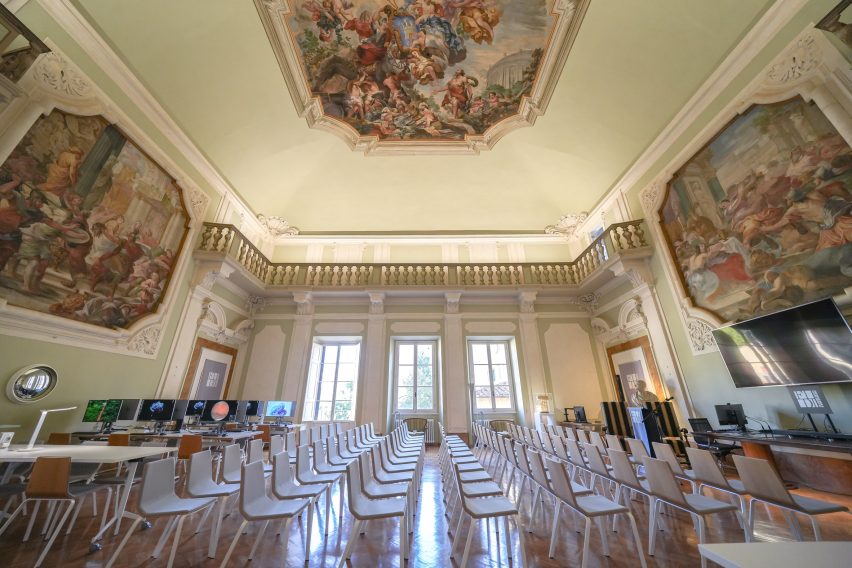
What facilities and resources are available? - computer labs, two photography studios featuring professional lighting, backdrops, and camera equipment for product, portrait and architectural photography
- library and VLeBooks, offering access to an extensive collection of books, journals, and digital publications covering architecture, interior design, graphic design, art and design theory
- materials library, providing a curated selection of finishes, textiles, woods, metals and plastics
- digital fabrication facilities, including large-format 3D printers and CNC Equipment for rapid prototyping and model making and precision cutting and fabrication of small-format colour printing for posters, and presentations, modelmaking workshop with space and equipment for constructing physical prototypes and presentation models
- Moodle Virtual Learning Environment (VLE), providing access to module materials, lecture notes, assignment submissions, assessment feedback, recorded resources and communication with tutors
What career prospects can I expect upon graduating?
Students completing the BA Graphic Design can expect to develop the professional skills, creative confidence and technical competence required for entry-level roles within the international graphic design and visual communication industries.
Graduates are prepared for careers in areas such as: graphic designer, brand identity designer, digital designer/visual communication designer, editorial designer, art director, UX/UI design assistant, illustrator/motion graphics designer, freelance graphic designer.
The course also provides a strong foundation for graduates wishing to continue their studies at postgraduate level in areas such as graphic design, visual communication, branding, digital media or related creative disciplines.
Through studio-based learning, professional practice activities, portfolio development and exposure to contemporary design processes, graduates are equipped to enter a competitive creative industry where employers increasingly value conceptual thinking, problem-solving abilities and cultural awareness.