Design "has to touch more than one sense" say Villeroy & Boch and Ideal Standard
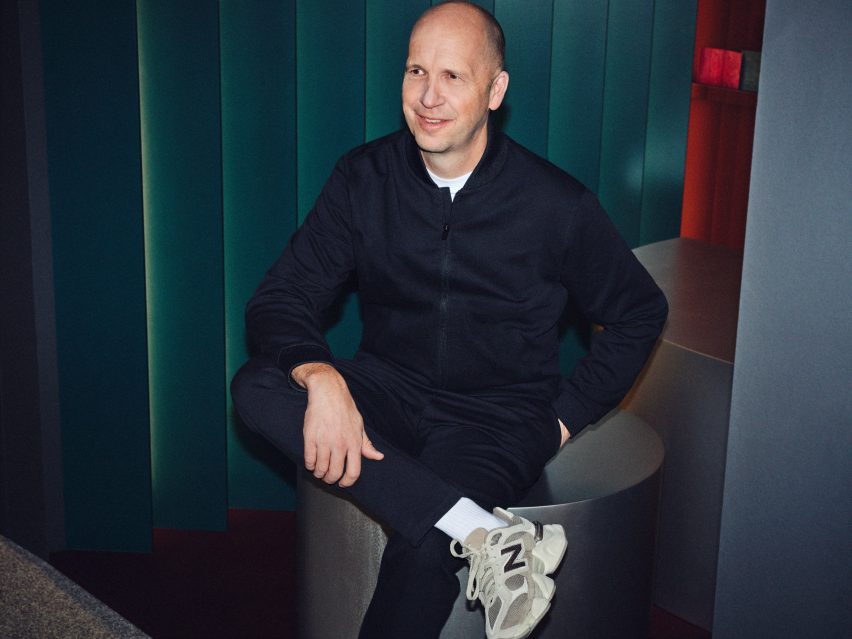
Bathroom design needs to move beyond static form to focus on sensory experience, says Sven Ullrich in this video interview produced by Dezeen for Villeroy & Boch and Ideal Standard.
Ullrich, who is Villeroy & Boch Group executive vice president of product and marketing, described the brands' Design Continuum exhibition during Milan design week as an attempt to shift attention away from objects and towards how spaces are experienced.
Rather than presenting products in isolation, the exhibition was conceived as a series of interconnected environments that focus on atmosphere, interaction and perception.
"It's less about the pure form – it's really about materials, colours, textures," Ullrich said. "But it's also about the interaction of people in the installation."
Created in collaboration with design agency Elastique, Design Continuum was presented in five rooms and combined projection, sound, texture and scent.
The spaces were designed to overlap visually and acoustically, allowing visitors to experience multiple environments at once rather than moving through clearly separated zones.
Ullrich described this as a deliberate attempt to move away from fixed viewpoints towards a more fluid understanding of space, shaped by movement and interaction.

He emphasised that immersive design must engage multiple senses rather than relying on visual form alone.
"You hear the sound and the interaction of other installations while you walk around," he said. "You focus on one installation, but you always get a glimpse of the other."

This idea of continuity ran throughout the exhibition, suggesting that design is defined not by individual objects, but by how people encounter and respond to a space as a whole.
Across the installation, visual elements were combined with sound, scent and tactility to create layered sensory experiences.
In one space, a 3D-printed washbasin made from recycled ceramic was paired with a silo that released fine sand, triggering projection mapping that visualised the transformation of discarded material into new products.
Elsewhere, ribbed basins could be rotated by visitors, causing projected colours and patterns to shift in response.

These interactions aimed to position the visitor as an active participant, shaping the environment through movement rather than passively observing it.
"When we say it's an immersive installation, it always has to touch more than one sense," said Ullrich.

Sound also played a key role in defining each space, with purpose-built soundscapes used to create distinct atmospheres and guide movement through the exhibition.
Other spaces extended this sensory approach through scent and tactility, with fragranced environments and textured ceramic surfaces designed to heighten perception and create what Ullrich described as an "attraction to the senses".
Ceramics formed the foundation of the exhibition, reflecting the shared heritage of Villeroy & Boch and Ideal Standard.
Rather than presenting the material in a conventional product-focused context, the Design Continuum exhibition explored how ceramics could operate within broader spatial and sensory compositions.

"Ceramics are one of the most historical and the most natural materials you have in architecture," Ullrich said, describing it as "the root of our company".
By combining traditional materials with interactive and atmospheric elements, the exhibition suggested a shift in bathroom design away from purely functional or visual considerations towards environments defined by how they are felt and experienced.
Design Continuum took place from 21 to 26 April 2026 at Foro Buonaparte 70, 20121 Milan, Italy. See Dezeen Events Guide for more architecture and design events around the world.
Partnership content
This video was produced for Villeroy & Boch and Ideal Standard as part of a partnership. Find out more about our partnership content here.