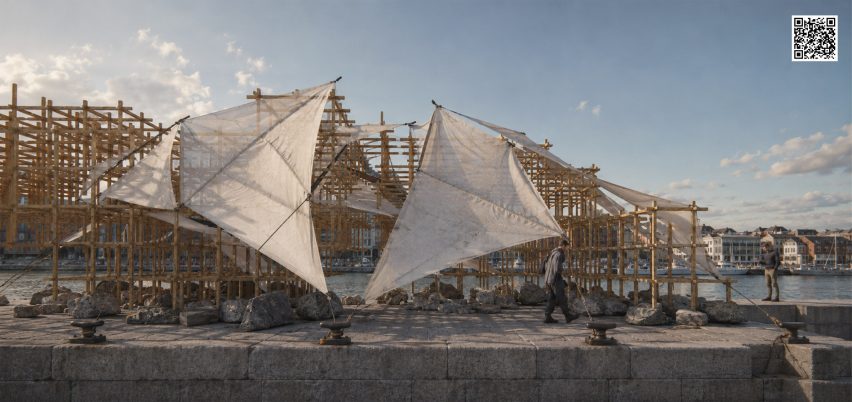
Waterfront repair and craft hub among projects from University of Plymouth
Dezeen School Shows: a proposal for a waterside repair and reuse hub exploring craft, material reuse and environmental stewardship is among projects from the University of Plymouth.
Also featured is a regenerative laboratory restoring Plymouth Sound’s seabed and a proposal to transform polluted harbour water into a resource for marine research, industry and public engagement.
University of Plymouth
Institution: University of Plymouth
School: School of Art, Design and Architecture
Course: BA (Hons) Architecture and Master of Architecture
Tutors: Alessandro Aurigi, Nikolina Bobic, Ricky Burke, Graham Devine, Mathew Emmett, Andy Humphreys and Sana Murrani
School statement:
“Architecture at the University of Plymouth is explored as a civic, environmental and material practice. The work asks how buildings, landscapes and institutions can support social and ecological life, and how design can shape futures responsive to the conditions of the present.
“Across undergraduate and postgraduate projects, students examine architecture as a way of connecting people, resources, knowledge and place.
“The projects showcased here focus on two settings of civic and environmental consequence in Plymouth: the working waterfront and the university campus.
“Postgraduate students worked through live engagement with Plymouth Fisheries and related stakeholders to reimagine the Fish Quay after the closure of the fish auction, asking how waterfront renewal might support the coexistence of small-scale fisheries, public access, marine ecology, local food economies and climate adaptation.
“Undergraduate students examined the university as a contested civic and knowledge institution through projects centred on the Students’ Union, Campus Park and wider city connections.
“Throughout, architecture is framed as relationships between labour and ecology, institution and public life, material systems and long-term stewardship.
“Proposals for adaptive reuse, flexible adaptation and low-carbon material systems rethink how buildings are occupied, maintained and shared, supporting practices that can change over time.”
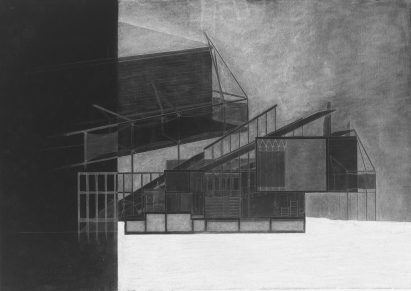
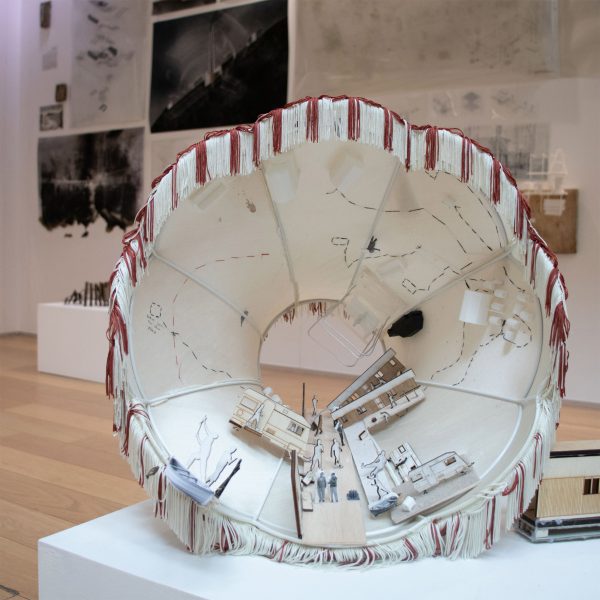
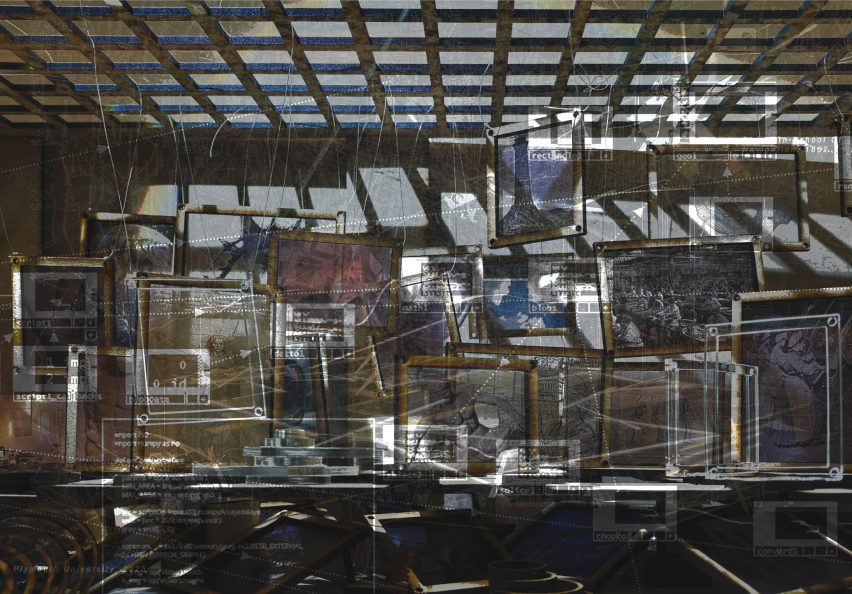
Aperture Obscura: Mechanisms of Perception by Libby Volokh
“Aperture Obscura positions itself within Plymouth’s reconstructed civic landscape as a mediator between everyday urban life and the distant realities of contemporary conflict and displacement.
“Located on Armada Way, a post-war axis shaped by wartime destruction and institutional reconstruction, the project explores how architecture can hold unresolved histories and present anxieties simultaneously.
“Through film, archive, and collective occupation, it seeks to recover voices obscured by conflict, drawing on the work of Martha Rosler, Paul Virilio and Gilles Deleuze.
“The adaptive reuse of the abandoned Salvation Army Congress Hall resists demolition, material extraction, replacement and civic erasure through reconstruction.”
Student: Libby Volokh
Course: ARCH6002 Design Studio and Professional Practice, BA (Hons) Architecture
Tutors: Mathew Emmett and Nikolina Bobic
Email: elizabethvolokh[at]gmail.com
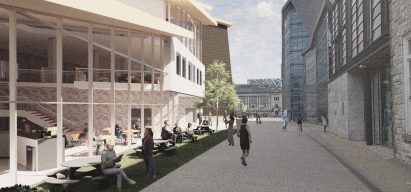
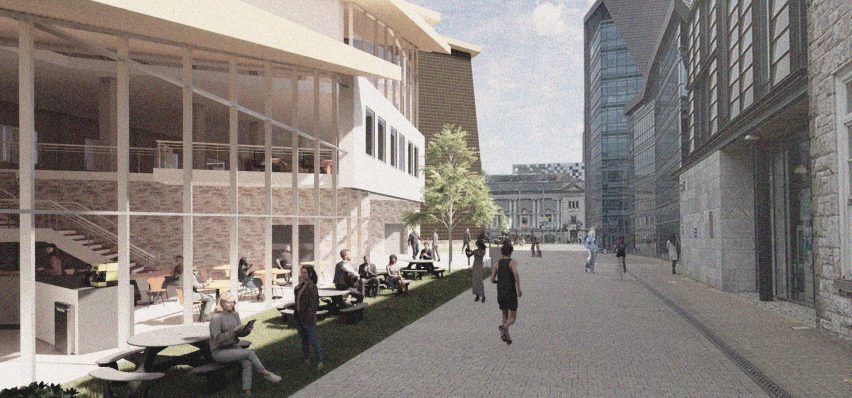
Civic Assemblage by Ciaran Halpin
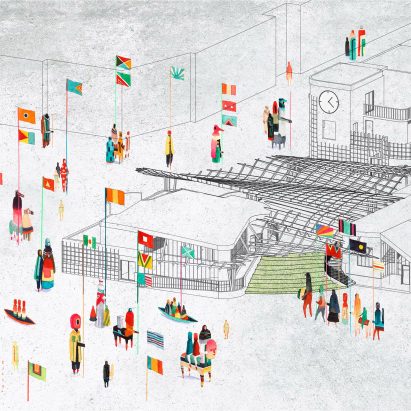
“What is the future role of the university? As institutions increasingly advocate lifelong learning, existing pedagogical frameworks struggle to support evolving relationships between education, industry and public life.
“Conventional models of teaching risk becoming isolated from the realities of material production and civic engagement.
“The Civic Assemblage emerges as an investigation into this condition, reimagining the university as an open, collaborative framework where making, learning and industry converge, thereby activating public participation and positioning education as a catalyst for social and urban transformation across Plymouth.”
Student: Ciaran Halpin
Course: ARCH6002 Design Studio and Professional Practice, BA (Hons) Architecture
Tutors: Ricky Burke and Alessandro Aurigi
Email: ciaran.halpin[at]outlook.com
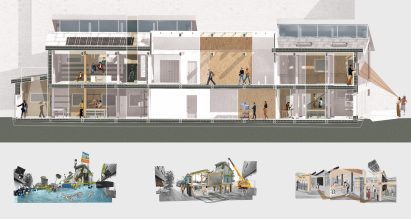
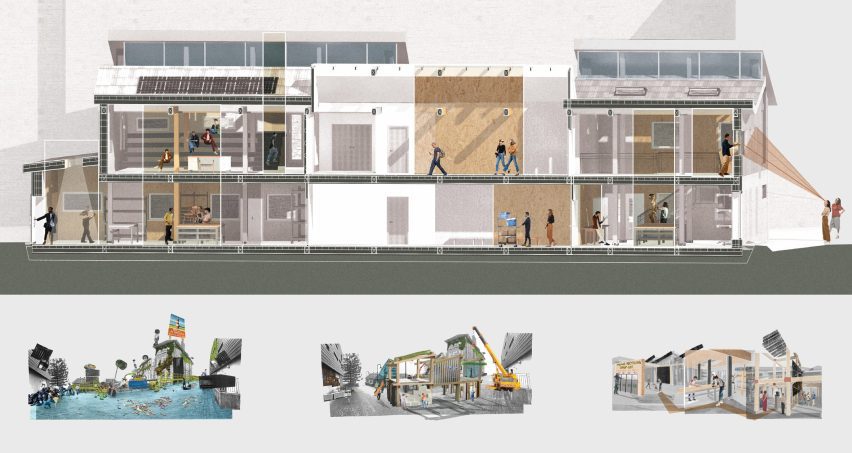
Second Nature: Learning through Waste, Repair and Reuse by Holly Salmons
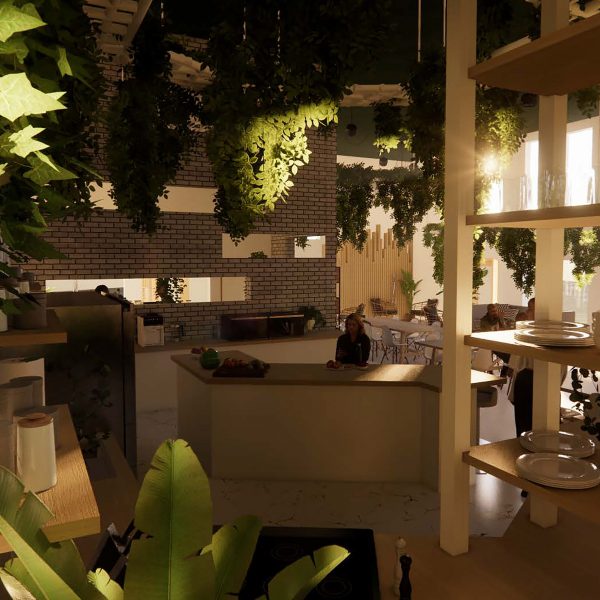
“This project addresses the UK’s lack of education, responsibility and accountability around waste and recycling at both a national and domestic scale.
“Situated on the university’s existing recycling centre, the project will localise the education and practice of upcycling and reuse.
“By involving students and the residents of Plymouth in practical lessons, and by making the sustainable, circular material processes that take place on site visible and integrated into public space, the project aims to change behaviours and attitudes towards over-consumption and carelessness regarding waste and recycling.”
Student: Holly Salmons
Course: ARCH6002 Design Studio and Professional Practice, BA (Hons) Architecture
Tutors: Andy Humphreys and Graham Devine
Email: hollsjs8[at]gmail.com
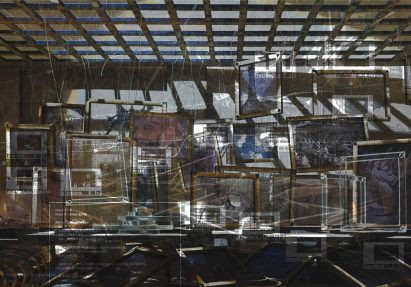
Pathologies of Place: Echoes of the Flesh by Freya Marchant
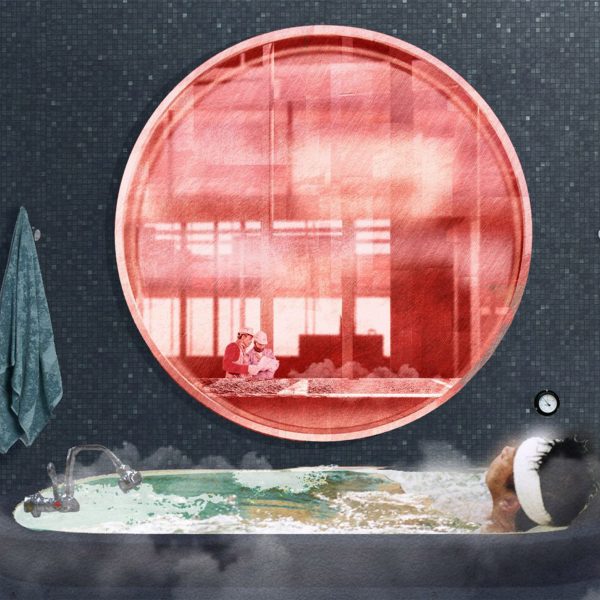
“Pathologies of Place retells narratives of bodies denied autonomy within Plymouth on both literal and socio-political levels.
“Examining the trajectory of the body, the project explores how certain bodies are pathologised and regulated through systems of care, control and spatial organisation, critiquing the influence of the Abercrombie Plan and scientific advancement in shaping perceptions of the body and space.
“The body is our basic means of having a world (Merleau-Ponty, 1945), yet it functions as a site of boundary-making (Butler, 1993), shaped by socio-political systems that tether it to normative and linear forms of being (Grosz, 1994).
“When disciplined and mechanised, the body is constrained by structures that enforce a predetermined trajectory (Betson, 2015).
“Can embodiment escape linearity in systems designed around a single privileged body? The project redistributes the body onto the building itself, producing moments of heightened proprioception.
“The building becomes responsive and metamorphic, adapting to Plymouth’s landscape through Arduino-based reactive systems.
“The project forms an archive in which, by encountering forgotten narratives of Plymouth, the inhabitant is prompted to relearn what it means to inhabit a body within a post-human condition.”
Student: Freya Marchant
Course: ARCH6002 Design Studio and Professional Practice, BA (Hons) Architecture
Tutors: Nikolina Bobic and Mathew Emmett
Email: freyapebbles[at]outlook.com
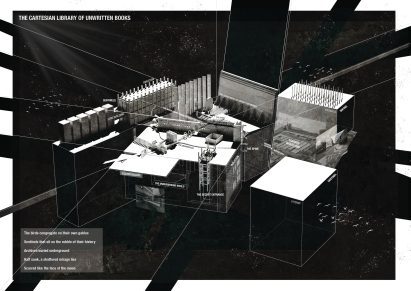
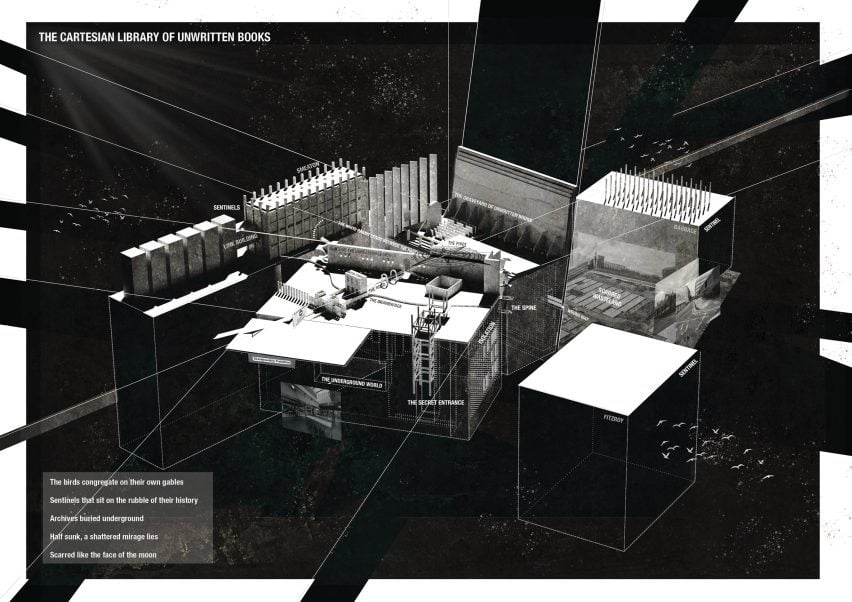
The Generative Library by Oliver Mowbray
“The traditional library of social exchange has become a temple to the Cartesian human. This adaptation to the university library ruptures physical, socio-economic and socio-cultural barriers, exposing students to exchange and collaboration whilst preserving physical media.
“Reclaimed rubble in gabion baskets holds a historic resonance that patinas with ecologies, appropriation and adaptation.
“Architecture here is generated through occupation and living memory; non-human elements act as responsive participants, a pulsating reactor, expanding and contracting.
“Extended landings and crossings, whilst unmoving, allow a ‘movement that is both integrative and exploratory’ (Leatherbarrow, 2009, p. 224), inspiring serendipitous encounters and informal collaborative learning.”
Student: Oliver Mowbray
Course: ARCH6002 Design Studio and Professional Practice, BA (Hons) Architecture
Tutors: Ricky Burke and Alessandro Aurigi
Email: ojmowbray[at]outlook.com
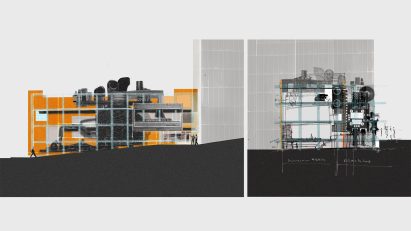
Data for Democracy by Yola Troughton
“Data for Democracy aims to reclaim the power of digital data held by the opaque hands of a few, redistributing it democratically back into our own regional systems.
“By empowering and protecting our local civic infrastructure as we move into the new digital age, the scheme looks to a more socially and environmentally sustainable approach to data storage and handling, integrating citizens’ assemblies and other civic workshops alongside a digital archive.
“Acting as an engine, the data centre powers discourse through access to contextualised information, while the excess thermal energy is harnessed through passive heating strategies to support the functions of the building.”
Student: Yola Troughton
Course: ARCH6002 Design Studio and Professional Practice, BA (Hons) Architecture
Tutors: Andy Humphreys and Graham Devine
Email: yola.troughton[at]gmail.com
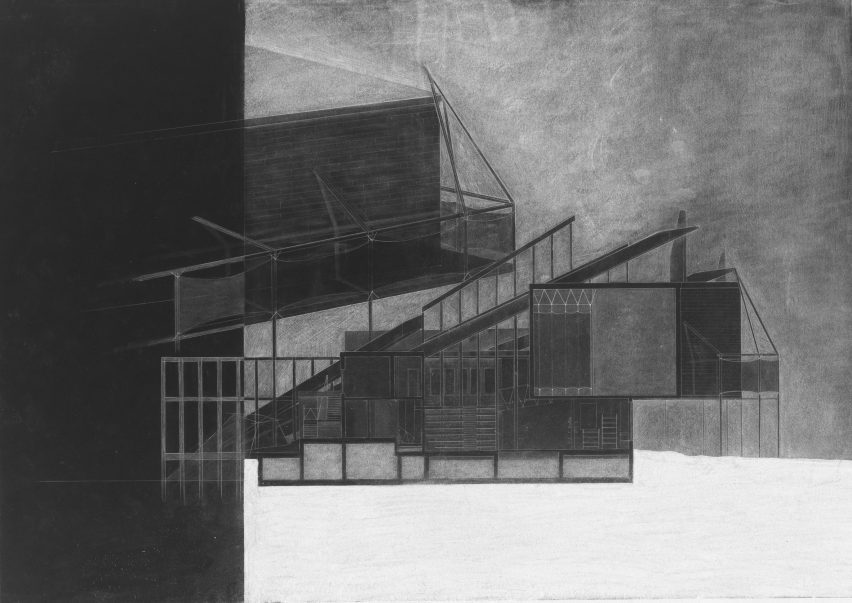
![Molecular Microplasti[cities]: Degradation as Disclosure by Charlie Hirst](https://static-2026.dezeen.com/uploads/2026/07/waterfront-repair-craft-hub-university-of-plymouth-schoolshows-g1_dezeen_2364_col_0-411x196.jpg)
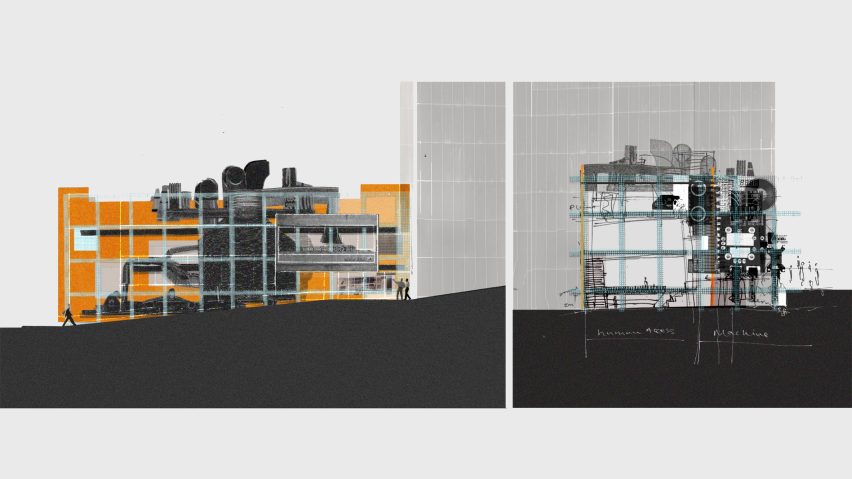
Molecular Microplasti[cities]: Degradation as Disclosure by Charlie Hirst
“Molecular Microplasti[cities] addresses the growing threat of microplastic pollution in marine ecosystems.
“Located at Sutton Harbour, the project retrofits existing infrastructure to transform polluted harbour water into a resource for research, industry and public engagement.
“Water is purified through two filtration towers integrated into the architecture and then reused to support aquaculture, marine research and fish market operations.
“The towers also house modular living pods for researchers and fishing industry workers. By making the invisible visible — revealing the hidden presence of microplastics through architecture — the project becomes a monument to environmental change, promoting awareness, collaboration and sustainable marine regeneration.”
Student: Charlie Hirst
Course: ARCH766 Design Praxis, Master of Architecture
Tutors: Mathew Emmett and Sana Murrani
Email: charlie_daniel[at]hotmail.co.uk
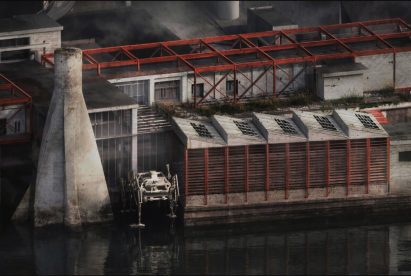
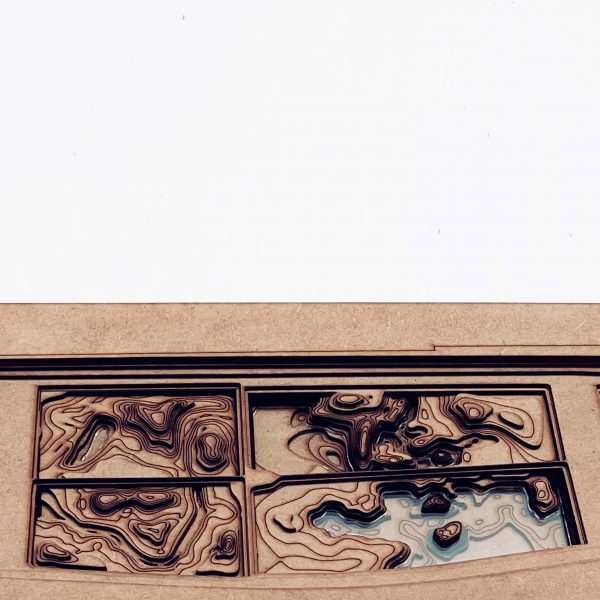
The Seabed Laboratory by Ben Howley
“The Seabed Laboratory responds to the long-term ecological decline of Plymouth Sound, where centuries of dredging and trawling have left soft scars across the seabed.
“The project treats these scars as opportunities for repair, positioning Fish Quay as a place where fishing communities and marine ecologists work together to restore the Sound.
“The old auction building is grafted onto new structures that support hatcheries, laboratories and seagrass workshops, while a recycled steel warehouse produces shellcrete reefs from waste scallop shells.
“A shellcrete tower shaped by kelp holdfasts marks the quay as a renewed landmark of restoration.”
Student: Ben Howley
Course: ARCH766 Design Praxis, Master of Architecture
Tutors: Sana Murrani and Mathew Emmett
Email: benhowley3[at]gmail.com
![[RE]Imagining Resilience Through System Thinking by Alastair Freeman](https://static-2026.dezeen.com/uploads/2026/07/waterfront-repair-craft-hub-university-of-plymouth-schoolshows_dezeen_2364_col_9-411x145.jpg)
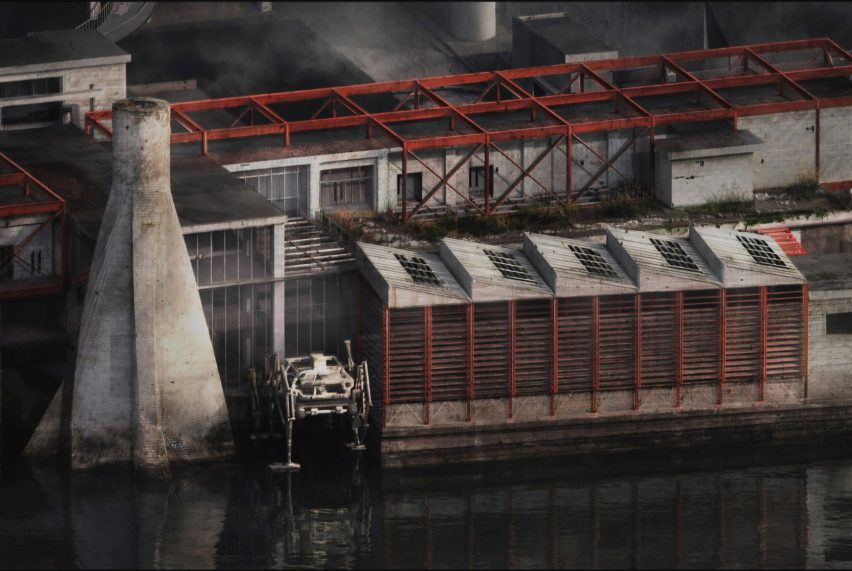
[RE]Imagining Resilience Through System Thinking by Alastair Freeman
“Regenerative design extends beyond traditional sustainability by actively repairing ecosystems and enhancing the capacity of future generations to thrive.
“This proposal seeks to recycle waste from the fishing industry into seagrass pods that restore rare marine habitats in Plymouth Sound, an area where climate change poses significant threats to biodiversity.
“Repurposing this waste establishes a circular model that regenerates the marine food web while delivering enduring ecological and human benefits.
“Ultimately, the project aims to transform the built environment into resilient, productive habitats that support both natural ecosystems and human communities.”
Student: Alastair Freeman
Course: ARCH766 Design Praxis, Master of Architecture
Tutors: Sana Murrani and Mathew Emmett
Email: freeman.alastair[at]gmail.com
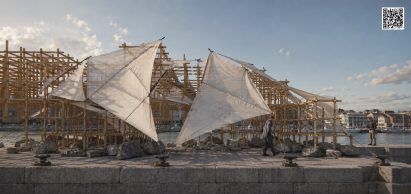
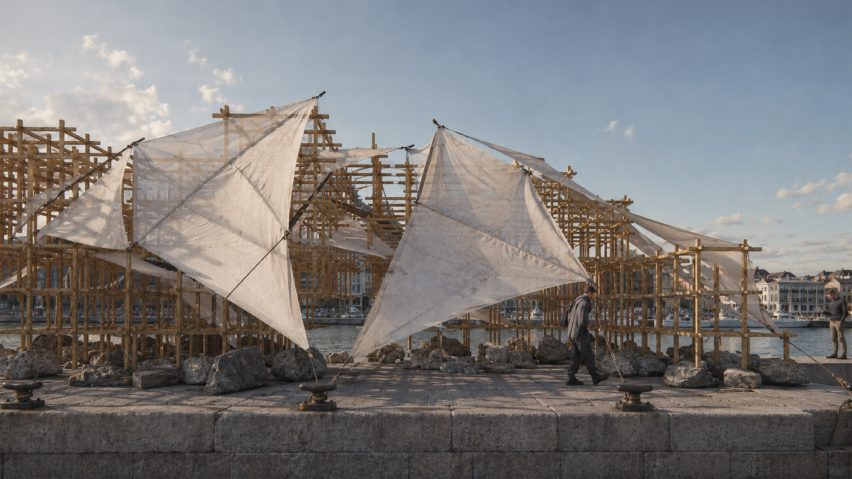
In Mutual Dependence – Mending through material, craft and environment by Zi Jie Chan
“The project proposes a pavilion that rethinks construction through mutual dependence, where material, environment and users are interlinked rather than controlled.
“In Plymouth’s maritime context of shipbuilding and repair, as well as Devon’s regenerative woodland practices, it uses timber offcuts, reclaimed sail and rope to form a low-tech, reversible structure.
“Instead of resisting coastal forces such as salt, humidity and wind, the design embraces processes of weathering, mending and adaptation, allowing it to evolve over time.
“This project challenges conventional construction methods based on permanence and extraction, instead promoting circular, craft-based architecture grounded in material awareness, reuse and ongoing care.”
Student: Zi Jie Chan
Course: ARCH763 Sustainable Technologies, Master of Architecture
Tutors: Andy Humphreys and Graham Devine
Email: zi.chan[at]postgrad.plymouth.ac.uk
Partnership content
This school show is a partnership between Dezeen and the University of Plymouth. Find out more about Dezeen partnership content here.
![Molecular Microplasti[cities]: Degradation as Disclosure by Charlie Hirst](https://static-2026.dezeen.com/uploads/2026/07/waterfront-repair-craft-hub-university-of-plymouth-schoolshows-g1_dezeen_2364_col_0-852x406.jpg)
![[RE]Imagining Resilience Through System Thinking by Alastair Freeman](https://static-2026.dezeen.com/uploads/2026/07/waterfront-repair-craft-hub-university-of-plymouth-schoolshows_dezeen_2364_col_9-852x301.jpg)