“If AI can do most of what we think an architect does, maybe we have defined the profession too narrowly”
Architects are increasingly, and existentially, anxious about AI. It can already produce images, generate endless options, manipulate form, draft text, analyse information and take on increasing amounts of technical production. The predictable professional response is to become defensive: to identify the bits of architectural work that machines cannot yet do, protect them, regulate them and insist ever more loudly on the special status of the architect.
This is absolutely the wrong response. Architecture has always had a tendency to retreat when it feels threatened: as its actual control over the production of buildings has diminished, it has clung ever more tightly to authorship, professional territory and the idea that certain activities somehow belong uniquely to architects. AI merely makes the weakness of that position more visible.
If AI can do most of what we think an architect does, maybe we have defined the profession too narrowly. If producing drawings, images, options and information constitutes our entire claim to value, we are defining our value in far too limited terms.
We are still, to an astonishing degree, trained to imagine ourselves as mini Corbusiers
The profession has spent decades confusing the production of architectural artefacts with architectural intelligence, and we have run out of road. We are still, to an astonishing degree, trained to imagine ourselves as mini Corbusiers. If we design a back extension, give it a sufficiently enigmatic name, photograph it carefully, attach enough rhetoric, we somehow persuade ourselves that we have made Ronchamp.
Architectural culture has encouraged this inflation for decades, in that every modest building becomes a manifesto, every detail becomes a proposition and every project arrives with the expectation that it should reveal something profound about architecture itself.
But the age of the hero is exhausted. The profession no longer has the cultural authority, the economic power or, frankly, the public attention to sustain this fantasy, however enthusiastically we continue to perform it for one another. AI may simply accelerate the reckoning: if machines can generate endless formal novelty and beautiful images, the architect’s claim to importance can’t continue to rest on being the singular creative intelligence who produces the special object.
The economic model that supported this fantasy is broken too. Architecture remains notoriously poorly paid relative to the length and cost of its education, the responsibility it carries and the hours it routinely demands. Yet architects have tolerated this for decades because the profession offered another form of compensation – the most important thing of all for architects: recognition, via awards, publications, photographs, lectures, the approval of our peers and the possibility that one small project might provide a tiny share of architectural glory.
We have accepted low pay, long hours, insecure employment and unpaid competitions partly because we have been sold the idea that authorship itself is a reward. If the work is meaningful enough, beautiful enough or visible enough, perhaps the sacrifice will somehow be justified.
That bargain has always been dubious, but it now looks increasingly absurd. Most architects will never become Corbusier, however many evenings they work, and most projects will never become Ronchamp, however much rhetoric is wrapped around them. Architectural status – irrelevant to most outside a handful of people in the profession – has nevertheless become a kind of substitute currency, and architecture has been remarkably successful at persuading people to accept less of the real kind in return.
We need to expand what clients understand architectural value to be, and therefore what they are prepared to pay architects to do
AI makes the bargain even harder to sustain. If the production work on which fees have traditionally depended becomes faster and cheaper, defending the same exhausted model will simply drive fees and salaries down further.
The answer cannot be to produce the same things more efficiently for less money. We need to expand what clients understand architectural value to be, and therefore what they are prepared to pay architects to do.
The more interesting response to AI is not to ask how architects protect what they currently do, but what architects might become capable of doing if some of that work no longer defines them.
With this, architectural intelligence becomes most useful where there is no simple answer. The most interesting projects rarely arrive as neatly defined problems awaiting visually arresting solutions. Instead, they involve conflicting needs, uncertain briefs, difficult sites, volatile markets, limited resources, political constraints and people who want different things. They involve other consultants who know things the architect does not, clients who change their minds, communities whose needs cannot be compressed into a consultation report and materials that stubbornly refuse to behave predictably like lines on a drawing.
This mess is the essence of architecture. The most useful architect is not simply the person who generates a solution, they are someone able to enter an unresolved situation, figure out what the problem actually is, connect different forms of knowledge, make spatial judgements and establish enough structure for something useful to emerge via collective endeavour rather than their own brilliance.
This demands a radically different model of authorship, which is less author and more host. That doesn’t mean becoming a passive facilitator, it means knowing how to bring people together, anticipating problems, establish frameworks within which others can work, exercising judgement, knowing when to intervene, and knowing when to shut up and not be the hero.
It also changes what architects might reasonably be paid for. At present, architecture fees are overwhelmingly organised around a relatively linear journey from brief, to concept, to information, to construction and eventually completion, but much of the work that might make architecture genuinely valuable sits awkwardly around the edges of that process.
Understanding a problem before a brief becomes fixed is often unpaid. Working seriously with communities gets compressed into consultation. Engaging directly with materials and makers is treated as secondary to design. Returning after occupation to understand what worked and what failed is rarely properly funded. Helping a building adapt over years barely appears in conventional fee structures at all.
There is an irony here, because for years architects have tried to make themselves more machine-like
But architects should be paid for diagnosis and briefing, for bringing different forms of knowledge together, for testing possibilities at full scale, negotiating spatial conflicts, post-occupancy work, adaptation and long-term stewardship. Practices should be able to maintain relationships with buildings and communities rather than disappearing at practical completion. Architecture fees might begin to pay for judgement over time, rather than simply production on the way towards an object.
This is not some romantic idea of architects becoming artists, activists or community workers instead of running viable businesses (which contemporary practice is not). Quite the opposite: it is about identifying forms of architectural value that are difficult to automate and, more importantly, are actually useful.
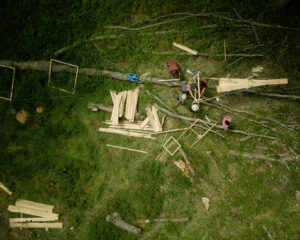
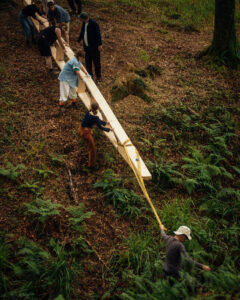
For the past 20 years, our educational initiative Studio in the Woods (pictured top and left) has accidentally provided a small laboratory for some of this. Its significance has never really been the timber structures that emerge over several days of co-production. Instead, the interesting aspect of Studio in the Woods is what happens when people design and make together under conditions in which the answer is not known beforehand, where ideas encounter the friction of weight, resistance, gravity, tools and materials. Where experts and non-experts work together as equals, and leadership moves according to what needs to happen next.
The skill of the architect in these situations is not to surrender judgement, but to exercise it differently. What should be negotiated? What can remain unresolved? Where is precision necessary? Where might uncertainty be productive? Who knows something that I do not? These are much more interesting questions for the future of the profession than whether AI can draw a convincing building.
There is an irony here, because for years architects have tried to make themselves more machine-like: eliminating uncertainty, standardising processes, increasing predictability, producing ever-more information and pretending that buildings can be completely resolved before anybody actually makes them. Now, machines are becoming extremely capable at exactly those things and we are surprised to find ourselves threatened, and we should stop trying to beat them at their own game.
Human architectural intelligence is at its richest when it is situated, relational and embodied. It involves judgement without complete information and responsibility for consequences that cannot be fully predicted. It means understanding materials as part of landscapes and economies, buildings as things that change through occupation, and design as something produced between many people rather than delivered by one.
None of this means drawings, technical knowledge, form or aesthetic judgement cease to matter. They matter enormously, but they are merely parts of architectural intelligence, not its definition.
The architect of the future does not need to be the person with the most original idea and the most charisma. They might instead be the person who can understand an uncertain situation, recognise what matters, establish a framework for action and create the conditions in which something richer than their own initial idea can emerge. AI may make the old version of the architect less necessary, but I’m not sure that is something we should mourn.
Piers Taylor is the founder of architecture practice Invisible Studio and the convenor of Studio in the Woods. He is professor of knowledge exchange in architecture at the University of the West of England and an external examiner at the Arts University Bournemouth, having previously held positions with the Architectural Association and the University of Cambridge. He holds a PhD from the University of Reading. He has presented several architecture shows on television including BBC programmes The House that £100k Built and The World’s Most Extraordinary Homes. His first book, Learning from the Local, was published in 2025.
Dezeen In Depth
If you enjoy reading Dezeen’s interviews, opinions and features, subscribe to Dezeen In Depth. Sent on the last Friday of each month, this newsletter provides a single place to read about the design and architecture stories behind the headlines.
Photography by Jim Stephenson
Read more
Recommended stories

“Working yourself to the point of exhaustion is no longer a badge of honour”
“Architects can rest easy that AI isn’t coming for their jobs just yet”

“I am not at all worried about facing the newly empowered competition enabled by AI”
“It is easy to find fault in architecture education”
Architecture fundamentally a human endeavour says panel at Trimble SketchUp talk in San Diego

“AI will never replace a Frank Lloyd Wright or a Mies van der Rohe” says commenter
Everything that’s going wrong with architecture