Public toilets in Paris by Chartier-Corbasson “elevate the ordinary”
French studio Chartier-Corbasson Architectes has transformed a neglected underground passage beneath the Trocadero Gardens in Paris into a public restroom, using an industrial-feeling palette of stainless and weathered steel.
The project forms part of the ongoing OnE masterplan, a competition-winning scheme to develop the public spaces and gardens around the Eiffel Tower that was awarded to Paris-based Chartier-Corbasson Architectes and London studio Gustafson Porter + Bowman in 2019.
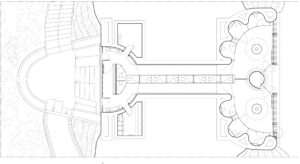
The public toilets occupy a tunnel through the Trocadero Gardens that was originally designed for the 1937 Universal Exposition by Roger Lardat, framed by distinctive openings in bush-hammered concrete and lined by flint walls that were etched with graffiti by US soldiers at the end of the second world war.

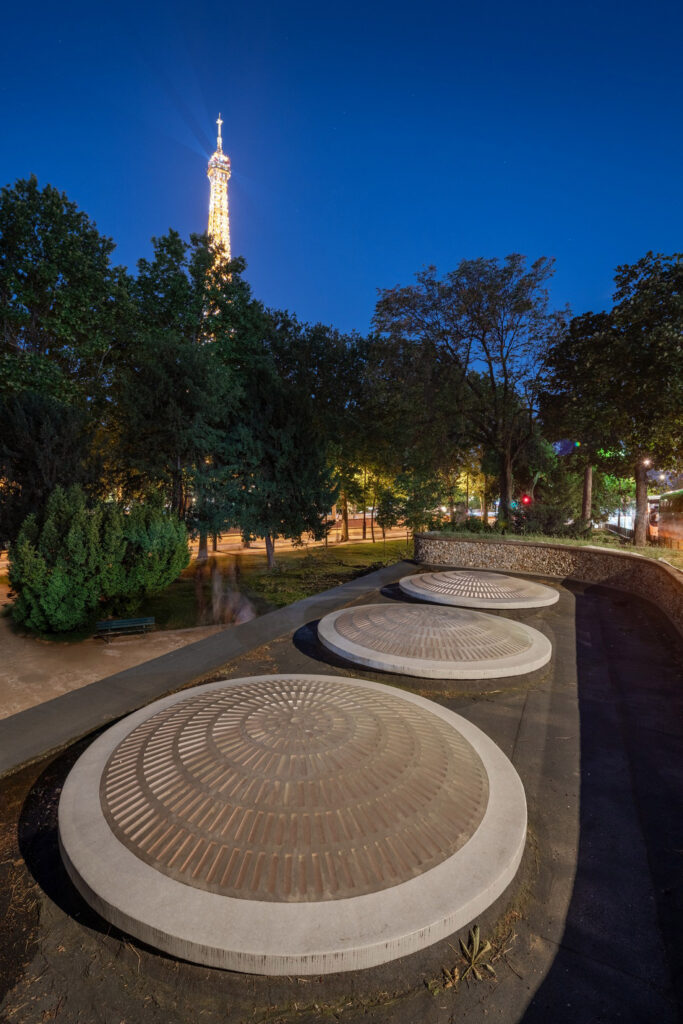
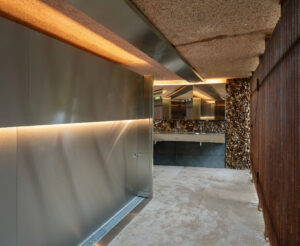
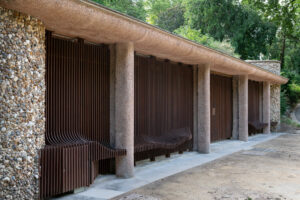
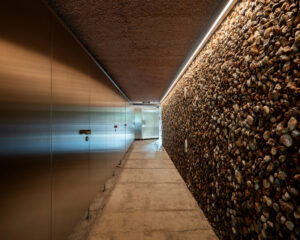
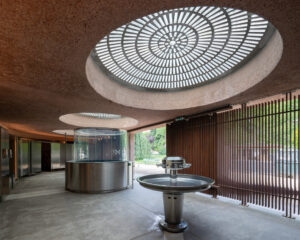
The tunnel had long been closed to the public, used instead as a storage area for the city’s cleaning services. For its renovation, which has been shortlisted in the Heritage project category of Dezeen Awards 2026, Chartier-Corbasson Architectes looked to highlight its thoughtful, utilitarian design while giving it a new purpose.
“Far from being a mere functional adaptation, the project, entirely off-site, transforms a closed, neglected, and invisible space into a high-value, integrated, and dignified public amenity situated in a busy urban environment,” explained the studio.
“By restoring meaning and form to a previously purely utilitarian space, this project demonstrates that architecture can elevate even the most ordinary uses, while having a significant impact on the city, its users, and its collective memory.”
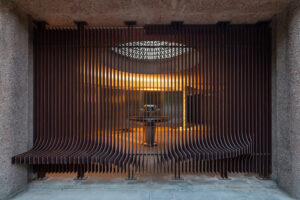
The distinctive pink-toned bush-hammered entrances at either end of the tunnel have been carefully restored, and now frame a series of new Corten steel gates that incorporate sculptural seating elements at either end.
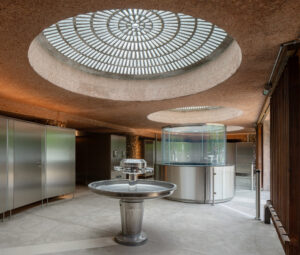
The original domed skylights that illuminate these entrance spaces have been updated with custom-made glass blocks, while below, their form is mirrored in a series of circular stainless-steel sinks.
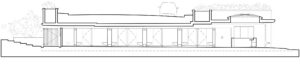
The majority of the toilets occupy a row of stainless-steel cubicles inserted between the flint-lined walls of the central passage, creating a two-way route with doors that open on alternating sides.
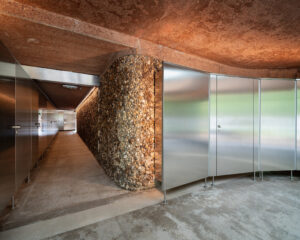
As much as possible, the existing structure was adapted with minimal intervention, demonstrated by a series of cubicles that have been tucked into a series of curved niches at one of the tunnel’s entrances and simply fronted with stainless-steel doors.
“The direct reuse of the underground space, without expansion or alteration, demonstrates a restrained and intelligent approach to urban transformation,” said the studio.
“The intervention focuses on a clear material contrast: the systematic use of stainless steel highlights the original flint walls and concrete, further enhanced by strategic artificial lighting,” it added.
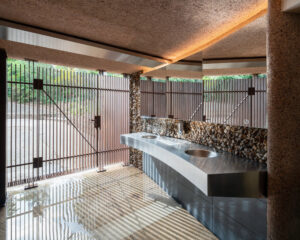
As part of the project, Chartier-Corbasson Architectes introduced natural ventilation into the subterranean spaces and also created new stainless-steel gutters to help manage water infiltration from above.
Given its setting in a high-traffic public park, the new elements were predominantly constructed off-site to minimise disruption and on-site waste.
Other projects that have recently sought to elevate public toilet design include a toilet block in London by Studio Weave, which is clad in contrasting panels of stone salvaged from a demolished office building, and the 17 Tokyo Toilets designed by famous architects.
Photography by Romain Meffre & Yves Marchand
Read more
Recommended stories
Studio Weave creates stone toilet block in London to “express democracy”
“As architects and designers, we don’t talk about toilets enough”
This week Sagrada Familia announced its final completion date after 140 years
Tile-clad Tokyo toilets are drenched in bright green and yellow light
Twenty unmissable installations and exhibitions at this year’s Milan design week
Hermitage Plaza by Foster + Partners
Chatillon Architectes releases first photos of Grand Palais restoration in Paris