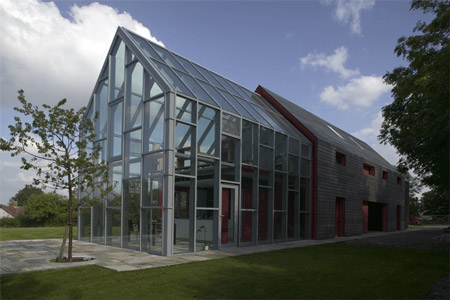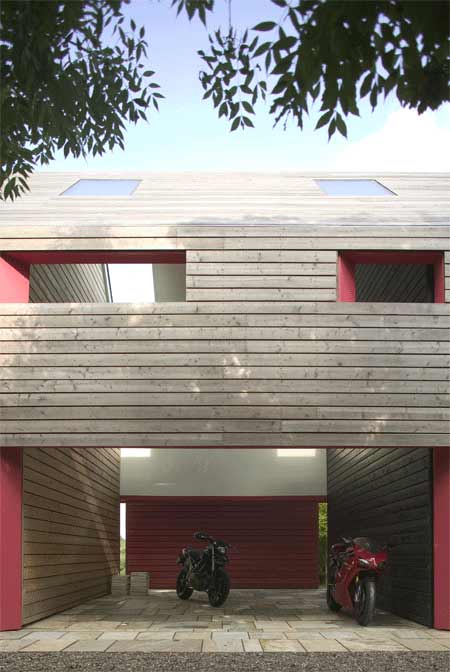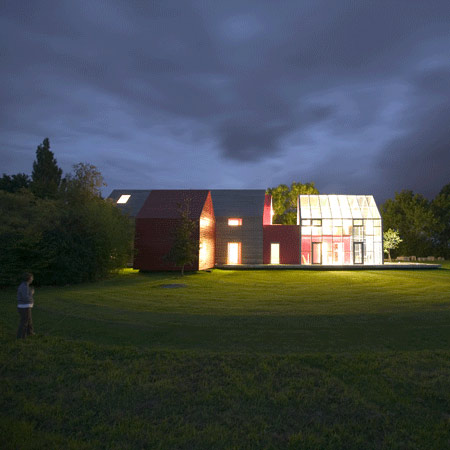
London architects dRMM have designed a house with mobile walls and roof that can be moved to cover and uncover parts of the dwelling.
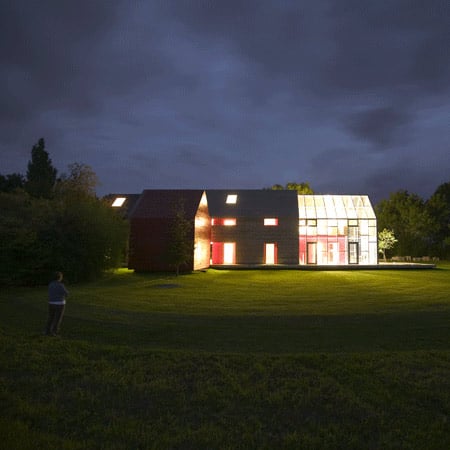
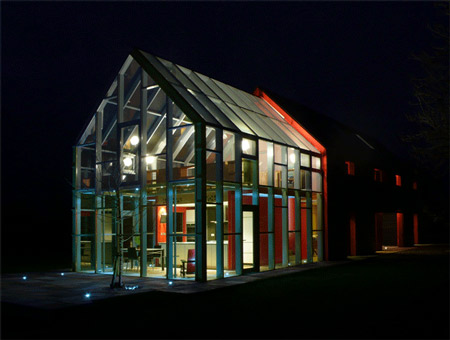
The house, in Suffolk, England, features a sliding structure that fits over the static main house, guest annexe and greenhouse.
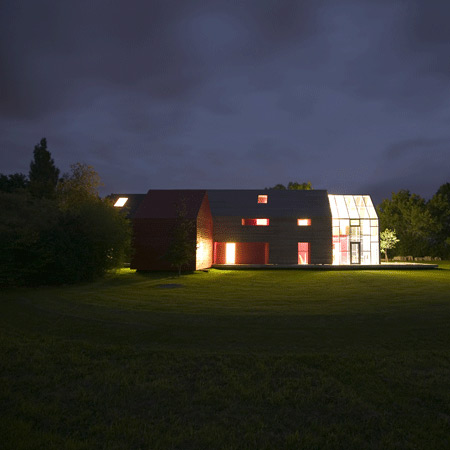
The mobile element, which is 28 metres long and weighs 50 tons, move along rails set into the ground.
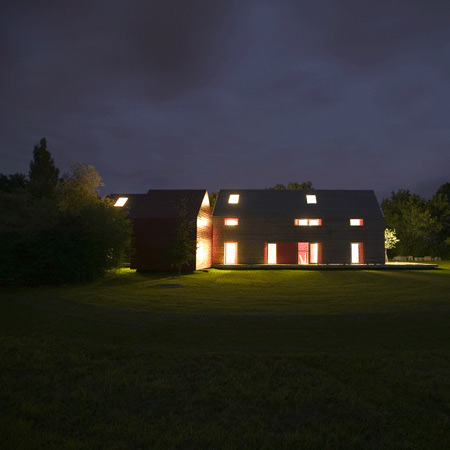
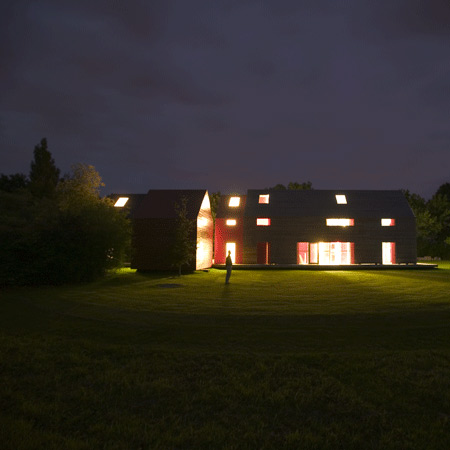
As it moves, the sliding element creates shifting outdoor living areas between the static elements as well as altering views, lighting conditions and the sense of enclosure inside the house.
The following information is from the dRMM:
–
‘SLIDING HOUSE’, SUFFOLK, UK
‘The Industrial and the Picturesque’: A new house with guest annexe and garage for a rural site in Suffolk, East Anglia – a small-holding formerly characterised by bungalow, outbuildings and caravan arranged casually under a big sky.
The stringent local Planning parameters for rural development were accepted by the architect who shares with the client a genuine appreciation of vernacular farm buildings.
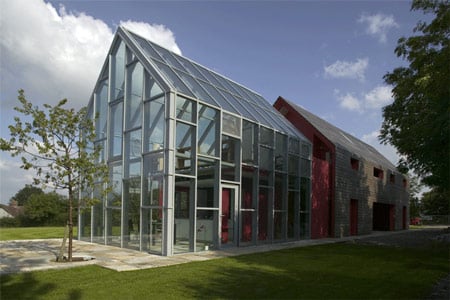
After studying alternatives it was agreed to manipulate the local timber framed and clad ’shed’ idiom.

The brief was a self-build house to retire to in order to grow food, entertain and enjoy the East Anglia landscape.
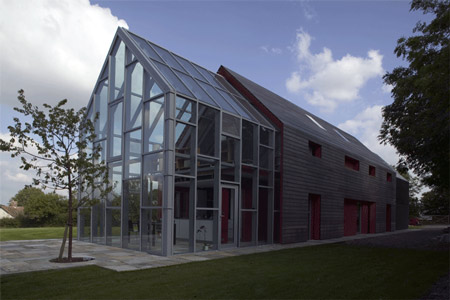
The client was both straightforward and sophisticated. The site offered a combination of rolling England and agricultural Holland. These parameters greatly appealed to the international architects interested in systems, materials and unconventional architecture.
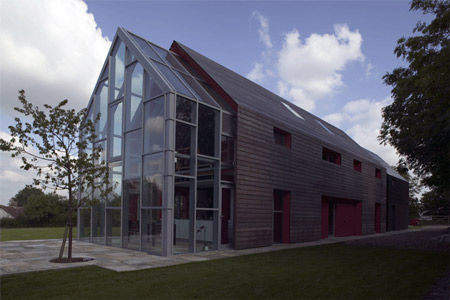
The project was designed to be elaborated on and built by the client, an enterprising mathematician and motorcyclist. A client/maker capable of calculating the value of design and of risk.
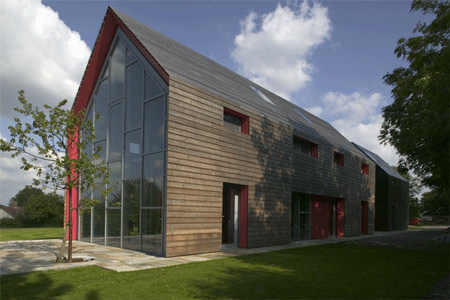
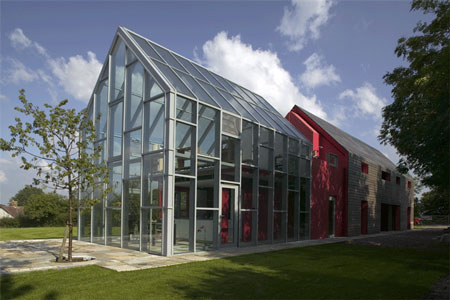
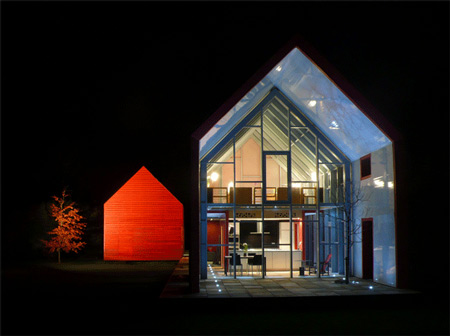
The outcome is 3 conventional building forms, with unconventional detailing and radical performance. And a big surprise. A 28m linear building of apparent simplicity follows the requisite maximum 5.8m permitted width, 7.2m height is sliced into 3 programmes; 16m house, 5m garage and 7m annexe. The garage is pulled off axis to form a courtyard between slices of building. The 3 fixed buildings are further defined with distinct finishes; red rubber membrane and glass, red and black stained larch respectively.
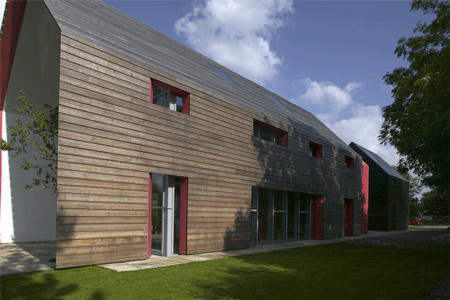
The linear composition is carefully sited on a level ridge which runs north/south along the north eastern boundary of the site. Thus the choreographed progression from road past annexe and garage, to house, glasshouse and then on to garden are a logical sequence. The bedroom/service half of the house is modular timber cassette construction, the living half a generic curtain wall glazing system. The annexe and garage are constructed from the modular timber cassette system with scandinavian laminated section windows and doors.
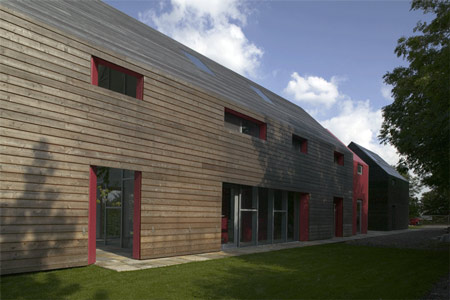
The surprise is that these separated forms can be transformed by the fourth and largest element in the group, the 50 ton mobile roof and wall enclosure which traverses the site. This is an autonomous structure; steel, timber, insulation and unstained larch spanning hidden tracks, recessed into a concrete raft on piles. The mobile roof and walls form an insulating structure that passes over the annexe, house and glasshouse, creating combinations of enclosure, open-air living and framing of views according to position.
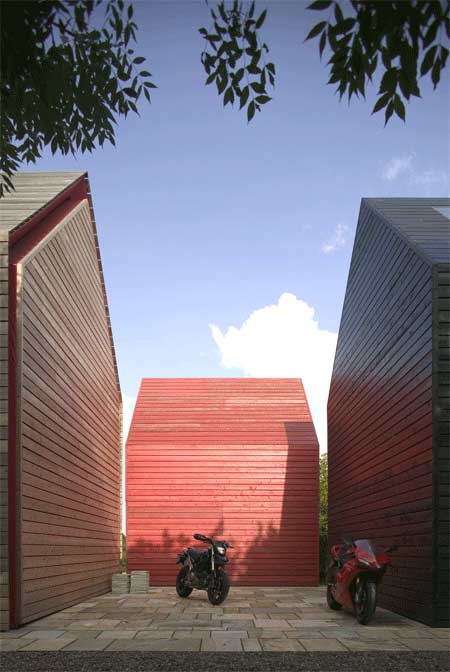
Each element of the composition is carefully proportioned in relation to frame, window and wall sizes. All elements were prefabricated to be assembled on site, except groundworks, internal joinery fixtures and external surfaces, which were in situ.
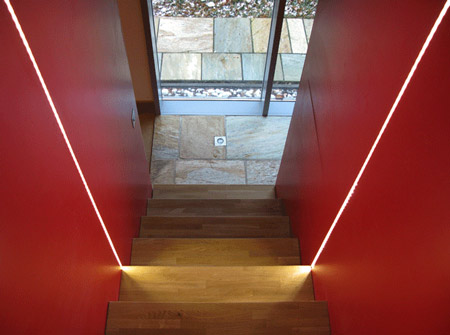
Movement is powered by hidden electric motors on ‘bogeys’ integrated into the wall thickness. Each of the 4 separate motors has its own pair of DC car batteries which are charged by mains or PV solar panels.
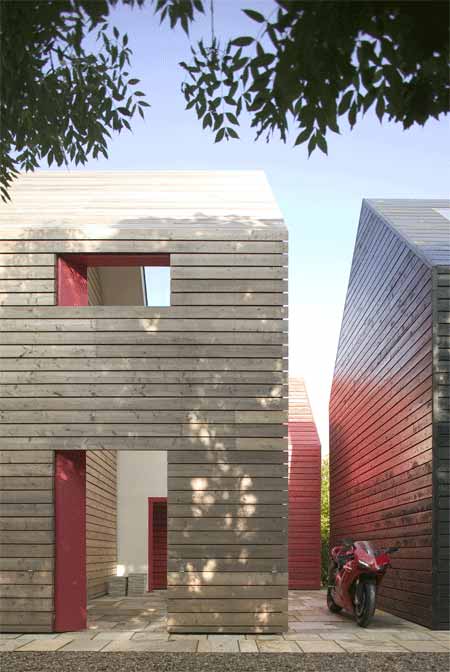
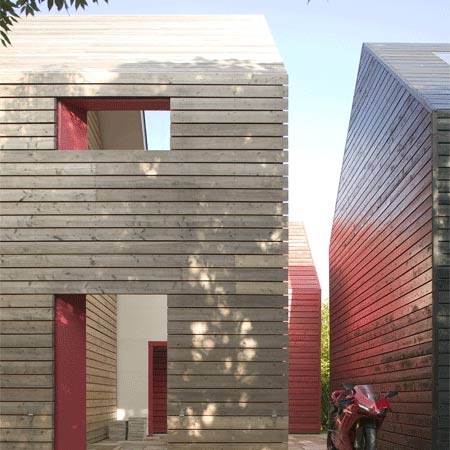
The railway tracks are recessed into the external terrace on which the entire composition rests. The 6m gauge ‘railway’ is further disguised by stone paving joints and a linear drainage gully.
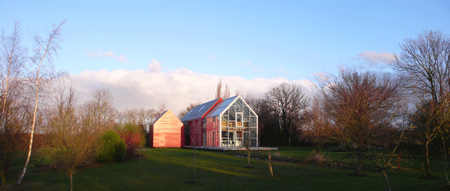
This aligns the whole composition, obviates any roof gutters, and draws the visitor toward the garden beyond. The tracks could be extended in the future should the client wish to build a swimming pool which in turn may need occasional shelter…

Sliding House offers radically variable spaces, extent of shelter, sunlight and insulation. The dynamic change is a physical phenomenon difficult to describe in words or images. It is about the ability to vary or connect the overall building composition and character according to season, weather, or a remote-controlled desire to delight.
Alex de Rijke, Director, dRMM
Client: Private client
Contractors: Self-build with extensive use of local and specialist contractors
Architect: dRMM; Alex de Rijke, Joana Pestana Lages Goncalves
Engineer: Michael Hadi Associates, Rutger Snoek, David Williams, Rob Hart
About dRMM
Alex de Rijke, Philip Marsh and Sadie Morgan founded dRMM, a London-based studio of international architects and designers, in 1995. Now a team of about 20, the practice takes pride in only carrying out work that is innovative, high quality and socially useful. They have a track record of creating extraordinary architecture within the standard constraints of the construction industry. Their radical projects are led by site, client needs, concept and construction, rather than formulaic or style-based decisions. The team defines its approach as economy of means, expressive of use, materials and construction: an architecture of ‘maximalism’.


January 19th, 2009 at 6:25 pm
finally it comes out.
interesting at the moment, but it would be better if the space interact by the moving cover.
January 19th, 2009 at 6:25 pm
That’s just amazing. Great idea! I love how one building can turn into a lot of different versions of itself only by sliding the cover-roof. I wonder why there has never been an idea like this before?
January 19th, 2009 at 6:38 pm
Very.. cool.
January 19th, 2009 at 6:46 pm
i think this building is well built but ultimately worthless and ridiculous folly perpetrated by engineers masquerading as architects.
January 19th, 2009 at 7:07 pm
Great Idea!!
Really a cool building.
January 19th, 2009 at 7:37 pm
HOT. more please!
January 19th, 2009 at 7:47 pm
pretty badass
January 19th, 2009 at 7:55 pm
brilliant! I am totally ripping this idea off, but I don’t know if it can be out done! I love the simple section of the house it self too. This could have been much more complicated in the number, shapes, sizes, etc of the moveing pieces but this is such a great solution that anything more would have ruined it. This is one of the best pieces i’ve seen on dezeen to date!
January 19th, 2009 at 7:56 pm
nice bikes…
January 19th, 2009 at 8:43 pm
it sounds totally amazing for the first moment, but has the cover any other function other than beeing a moving theaterical decoration?
and i’m sure it was expensive decoration .
January 19th, 2009 at 9:06 pm
Really interesting building. I love the way the living space can adapt, especially interesting for different seasons.
January 19th, 2009 at 9:15 pm
NICE…Id like to go see it…
January 19th, 2009 at 9:30 pm
reminds me of a great chapell in colombia…
http://daniel-bonilla.com/capcalera1.html
January 19th, 2009 at 10:32 pm
The modularity of the structure is a great idea. Having the actual ability to control interior light exposure, shading, and the weather-proofing of exterior spaces allows for each space to function in multiple ways. The shell does’t interact with the spaces, it creates them! I also love how it changes the transparency, color and massing of the exterior. Bravo!
January 19th, 2009 at 10:44 pm
WOW
January 19th, 2009 at 11:01 pm
Finally such a nice and simple solar (and more) device.
I would play with it all the time!
January 19th, 2009 at 11:17 pm
Rodger how it took you to come u with that one?
Give it a break, this is a fantastic project.
January 19th, 2009 at 11:40 pm
I love this.
January 20th, 2009 at 12:06 am
That’s quite an expensive window shutter.
January 20th, 2009 at 12:45 am
Yeah, if this is the work of an engineer, hire me that engineer. This project is awesome. Just watch out for the kids and pets!
January 20th, 2009 at 2:46 am
How weird! I checked dezeen when I got into school and this project wasn’t up. I then came up with (what I thought was an original idea) for my design project in which the courtyard is enclosed by 2 sliding walls and a sliding roof (all independent).. so that there can be 8 iterations of the courtyard. I then check dezeen in the night and see this! Will I ever catch a break and have an original idea?
January 20th, 2009 at 5:35 am
Convertible house. I can dig it!
This should bring about some great
affordable eco transformer houses.
Thanks.
January 20th, 2009 at 6:34 am
Fantastic, I dig the Ducati (s?) too.
Very expensive, I wonder how the insulation works but without waterproofing, ie there is essentially 2 walls throughout.
Great idea though, and the typical house shape really pulls it off.
January 20th, 2009 at 8:12 am
CRAZY!!!!!!!!!!!
January 20th, 2009 at 9:37 am
I really, really like it.
January 20th, 2009 at 11:09 am
yeah!
January 20th, 2009 at 12:15 pm
Very original. I particularly love the way it goes so far as to enclose the tree at the far end to create a shaded terrace with an added bit of life. You would have to keep on top of the pruning for sure!
January 20th, 2009 at 1:51 pm
@ paris-moi.
fantastic project it might be, don’t disagree… but it a very unremarkable piece of architecture. its architectural forms are based archetypes, ie 80’s cliche’s. i am at a loss to find any sophistication in the architectural design that is equal to the sophistication of the engineering. which gets back to my point. this project is designed by engineers, not architects.
January 20th, 2009 at 2:00 pm
pretty wonderful.
January 20th, 2009 at 2:10 pm
what will they think of next….
genuine novelty. i’ll give them that.
January 20th, 2009 at 3:33 pm
Great project!!!
I can’t believe MVRDV didn’t come up with this…. did these architects work there before? Very original.
January 20th, 2009 at 3:38 pm
hey, this is kinda nice, at first i thought the glass house thing was moving but it seems the timber pannel walls are the one moving ahaha. but how long would it take to go from each extreme end?
January 20th, 2009 at 6:14 pm
It takes six minutes to traverse the entire site, togon.
Thanks for your comments, all.
Ciara, dRMM
January 21st, 2009 at 5:07 am
And who doesn’t want the reincarnation of Jacques Tati to make a movie here?
January 21st, 2009 at 10:07 am
Absolutely fantastic..I can’t believe what looks like the “building” moves. Quite an awesome effect. and if you get bored with one way, switch it up. What a fantastic project and engineering!
January 21st, 2009 at 4:16 pm
very clever
January 21st, 2009 at 4:39 pm
villa girasole !
http://www.treehugger.com/files/2008/08/1935-house-follows-sun.php
January 21st, 2009 at 5:45 pm
Even just building a garage or outbuilding using this method would be cool.
Especially for projects that can be built within the space allotted, but hard to get out of said space, like a boat.
January 21st, 2009 at 7:39 pm
is this the next thing
after the cantileversydrome?
verry cheap but expensive effectarchitecture, nothing more….
January 22nd, 2009 at 10:28 am
everything about this project is simply great!
concept, form, function.
colours and materials.
photographs are very very good.
congrats to all of them including the client.
January 22nd, 2009 at 2:43 pm
cmon rodgers,
don’t be so critic about the engineers…
it’s a great buiding, and a “based archetypes”, are sometimes pretty hard to achieve with them (engineers)… the main point here looks the great idea of the authors, or a “simple” idea of a different cover could make a dynamic and exciting space(s), and as some said: KISS
keep it simple stupid!!
January 22nd, 2009 at 3:16 pm
great idea..!! and now turn into a truck or airplain..
No serious, the possibility to adapt to various circumstances and wishes is a quality that could be explored further.
Go Transformers…!!
January 26th, 2009 at 6:33 pm
nice, very interesting.
so, it takes 6 mins. to move the whole thing…
I assume that it needs a motor or other device to move it mechanically.
Another question: how much more expensive did the project turn on due to this invention?
10%, 25% more?
January 26th, 2009 at 10:14 pm
Domestic foreskin.
January 27th, 2009 at 12:59 pm
v nice.
January 27th, 2009 at 1:41 pm
You are being optimistic on the budget, Christian! This isn’t a house it is three buildings and a railway.
It is powered by four 24v DC motors running on batteries, by the way. Like an electric car it recharges its batteries when parked.
Me3mar – the function of the roof is shade, insulation, decoration and (importantly) hiding all that scary glass from the planning officers.
January 28th, 2009 at 10:22 am
pff..amazing! …a schizoid [house] building…………
January 28th, 2009 at 2:39 pm
Wonder!
January 28th, 2009 at 3:20 pm
Hee hee (roger’s comment) Cliche! The 80’s! You’d have to go back in excess of a couple thousand years for this archetype “|^|”.
I thought it was porn for architects, in the best way. I really liked the pictures; and the concept is so interesting. It was wonderful.
January 31st, 2009 at 10:45 am
Fine & Exelent
February 3rd, 2009 at 4:41 pm
What happens when the roof slides off the house all together into the yard?
February 4th, 2009 at 9:10 pm
Very tastefully done. Rodger, are you even an architect? Your statements seem to say otherwise. You might stick to leaving comments on websites you have actual pertinent knowledge about and experience with. I AM an architect, and I see a playful idea that has been constructed using common construction methods in completely uncommon ways. To The Client and dRMM, appreciate the response to comments. Very helpful.
I must say though that there does not seem to be a nexus between the ultimate client interest or dividend and the actual added cost. However, I hope such constraints don’t stop us in the future, either. As we can expect, dRMM continues to challenge the concepts of conventional building practices, architecture and space with this building. Overall, an excellent project.
One thing: I would have liked to see a site plan or aerial photo illustrating some of the site design concepts though. Maybe even a series of birds eye views of the building forms as the operable enclosure shifts from “zero to sixty”.
February 16th, 2009 at 7:03 pm
Congratulations on a great idea combined with straight forward robust Architecture and Engineering.
March 1st, 2009 at 11:23 pm
I live down the road from this building and it will never sit well in the Suffolk landscape, it truly looks out of place, it stands on a raised stage, looks ominous and industrial in a very rural setting. Gimmic over aesthetic…… the emperos new clothes comes to mind. A wasted opportunity given the beautiful location and the amount of money that must have been spent.
March 2nd, 2009 at 3:14 pm
This buildingist fantastic. Very original.
March 3rd, 2009 at 1:52 pm
This is a post for the Client.
I really love this idea. I am an Architecture student currently in my Honours year. We have to present a building in the uk which has particular interest.
Firstly would you have any issues with me using the material I have found on the web to form a presentation board and an esaay.
Secondly- If you are happy for me to continue would you be able to give me some more information about your building.
Regards
Steven
March 4th, 2009 at 7:43 am
Well this sure has the delight factor! I’d love to see pictures from the inside looking out. How do the living/entertaining spaces change and how do the moving apertures change the interior’s relationship to the landscape? I’m sure this house has so much more to experience than the (very fine) exterior pictures that I’ve seen so far.
ps. Roger, you’re comments are very narrow minded for someone critical of convention.
Bravo to the whole creative team, Client, Architects and Engineers.
March 22nd, 2009 at 1:59 am
Fukn G E N I O U S !!!
April 8th, 2009 at 5:10 pm
one of my favourite projects so far…..simple idea but great merits in it…
June 18th, 2009 at 11:06 pm
it is truly creative idea but I dont think I can live in such a house that may turn into an aeroplan !!
September 18th, 2009 at 1:34 am
As a parent to the client in this enterprise, I have to express my own admiration for the dedication given to his design flair, project management, and many thousands of hours of perfectionist work in detailing and completing both the interior and exterior facets of the building. This was self-build with a difference, and I fear I would have fallen at the first encounter with the planning authorities, not in East Anglia noted for their forward thinking!