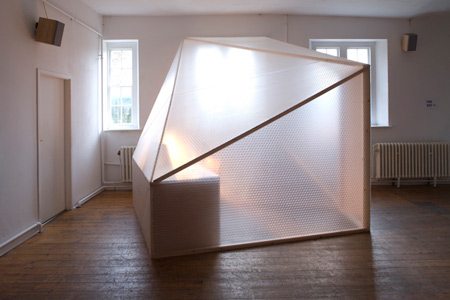
Selective Insulation is a project by Berlin architects Davidson Rafailidis that creates insulated workspaces within a larger, cold room.
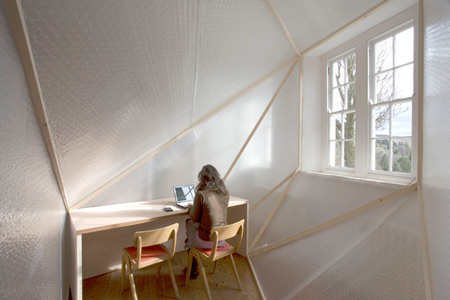
The concept has been applied to an artist’s studio in Hexham, UK, where the nineteenth-century building makes it difficult to maintain warm working conditions for much of the year.
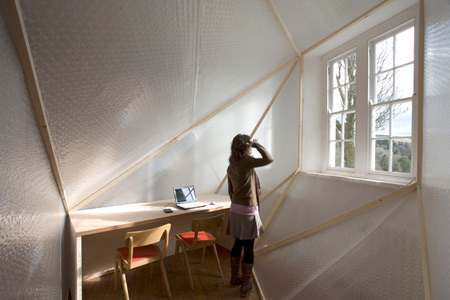
Rather than trying to insulate the whole building, pockets of warmth shape the workspaces, which include a desk for two people, a door and a window.
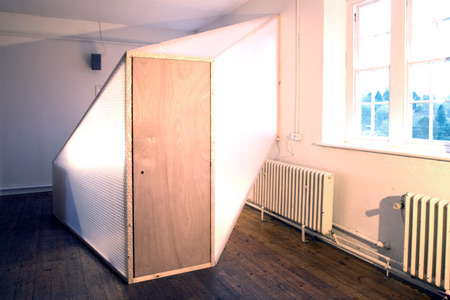
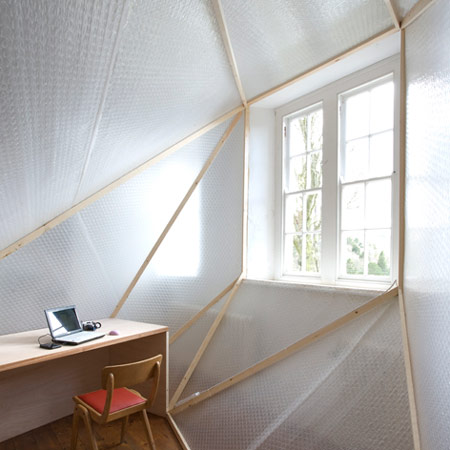
“These three elements are positioned as structural anchors, and a connect-the-dots approach is used to create a framework for the volume,” the architects explain.

This framework is covered with two-ply bubblewrap, normally used to insulate greenhouses.
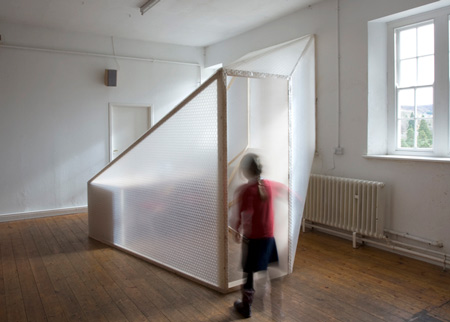
Photographs by Steve Mayes Photography.
Here’s some more information from Davidson Rafailidis
–
Selective Insulation, Stephanie Davidson & Georg Rafailidis
davidsonrafailidis.net
Selective Insulation is an artists studio in Hexham UK. The enclosure is a response to the chilly working conditions in the Old School House, an artists facility. In the Fall, Winter and early Spring, the uninsulated building, a masonry construction built in 1849, requires intensive heating in order to keep it thermally comfortable. A conventional approach to improving the buildings thermal efficiency would be to line the inner side of the stone walls with a new layer of insulation.
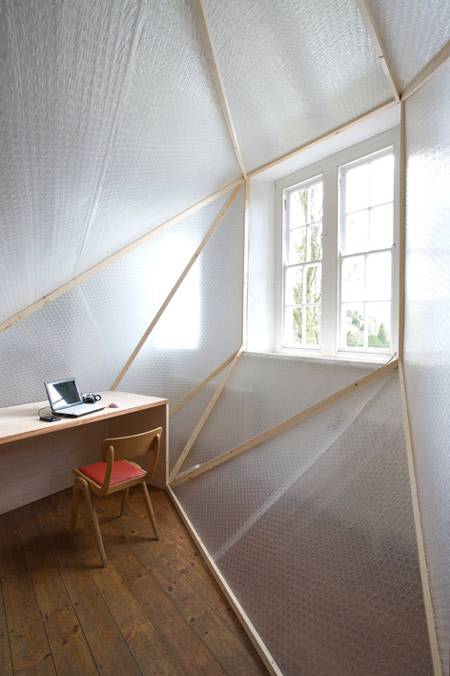
This approach would lose all potential thermal mass in the stone and create an equally distributed warm zone in the interior. In this project, we asked the question, can insulating a building be more strategic? Can it have formal consequences? Can it organize space?? Selective Insulation defines small areas in a building that need to be warm during the cold months of the year. The result are warm pockets within existing uninsulated spaces of a building.
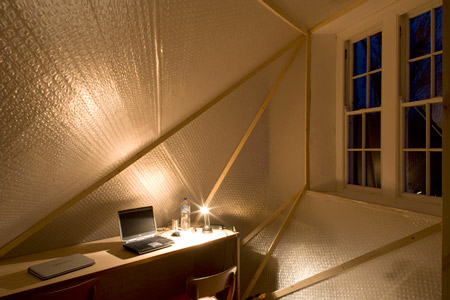
The form of the installation, which acts as a small warm room for sedentary or desk-related work, comes out of a set of parameters related to how the room is used, or the program. Required in the program of desk-related work are: 1. a desk, 2. a way to enter/exit, and 3. access to a window. These three elements are positioned as structural anchors, and a connect-the-dots approach is used to create a framework for the volume.

The 4m2 interior is the minimum required desk-related working space for two people. Around the framework, an insulating layer of double-ply bubblewrap, commonly used to insulate greenhouses, is wrapped, sealing the space thermally. The installation is positioned within a 66m2 working space as a room-in-a-room, providing temperature-specific spaces for different activities.
More about Davidson Rafailidis on Dezeen:
.

–
Posted by Rose Etherington


May 28th, 2009 at 12:11 pm
this has ventilation issues. after a couple of hours work, this enclosed space would stink. if it stinks, you open the door or window and therefor lose the warmth that has been built up.
Two ply bubblewrapping is also constantly going to make annoying squeeky sounds. in an enclosed space this would soon drive you nuts.
May 28th, 2009 at 12:14 pm
I don’t really care about the project but… what chair is that? It is awesome! I’m going nuts with these kinds of chairs. They are so cool
May 28th, 2009 at 1:29 pm
very interesting concept… use the daylight energy for a small room so it is enough to warm the room… nice… the room around the chamber could be used better then just empty space espacially if its a beautifull 19th century room! the bubblewrap creates a special atmosphere inside… not sure if i would like it for working cause it can be mysterious with the lights from outside and the semi-transparence… like the project with all the pros and cons!
May 28th, 2009 at 3:09 pm
How exactly does isolating yourself from the heat source (the rads) and sealing yourself in nice and tightly with the cold source (the old, inefficient, drafty windows) create a warm workspace? Or is the warm workspace outside of the pods?
May 28th, 2009 at 3:34 pm
I like the idea but in my opinion the most cold is coming through the window, and the heat from the radiators is outside the box so its not coming in. The workspace could get hot enough though by the sun, the heat you and your colleague produce + elecktric components.
But what if it gets to hot? less of oxigen? and last but not least, what if your colleague ate some beans? thx but no thx
May 28th, 2009 at 3:38 pm
It evokes feelings of being trapped in a spider web, hunted and helpless. I feel this would impede my ability to work.
May 28th, 2009 at 5:00 pm
I agree with Jonathan and Stijn. I have my doubts about the insulating effect of the space. The building is not insulated as they say. So the floor is a thermal cold bridge. Also the window is a thermal cold bridge. And since the radiators are outside of the enclosed space I think it will be chilly in that space. Except when it’s a very sunny day, so the sun can heat up the space. Also ventilation is worth a point of remark.
I like the formal aspect – connect-the-dots approach – of the space. It generates a ‘cool’ space.
May 28th, 2009 at 7:57 pm
That chair is nice. It looks Danish.
May 28th, 2009 at 9:34 pm
Having made tents from bubble wrap, I can say that it’s actually a surprisingly nice atmosphere. That being said, I always had the “door” open. Ventilation looks like it would be a definite problem. Since it’s a small space though, I wonder how much of the heating would be done by body heat alone.
May 28th, 2009 at 10:33 pm
It’s a one-off, or at least the beginning to a conversation to something more refined (or not) Well done.
May 29th, 2009 at 3:45 pm
Pretty cool, but definitely a down-economy project.
May 29th, 2009 at 6:16 pm
Great idea, great effect & create new atmosphere in Berlin plus many thoughtful comments which you can improve interesting space for a better function. In another hand it will be painful to apply this material to my hometown as the high gap of humility & super hot – 43 C + load of fine dust.
May 30th, 2009 at 8:46 pm
It’s really awesome looking. But from personal experience (working in a really big cold space, we’ve tried creating smaller rooms with bubble foil and strech foil) I’ve learned it is not very comfortable….
June 1st, 2009 at 12:35 pm
another good example of selective insulation
http://www.blaworld.com/
June 3rd, 2009 at 10:08 am
nice idea
September 13th, 2009 at 11:24 am
this is pure fashion to me. nothing functional, why not rent a crappy small room instead?
how would you open the window without destroying the plastic surface?
a light bulp makes it look very confortable, but won’t help the heating problems
September 29th, 2009 at 5:37 pm
This looks like a major fire hazard, why not just the insulate the loft and make more use of the floor space. Or upgrade the radiators that look about 20 years old.
I like the aethetics of the design and the out the box thinking but I am not convinced it would pass a health and safety audit!