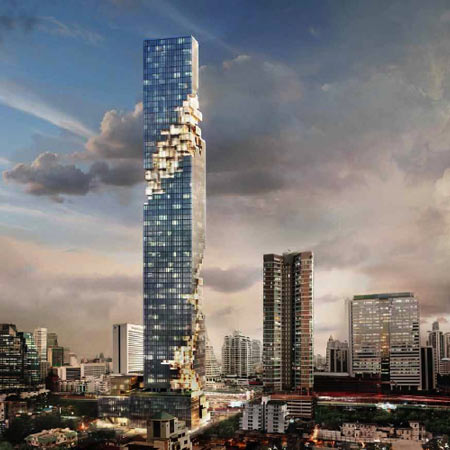
German architect Ole Scheeren of Office for Metropolitan Architecture has designed a skyscraper for Bangkok in Thailand.
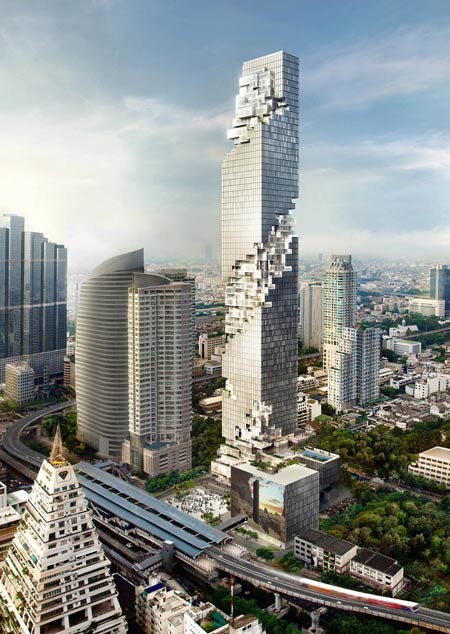
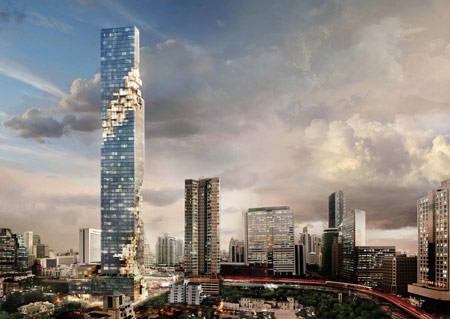
Called MahaNakhon, the building consists of a 77-storey glass tower.
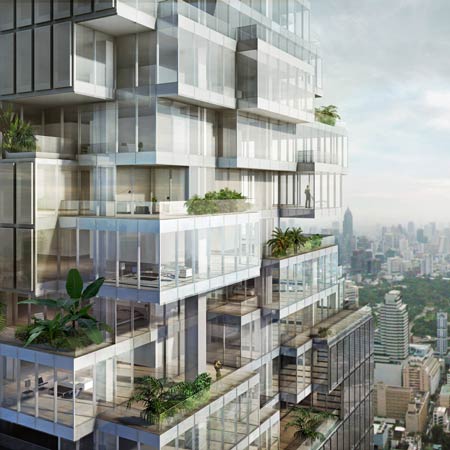
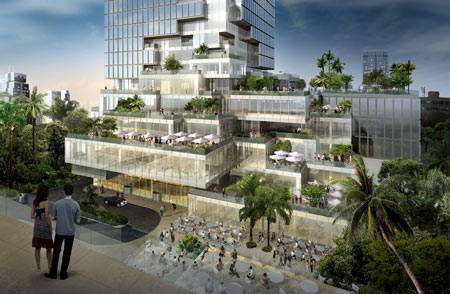
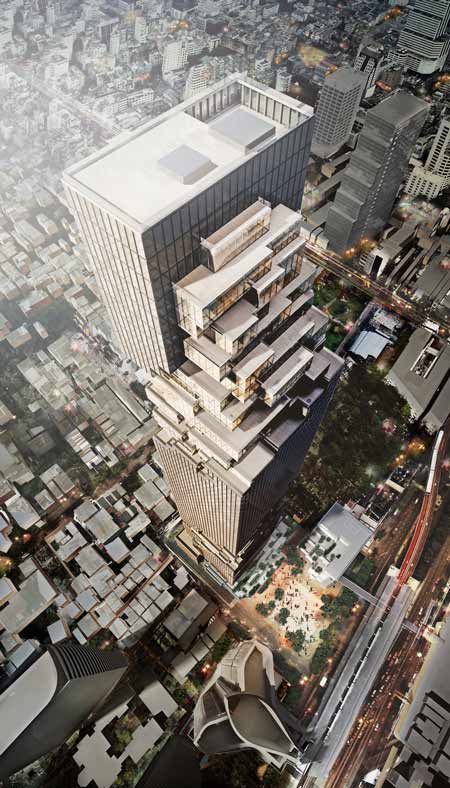
A band of shifted, box-like elements breaks up the surface and creates terraces and balconies.
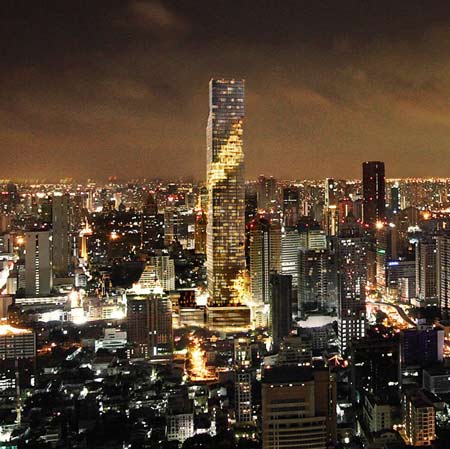
There will also be a public plaza, retail space, 200 homes, a hotel, bar and restaurant. Building is due for completion in 2010.
Images © OMA/Ole Scheeren.
See all our stories about OMA in our special category.
Here’s some more information from OMA:
–
Bangkok Rising: Construction to Begin on Ole Scheeren / OMA’s MahaNakhon Bangkok’s Tallest Building to be a Lush Urban Oasis with The Ritz-Carlton Residences, Public Square and Five-Star Edition Hotel Collaboration with New York’s Ian Schrager to Be Completed 2012.
In the 125 years since William Le Baron Jenney’s ten-storey Home Insurance Building in Chicago became the world’s first skyscraper, the spectacle of soaring towers has become increasingly common wherever land is scarce, allowing cities to stack life ever taller, denser and more dynamic. Like cathedrals and palaces of the past, skyscrapers today define their cities’ identities as they shape the skyline. As the late critic Herbert Muschamp wrote of these modern wonders, “Contemporary architects reveal the inner world in the process of adorning the outer one.”
Beginning in Fall 2009, the city of Bangkok – home to an estimated 15 million people – will start to embrace an unprecedented new architectural manifestation of its extraordinary ‘inner world’ when construction begins on MahaNakhon, a dazzling tower designed by internationally celebrated German architect Ole Scheeren, Partner of the Office for Metropolitan Architecture (OMA).
With MahaNakhon, Scheeren, whose many landmark projects include the CCTV Tower in Beijing, has crafted a gleaming 77-storey skyscraper that will be the tallest building in Thailand’s capital. The design moves beyond the traditional formula of a seamless, inert, glossy totem, and instead actively engages the city: MahaNakhon’s pixilated and carved presence embraces and connects to the surrounding urban fabric rather than overpowering it. Its glittering stacked surfaces, terraces and protrusions will simultaneously create the impression of digital pixilation and echo the irregularity of ancient mountain topography.
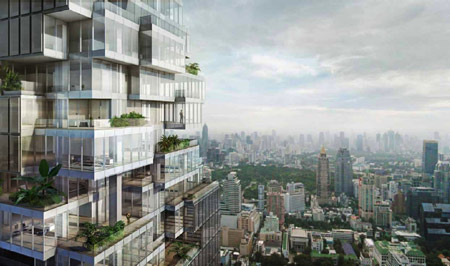
This architectural geography is conceived to convey the energy, intensity and inclusiveness of Thai society and celebrate Bangkok’s emergence as a true global capital, fitting the Thai meaning of the name MahaNakhon, translated as ‘great metropolis’. MahaNakhon is developed by PACE Development Co., Ltd. of Bangkok with joint venture partner Industrial Buildings Corporation Public Company Ltd (IBC).
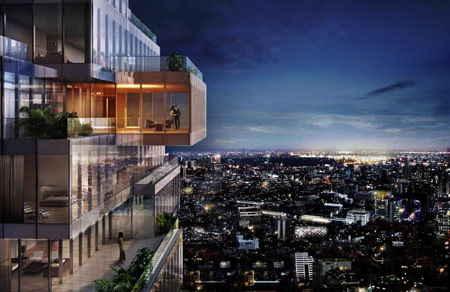
The complex, at 150,000 square meters (approximately 1,6 million square feet) seeks to communicate intimately with Bangkok from the ground up: its series of components comprise MahaNakhon Square, a landscaped outdoor public plaza intended as a new public destination within the city; MahaNakhon Terraces, 10,000 square meters (nearly 110,000 square feet) of luxury retail space with lush gardens and terraces spread over multiple levels for restaurants, cafes and a 24 hour marketplace; The Ritz-Carlton Residences, Bangkok with 200 highly-customized single-level and duplex homes, each offering the atmosphere of a skybox penthouse, managed by The Ritz-Carlton with five-star amenities for all residents; The Bangkok Edition, a signature boutique hotel with 150 hotel rooms, a collaboration between Marriott International and renowned hotelier Ian Schrager; and a multi-level roof-top Sky Bar and restaurant.
Sorapoj Techakraisri, CEO of PACE Development describes MahaNakhon as, “the result of a strongly held wish to do something for Thailand that is both an enduring architectural symbol and a very real and practical example of a firm commitment to, and confidence in, our nation’s long term economic prosperity and cultural diversity. MahaNakhon will be the city’s tallest building, but more significantly it will accurately represent the audacity of Bangkok today – the optimism and strength of Thai culture and the value of that culture to Asia and the rest of the world.”
Dalit Braun, CEO of IBC, commented, “Every nation needs a symbol of confidence in its future. We believe MahaNakhon will perfectly embody the essence of a strong and forward looking country that is the gateway to Southeast Asia while serving as a bold architectural landmark. IBC feels especially privileged to be part of this truly imaginative project.”
According to its developers, MahaNakhon will be completed in 2012. Homes available at MahaNakhon will range in size from 125 square meters (1,350 square feet) to 830 square meters (8,930 square feet) with ceilings up to 3.5 meters high (approximately 11.5 feet).
The Building
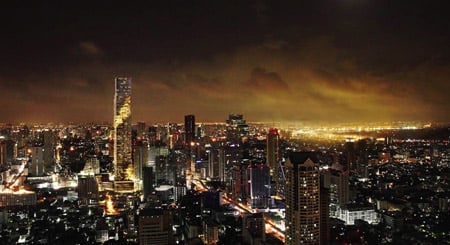
With its distinctive sculptural appearance, MahaNakhon has been carefully carved to introduce a three-dimensional ribbon of architectural ‘pixels’ that circle the tower’s full height, as if excavating portions of the elegant glass curtain wall to reveal the inner life of the building – metaphorically and actually an architecture that encloses and protects its inhabitants while revealing the inner life of their city. The pixilation gives MahaNakhon an arresting profile on the skyline while generating a set of very special features to house the diverse functions of the building complex in an intelligently strategic way.
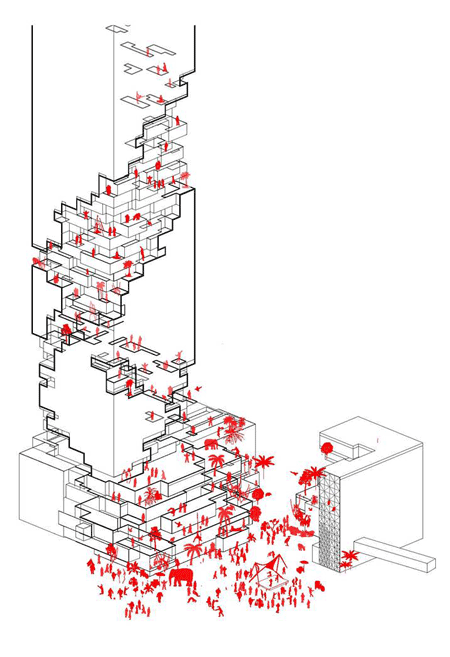
Ole Scheeren’s design for MahaNakhon dismantles the typical tower and podium typology to render not a tower in isolation but instead a skyscraper that melds with the city by gradually ‘dissolving’ the mass as it moves vertically between ground and sky. This effect begins with a series of generous, cascading indoor/outdoor terraces at The Hill – the 7-storey area of tower’s base housing luxury retail and dining. Here MahaNakhon’s architecture is articulated to evoke the shifting protrusions of a mountain landscape. The Hill Terraces fit keenly with the lush, cultivated tropical gardens that give way to the city’s own many green swaths.
MahaNakhon also features an adjacent freestanding 7-storey building known as the Cube, with multi-level indoor/outdoor terraces corresponding to those of the Hill Terraces across the expanse of an outdoor atrium. The outdoor atrium forms a natural valley, offering a network of social spaces with an extensive and carefully selected mix of dining and leisure facilities that serve the general public via a direct above-ground pedestrian link to the main CBD Skytrain station and plaza-level access, The Ritz-Carlton Residences in the main tower of MahaNakhon, as well as guests of The Bangkok Edition Hotel.
MahaNakhon Square, located in front of the tower, is intimately connected to the space between The Hill and Cube. This dynamic public plaza – intended as a meeting place, a spot for planned and spontaneous cultural events – will be a landscaped retreat for the city’s inhabitants, a gathering place, a rare venue for cultural and social interactivity, with direct connection to the Chongnonsi Skytrain station and future rapid bus transit system: an urban oasis that provides refuge from the intense daily clamor of greater Bangkok while offering constant easy access for reconnection to it.
The Ritz-Carlton Residences of MahaNahkon – 200 two to five bedroom homes on floors 24 through 73 of the building – will occupy projecting glass skyboxes with sweeping views and generous indoor/ outdoor spaces with plunge pools and oversized terraces uncommon to high-rise living in global capitals but well-suited to the tropical climate of Bangkok. The tower’s ‘pixels’ have been designed to maximize unobstructed panoramas for the residences, offering rare bird’s eye views of the city and the Chaophraya River.
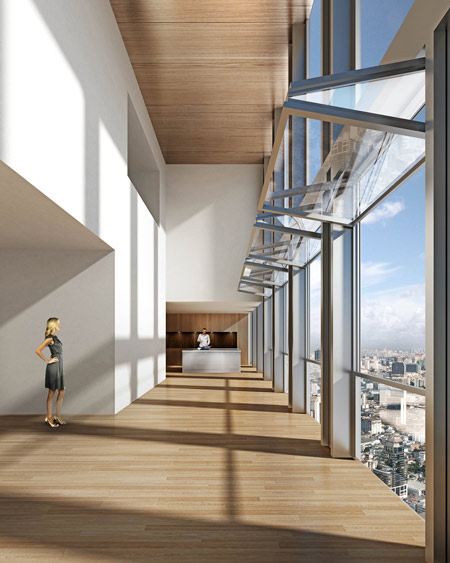
Residences located in the non-pixilated portions of the tower will enjoy a parallel innovation: single-level and duplex units here offer grandly scaled double height living spaces equipped with custom-designed cassette curtain wall systems with floor-to-ceiling window walls and operable “bi-fold balcony windows,” as well as secondary operable ventilation panels. The bi-fold balcony windows feature glazing units that fold open inwards to the ceiling, providing an innovative and unprecedented conversion of indoor to outdoor space. Thus the MahaNakhon tower enjoys great levels of permeability and a relationship to the world beyond.
The top of the MahaNakhon tower houses a multi-level three-floor Sky Bar and restaurant with dramatic double-height spaces, private dining facilities for entertaining, and a rooftop outdoor bar with sweeping 360° views of the skyline and river, floating 310 meters (more than 1,000 feet) above the city.
About Ole Scheeren, Partner, OMA
Born in 1971 in Karlsruhe, Germany, Ole Scheeren is an internationally acclaimed architect and partner along with Rem Koolhaas in the firm of Office for Metropolitan Architecture (OMA). Scheeren is director of OMA Rotterdam and OMA Beijing and in charge of the firm’s work across Asia. As partner-in-charge of OMA’s largest project to date, he led design and construction of the China Central Television Station (CCTV) and the Television Cultural Center (TVCC) in Beijing.
His current projects include MahaNakhon; The Scotts Tower and Gillman Heights, both in Singapore; a media center in Shanghai; and the Taipei Performing Arts Centre in Taiwan. Since 1999 he has directed OMA’s work for Prada and completed the Prada Epicenters in New York City (2001) and Los Angeles (2004). In 2006, Scheeren designed two exhibitions – one for The Museum of Modern Art in New York and another for Beijing – featuring the CCTV project. Ole Scheeren joined Rem Koolhaas and OMA in 1995 and became partner in 2002
Previously he worked for architecture firms in Germany; collaborated with 2×4, a graphic design firm in New York; and was engaged in a range of projects through his own studio in the United Kingdom. He has been involved in various art initiatives and exhibitions, such as Cities on the Move in London and Bangkok, Media City Seoul, and the Rotterdam Film Festival. Scheeren’s work is featured in the collections of major museums, including the Museum of Modern Art MoMA, New York.
He writes and lectures on a regular basis. Educated at the Universities of Lausanne and Karlsruhe, Ole Scheeren graduated from the Architectural Association in London and received the RIBA Silver Medal.
–
Posted by Rose Etherington


July 23rd, 2009 at 11:21 am
reminds me of
http://www.dezeen.com/wp-content/uploads/2008/09/07-sky-villa-day.jpg
July 23rd, 2009 at 11:22 am
it looks burnt. are those renders showing the post-chinese new year condition?
July 23rd, 2009 at 11:31 am
yuck…looks like a decaying part of the body.
July 23rd, 2009 at 11:40 am
A stunning and evocative erosion of the traditional tower block
And please, no one say anything about HdeM’s New York tower, there is not enough similarities to warrant that debate.
July 23rd, 2009 at 11:44 am
Dear God, please protect my beloved Asia from this western infestation. This scraper even looks like it was attacked by termites, or is it the flying locusts from koolhaasland?
Does the world have to be so similar? Wheres all our Eastern-ness going? We used to have a life!
July 23rd, 2009 at 11:55 am
and this…
http://www.ecosilly.com/2008/12/09/daniel-libeskind%E2%80%99s-soaring-green-garden-tower-for-nyc/
July 23rd, 2009 at 12:01 pm
Looks like the nightmare of a structural engineer.
July 23rd, 2009 at 12:50 pm
It’s the 56 Leonard project by H&deM with nearly identical renderings. I’m having boom-time NYC deja-vu. Haha.
July 23rd, 2009 at 12:55 pm
I love the shape .. but it kinda looks like it is on flames indeed ! Beautiful facade though.
July 23rd, 2009 at 1:27 pm
lookes like a failed 9/11
like it
July 23rd, 2009 at 1:50 pm
Was Godzilla in town?
July 23rd, 2009 at 2:27 pm
Jenga anybody?
July 23rd, 2009 at 2:33 pm
to all you haters out there: … tssssh.
Some refreshing work from OMA again.
well.. I guess the prada transformer was refreshing too….
July 23rd, 2009 at 2:42 pm
Great design, Atrocious choice of location – Ole Scheeren have you actually been to Bangkok and peered outside the velvet curtains of the 5 star hotel lobby. Nothing in this horrid pillar to the rich suggests integration with the wider cultural and political landscape of the city. A rich man may experience this building as a ‘refuge’, but to a poor man, its a citadel, and a declaration of hostile intent.
July 23rd, 2009 at 2:48 pm
Wow. I find that intensely disconcerting. It will stay with me, I suspect, but not in a good way.
July 23rd, 2009 at 4:31 pm
conceptual ideas and models for this project were presented in oma’s last el croquis, i wouldn’t say this ‘looks’ like H&D’s tower, i would suggest the other way around. H&D’s tower is great, of course, but this project is articulated to create much more intriguing effects.
props to oma for continuing the bang.
July 23rd, 2009 at 4:55 pm
to Jacqui: Have you actually been to Bangkok? When exactly? If you don’t strictly follow Lonely Planet’s “exotic” walk, you will see that the city has evolved a lot in the past decade.
I live in Bangkok and don’t find this building unfriendly at all. (And I am definitely not a rich man.) Do you mean that because some percentage of population is poor, Bangkok doesn’t deserve good design? Tokyo has a lot of homeless people too, so those brandname towers don’t belong there, do they?
And for those who think that this building is not Asian enough, then can you enlighten me by showing a skyscraper which looks oh-so-Asian without oh-so-obvious symbol, say bamboo. Should there be a tower in the shape of elephant in Bangkok? Oh, there’s already one, indeed.
July 23rd, 2009 at 5:47 pm
I absolutely LOVE this “No More Mister Nice Guy” architecture!!!!
Super strong concept and form!! Can’t wait to see it built!!
July 23rd, 2009 at 5:59 pm
Genius!!…
July 23rd, 2009 at 6:07 pm
Puri- WELL SAID!! I couldn’t have put it better myself. This is an original design and challenges the typology of the skyscraper in an interesting way, something we have come to expect from OMA. I like the way it seems to deteriorate and erode away, allowing the city in-revealing its insides in contrast to the separation between skin and function of many existing skyscrapers (something Koolhaas analysed extensively in ‘Delirious New York’.) Hopefully one day i’ll have the balls and the brain to put forward a design like this.
July 23rd, 2009 at 7:34 pm
OMA is back!!
July 23rd, 2009 at 8:02 pm
I totally agree with Puri, i’ve spent 2 months in BKK and i find this shape to perfectly fit the shiny malls vs. choatic housing sectors you can find by walking through the whole city…
I’m generally not fond of tower designs as they mainly deal with aesthetic and pure form, i’m also not fond of pixelated stuff, but dunno why, this one i really like ! Probably the revealed “pixels” give back an idea of human scale…
I think they shoud have avoided the sprawling ground levels…
July 23rd, 2009 at 8:45 pm
I want “No More Mister Nice Guy” to become a legitimate genre of architecture!
I love how radical this is–incorporating the aesthetics of destruction into the form. Reminds me of the German architect (can’t recall his name) who said he conceived buildings with the idea of what sort of ruin they’d leave behind.
It also calls to mind one of those 9/11 viral jokes about the Twin Towers being rebuilt with a massive donut shaped cavity for planes to fly through…
July 23rd, 2009 at 9:51 pm
There seems to be a trend lately of ‘destabilized’ architecture which likely reflects our destabilized world. For example, buildings designed off-center so that they look like they are going to fall over, horizontally shifted floor plates signifying instability, and now this project where it looks as though the building has been eroded.
I think it is an interesting reflection of contemporary culture where power is shifting and no one is certain where we will be in 50 years.
July 23rd, 2009 at 10:55 pm
I like the double height operable glazing. I hope that there is a double skin on the building where the facade is taught.
July 24th, 2009 at 12:49 am
Not bad but not really new.
There was already a simliar idea by Mass Studies..
July 24th, 2009 at 1:21 am
Digging the Elephants in the diagram.
July 24th, 2009 at 2:39 am
just wondering how safe is it to open the ‘bi fold’ windows at great height, I suppose the air draft would be very strong up there and the parapet is just 1m or so, looks so scary
July 24th, 2009 at 4:39 am
Great Design with Glass Box idea Anyway Bangkok Thailand is very very very hot City na !!!!
July 24th, 2009 at 4:54 am
looks like a combination of daniel libeskind and herzog de meuron
http://www.dezeen.com/2008/09/14/56-leonard-street-by-herzog-de-meuron/
July 24th, 2009 at 5:59 am
there are inventors and there are the copier – it’s strange seeing OMA / Ole shifting over to the copier – H&dM in Tribeca and the operable windows reminds me on the Shutter Building from Shigaru Ban close to the Highline /NY
July 24th, 2009 at 7:59 am
The building will ruin Bangkok skyline!! ( I mean worsen the original-not a very good one. )
Moreover, feel a bit concern about the ancient Muslim graveyard at the back of the building which origianlly has a potential to be an urban cultural heritage park. Sathorn really need more urban parks. A green connection to urban edge at the other side of Chao Praya River.
Well, the concept itself look interesting though. Also the dramatic view from different opening will introduce a new perception for users.
Would be glad if this happens in somewhere else.
Of course, Not In My Backyard!!
July 24th, 2009 at 8:47 am
I’m a Bangkokian, and I’m liking it. Bangkok has this rotten, chaotic, ever-changing mess goin’ on all the time. Gotta live in here to really know what it means. I’m glad it’s not another clean, modernistic tropical design–boring stuffs Thai and Singaporean architects are doing all the time.
July 24th, 2009 at 10:36 am
and for reference, elephant buliding in BKK
http://www.success-ed-travel.com/images/1190780093/elephant-building.jpg
……. hurrrr
July 24th, 2009 at 11:49 am
the elephant building in BKK looks like this :
http://img510.imageshack.us/img510/6452/cs1vb7.jpg
July 24th, 2009 at 3:11 pm
it’s not a H&deM copy at all. It’s a revisitation of an older OMA project in Tokyo. That was designed years ago. By the same time Jean Nouvel had a similar approach, also for a Japanese project.
H&deM’s Leonard St. Tower doesn’t have anything in common with OMA’s project. Errosion (as well as porosity, for instance) it’s a common theme in current architecture. Otherwise the project would yield a strong identity to Bangkok (look at the many anonimous commercial crap surrounding the area in the renderings). Read what Joaquin says above.
July 24th, 2009 at 3:11 pm
oh my god i promise not to read these comments any more. Recentfull and hating people, I Question myself if the people who write bs about other great architect’s work through here, have actually even designed a doll house? I have to grab a hold of my emotions because seeing poeple just criticizing for the sake of it makes me sick!
July 24th, 2009 at 6:17 pm
IT’S GOOD TO BE KOOLHAAS’ PROTEGÈE !!!!!
July 24th, 2009 at 8:47 pm
why are 70ies sculputurs re appearing in architecture today? postmodern in appocalyptic way!
July 24th, 2009 at 9:41 pm
I think noone has pointed out the resemblance to the work of Site yet, especially the momentum of the small building ´fallen off´ the tower. In this respect it might as well fit as another product of oma´s fascination to the work of some of the 70´s visionary antiarchitects like Superstudio. I would also see a new fragment of the death-star references though. All this for me shows oma back at its practice of pop-cult cross-refencing and intellectual lecturing (if not quixotism).
July 24th, 2009 at 10:24 pm
Will Rem be happy with Ole promoting himslf like this?
July 25th, 2009 at 8:55 am
Hi Puri, actually, I live in Jakarta, also land of the shiny tall building, and have for many many years. I also have been to Bangkok, although I wouldn’t claim to know it. I fully understand that some residents of Jakarta enjoy the skyscrapers and the sense of modernity. I myself have to say that as far as architecture goes, Southeast Asian cities have been a lot more willing to experiment and innovate than in many Anglosaxon countries. I am not interested in preserving a so called ‘Asian’ traditionalism and nor do I lament the economic changes that Southeast Asia has experienced over the past few decades. But I do think its important, as residents of Southeast Asia, that we maintain a critical stance towards their contradictory, unintended effects.
My apologies to the architect for my earlier remarks. He has created something original and remarkable and I strongly believe that all attempts to originally contribute to a genre, a discipline, a field of expertise should be deeply respected and I should have stressed this earlier. There’s nothing wrong with the building in and of itself and I am not qualified to speak about them if they are. My complaint is not here. What concerns me is the way that architecture in Southeast Asian cities are carving up public space along heavily stratified lines. In my city, there are no places in which the classes intermingle. There is no public space that is accessible to the poor. In fact, in all my years as an ethnographer of the city, the poor, lower middle class and middle class are increasingly pushed into the corners of the city, while the upper middle and upper classes move through the city and interact in its spaces as if space itself wasn’t tied to access to capital. In my city, 95% of the new buildings serve just 10% of the population. Because of the way public space is organised, the poor and the rich live in worlds a million miles apart from each other. My quibble is this, the propagation of the belief that public space is just that ‘public’ when it it patently not.
So when the blurb for this building tells me that it ‘engages the city’, I am forced to ask, whose city? And when it tells me that its creating a landscaped retreat for the city’s residents, one has to ask, well, whose residents? I am not suggesting that Southeast Asia does not have elite buildings, yuppy malls and so on, but in Southeast Asia, these forms of space are being constructed with no parallel flourishing in parks, museums and other types of space where access is not reliant upon capital. I worry about the kind of society we create when space is designed like this. Thank you for your time.
July 25th, 2009 at 12:31 pm
I shall soon trade London for Bangkok and settle by some 30 storey condo (nearly completed) right under the Maha Nakhon tower.
Fortunately enough with my flat overlooking what appears to be the future Bangkok landmark.
I must admit – having trained as an Architect in Italy 2 decades ago (tho I ended up working in a totally different industry) – the viewing of the first Maha Nakhon picture available on the internet generated mixed feelings with disappointment prevailing.
However, on second thoughts, I find the project rather daring and original. One that will certainly stand out from a jungle of hundreds of similar towers scattered around Bangkok (and indeed the world), and which has clearly sparked an interesting debate before its very own foundations have been set ….
Watch this space and see you all by the sky bar!
July 27th, 2009 at 4:03 am
that building will be a great masterpiece.. i want to visit that architecture.
July 27th, 2009 at 2:38 pm
To Puri and Jacqui, I am from Bangkok. You both have the right points.
Bangkok awaits good design and good public space. The design that is not simply metaphoric but critical and the space that is not simply open but space for many publics.
The gap between the rich and the poor is so high in Bangkok. This building has good intention in trying to link with the city symbolically and physically. But in everyday reality, it’s difficult to see that most of the people can afford to be inside the building filled with luxurious shops, restaurants and, perhaps, even the viewing space at its top. Surely the little open space in front of the building will be guarded in certain level. The only rich interaction interface will be that of the 2 m. by 50 m. footpath.
However, let’s don’t be too pessimistic. I think Mr. Scheeren know Bangkok well, he was there 10 years ago seriously organising the exhibition ‘cities on the move’. I think Bangkok, with its complex political, physical, social and economic conditions can well response to MahaNakorn.
July 27th, 2009 at 10:24 pm
http://www.56leonardtribeca.com
http://cheungvogl.com/alexander_house_ny.htm
you can’t stop a trend….
July 28th, 2009 at 11:50 am
Architectural frustration to make something ‘iconic’… looks like an earthquake hit BKK!!!
July 28th, 2009 at 11:55 am
Stunning, I’ll take a penthouse box thank you very much.
July 29th, 2009 at 10:04 am
I looks nice…unique…
July 29th, 2009 at 2:03 pm
Wow! How did it pass the fengsui man’s opinion. Because of it’s unfinished facade be so strong for Bangkok skyline.
July 30th, 2009 at 12:36 pm
Is this what Rem talked about not being iconic??
July 30th, 2009 at 5:52 pm
OMA ripping off wikipedia?
from the “Skyscraper” page: “Like temples and palaces of the past, skyscrapers are considered symbols of a city’s economic power. Not only do they define the skyline, they help to define the city’s identity.”
August 8th, 2009 at 9:43 pm
The more broken up area looks a lot like the condo tower Herzog and Demeuron proposed in lower manhattan…
August 18th, 2009 at 11:05 am
what is oma without opa?
mr. koolhaas brought surprisingly new variations in existing highrise typologies as no other. this highrise tower is different, with the many disadvantages of these more expensive, less sustainable, less durable, less flexible, mostly formalistical ‘terrassenhäuser’. what happens, when roof-, ceiling- and windowcleaners are going to earn money, even in bangkok?