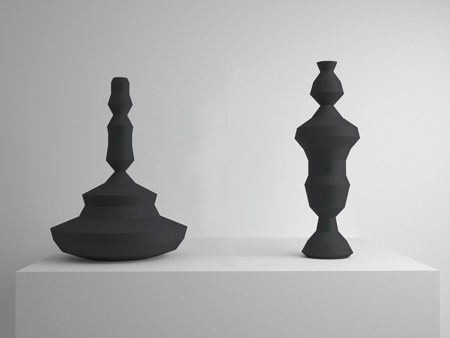
Paris based design studio NOCC have produced a range of objects whose forms are generated according to the shape of sound waves recorded when their names are pronounced.
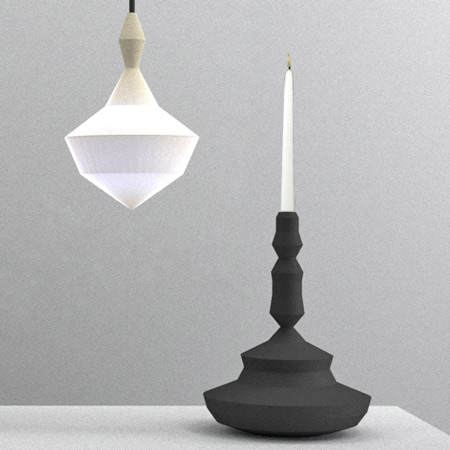
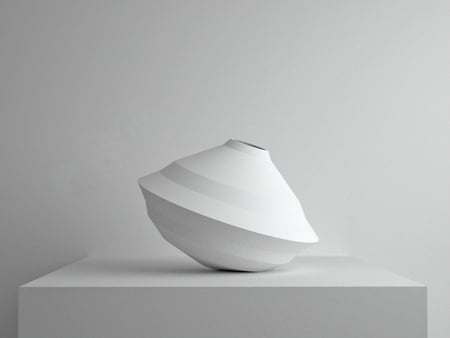
The collection, named Object of Sound, includes a candle holder, lampshade, and vase.
The profile of the soundwave recorded for each product is rotated into a 3D form, unique to the tone and volume of voice recorded.
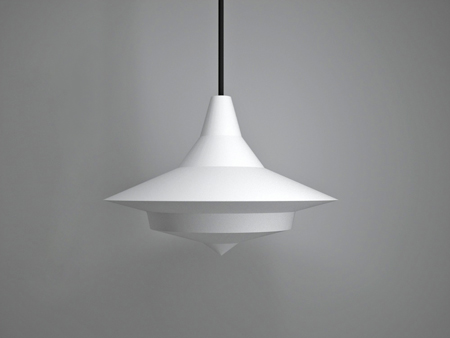
This form is then made using rapid-manufacturing, meaning that each product could be unique and dictated by the voice of it’s owner.

Watch a movie about the project here.
Here is some more text from NOCC:
–
OBJECT OF SOUND by NOCC
Paris-based studio NOCC’s Object of Sound is a collection of objects consisting of a candle holder, a lampshade, and a vase. Each item takes its form from the graphic produced by a person’s voice pronouncing the name of the object.
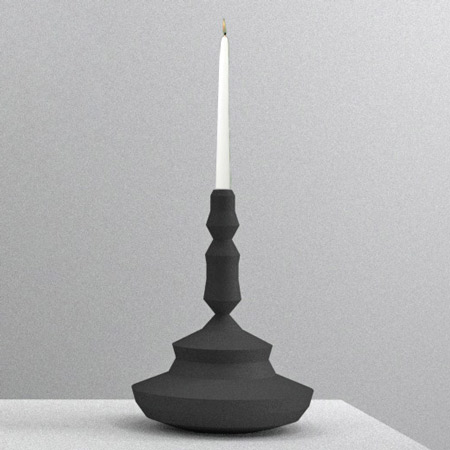
The profile of the sound is shaped into a 3D form and becomes an object. By giving volume to the sound wave, the form becomes a piece that is used according to the word pronounced. A candle holder profile becomes a candle holder, a vase profile becomes a vase and a light profile becomes a light.
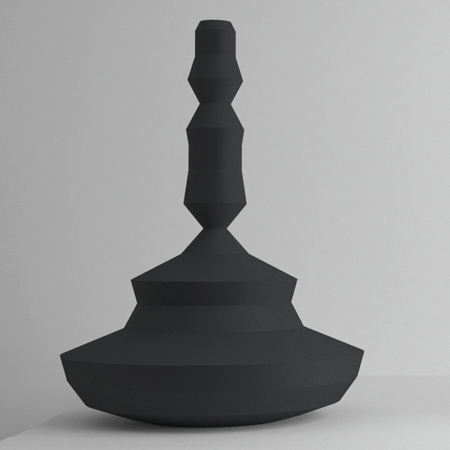
Provided are examples of objects created from NOCC’s voices, but the underlying concept of Object of Sound is that each unique voice creates a unique and personal shape.

Object of Sound pieces are produced using rapid manufacturing technology. Thanks to this technology, every object can be produced individually. NOCC’s Object of Sound will be available at a forthcoming on-line store, Self-Studio.com
Dimensions :
Candleholder: 275 x 92 mm
Vase: 154 x 228 mm
Light: 320 x 250 mm
Technology and Material :
Candleholder: SLS polyamide with black soft touch finish
Vase: SLS polyamide
Light: SLS polyamide
–
Posted by Ali Morris


July 27th, 2009 at 7:53 pm
Looks like the sound shape is arbitrary, in that you control the amplitude. Candle Holder looks like it decrescendos in order to make a wide base resembling the traditional object. I feel like outside of lathing, there are much more interesting applications of this idea.
July 27th, 2009 at 9:13 pm
Clearly brizio sound system is at the beginning of any french projects with sound or with population
http://www.via.fr/telechargement/gp/surfaces/briziosoundsystem.jpg
July 27th, 2009 at 10:51 pm
brilliant
July 28th, 2009 at 10:50 am
Like the shape but the concept is not original at all.
Already few designers have done exactly the same, … nearly 8 years ago.
Enough of those projects with sound, pictures etc… turn into 3D shape and rapid prototyped.
It’s absolutely not interesting anymore…..
July 28th, 2009 at 4:00 pm
design trick # 32 from the book of “how to make design these days”
don’t design yourself, let numbers do it
take any relevant or irrelevant graph and apply it to furniture, architecture or whatever.
popular by architects in the late 90’s and early 2000..now also seen in furniture
July 29th, 2009 at 8:49 am
Dude,
I did-id, like, six years ago for my MA Industrial Design Thesis “The sound that products make”. I also helped my friend at teh RCA Design Products do this as well in 2005.
I found, like B said, it was ‘too easy’ in terms of the context of sound and products.
These are nice ideas to be produced, though… hats off to them!
July 30th, 2009 at 2:16 pm
Hate to be the hater… but B said it…
‘Data driven design’ – why not just design something?
… is the choice to release control over form to a system a technique in the same that sanding removes the human hand? When I see well sanded furniture I think ‘I would rather be spending time making something new than spending time sanding.’
Sound waves are also not jagged unless interpretted in low resolution – the ‘design’ element here is choosing which portion of the ’sound wave’ looks nice – which they do! I feel if the goal is to create nice forms, just go ahead and make them, no need for all the conceptualish stuff.
Be proud of your human hand and your human mind!
Or head in the other direction and become a minimalist (in the Judd sense).
July 30th, 2009 at 4:00 pm
asdfghjkl Funny to say that Minimal art is not conceptual as Minimalism is a movement born from the conceptual movement. Have to study art history a bit more…
August 1st, 2009 at 9:58 pm
John – I didn’t say Minimalism is not conceptual.
The concept of Minimalsim (as put forwards by the Minimalists) was the possibility of the object and the subject being one – and nothing more than that.
The techniques used to create artworks attempted as far as possible to remove the hand of the artist – such as the work of Judd, LeWitt, Andre. Right or wrong it was an attempt at ‘no design’ – which has parrallels with the idea of relinquishing one’s creativity to data or another system as seen in the work above.
So, yes – indeed, one does have to study art history a bit more.
Could I suggest you start with Wikipedia?