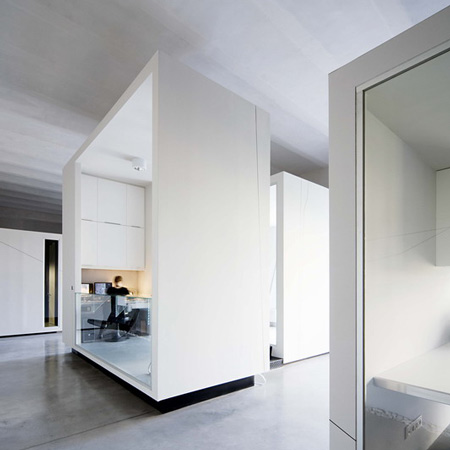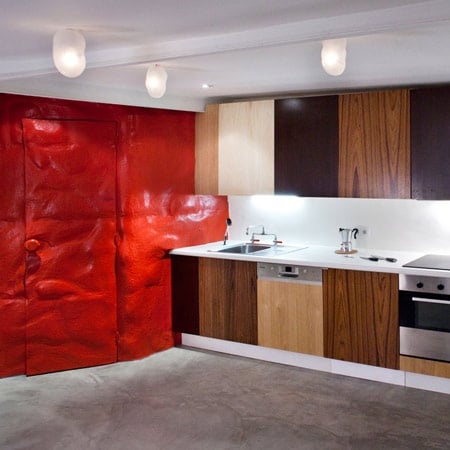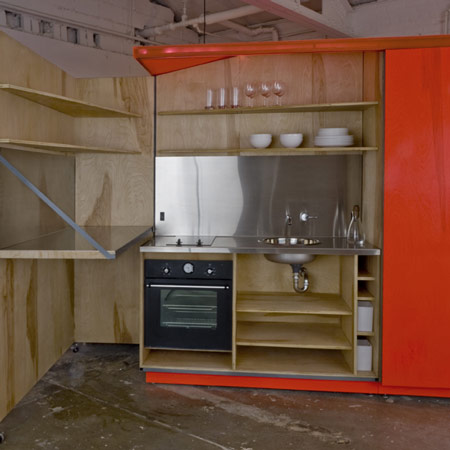
Michigan designer Andrew Kline has designed a compact unit for transforming disused industrial spaces into temporary homes.
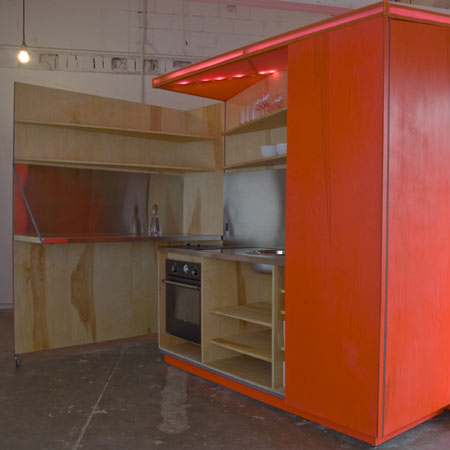
Called Interior Living Unit, the project comprises a kitchen, bathroom, bed and storage that all fold away into a cubic red box.
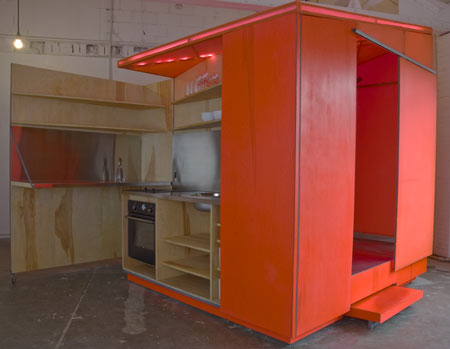
When folded away the surrounding room could be used as a work space or for public functions.
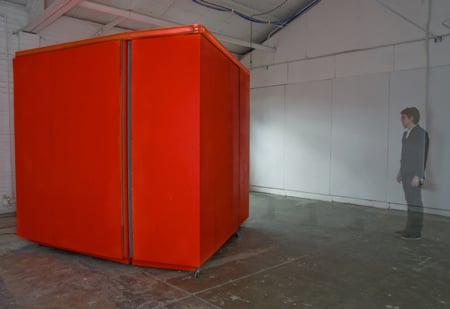
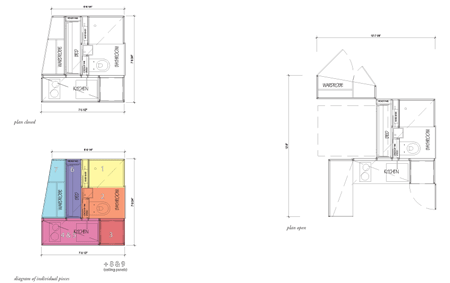
The cube breaks down into nine pieces for easy transportation to a new space.
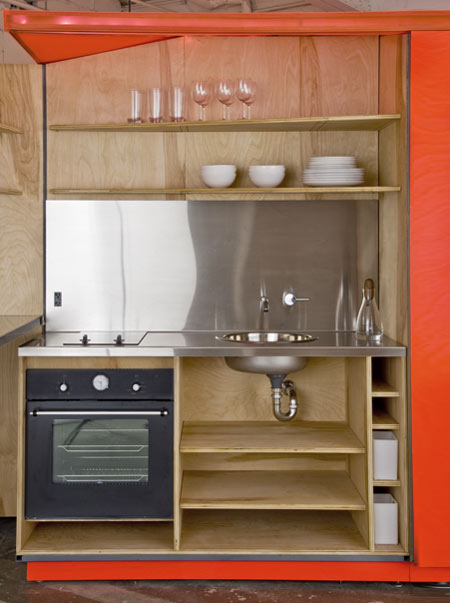
Photographs are by James Carrillo.
Here's some more information from the designer:
The Interior Living Unit is composed of 9 pieces, sized to fit through standard doorways and be combined in the space within.
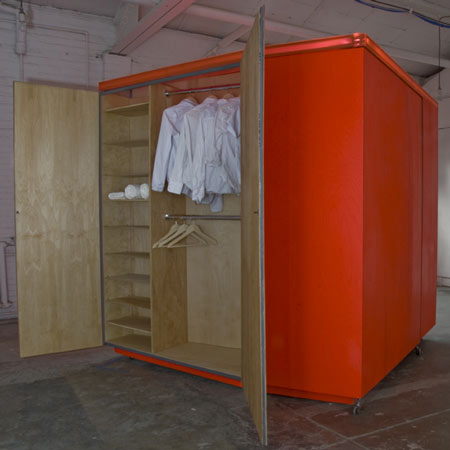
Centralizing the program requirements of a home, The Unit allows the surround space to be used for other purposes, such as workspace.
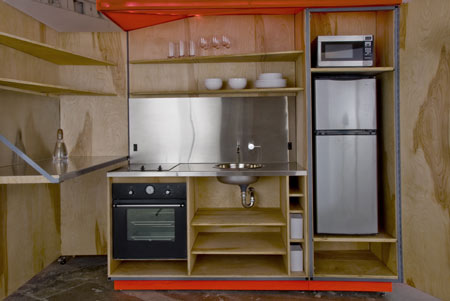
The Unit folds (closed) and unfolds (open) to reveal different functions when needed: a wardrobe, bed, kitchen, and bathroom.
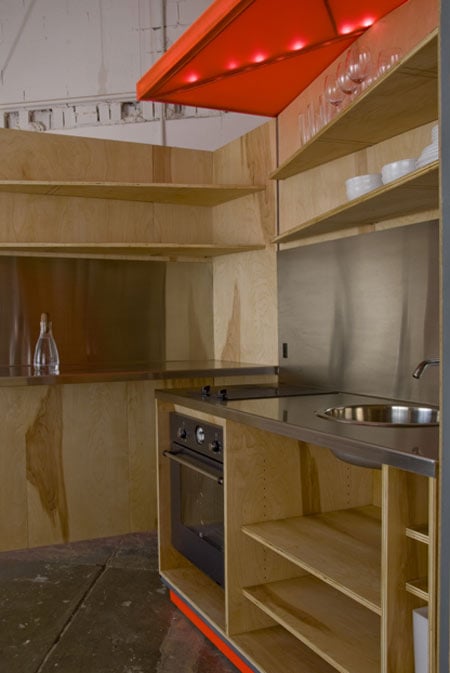
When the Unit is folded the private program requirements of a home are removed and the surrounding space can be transformed for public uses.
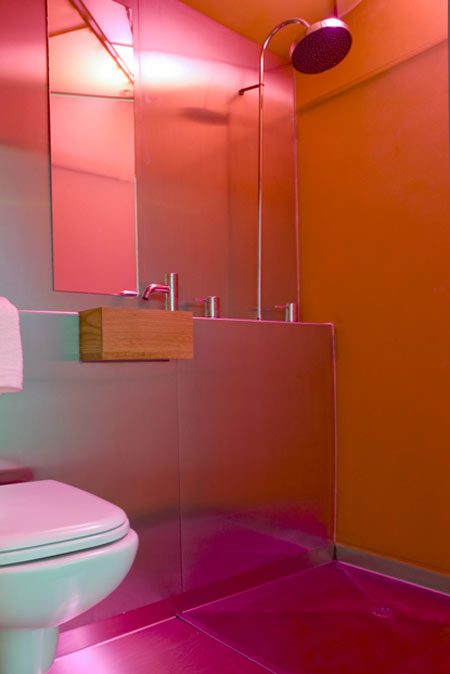
For example: a yoga instructor could live in the same space in which he or she teaches.
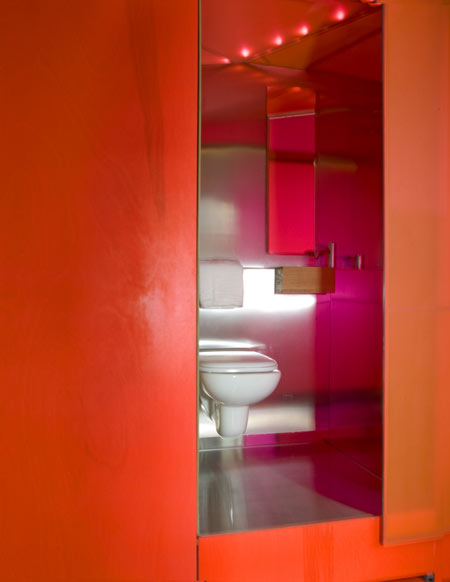
These Units, utilized in vacant buildings, can build communities in hollow urban areas of post industrial cities, such as Detroit.
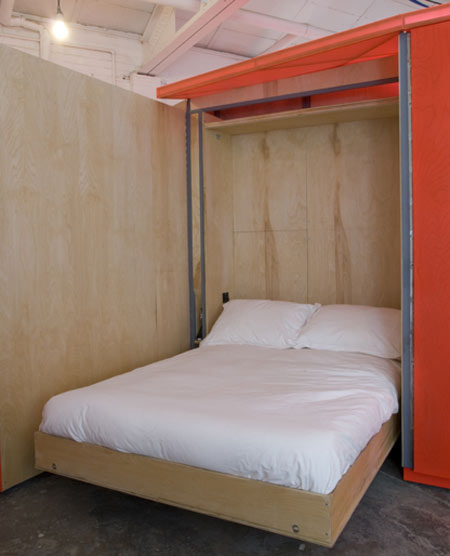
Once taken apart, the Unit is easily transported in a moving van and can be re-installed in another space, allowing the owner to take their home with them if they move.
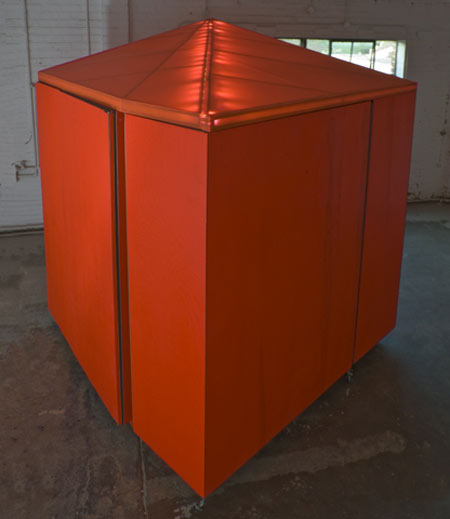
This project challenges current platforms of living bringing the transportability of a trailer to the urban fabric; existing buildings in multiple cities can be readied for Units allowing owners to rent space for their home.
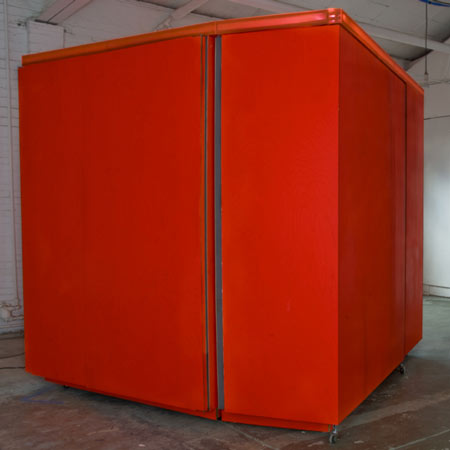
Mass customization allows users to personalize their Living Unit, building emotional connections, a sense of place and pride in contrast to many apartment projects with little character.
See also:
.
![]() |
![]() |
![]() |
| FLKS by Kapteinbolt |
Goldberger by Tervhivatal |
My Caravan Studio by Paul Coudamy |


“Once taken apart, the Unit is easily transported in a moving van and can be re-installed in another space, allowing the owner to take their home with them if they move.”
Even my flat once taken apart can be easily transported into another space.
What remains unclear to me is that how much extra space is needed for this unit to work, since the user must walk around it for every function.
“These Units, utilized in vacant buildings, can build communities in hollow urban areas of post industrial cities, such as Detroit.”
What would the borders be between different members of communities living inside an industrial interior ?
Yet I still don’t understand what solves this design…
awesome! i love micro living ;)
Great idea. one question though- how would it be connected to the pluming system?
Neat design…but how practical? Utilities required would be extensive and need to be retrofitted to any unused factory. Not nearly as portable as one might think. I would think shared facilities in such a situation would be the only answer with the living portions private and permanent. Easier to move clothes and limited gear to new location than ship what would be redundant at new location.
Very Nice….this has been done a few times before and this particular version is much more interesting than those before it. Great job.
This isn’t an original idea or an original interpretation.
Why have triangular shelves? No dining table? Do you really need an oven?
felex…the triangular shelves fit together when the unit is closed and the ones on the left are cut back as a result so as not to hit someone in the head.
While I appreciate the effort at creating a small and modular unit for living, this design seems to ignore how it would work within structures, along side additional units. It also seems to ignore the need for sewer, water (and a water heater), and electrical connections. The concept is interesting in that it is a living unit that is essentially a large piece of furniture that simply exists within another space, but it’s relatively short sighted approach leaves much to be desired.
I have a hard time with these quick living fixes. I agree with much that has been said especially about this not being an original idea. All this is is a glorified set up for a Hooverville or some gypsies that are tired of living in trailers.
kudos. great for detroit.
awesome! i love small things- the best things come in small packages. theres a few niggles but who cares when it sooooo neat!!!
This has already been done in the early 90′s by Alan Wexler. Check out his “Crate House”
http://www.allanwexlerstudio.com/architecture/08_01_architecture/08_architecture_12.htm
Check this out. Much cooler :)
http://www.youtube.com/watch?v=qRfL0evPUdY
The “Create House” link doesn’t provide enough information unfortunately. But the columns suggest a way of providing services to the units in a vertical
service module. The “house’ would have to be designed around that element with connections to it in mind, Otherwise these are just interesting design exercises.
. Nakagin Capsule Tower – Tokyo, Japan, has much the same features of the
examples here, a small living unit that can be remove and replaced.
Sadly the idea didn’t catch on possibly due to era of bubble affluence, but it’s time may come again!
http://www.arcspace.com/architects/kurokawa/nakagin/nakagin.html
Thanks for all of your comments, and thank you Dezeen for posting my project. Perhaps I can be of some help with the questions posted:
The unit attaches to traditional plumbing – the concept intends that the building would be plumbed for the units to "plug in" – the prefabricated units allow this retrofit into a building to happen quickly, as soon as the utilties are in place the units are installed. Preparing multiple buildings in different cities would allow users to move their homes with them. I disagree that this would be too extensive as Edward has commented – plumbing would be added to any building (no matter the design solution) that is retrofitted for non-industrial use…
The unit is wired and has a water heater.
Thank you for bringing Allan Wexler into the conversation. He has been a major influence and I'm glad to see his work being highlighted.
Again – thank you for the conversation. There are videos of the unit being assembled and unfolding on my website.
-AK
So I would be able to poop somewhere if I lived here?
Where does one dress and undress? Also sleeping in the common area would be uncomfortable. But if this is for subsistence living I suppose one must make sacrifices.
I like the design a lot. You have everything you need in a "box" and you can even take your home in a van if you want to move. Nice concept, especially for those who have nomad soul. The bathroom is my favorite part, but I don't really like the color of the wood they used for the kitchen.