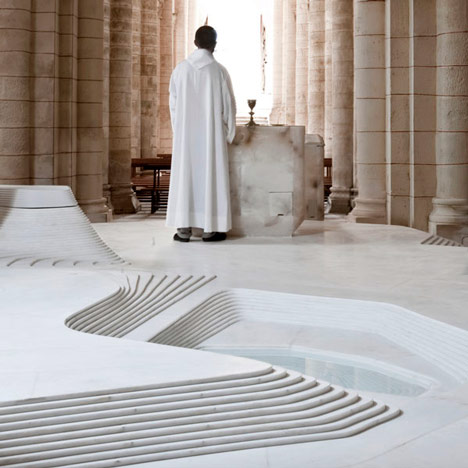
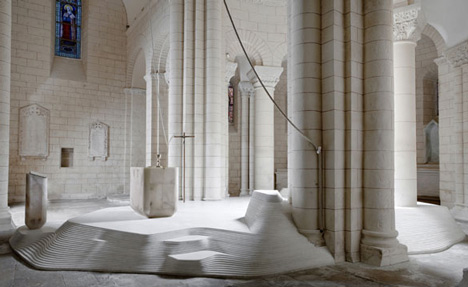
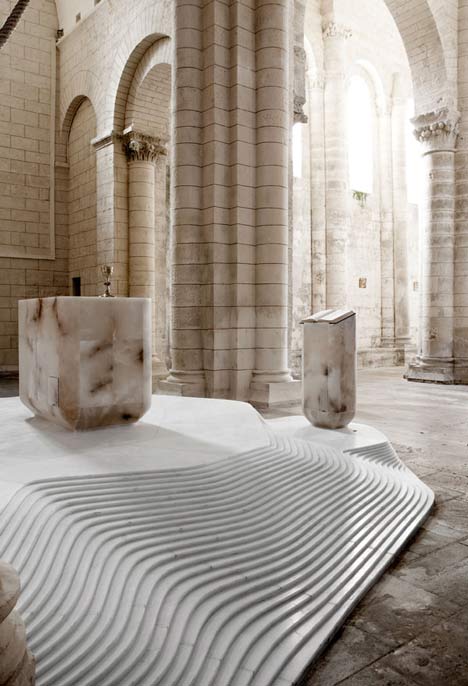
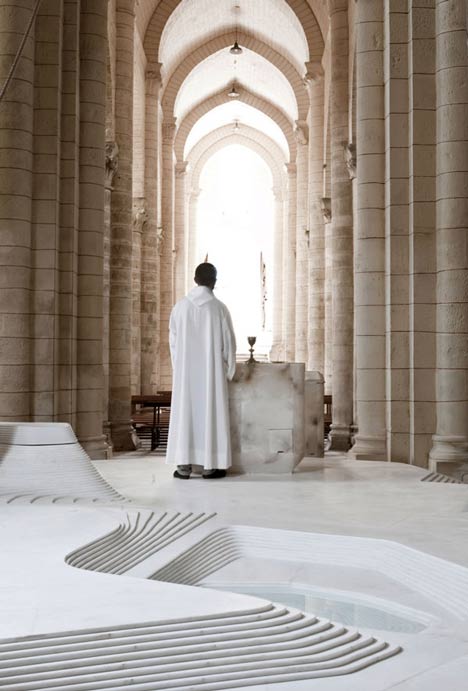
French designer Mathieu Lehanneur has added stacked layers of white marble to create a podium in this Romanesque church in France.

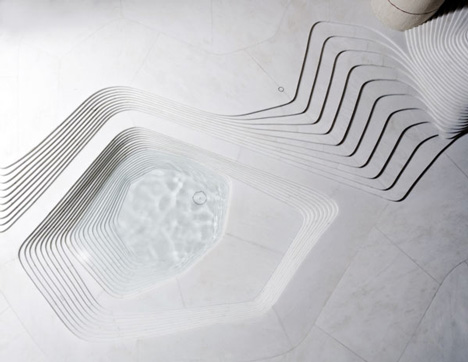
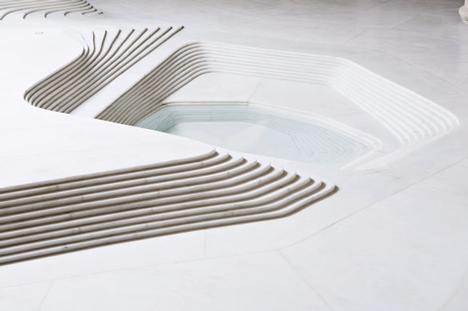
The marble strata step up and down, with a still pool of clear water created in one sunken area.

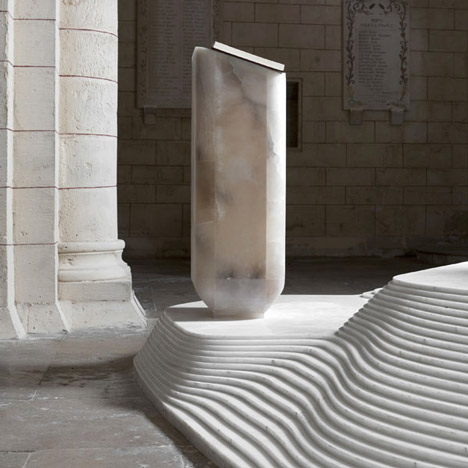
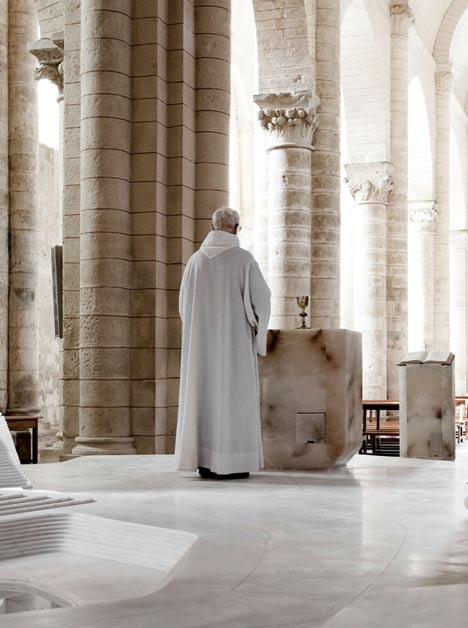
The alter and ambo are made from a coloured mineral material, similar to the existing interior of the church.

Photography is by Felipe Ribon.

More projects by Mathieu Lehanneur on Dezeen »
Here are some more details about the project:
St Hilaire church in Melle by Mathieu Lehanneur

Mathieu Lehanneur has converted the choir at St Hilaire church in Melle in the Deux-Sèvres department (France). The designer has enhanced the Romanesque building with a very mineral look, a surge of white marble that he imagines "prior to the construction of the church. A mineral presence justifying that the church was built there. Reflecting the extreme care paid to the telluric energy of stones and territories in the building of Romanesque churches, this place of worship would have been built on this specific area for the discernable energy that emanates from it."

An architectural gesture equally paradoxical and strangely distinguishable which will undoubtedly mark an important milestone in the development of religious works. The white marble creates a homogenous mineral block formed from successive strata which seem to recall the sedimentary formation of the basement. The liturgical furniture (altar and ambo) is made from coloured alabaster, close to the colour of the original stone of the church. The result is a visual impact, one of Lehanneurs trade secrets, this time using the purity of the geological chaos to highlight the perfection of the Romanesque geometry.
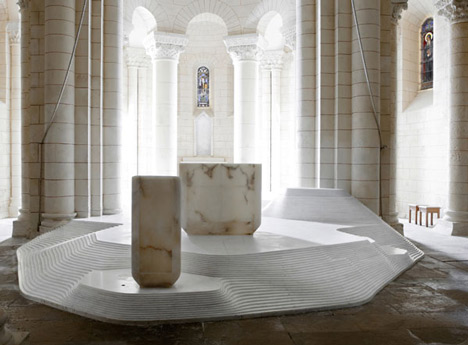
The complicity between the church and this mineral mass is completed by the baptistery hollowed out from the same material. The water that it holds appears to be from the river which runs below the church: the ultimate linking of the building with its environment.
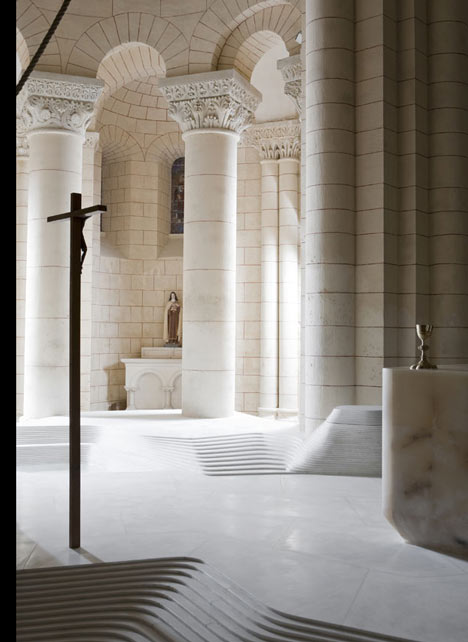
A scenario inspired by the topology of the place, just like a box sunk into the sand, the church in fact gives the impression of nestling in the landscape. Its not just a building placed on the ground but part of the region and reveals itself to visitors as they descend. The main idea of the project was then to accentuate this sensation of progressive discovery and taking root in the land, "I imagine that when this box was sunk into the ground as if pushed by an invisible, maybe divine hand, it revealed the geology of it, the visible aspect of a mineral and massive form: a revelation which seems anterior, and not posterior, to the construction of the church."

This play between anterior or posterior construction allows a relief to be produced which creates a natural hierarchy between the celebrant and the congregation. It simply uses then the sites topology in order for a better comprehension. An organic architecture which is not though a break with with the liturgical codes and conceals symbolic invariants like the eight sided baptistery or the altar built at the junction of the transept.
See also:
.
![]() |
![]() |
![]() |
| The JWT Agency by Mathieu Lehanneur |
Studio 13/16 by Mathieu Lehanneur |
L’Atelier des Enfants by Mathieu Lehanneur |


To me this looks like a temporary installation – the concept is interesting but it looks out of place – imo
I would hope that they have only used marble at the edges and "inside" another material, otherwise it is an extravagant show of opulence by the church, and a huge waste of the congregations money!
It's really amazing how one can turn history and geology to justify a project that doesn't make any sense at all.
Exquisite!
Makes the priests look a bit like Obi-wan Kenobi, and the church like it has been reassembled in a distant planet. Intentional subversion?
Can help the impression that it looks like perfume display at Debenhams..
the priests must have really small feet to walk and down those steps every day!
Well I'm sure the church rats are very thankful –they even got an indoor swimming pool ;)
Big. Site. Model :-O
@Mateo- If you look at the 4th image the contours widen to become steps. Apparently this site model is not to be approached from all sides. Which is a mite too bad; that token pool of water could have been more interesting if it were visible to the congregation.
An good example of an idea that sound nice at first but isn’t.
Just way out of space
Beautiful…. and so so expensive.. but beautiful nonetheless
I imagine a constant series of trips, missteps and other such occurrences. It does look nice, but the impression I get from these photos is that it is a risky environment.
regards,
G.
Awesome ! I want wo see more traditional expensive materials in modern shapes!
@klauszoia
how does it 'make no sense whatsoever' ?
History & topology: "A scenario inspired by the topology of the place [....]" : that's fine, but then, why only the choir? and most of all, what do they know about the topology of that place prior to the construction (Romanesque period, not yesterday..)? Simply they liked that form. Be honest.
Material: ok, so let's pretend the design is fine..what about the material? if it's a "prior topology" why use a different material (not only for the cost..), and why use a third material for the altar and the ambo?
I could go on and on..
back to the steps issue – in all seriousness – with priests usually being elderly folk, isn't it a bit dangerous not to have to clear steps, handrails, easy access and warnings about the dangers of those confusing slopes? I dont think this design is very inclusive of the age group that it is designed for. What if the priest was on a wheelchair, or partially sighted?
I hope no priests get injured from this thing.
This looks like a project by an architecture student used to lasercutting chipboard.
Sadly, this is not a model. The scale and sense of space are off.
Sadly, this is marble. Takes millions of years to produce.
I'm shocked to hear criticism of something so inarguably beautiful! After all, cathedrals are in themselves expensive, wasteful and opulent advertisements for religion. HOWEVER, even I, the non believer (in organized religion as it stands), concede that these structures make a good argument for religious belief- placing its inhabitant in a position of awe and smallness in relationship to this built metaphor of the utter greatness of the world at large.
I feel that this installation does the same thing!!! It emulates nature and topology. The way that a mountain scape with a lake at its bottom leaves us in wonder, right? I think therefor its a GREAT alter. And the layered marbles/ alabaster is stunning to behold.
i was shown around a small church a week or so ago in connection with the refurbishment they are about to embark on, interestingly they are installing underfloor heating (good for them). Their conversion is nothing like above, i liked the idea of some parts but not others, however it seemed it had all been decided along side the local church goers and i think thats good.
oh in West Sussex. (sorry i forgot to say that, Rustington village to be exact) – (they have an interesting clock as well).
Sorry, for me the juxtaposition of smooth white marble of contemporary design and the erosion and patina of flagstones worn by history just doesn't work. In fact I'd go as far as to say covering such a beautiful existing floor is sacrilege! I'm not against marrying the old with the new but here the materials and surfaces jar against, rather than complement, each other.
Form follows function….it seems that this has not been taken to account totally…
Landscape model takes on a life of its own! http://barkitecturemag.com/?p=204