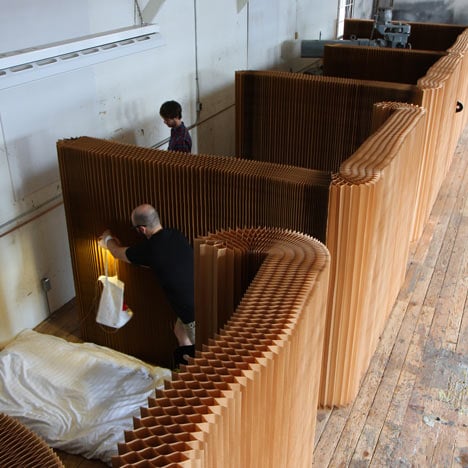
Canadian studio Molo has designed a system of paper partitions that provide privacy at shelters in the wake of a disaster.
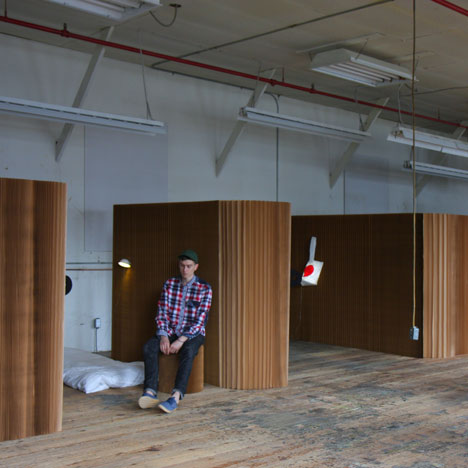
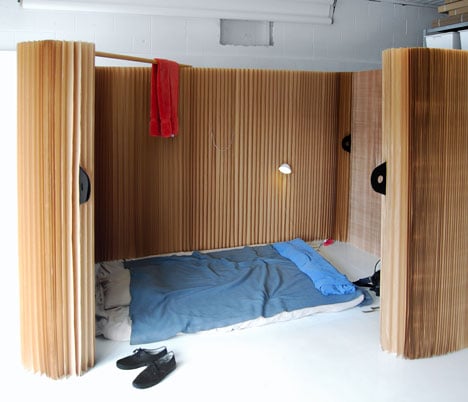
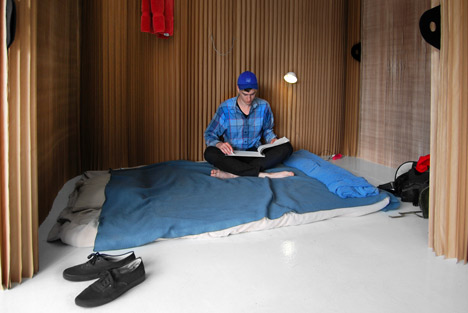
Called Softshelter, the walls create a sense of community and personal space despite the bleak conditions of emergency shelters.
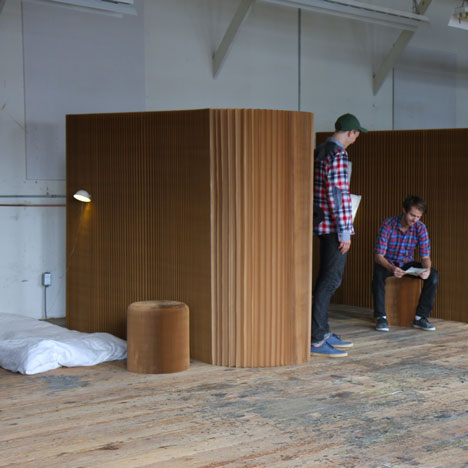
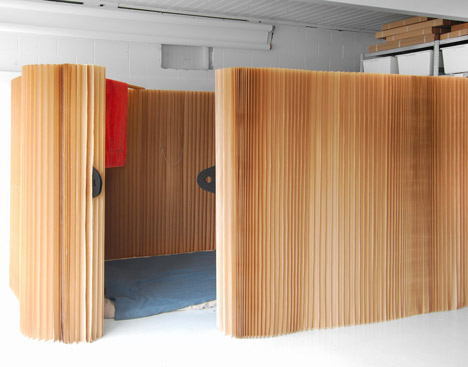
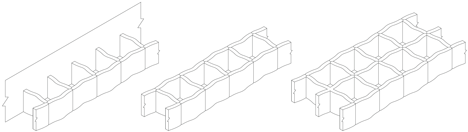
Like an accordion, the kraft paper walls can expand and contract until they meet the edge of another wall.
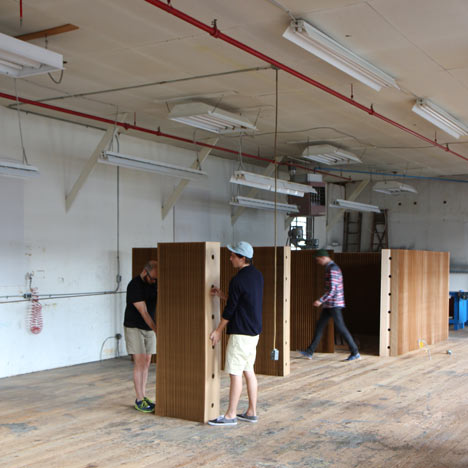
The walls are joined together by detachable magnetic panels and therefore require only a few people to assemble with minimal instructions and no tools.
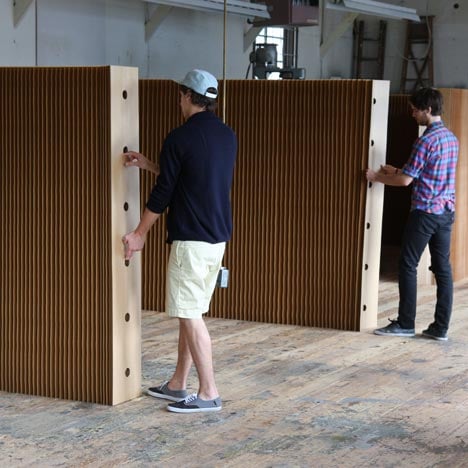
Each flat-packed unit can arrive at the shelter ready for immediate set-up. See more stories on disaster relief »
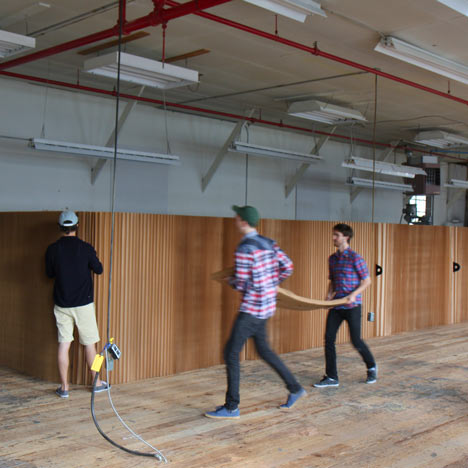
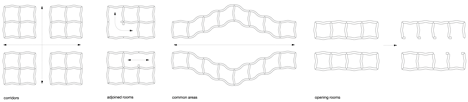
Rooms can stand alone or be clustered together in order to create corridors, conjoined rooms, and common rooms.
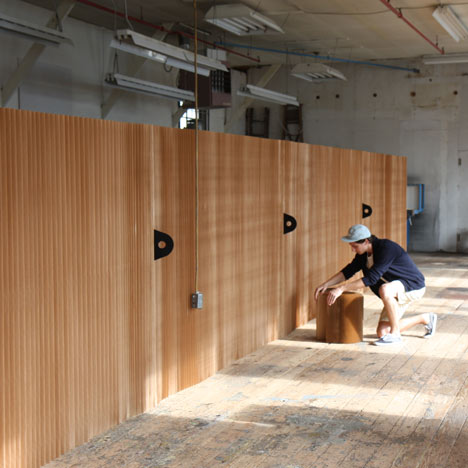
The flexible nature of the walls allows for placement even in irregular spaces.
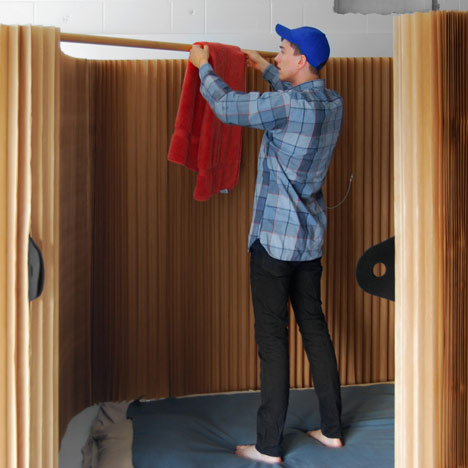
A simple 12-volt power cord can be strung through the walls to reach all adjoining units.
Other relief efforts for victims of natural disasters include Shigeru Ban's temporary housing project and a design for solar-powered emergency tents.
See more projects on paper enclosures here.
Here is some more information from the designers:
softshelter
a solution to homelessness caused by disaster
softshelter is a system for creating personal space within a larger shelter area in order to provide individuals and families with a sense of privacy and encourage community-building in the days following a disaster.
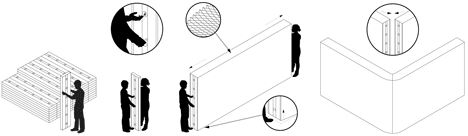
Quick start guide
softshelter is part of molo’s ongoing research-driven exploration of materials, fabrication techniques and space-making with a focus on enhancing common daily ritual and flexible use of space.
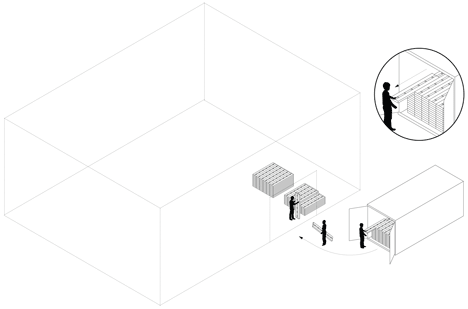
Deployment
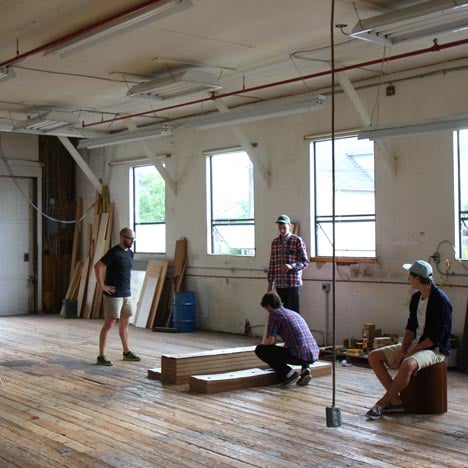
We are currently preparing a study in which a member of the molo team will occupy softshelter; the flexible shelter will be set up in molo’s workshop space from now through September. We will share the experience through a series of stories as the project progresses. softshelter will soon be available as a fully deployable system. By occupying the shelter as it is being designed, we will be able to make discoveries that allow us to further refine a system that, hopefully, will one day be able to assist in disaster relief in an immediate and tangible way.
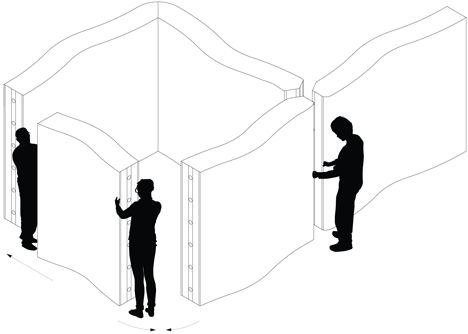
Setting up a room
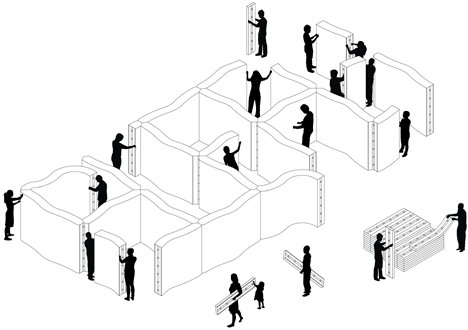
Setting up a community of rooms
Room types
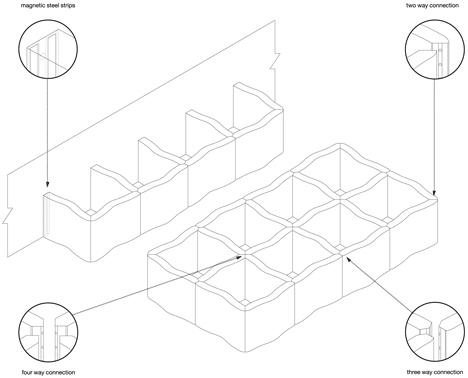
Connection types
Form making
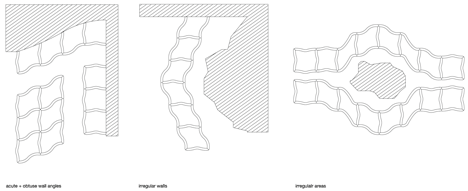
Room conditions
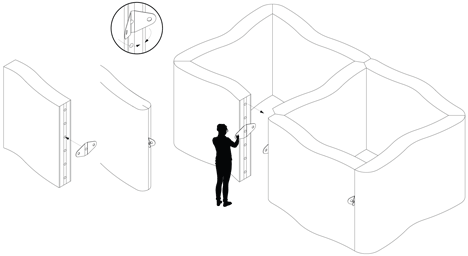
Using the door
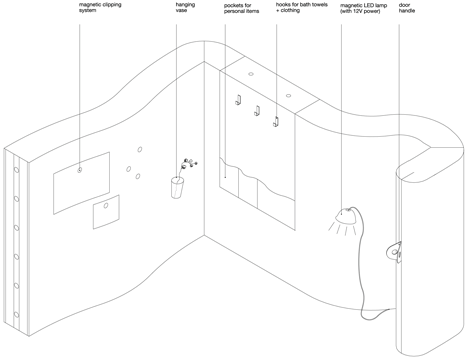
Home-making accessories
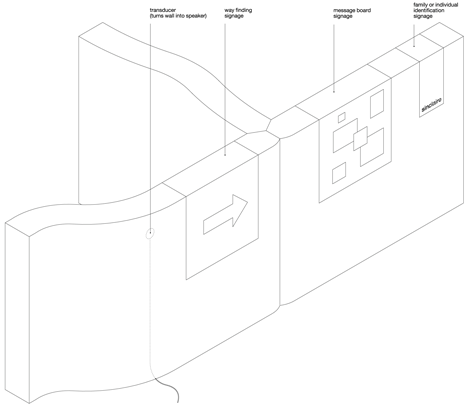
Community accessories
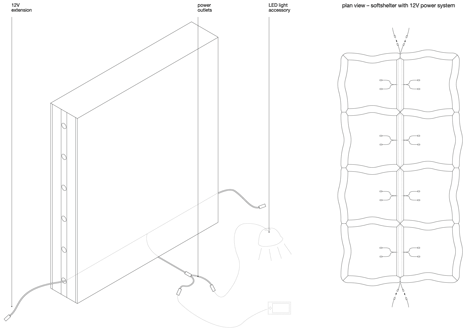
12V power


This is really cool! It adds a layer of sound diffusion as well. I would consider some issues relating to the fire protection though…
yes, the barrier does absorb sound and creates a comfortable sense of privacy. Being flexible the privacy can be adjusted – the walls can even open fully so that the "room" contributes to a larger public space.
The walls are safely fire retardant treated and have M1 and B1 fire ratings.
'in a wake of disaster' people support other people,
they don't make walls
Socially conscious designs are great, but re-marketing an existing product to be "specifically designed" for this purpose is not very noble. These are also not cheap – at $1250 per 6' tall x 15'long its almost almost $85 per linear foot for very unstable living barrier.
Socially conscious design? We simply "design". This is not re-marketing mfb. This is the work that our exploration with flexible space (soft) started with 11 years ago. In any case, design and exploration aren't supposed to have functional barriers are they?
Revised structure, material and in larger quantities allow for a price that is much different from purchasing a single softwall.
Unstable? Not how we use them. You should visit us at one of our workshops to find out more – Paris in Sept, Vancouver in Oct.
I love Canadians. Only thing missing is the Hudson Bay Blanket
Love it, well thought in large and small scale from the production to the end.
If only it wasn't so expensive…
i think they're trying to slap any possible use they can on this system to make it seem endlessly convertable, but it's still just the same! really getting bored of seeing this system already.. people could also just throw up some cardboard boxes to achieve the same effect for free.
fire hazard
Elegant, useful, easy.
Monastic simplicity for times of stressful mess.
Wow!
Also like the fact that this simple base is open to adding-subtracting, with a range of possible customization by the users.
Hoping this becomes a 'staple' in emergency relief – do not let it disappear (like too many other good emergency designs)!
As an emergency relief opp, too expensive, too flammable, too flimsy.
As collapsible privacy screen for domestic use (and for those who can afford it), neat idea.
hipster shelter
beautiful and very practical! but I thing at the end the most important thing is that it need to be cheap. No one is going to spend in expensive paper walls in the middle of a natural disaster. They might want to use it for basic needs such as food.
am thinking about how sometimes privacy is good (for sleep) especailly when dealing with an after shock, looks like a really good project, is the paper waterproof/damp proof etc etc
I supposed its provided free for the disaster, why didn't they use the money to contribute to food and other necessities instead, but using this as a means to market their expensive and impractical product. Perhaps a simple tent might do the job at cheaper rate and probably easier to maintain and store aside for future disaster effort. What are they going to do with these paper wall that needs to be kept away from rain, etc.
Really lovely and interesting soloution to a design specific problem. More interestingly is considering the function that these "walls" provide in which you point out that they are to excist in already existing compounds, such as larger tents, warehouses, etc where there is either none, or limited need of wind and water proofing.
Futher more, it's encouraging to see a design group strive to solve a problem of such an uncomfotable topic by doing other than just "giving food" which is rather short term, and shor sighted.
Good luck with it!
Yes cost is a huge issue, but that aside, something light and portable is very much needed to give much needed privacy. Yes food and other services are needed but there is a reason people put up all those tents in refugee camps…not everyone want to live as if they were at a music festival when they have lost their home
I agree with Espo that placing these inside makes them simply barriers, not shelters. Shelters imply safety from the elements, not just privacy.
Nonetheless, they seem cool.
This looks like a really cool product – I look forward to seeing it in Vancouver.
By comparison to the options currently available to refugees of natural disasters (from what I've observed, I'm no expert) this seems like a really nice, and potentially successful idea. & are people not reading the comments before posting? Because I read they have a good fire rating and are cheaper than their counterpart because of manufacturing numbers. Exactly how viable their cost is however is not clear.
Personally, I think tom de vrieze is absolutely correct by saying " 'in a wake of disaster' people support other people, they don't make walls." I've been through one of the biggest earthquake in my country. I was really scared at that time. Yet I don't recall looking for any privacy, but the intimacy with those around me.
Many people are living in halls in Japan, with only a knee high partition between them and the person opposite, and a tiny partition between 'neighbours'. You only have privacy if you are lying down, and everyone else is lying down. Others live in tents on halls, which offer no acoustic properties. This would be a good solution for those people.
It looks liek a longer term solution where people won't be able to return to their homes for a few months, or have no immediate hope of a permanent shelter. Definitely better than tents.
This product is intriguing. With use, the cost should decrease, and the number of applications increase. I'd love to have some of it just to play with.