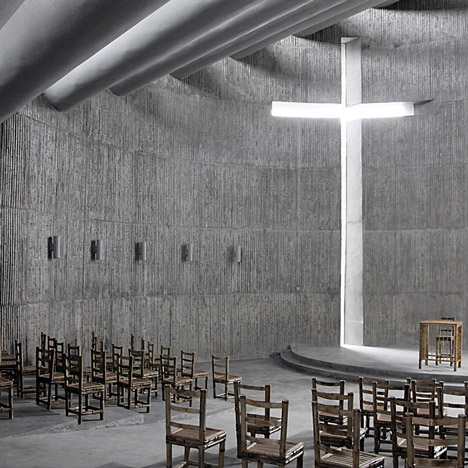
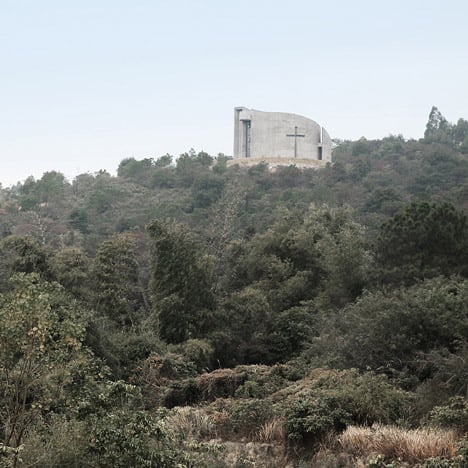
Hong Kong firm O Studio Architects have completed a stark concrete church on the side of a sacred mountain in China.
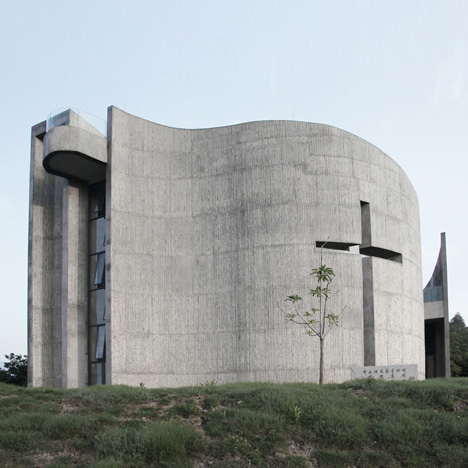
Named the Church of Seed, the building on Mount Luofu is formed of three curved walls that curl around the interior like the casing around the seed of a plant.
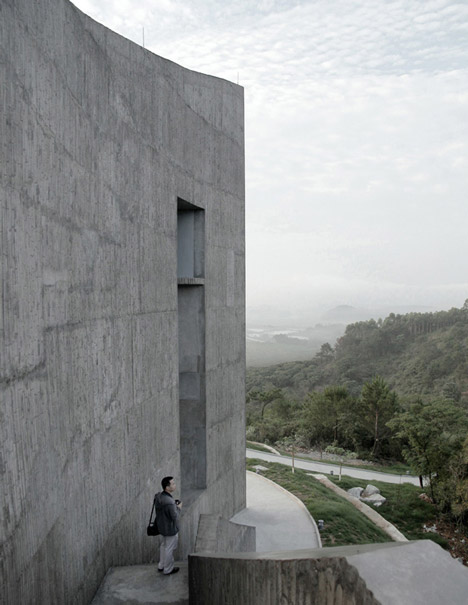
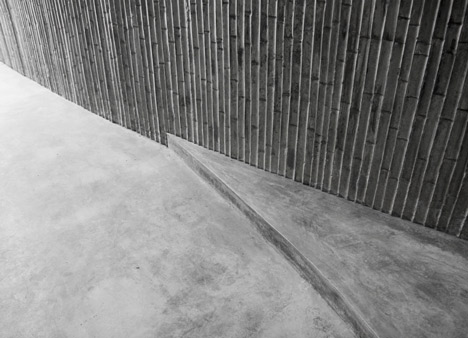
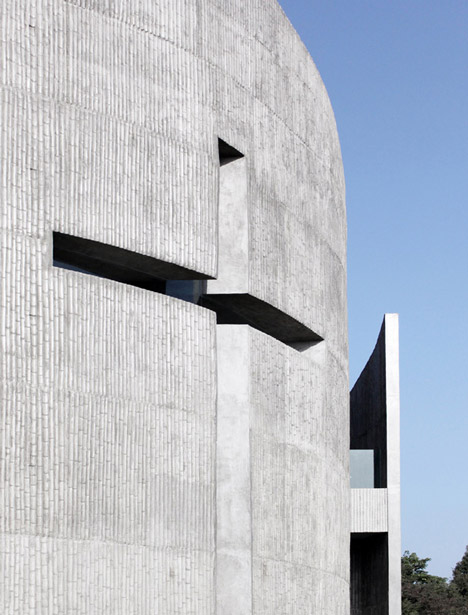
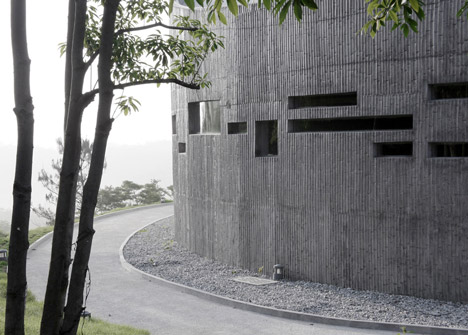
Vertical ridges in the surface of these inclined walls reveal the bamboo formwork that the concrete was cast into, while handmade bamboo furniture provides seating for 60 inside the central hall.
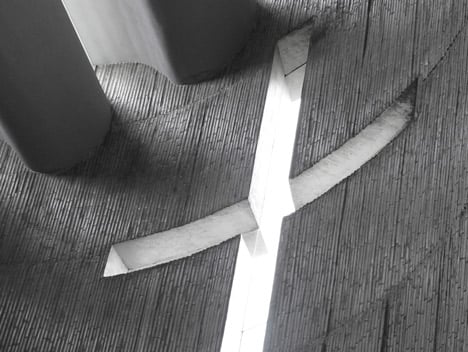
A large cross-shaped opening on the southeast elevation draws in soft sunlight in the mornings, while a solid west wall blocks out glare in the afternoons.
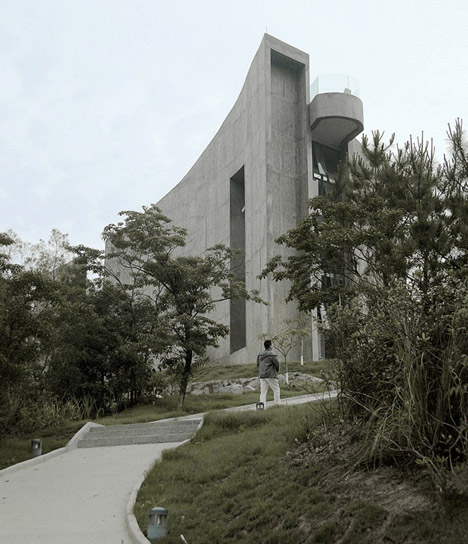
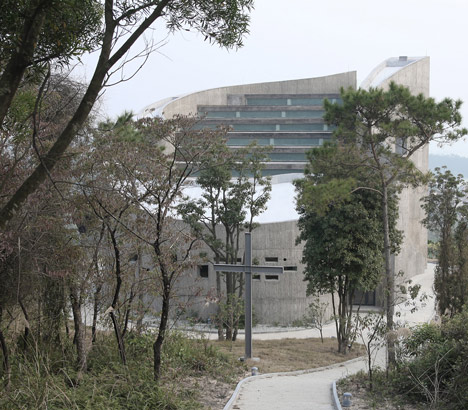
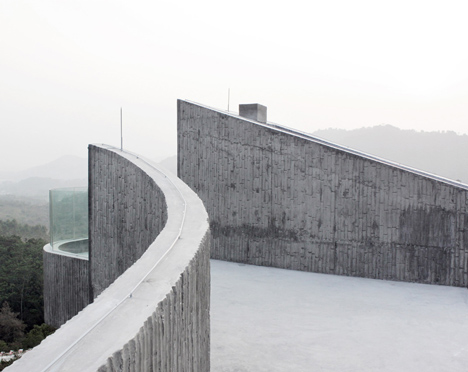
A staircase on the side of the church leads up to a rooftop observation deck.
We've featured all kinds of religious buildings on Dezeen, even a temple for atheists - see them all here.
Photography is by Jingchao Wen.
Here's a more detailed explanation from O Studio Architects:
Church of Seed
Church of Seed is located at Luofu Mountain Scenery District - one of the seven famous Taoist Mountains in China.
Although there are various kinds of Taoist and Buddhist temples in this district, western religious element has not yet been found.
Besides developing private houses, the client in this project intends to develop a small church for the surrounding village people in order to widen the spectrum of religious culture.
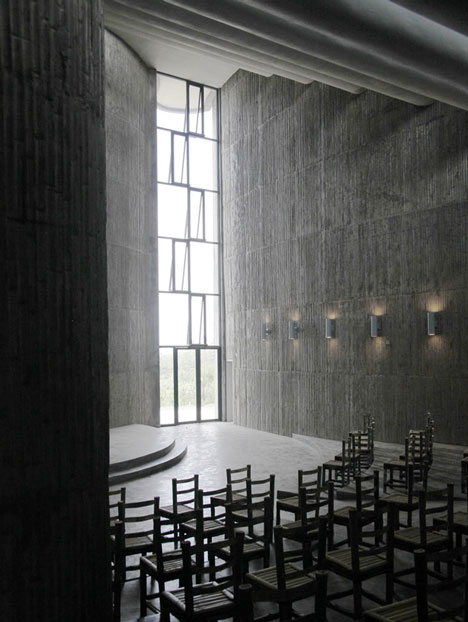
This church provides not only worship and meditation space for Christians, but also recreational and gathering places for the surrounding village people.
Instead of promoting Christian religion actively and aggressively, the message of religion is communicated subtly through the play of light and shadow in this architecture.
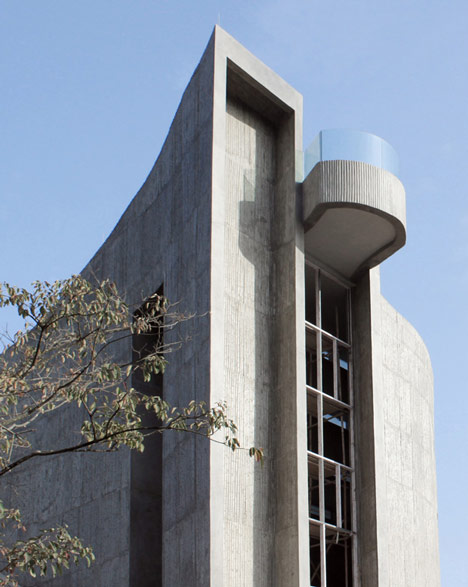
Situated within the beautiful landscape of Luofu Mountain, Church of Seed has an area of 280m2 and can accommodate 60 people.
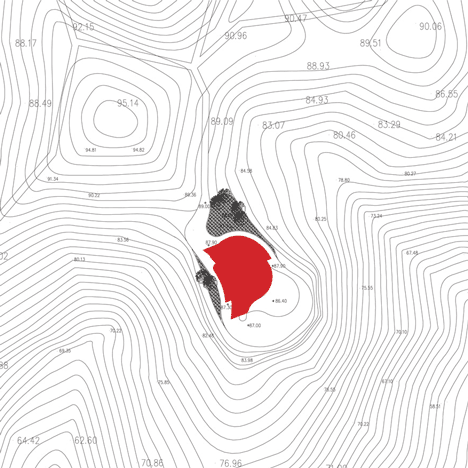
The design concept is triggered by the form of a seed - a famous metaphorical element in the Gospel stories.
A curve line follows the outline of a seed and marks the enclosing wall element. The curve is then split into three parts, and three entries are formed at where the curve wall splits: the south east facing wall has a cross shape opening which introduces morning sun into the interior; the west facing wall is solid and blocking the afternoon sun; the north facing wall is thicken to accommodate toilet facility.
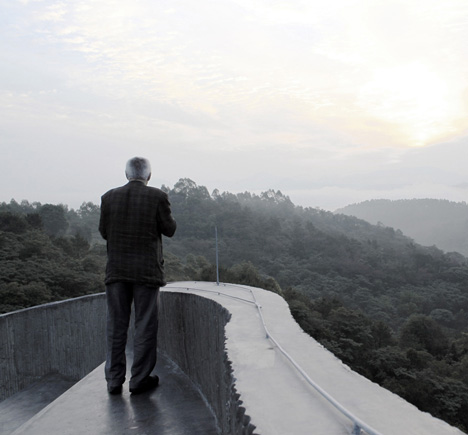
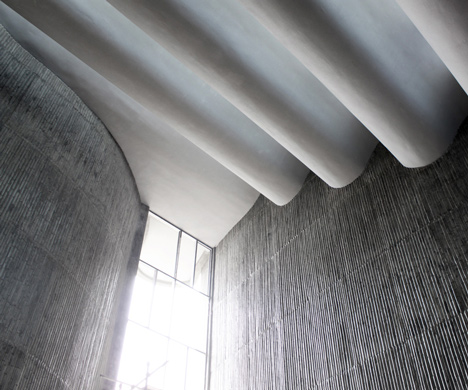
The stepping roof terrace allows diffuse northern daylight into the interior and provides a dramatic headroom increment (3 – 12 meters) from the main entrance towards the worshiping space. Visitors can walk up to the stepping roof terrace, arrive at the observation deck and enjoy the distant view of mountain and water.
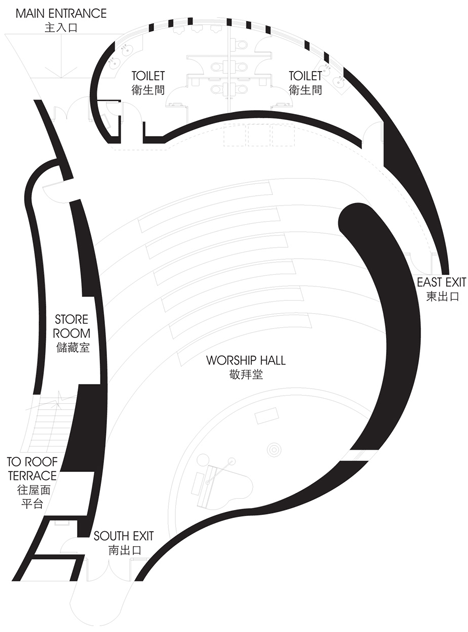
Church of Seed has a raw, natural and non-decorative material language.
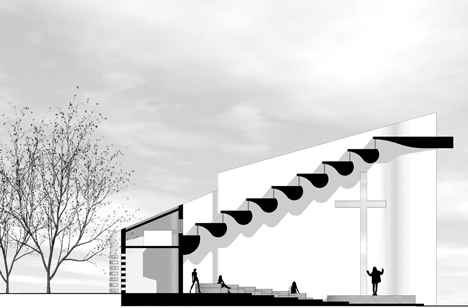
The main structure is constructed by in-situ concrete with bamboo formworks. In-situ concrete construction is economically sound and practical for local builders. The bamboo texture left on the concrete surface reduces the massiveness of concrete wall and harmonizes with the surrounding trees and green landscape. Plus the transparent windows and doors, and the handmade bamboo furniture by local farmers, the presence of the church is humble and close to village life.
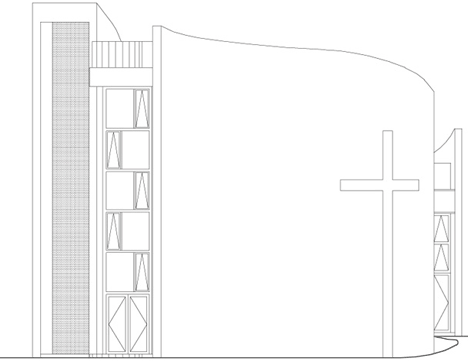
Although a seed is the starting point of this design, the church does not intend to literally illustrate its image.
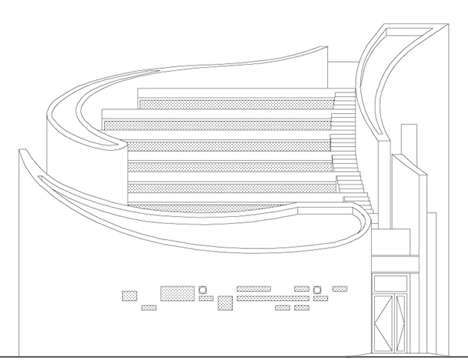
The abstract form and space of the church is conveyed through the play of light, shadow, material and texture.
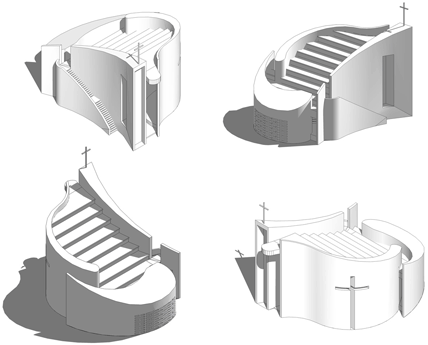
This is not a piece of architecture which purely celebrates its sculptural form, but a building which respects the natural environment and local culture.

Location: Huizhou, China
Site Area: 1200m2
Floor Area: 280m2
Status Built: 2010
Design Architect: O Studio Architects
Project Architect: Guangzhou Architectural Engineering Design Institute
Structure Consultant: Guangzhou Architectural Engineering Design Institute
M&E Consultant: Guangzhou Architectural Engineering Design Institute
Main Contractor: Maoming Construction Group Co. Ltd.


Ronchamp ring a bell?
it certainly is a copy of ronchamp, but to their credit they copied at least the whole thing including the landscape around it.
Well, it rings a church bell..but nothing more than that. I think it is an insult on Le Corbusiers work to call this a copy..? But it's defenitely inspired by…
the lovechild of Ronchamp and the Church of Light by ando
I find the severe austerity of this project quite uplifting. The only element that adorns the interior is the light pouring in from the windows and the cross.
Nothing to distract you from quieting your mind and seek inner peace :)
Where is Zordon?
it's not very easy to "copy" Corbusier.
…it's certainly a very beautiful sense, although the pictures convey nothing of community.
Church is not the building…Church is the community
Æsisi Era I agree, a complete Corbusier rip off!
Love the bamboo imprints on the concrete.
Looks like a sweet place to test out a remote control helicopter!
This is impressive! And the only thing that is remotely 'resemble' Ronchamp is that is on a secluded location.
Are you serious? I find this project interesting and I don't have anything against reusing ideas, but this will make anyone educated in architecture thinking on Ronchamp at first sight, even if it's just a glimpse of the plan. There are important differences, the roof especially, but come on… even the rough texture of the concrete has been interpreted, although "with chinese characteristics"
Quite beautiful.
I cant understand how you can interpret this design into a copy of Ronchamp,
if so a BMW is a COPY of a SAAB because they both share similar briefs/ programmes, are formed from similar/familiar materials within a narrow scale range.
It looks to me to be a well considered design expressing form and structure both internally and externally, Robert Venturi would be proud.
I like the subtle references to Ronchamp, which show the designers are working in discourse within existing built context.
one should visit Ronchamp before asuming that this building is a copy of Le Corbusier's work.
It is a church, it uses concrete and it is situated in a hilly landscape, but to see this as a copy of Ronchamp is hilarious.
It's barely a copy of le Corbusier, more of an attempt to copy the church of light in Japan.
a rip off of three projects:
church of corbusier
church of tadoa
and church of jorg utzon(kopenhagen)
I Also thought of Ando's Cross and Utzons Ceiling. Its just too close, makes me wonder what part of the design was theirs….
bathroom opening onto a worship space? good lord!
I agree, this is derivative of so many other projects its sad-basically a pastiche of famous imagery, but of course, as all copies are, without the initial raison d'etre, the inspiration behind these images, they are merely images….the watered down version of the ando cross cut out of concrete is the most dissappointing.
this is how beautifully original and inventive projects get lost amid their replicas and and become cliches. its not an homage, its destructuve.
try to find your own voice, and something original to say next time.
(architecture is not a buffet of trite images to choose from and then paste together)
typical Chinese architecture:
copy copy copy.
a bot of corb, nervi, barragan, ando, utzon, and some aalto for the roof for good measure.
good grief.
If you say this is typical Chinese architecture, then you probably haven't seen much chinese architecture.
I really don't understand all this talk about rip off. Although, as I said in a previous comment, denying the influence of Ronchamp is nonsense, that doesn't mean this is a copy, of course not a rip off. From Utzon's Bagsvärd why, because it has curved concrete shapes in the roof? The ones here are all the same, independent and serial, while Utzon's are two different, continuous surfaces that fold over themselves. For that matter it looks more than anything from Miguel Fisac, for example. From Ando's Church of Light because of the cross? Maybe that has been taken too literally, but big news, every church has a cross somewhere. I wonder how many modern churches we don't know about have it this way.
All due respect, I think all this comes from not having studied enough history and misunderstanding the creation process. I guess for everyone here using "rip off", le Corbusier's Unité d'Habitation is a rip off from Ginzburg's Narkomfin, and Jacobsen's SAS the same from SOM's Lever House. I don't think there's one single building using only original solutions. The creation process is an additive one, piece by piece we build something new, but we always work from something, not thin air. If you try to ignore that, 99% of the times you will end up either deceiving yourself and designing something already done a thousand times without even knowing it, or drawing something impossible to build/use/look at.
i dont think is a rip of of Ronchamp.
Goose bumps
pff. looks like a copy of tadao ando – church of light….
Now if only we can build a mosque/temple/mandir at holy Christian sites too.
Like the Dome of the Rock in Jerusalem, or Hagia Sofia in Istanbul?
ppp:
"with all due respect" if you cant see the obvious derivative nature of this project, then you are either kidding yourself, or were involved with this project and compelled to defend it. It goes without saying that architecture cannot be conceived of in a vacuum, but clearly there is a difference between influence and uninspired mimickry. If there was only one obvious referant that everyone is noticing, but there are several-it is a very obvious assemblage of images. The skylit roof is straight Aalto, and the glass cross cut out of concrete is undeniably Ando, and I could go on and on. And that is lousy architecture-and why everyone is commenting on it. If there was anything original, inspired, or worth ralking about, we would be. There isnt. It's a characature of a handful of recognizable forms and images at worst, and at best, a derivative uninspired building.
Still dont agree? Look at Ando's church and how the cross is detailed and done in comparison. It's the difference between one who knows what they are doing and why, and one who is copying it without really getting it.
Sorry if you felt offended by my last post, it wasn´t my intention. No, I don´t know this project more than you do, and yes, I see the derivative nature of this project. The thing is that I don´t regard that as bad for itself. However, I agree with you on the fact that this project uses too many and that provokes and incoherent result, which is a big flaw. But I was talking about this way of thinking as if the only way of making good architecture is to be absolutely original every time, and is not legitimate to use previous solutions. Maybe I was doing a bit of off-topic. And of course I don't dare to compare this project with any of the others mentioned in this thread. Those are masterpieces, and this is only something I'll forget about in a week.
PS: I any case, not that it makes correct what I said, but I don´t see "everyone" agreeing here, so maybe things are not so "obvious", "go without saying", "straight" and "undeniable" as you seem to think they are.
CRx:
If ppp really is involved in this project, you must be a die-hard competitior of the designer:)
You focus so much on "which look like what". There are some many "look alike" architecture today. You probably should spend all of your time critizing them without doing any good architecture yourself.
I agree there are many familiar images and references coming from various precedences, but I can see the designer play a fun game with these masters. It is much better than MAD "looks like" Hadid, REX "looks like" OMA…employee "looks like" boss
everyone gets inspiration from everywhere, why is it uniquely copying ? Dezeen, you're supposed to be a neutral voice, but here you're being political.
Well, I find the formal expression very appealing, but I cannot sense any kind connection to its context. It appears to be nothing more than an unrestrained form-driven exercise. Too bad. The bamboo imprint in the concrete is indeed very beautiful.
It's not a copy but a water down simulacrum . Never been to ronchamp but the images is enough to tell a story of simulation . Other than that I rather see this than so many other " originals".
To summarize the long long criticism here:
"concrete wall+cross window+church=copy of Ando
concrete+church+hilly landscape=copy of Ronchamp
curvy roof=copy of Aalto"
Our masters are laughing (either in heaven or on earth), because people are so superficial here.
The church designers are laughing, because they are on the same table with masters, and they got the hottest story of the week so easily.
There is a saying: the best copy, the great steal. I can see the references, but that is normal in every architecture project. Everything has been done, is just the same with some twist. Who cares? The thing produced here looks nice, makes an impact, and if it fits its function I see no reason why it should be bad that it resembles or copies the work or those architects.
and add kengo kuma and peter zumthor to the list… the building is such a discomforting creation.
Or for that matter, is not very ease to copy Tadao Ando!
There is no such thing as pure originality. We are all influenced/ inspired. Having said that this building does produce a lot of confusion as it resembles too many famous pieces of architecture. One would think they would have realized it at some point through out the design process.
nothing more to said..its a little cold out their….good concept…i think they need to work more on interiors………..
It’s a copy.
Not everything has been done yet! There has to be some room left for originality no? I think the point(s) being made here are that imitating great works is not necessarily bad, unless its done superficially-which it appears to be in this project.
As someone put it, it IS difficult to copy Ando, or the others-and unfortunately, this project proves that to be true.
Don’t be haters… What have you done lately?