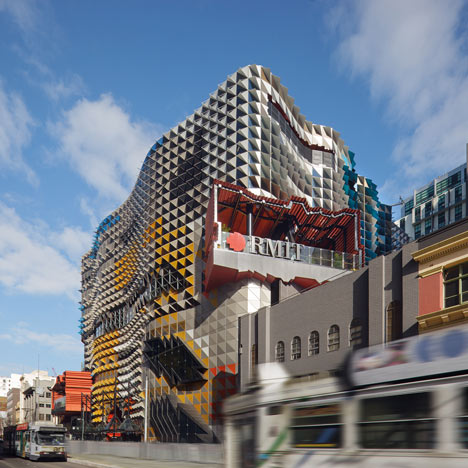
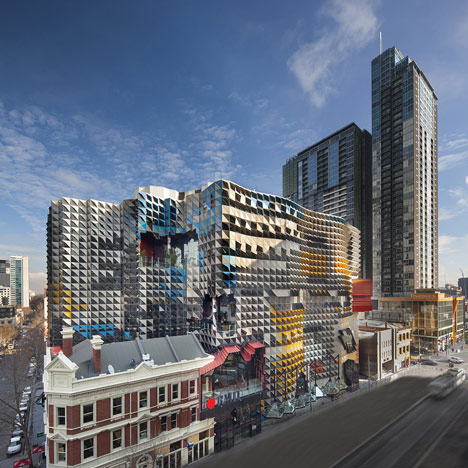
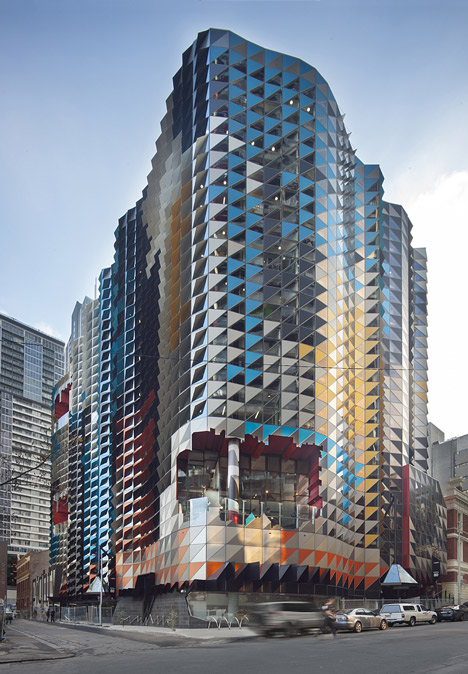
This university building in Melbourne by Australian architects Lyons is covered in brightly coloured scales (+ slideshow).
Above: photograph by John Gollings
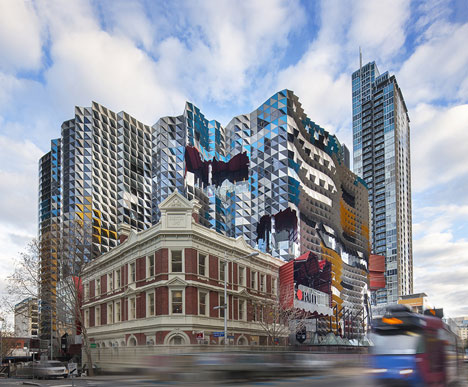
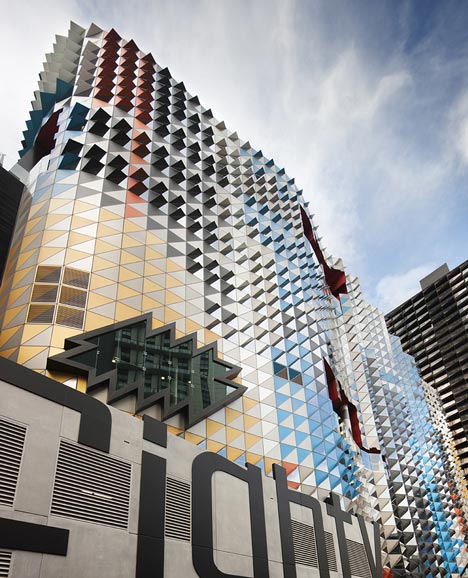
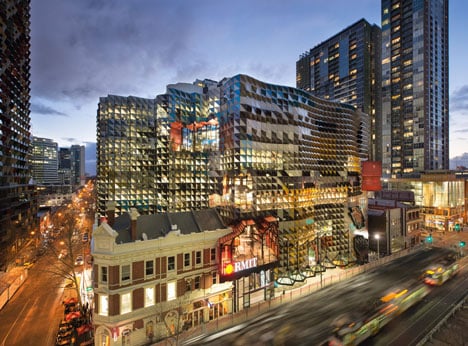
Lyons used a pixellated image of the surrounding buildings to create a map of colour across the exterior. "The building derives its identity from its surroundings," Lyons told Dezeen. "It's a chameleon and a mirror."
Above: photograph by John Gollings
As part of technology and design university RMIT, the Swanston Academic Building provides learning spaces for the college of business, right in the centre of Melbourne.
Above: photograph by John Gollings
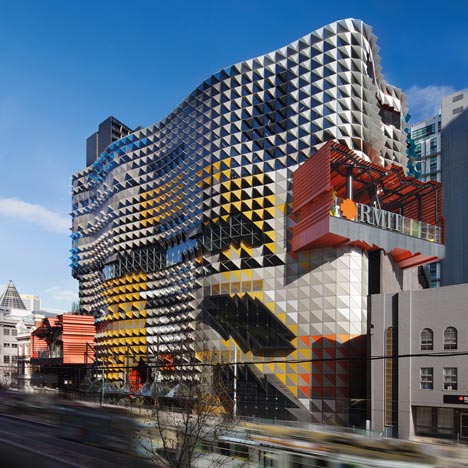
The walls have both curved and folded surfaces, creating a series of jagged edges that give the building an uneven profile. "In the same spirit as the facade, the undulating walls were a result of the building being 'affected and influenced' physically by its surrounds," said Lyons.
Above: photograph by John Gollings
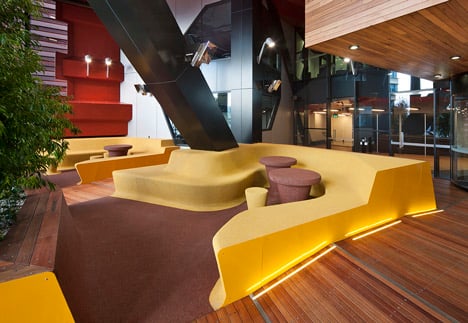
At ten storeys, the architects describe the building as a "vertical campus," where double-height lobbies are intended to function as social spaces that take the place of the traditional college green.
Above: photograph by John Gollings
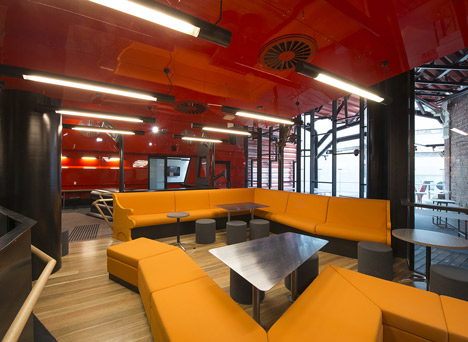
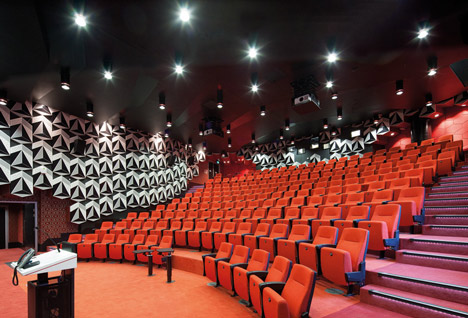
Most of these spaces feature vivid colours or pronounced geometric patterns. "The profile of each space and its character - including colour, materials, type of furniture and details - is informed by the landmark it faces," said Lyons.
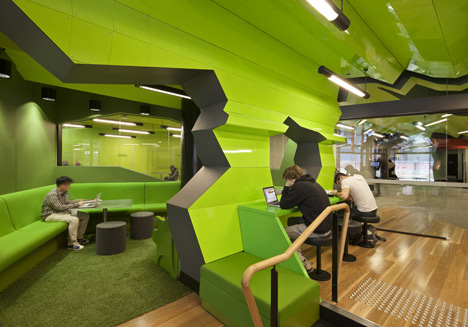
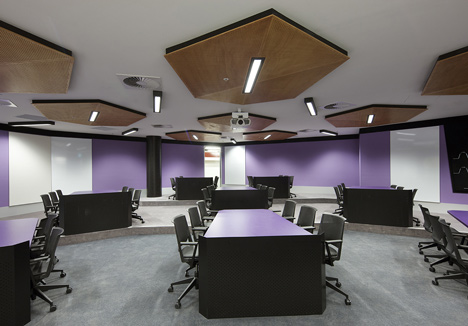
The building contains a variety of flexible learning spaces, from 300 person lecture theatres to 30 person classrooms.
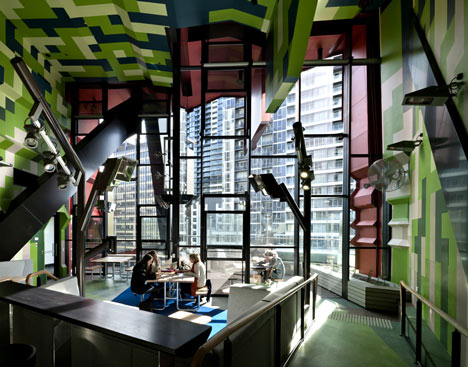
Above: photograph by Dianna Snape
Lyons also recently completed a scientific research centre in Canberra for another university.
Above: photograph by John Gollings
See all our stories about Lyons »
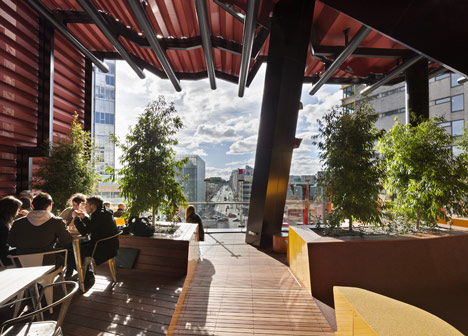
Here's some extra information from Lyons:
A new student experience for Gen Z and beyond – RMIT University’s new Swanston Academic Building Project
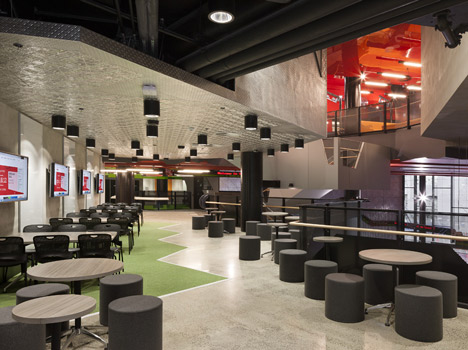
Active student learning spaces are a key emerging trend in both University and TAFE campuses.
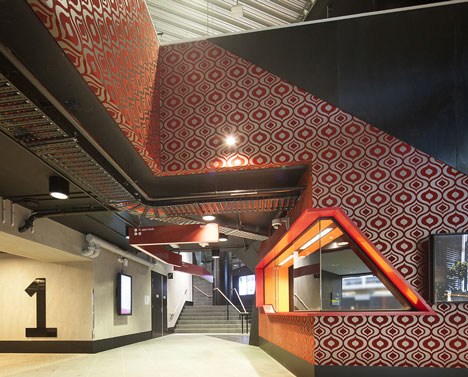
Above: photograph by John Gollings
While many universities have designed progressive teaching and learning spaces at the ‘experimental’ end of their teaching and learning activities, RMIT has recently completed its new Swanston Academic Building (SAB) which incorporates nearly 100 new spaces designed on new learning concepts.
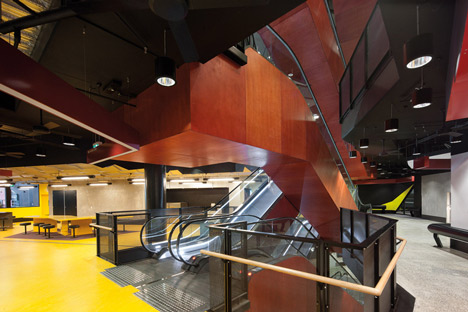
Above: photograph by John Gollings
This major new building will provide the University with significant new capability into the future, as well as significantly enhancing the student experience within its city campus.
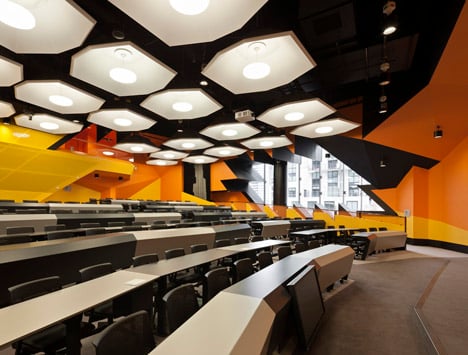
The brief for the project developed by RMIT, includes 85 learning spaces, 11 informal student ‘portals’, accommodation for 800 staff from the Colleges of Business, all within a footprint of approximately 35,000m2.
Integral to the teaching and learning brief is to achieve high sustainability benchmarks – including both substantive energy reductions, and improved amenity.
Above: photograph by John Gollings
A further key objective is for the new building to reinforce RMIT’s position and character as an urban campus – a campus in the city and of the city.
Above: photograph by John Gollings
The design creates a ‘vertical campus’, rather than a multi-level teaching building, where the journey through the building is connected by student and staff social spaces, or ‘portals’.
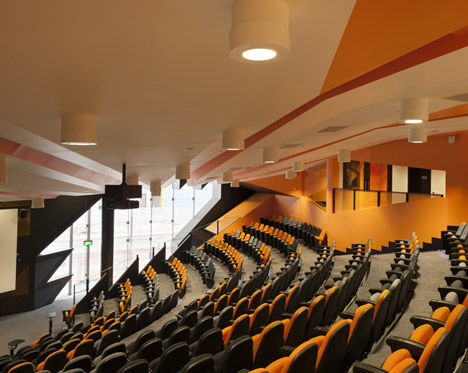
Above: photograph by Dianna Snape
This concept is characterised by a series of double height social spaces, dispersed throughout the building as a main focal point on each floor, providing space for informal student learning.
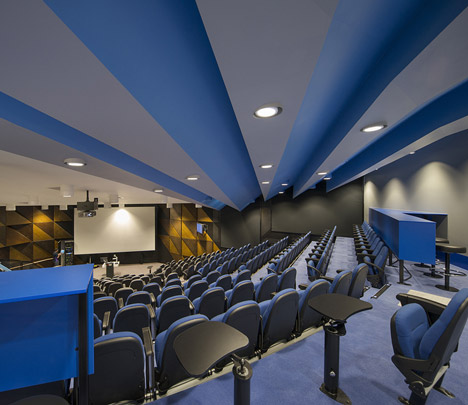
They are characterised by their connection to natural light and air, variety of furniture, and a marked difference to other teaching spaces.
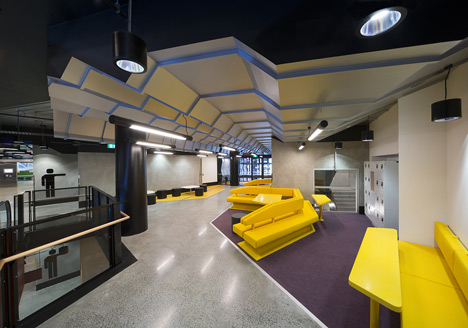
Above: photograph by John Gollings
This is envisaged to encourage and support the type of peer-to-peer learning traditionally associated with the ‘college lawn’.
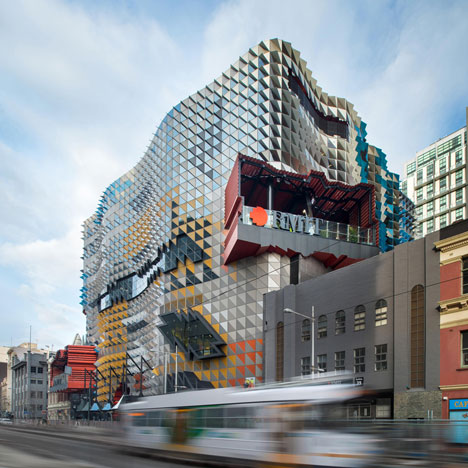
Above: photograph by John Gollings
The portals provide students with a place for informal learning, social interaction access to technology, and respite from the formal academic program in a varied array of designs and locations throughout the building.
Above: photograph by John Gollings
A diverse range of 85 new learning spaces are provided in the SAB, ranging from 30 to 360 person capacity, each responding to the teaching and learning needs identified by the University through an innovative joint timetabling project run by RMIT and Lyons.
Above: photograph by John Gollings
The building design responds to a wide range of class sizes and a diverse mix of teaching modes; didactic, collaborative, discursive, project-based group work, team teaching and workplace simulation.
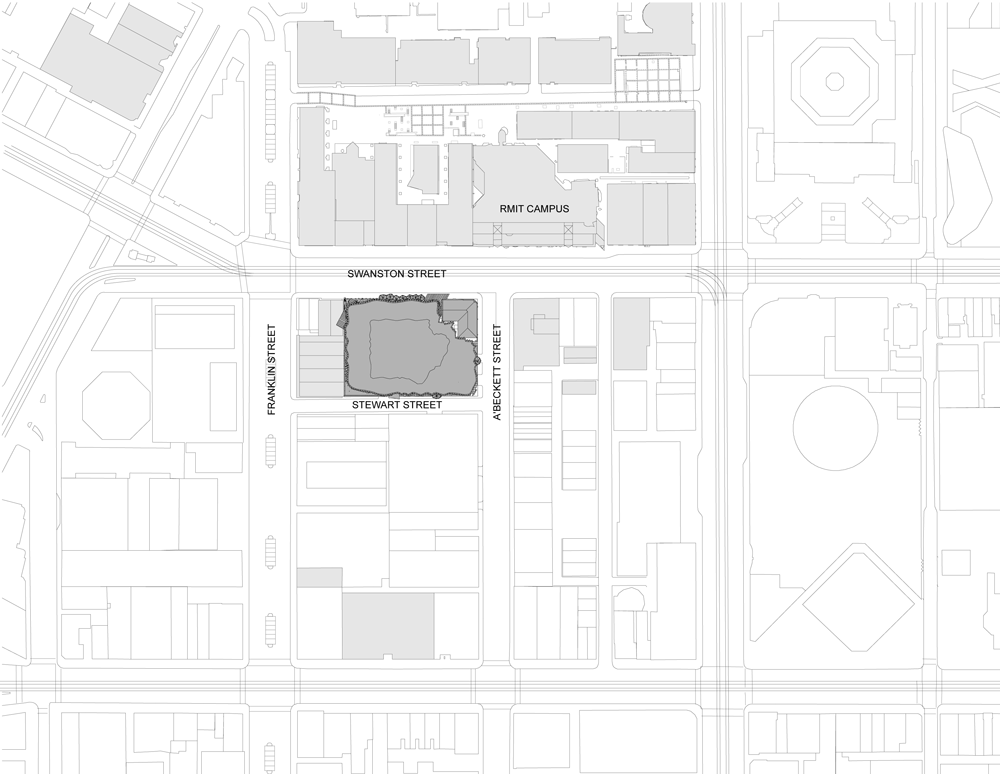
Above: site plan - click above for larger image
Above: basement plan - click above for larger image
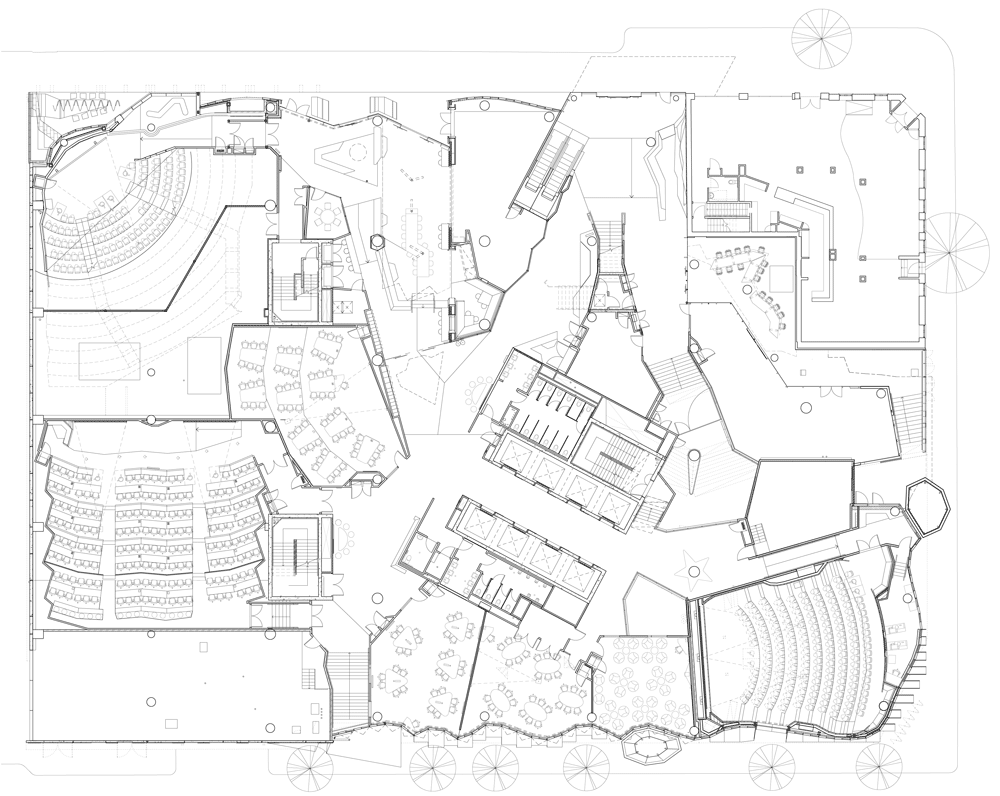
Above: ground floor plan - click above for larger image
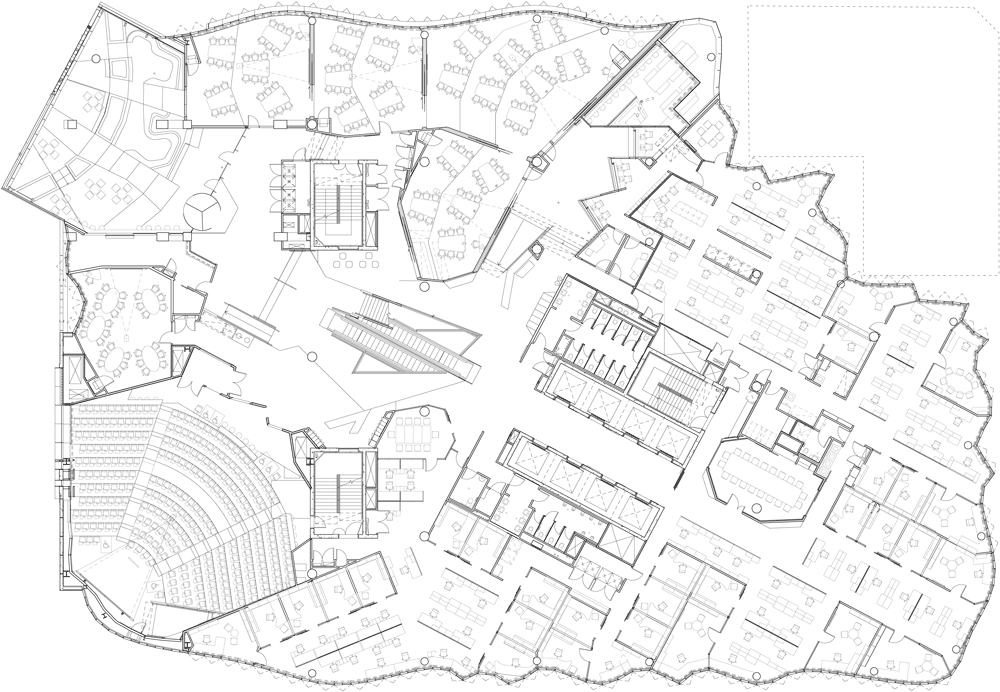
Above: first floor plan - click above for larger image
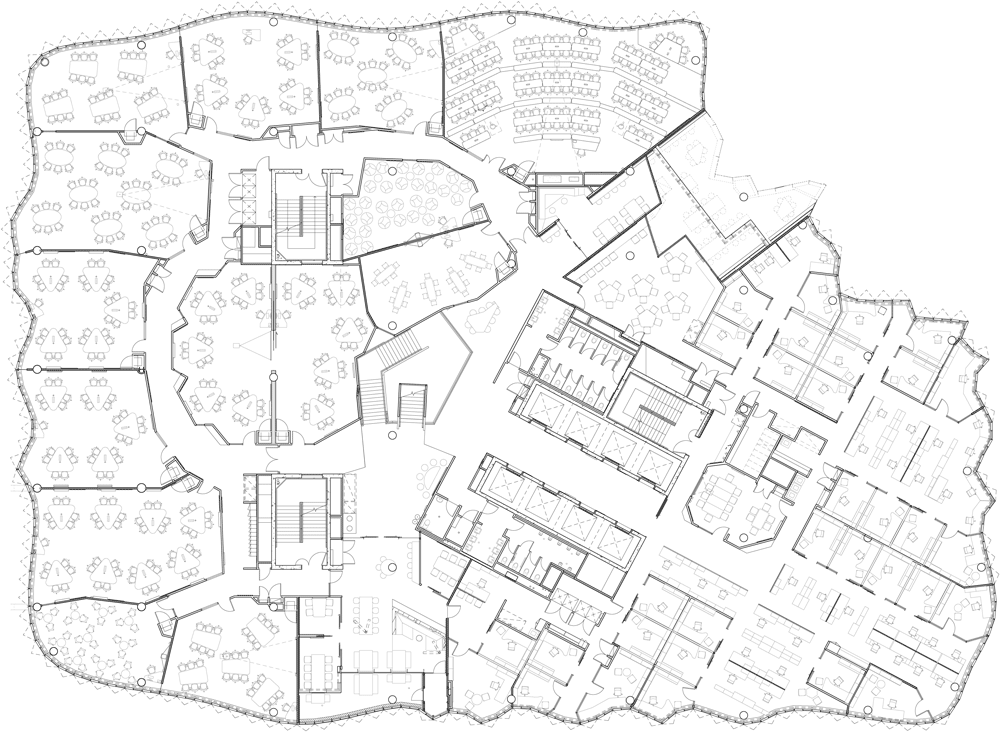
Above: second floor plan - click above for larger image
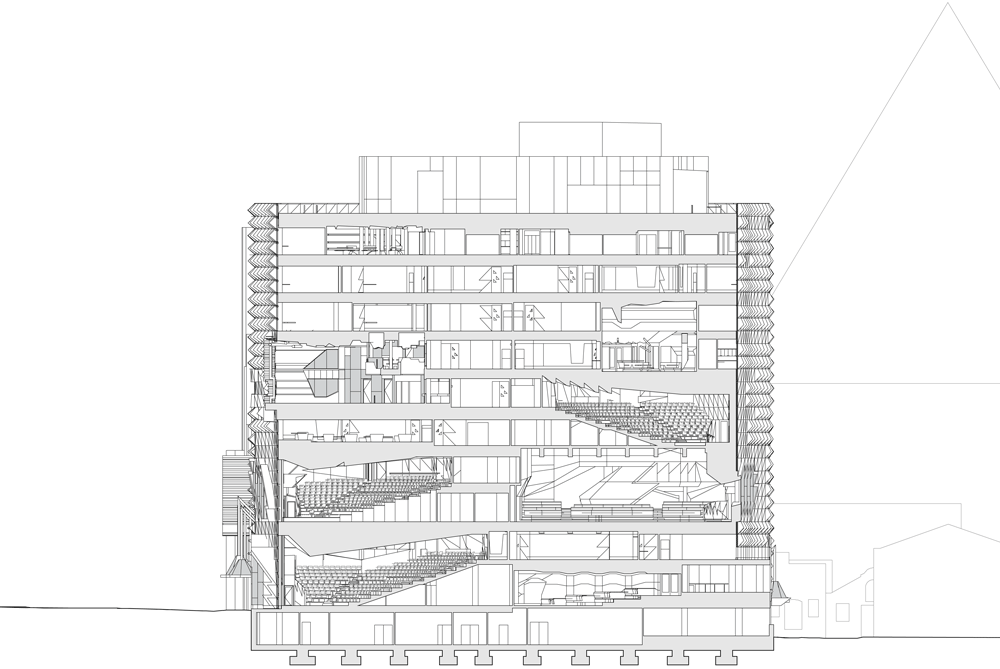
Above: cross section - click above for larger image
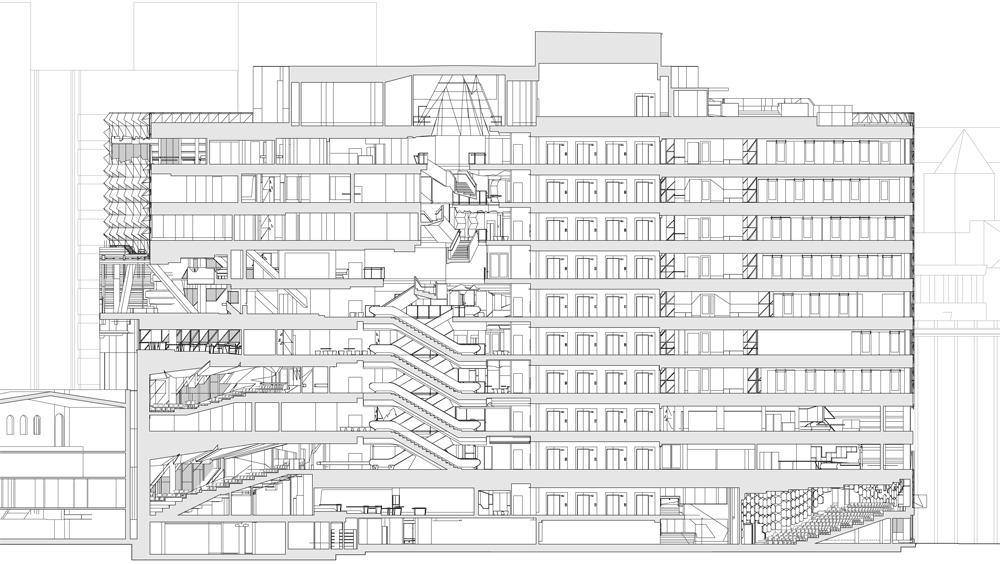
Above: long section - click above for larger image
Above: Swanson Street east elevation - click above for larger image


Only in Australia.
U-G-L-Y, you ain’t got no alibi, you UGLY!
The Victorian building on the corner is like a finely matured cheese about to be shredded by the crude cheesegrater looming menacingly over it.
High energy! Love it. I love it when the skills, tastes, technologies and ambitions of one generation are juxtaposed with another. And yet another Australian academic institution with the balls to make this happen. Bravo!
Ambition stills needs refinement.
Are you serious?! Have a word with yourself.
A university for the ADHD generation.
Pop, but not architecture. This gaudy building fails any urban connection to the neighbourhood and the cavernous interiors, although “different”, convey a bland redundancy.
You live in this neighbourhood? I find that hard to believe.
I do and it fails in every sense. It is really an eyesore.
I think its facades buzz the way Melbourne does. The interior could have used some areas of white oasis, though. I’d probably find my self spending 20 minutes in the toilet just to let my mind unwind. Otherwise I can’t imagine you really like the Melbourne landscape. A quarter of Melbourne is like this.
Clearly you’ve never been to this building.
Actually, this building makes the neighbourhood. The surrounds are a mixture of bland 1960s concrete anonymity, a couple of nice old Victorian buildings and old warehouses, and a PoMo 1980s building down the road (and the wonderful Storey Hall redo). It’s an exceptionally diverse neighbourhood that, I think, welcomes it’s newest arrival. I walk past this building most days and have spent some time inside. It’s an exciting building to be in, and as an educator (I work for a rival university) – it has fantastic learning, teaching, studying, lab and lecture facilities. I would love to work and teach in this building. Also, lots of nooks for hanging out in or for a quiet read and a coffee. Incredibly exciting on the outside too, from all angles.
Some more context: just up the road is Australia’s highest ranked university (the University of Melbourne), which is more traditional, “sandstone” and well, old. RMIT is aiming itself squarely at a tech-savvy, digi-creative/biz type of student. Hence, the architecture in Swanston St. No sandstone or beige in sight, thank goodness. This Melburnian educator loves it dearly.
It is like a conglomerate of everything that makes me want to vomit!
The good thing is that it won’t gradually look dated.
I concur.
It already looks dated. This building appears to have been designed by the BBC for a Doctor Who set in 1972.
It’s a serious expression of the playfulness of FAT architects seen through eyes raised on Nintendo at a scale I wouldn’t have thought financeable.
It will, of course, look really dated in just a few years. But, like the video game or cellphone, I don’t think timelessness is a goal. Though now that I think about it, I sure could play some ToeJam & Earl right now.
Actually it came in under budget and ahead of schedule.
Only in Melbourne. This one takes the cake: zero order, zero restraint. Still kudos for having the nerve to build such a monster.
The last building of note from Australia is still the Sydney Opera House and it took 13 years to build. How can you teach the current generation with this building? UGLY is the best way to put it.
Thirteen years to build and there were still petitions circulating from local residents three years later to have it torn down because it was considered so ugly.
I see that you are a sensitive one. Then it just shows that you guys can’t tell good architecture when it’s right in front of you. Glad this is way down under where it will be out of sight.
42si why so worked up about Australia? The Sydney Opera House is a standout building in the global architectural canon, a rare building indeed, but why use it to denigrate the quality of a culture and the efforts of a nation’s architects? I’m not sure why you turn on TurnItUpTo11 as a “sensitive one” – at least their comments are constructive and to the point.
Australia continues to make a valuable contribution to architectural culture. If we were to take just this year’s recent World Architecture Festival as any kind of benchmark we would find that Australia is performing reasonable well; The Royal Children’s Hospital by Bates Smart, Martin No38 by Kerry Hill, Darling Quarter by FJMT, the Shearer’s Quarters by John Wardle all picked up awards.
DCM have also contributed some buildings of note in Britain, including the Stonehenge Visitor’s Centre and the Manchester Civil Justice Centre.
To be sure none of these are up there with the Sydney Opera House but how many buildings or architects or nations could claim to consistently deliver architecture of such dizzying grandeur?
If you would like to have a less bigoted discussion about the state of Australian or even global architecture then tell us who you are and offer some more constructive thoughts please.
Mark,
Perhaps to your surprise, I actually enjoyed your comments except for the last paragraph. “Worked up” I may be but not “bigoted”; not a nice word to use in this cross cultural world. I am aware of some of the architects you mentioned and some featured on this blog. So I will spend the time to discuss this further.
I will rephrase and try to contain my critique only to this building. I have been there and of course to Melbourne. As objectively as I can, there seems to be a movement of architecture stemmed from a representation of the Post Modern era. I believe this building is ornamental in nature. What do you think of the opening in the facade that is purposely “blown out”? I find this gesture naive and it does not take architecture seriously. I believe the other architects you mentioned can co much better. I would also add Neil Durbock to your list.
You may have noticed that I mentioned Australia was used in a positive context in relation to the Opera House. But this building is a naive one. The plan tries too hard to fit the program in, it’s overly dense and it lacks commitment to the exterior skin. Messiness does not make good architecture. Gaudi does it with conviction to structure and this just does nothing for me.
To go further, I don’t blame Lyons alone. I have found a lack of architectural critique in the public realm like news and prints in Melbourne. Patrons should also know better. RMIT is not a shabby architecture school so what is the review and selection process? Why was this type of architecture chosen?
By the way, my name is Johan.
Johan,
Nice to meet you. Bigoted is not a nice word but it was carefully chosen. Given your second round comments I will withdraw it, please put it down to antipodean angst.
There has been a movement of architecture in Melbourne that stemmed from the Post Modern era. The influence of Rossi and Venturi were particularly important but Peter Corrigan via Yale also had a significant impact on local culture.
Your choice of the word ‘representation’ is particularly apt. I would propose that the building deploys representation rather than ornamentation as a method for architecture. There is a critical difference there. I would say that the building is not ornamented, rather it has cosmetics smeared to its surface. This is not a good thing.
The openings or Boolean subtractions, rather than being convincing built form become merely the image of the city, its representation. The building attempts to embody the city in a single building rather than be a building in the city. I don’t believe it to be a naïve method, Lyons are by no means naïve, but the strategy has been subsumed by countless other methods, materials and strategies. It could be argued that the city is like that but I would agree with Des Smith when he says the architecture is “complexity without contradiction”
Regarding your comments about the plan. I would not disagree. There is an excellent diagram buried in there somewhere. The premise of carving out the mass of a deep floor plate to provide views, light and air is a good strategy but, as you say and the plan reveals this initial strategy has been frustrated by a very frenzied hand. I agree, messiness does not make good architecture but nor does cleanliness and I have nothing against mess. Mess can be the product of genius or a disordered mind. I would argue that this is the product of a disordered mind.
You’re wrong about the lack of architectural critique in the public realm in Melbourne. There’s plenty. Like all cities, some of it good, some bad, some indifferent. There’s a hell of a lot of handwringing about ‘critical culture’. My view is not that we lack critique in the public realm but that we lack critical purpose in architecture. That’s a bit of a blanket statement but, hey, better to keep this shortish.
So it may be that we’re in furious agreement!
I'm not at all sensitive. But I'm not at all conservative. I love the discussion about architecture and I love alternative views. My point is that the Opera House was a radical building and widely loathed before it was universally loved. Give me ugly over bland any day.
“The only thing worse than vulgar urbanism is tasteful urbanism” – R. Venturi
Anna, we should date.
Pop, yet not architecture. This is a tardy, misapprehended Venturi lesson. Wonder how much pizzaz its neighbourhood can bear?
Then, when you look at the cavernous interiors, although ‘different’ one from another, they all convey a bland sense of redundancy.
I live across the road from this building. When the wind is strong the facade vibrates and makes a really high-pitched sound. Thanks Lyons.
Only in Australia! So true. Love the creativity. Truly a pop building representing the 20th century. It’s so sad that you don’t see creativity like that in the US. Codes and conservatism kills everything.
Only in Australia, thankfully for the rest of the world! This is too much.
I love the design, but I think it’s extremely complex as design university building. It would be nice as a hotel or library. For design/art university, I am not sure how the student will have their creativity encouraged if the enclosure is too dominant. Should be nice if art/design university is not too complex. Considering Melbourne as a city itself is already rich, the city and the vicinity should become a abundant source of creativity, instead if this very colourful chameleon look-alike building. But it is Melbourne, so may be ok. :)
This building houses mostly economics and business students, hence the colourful and varied “breakout” spaces. RMIT have built another building further along to house their new “design hub”. It’s a much calmer affair, less colour. An altogether different beast so they do commission buildings that perform various purposes.
Maybe its a commentary on business professionals; joke from architects to accountants. Frankly, I think it’s good humour :P
Obviously, they discovered the “extrude” function in Rhino.
Not a centimeter in this building that is anything less than stark crudeness. This is the pure definition of an architectural crime.
Such things exist! Of course they do, but who’s there to punish the scoundrels? Intellectual criticism neglects hatred and only begets a tolerant understanding.
No redeeming feature.
Meat tenderizer.
Was on an awards jury a few years ago where a representative for the same firm was taking the jury around a judicial court building they had designed. Design process described as “well, we did some diagrams and after a few sketches, we just cracked it” – as you do for a complex building hey? One just “cracks it”! Looks like the same in-depth design process happened here.
Telling tales outa school. That’s a shame.
Talk about being afraid of a 90 degree angle.
My god, what a conservative bunch you Dezeen readers are!
Architecture bullying.
The building got goosebumps at the idea it would actually get built.
Melbournian architects have got to stop this obsession with facade madness! It is shallow, gaudy, ugly, tasteless, and utterly stupid! Architecture is a lot more than just facade dressing! Stop trying to make a quick buck, and spend more time on thoughtful and intelligent design. This has gotten out of hand, as if Storey Hall isn’t enough of an eyeseore for the city already.
I disagree. Melbourne is so far down this path already that terrible architecture has become a part of the city’s identity. I say keep it going.
Oh no, this is just horrible! Some of the interiors are okay but the exterior is hideous. It’s painful on the eyes.
Whatever they were taking while designing this project, it should become illegal.
At this point in the Earth’s life architects can’t continue doing things like this. I mean for an academic purpose or temporary architecture it might be a great exercise, but we must think as architects about so many things like the user itself, neighbourhood, visual pollution, urban trace, history. I think this is a bad result of a great idea.
Good one Lyons. Very funny.
I am a resident of Melbourne and I am NOT an architect, and I would like to make a few points towards all the predictable haters in this comments section.
Melbourne is not Paris. It is a complete architectural mess, but that is probably what makes it most interesting. It is a city with architectural balls. This building will stand as a snapshot of something undeniably modern and of a particular time.
I went into this building for the first time the other week and it blew my socks off, and the place was buzzing with energy. It isn’t beautiful but is is a whole lot of fun, which is a rarity in architecture these days. If this doesn’t make students want to turn up for lectures then nothing will. So lighten up everyone!
Contemporary Australian architecture is very poor. Melbourne is, for the most part, an exception. I cannot seriously access it until I experience what it offers the user. I admire that it challenges convention visually, something desperately needed particularly in Sydney.
Like so much of Lyons’ output, this building is attention-seeking crap, imposed on its hapless occupants and the benign city around it. There are lots of good architects doing good work in Melbourne – why are Lyons lavished with so much unjustified attention – the most (over) published practice in Australia by far during the last decade – when their work is so breathlessly shallow? Ugly is only the start of it.
As a non-architect, interested in architecure and living in Melbourne, I have to say the comments here seem darn lazy. They’re not really comments, but cheap one-liners. Doesn’t architecture require more complex thinking that tweet-size backhanders?
I started riding past this building a few months ago. It is so amazing to see and feel. It lifted my spirit. Its also a signifier of university life on the west side of the road. This university avenue is truly amazing. The complxity of buildings, including the new Sean Godsell building leading up to and including Melbourne university, treat education as important. What an achievement!
So ignore the one-liners that treat architecture as a tweet. Im proud of this building and RMIT.
In less than 140 characters, well put.
Yes, you’re obviously not an architect. The important aspect that you will not be considering is the longevity of such a monstrous building. Also, if your view is indicative of an average Australian, which I hope it isn’t, then I’m not surprised that disasters like this get built there.
I had a colleague who worked out in Australia and her description of Australian architecture was “confused compositions of contradicting style”, ie tasteless. She appears to be spot on.
I don’t know why Dezeen allows comments when most of you readers seem to find it easier to write glib one liners denouncing any sort of high minded creative endeavour. This is an amazing building and rather than fight with the surrounding architecture, it adds to an exciting canon of large scale architecural experimentation that, yes, can happen only in Melbourne, expressively because there is an environment where the general public have embraced modernity.
If you are trying to compare what’s going on in Australia to that of much more architecturally conservative places such as the UK it possibly will seem quite brash. The point that you would be missing though, is that this and similar buildings are full of ideas. They are built on ideas. That there is a place where new ideas and models and motifs are allowed, and even encouraged, should be celebrated not degraded.
I am on the Industry Advisory Board of the College of Business which is the occupant of this building and from a "fit for purpose" test, this building really works as a campus. It is an amazing social and learning space.
I took a Yale architectural academic through this building a couple of months ago. He was at first sceptical of the facade but upon seeing the incredible way the building functions and its truly innovative academic nature, he was completely won over. He declared that Yale and the US needed this kind of progressive architecture. Whenever I have visited the building it’s a hive of energy and activity that I have never seen before in an academic building. Students love it. It is true that real innovation often frightens the conservative. Just as the Sydney Opera House did over 30 years ago.
An absolute disaster, made clear by playful uncoordinated interiors seemingly produced by adolescents who have not grown up.
Spot on.
Melbourne architecture.
It doesn’t care for style or formal harmony but is interested in the expression of something complex. Produced in the hope that people can make comparative references within its formal composition. It is a tribal response to a type of architecture that is destined to be disregarded.
Clearly this is the case.
Bad to look at, even worse to be inside.
The reason for the one liners folks, is that it is worthy of little more. I think aspects of the exterior are good, but it does not sit well at all with the building in front, it just clashes (in these photos at least) and for that reason it is a complete architectural fail. To not have considered the environment, or even worst to not have the ability to be able to identify a problem here, is unforgivable.
I guess I’m still young enough to like this building despite all criticisms!
Wow, you guys are negative!
Although this reptilian building is not my cup of tea, I am impressed by the way that a strong design intent has been maintained – and not allowed to be valued engineered.
Well done architects, whatever your weird tastes are!
Anyone else find it offensive that higher education spends this amount of money on expressive showpieces instead of actually investing in the students?
I’m pretty sure this building is for the students.
RMIT has a strong history of investing in architecture (often challenging, often for good reason) to better the learning environment, resources and experiences of their students.
This by supporting a strong local architecture community and culture, with its diverse ideological positions – watch this space for the other end of the spectrum, not 200m away, soon to be published I would hazard.
Certainly, whilst images of this, and the other landmark buildings built and being built on campus may be used to promote the university, they are built for and being used by students and staff.
I’ll say it again: the building came in under budget and ahead of time.
It sure is ambitious. I wonder what the students think? Too crazy to concentrate or mentally stimulating?
Batman is coming out from the hole?
Holy ugly Batman!
RMIT are single-handedly destroying Melbourne. As an academic institution they have a blind obsession with parametric design to the point that they create meaningless formalism at every stroke. It’s a long old tale that Melbourne wants it’s Sydney Opera house. RMIT thinks it will be the one to deliver when instead they continue to rip apart the urban fabric that makes Melbourne so special. This is an architectural crime.
Guessing you studied architecture at the rival Melbourne University then?
Definitely will make it to the five ugliest buildings of all time. And not in a good way. Don’t get me wrong. I sometimes call something ugly as a compliment, but definitely not this one.
I think there is something intellectually stimulating and challenging to go for something unexpected, unique and even somewhat ugly, if you have the something to say behind it or if you are intentionally trying to use the affect that you create through the unexpectedly unappetizing form of the buildings, space or the artwork for that matter.
Well, it is suffice to say, none of these things are happening here. Disappointing work of architecture. If this was a small house I would not be writing this comment. But seeing a lot of capital being spent on this, as opposed to a great work of architecture, makes me just very upset.
Patterns gone crazy.
On a positive note, at least it’s all the way down in Australia. I won’t ever have to see it!
A university with an accent on the looks instead of the content, I would say. No thanks. Looks like a game centre or casino instead of a proper university.