This wooden folly cantilevers across a garden lake to create a meditation room and children's play den for a family living in Hampshire, England (+ slideshow).
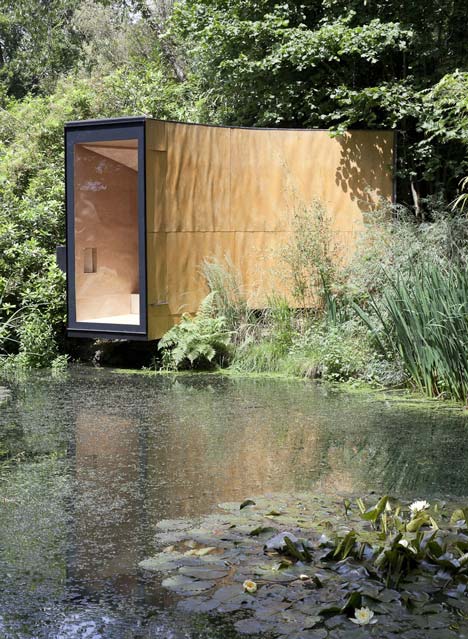
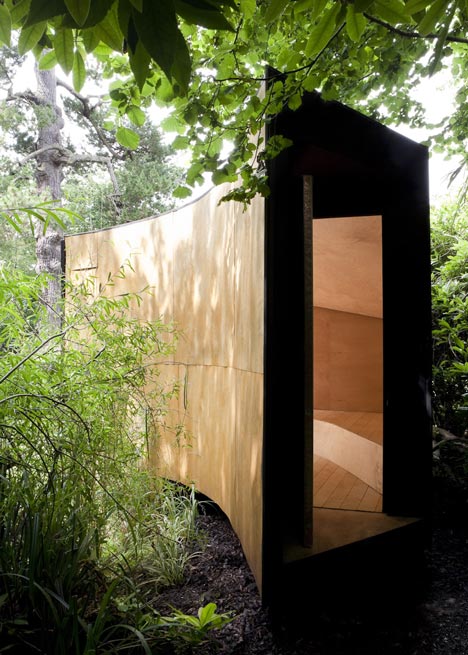
Nestled amongst the trees at the water's edge, The Forest Pond House is the first built project by London studio TDO and has a curved body constructed using sheets of plywood and copper.
The architects combined two concepts for the design of the structure. "The children's den programme was about hiding and playing in the woods, and the meditation programme was about focus, relaxation and immersion in the environment," architect Tom Lewith told Dezeen.
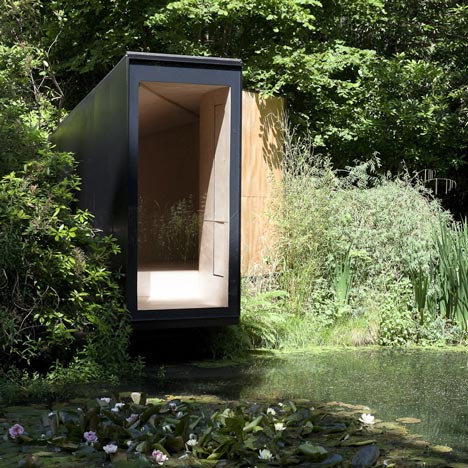
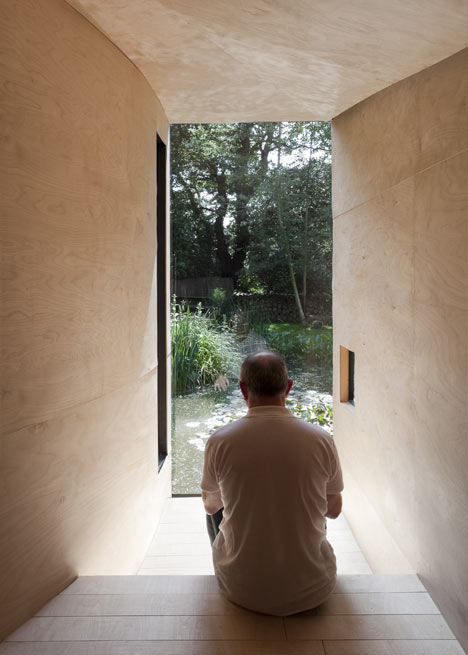
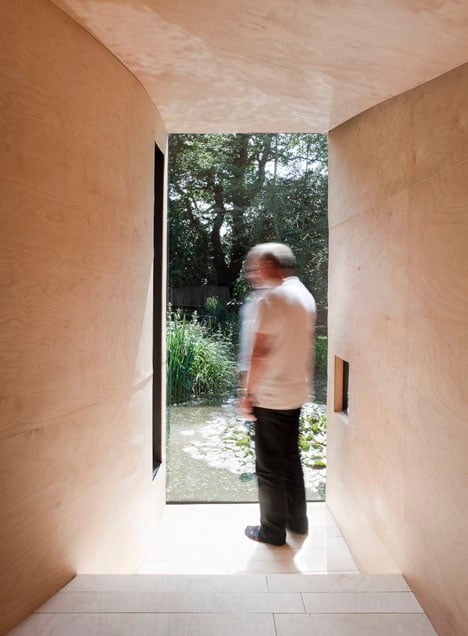
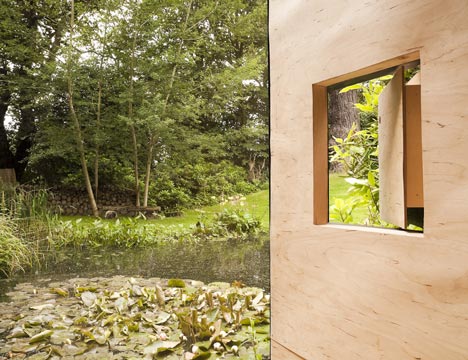
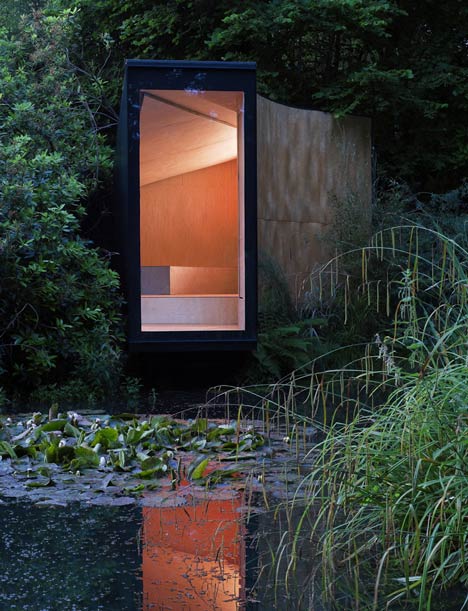
A glazed end wall frames a view out across the surface of the pond and the floor staggers down to create a window seat for one or two people.
Lewith explained: "Cantilevering over the pond was important to us, as we wanted the space to physically straddle the forest and pond in the same way we crossed over the two programmes. We saw the forest being dark, mysterious and busy - a place for kids to have fun. The pond we saw as more about meditation with its reflection and calm."
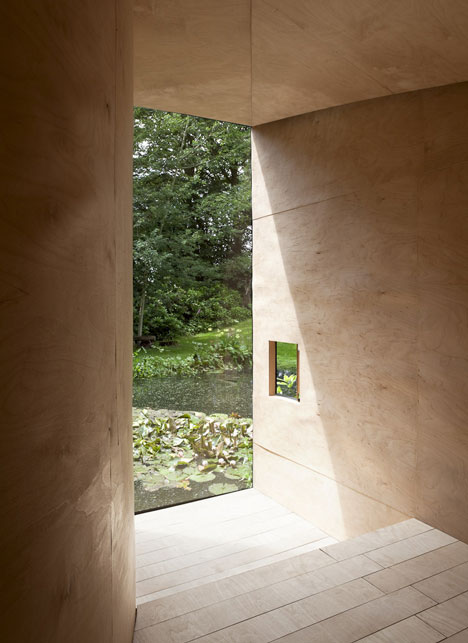
The ceiling angles upwards above the window seat, exaggerating the contrast in proportions between the front and rear of the folly.
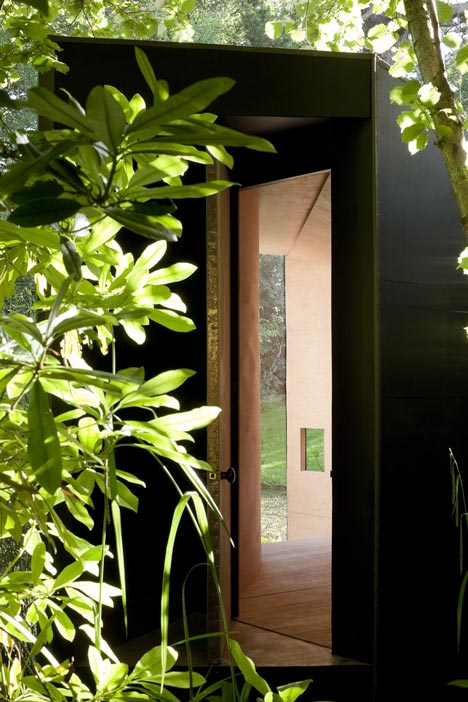
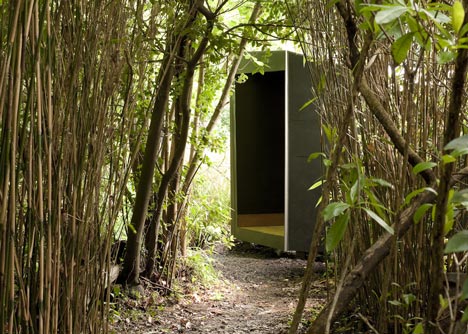
On the exterior, one wall is coated with blackboard paint to encourage children to draw pictures straight onto the building.
Tom Lewith launched TDO in 2010 alongside fellow graduates Doug Hodgson and Owen Jones. The Forest Pond House was one of 24 projects nominated for the AJ Small Projects Awards 2013.
Other follies completed in recent months include a wooden playhouse with folding window hatches and a wedge-shaped pavilion with a pool of water inside.
Photography is by Ben Blossom.
Here's some more information from TDO:
Located in rural Hampshire, The Forest Pond House is both a space for meditation and a children's den in the woods. Made from timber, glass and copper, it lies on the bank of a pond at the foot of a family garden.
The Forest Pond House encapsulates the ethos of TDO's founders. Their architecture is joyful and inventive. Their buildings complement their surroundings. For them, the way in which people experience a building is paramount.
Above: site plan - click above for larger image
Three alumni of London's Bartlett School of Architecture and Royal College of Art formed TDO Architecture in 2010. The Forest Pond House was built over nine months for £7,500 and is their first completed building.
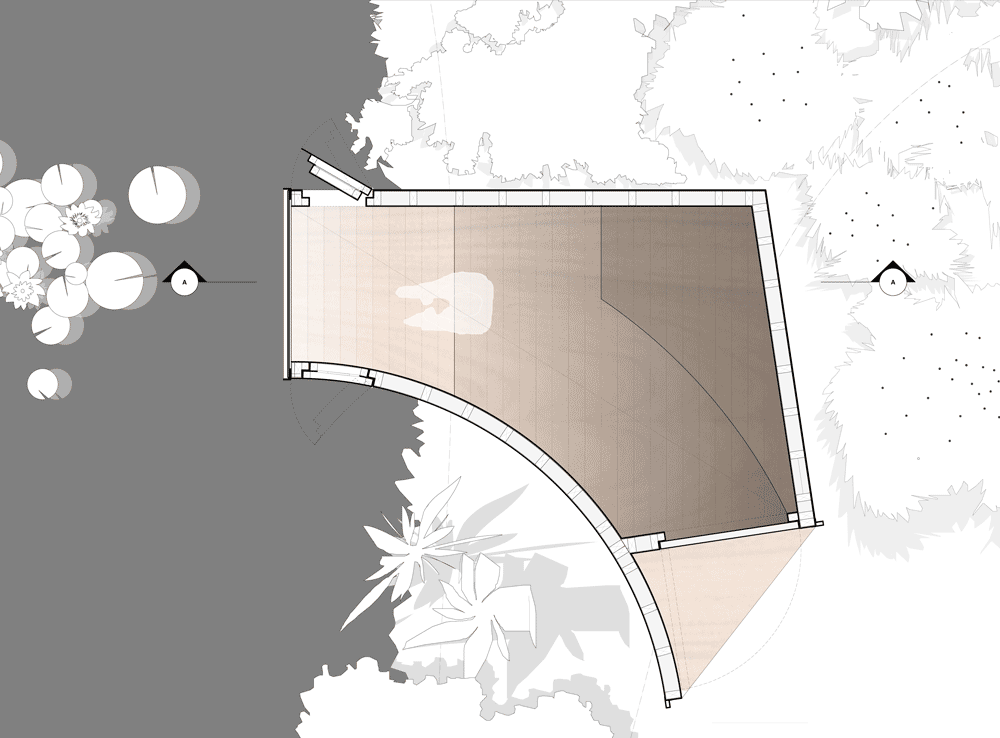
Above: floor plan - click above for larger image
The Pond House combines contrasting surroundings and contrasting uses to striking effect. It nestles between the dark drama of the forest and the bright calm of the water. Black, angular sides address the forest; light, curved surfaces and sheet glass address the pond. As well as mirroring the Pond House's environment, the design creates its dual functions. The dark elevations serve as blackboards for drawing in the woods. A rising floor shrinks one corner down to the size of a child. The brighter end of the Pond House, with its single source of light and bench looking onto the water, offers focus and a place for reflection.
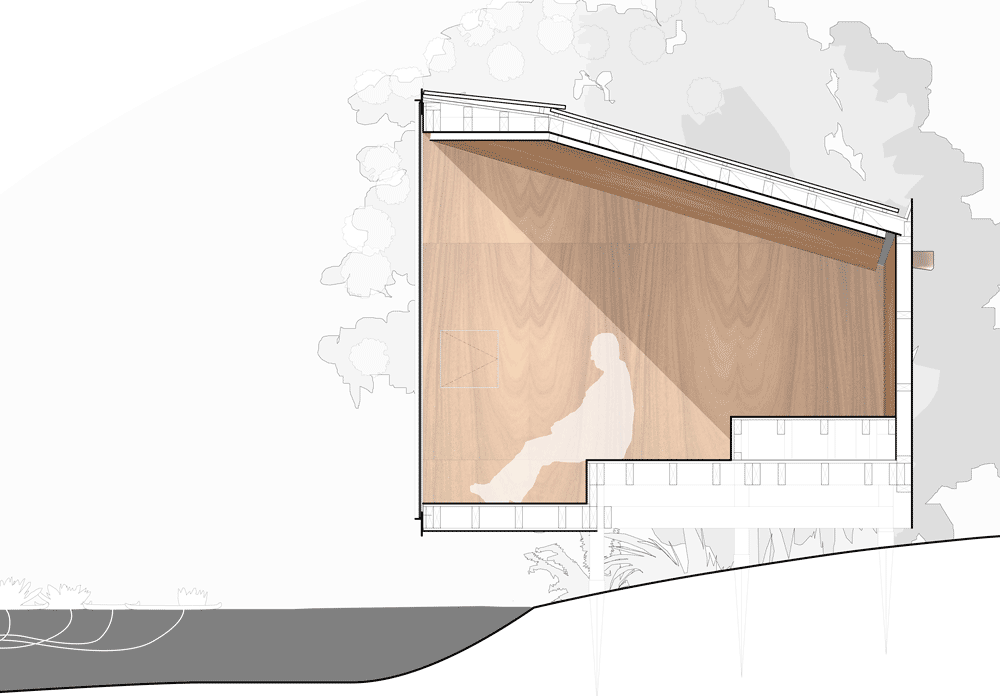
Above: section - click above for larger image


A really nice toilet, without the clutter of a WC or basin.
Does this place need any further function, other than that of a seat in a relaxing place? I would certainly like to spend some time there.
Do you need a structure to sit next to a pond?
You might need shelter from the wind and rain though you cheeky so-and-so!
If it gets chilly, or windy, or hot, or rainy.
When a seat just wouldn’t suffice.
Paul, I think you can consider it a meditation place as well; a sanctuary in which you can find your inner peace. Great construction – subtle and clean.
@Archirube – What do you mean by need? I am sure the clients want this space.
I like the things that I design and build to push the limits in some way, shape or form. It doesn’t take too much for an engineer and architect to design a small cantilever over a pond.
@Bogdan – I wholly agree with you. Quietness, water, beautiful timber, light – what more does one need? I would read, paint, study or draw here. Or, simply leave the house to listen to a bit of music!
It is a really nice space and well deserving of nomination for the AJ Small Projects Awards 2013.
Wait until you find a hobo living in there.
The amazing thing about a place like this isn’t its real function, but the community of people that need this: people that really want and then respect a public, unguarded building for a single spiritual function such as meditation. A community that builds a place like this probably deserves it. Sadly, I don’t live in that place.
This is beautiful. One of the best things I’ve seen in a long while. Yes, you could sit by the pond in a chair and I’m sure they do that also. The point of the architecture is to construct a particular kind of relationship with the pond – to focus and frame (literally) one’s attention in a particular way.
A really beautiful structure. Curious though, is the exterior cladding treated at all? Seems to be warping a lot in the last photo. Would be a shame if it was just a rotten old pile of junk in 2-3 years.
Sometimes it’s not about seeing a view, but experiencing it.
It’s like the old romantic gardens, where the landscape architect framed the views with help of a planned path going “randomly” through the garden. Here you would also find the old “chinese” teahouses next to ponds and/or lakes – they were not needed in order to see the view, you could just sit on the grass. They were there as part of the walk, and were showing very specific picturesque frames in context to the stories. The gardens were no more real (true to nature) than the fairytales at the same time were.
Within limits I find this phenomena quite interesting and also provoking, but what I really like about THIS project is that they didn’t change the “real” nature, they just forced architecture’s butt in the seat, so to say – and now it looks new and fresh, but imagine coming back in 15 years and this old, green, overgrown with leafs’n'such hut still sits by the lakeside. And when you enter it without any prior expectations, the view would still be there as beautiful as it was 15 years ago (hopefully, knock-on-wood). So it’s almost reversed romantism, if that is possible.
P.S. pee in the woods.
Great idea, clean lines but a bit claustrophobic looking. I wonder if the students that designed this actually took the time to study zen garden structures or specifically moon-viewing rooms?
Need to work on proportions though – not to be critical just more practical. After all who would know more about meditating by a pond than zen monks who originally came up with this idea in the first place?
A great project, well worthy of being nominated for AJ small buildings award. A carefully crafted piece of architecture that takes nothing away from the beauty of the landscape. Instead, it frames it.
A waste of money, really.
Absolutely ugly inside and out. Complicated method to desecrate a pond.