
OMA designs pyramidal building in China as "three-dimensional village"
Architecture studio OMA has completed Hangzhou Prism, a mixed-use building in southeastern China with a pyramidal form that incorporates a public square at its base.
Located in an emerging central business district in Hangzhou, the asymmetric building functions as a mixed-use complex with a hotel, homes, offices and a public square.
OMA designed the 43,000-square-metre structure as a departure from "typical residential towers", establishing it as a recognisable landmark for the district's skyline.
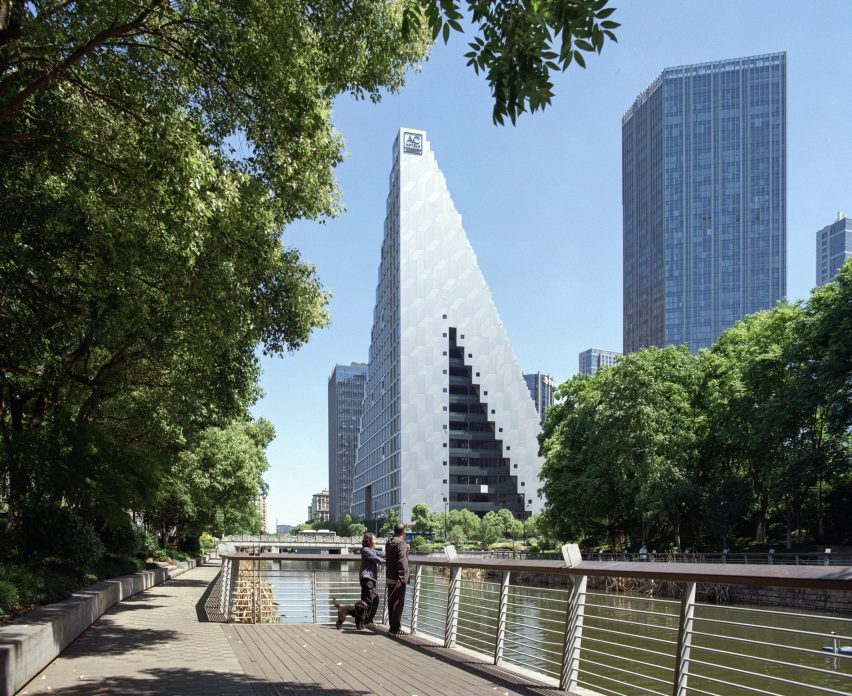
"The Hangzhou Prism is located at the core of Hangzhou's Future Tech City development, one of China's most successful innovation areas," said OMA partner Chris van Duijn.
"The design of the Prism shares this ambition to innovate. A cluster of typical residential towers was transformed into this single, porous structure, creating a three-dimensional village for young professionals and visitors," he continued.
"It is a design that maximizes synergy and interaction with opportunities for events, community, and fun."
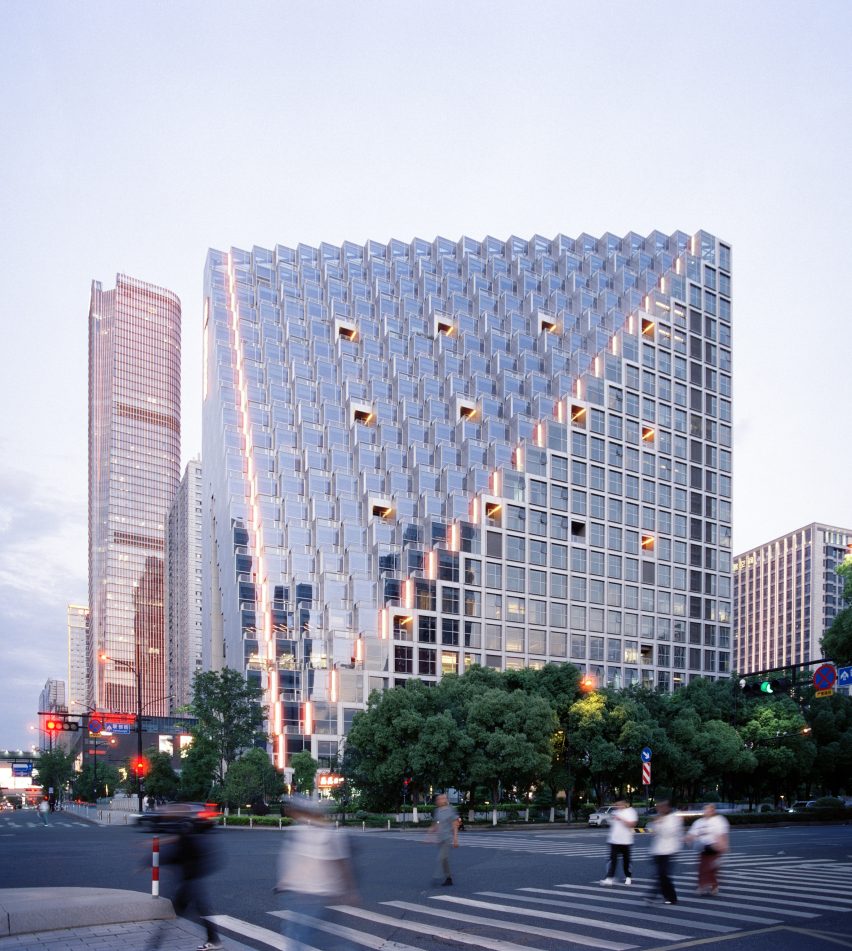
Peaking at 106.5 metres, Hangzhou Prism's distinctive shape is formed by two oblique facades lined with projecting cubic balconies. A large void punctures flat facades at ground level.
OMA first revealed the design in 2019, when it described the building as "a pinnacle reaching into the sky", referring to the ancient Chinese proverb "above, there is heaven; below, there is Suzhou and Hangzhou".
Inside, the hotel occupies the majority of the built form, encompassing 20,000 square metres. Meanwhile, the residences are spread across 10,000 square metres.
The offices and commercial areas occupy the remaining space, measuring 5,000 and 8,000 square metres, respectively.
Hangzhou Prism's apartments, or "lofts", occupy the upper levels of the building for a feeling of exclusivity. They each have private outdoor terraces with views over the city.
However, according to OMA, communal spaces are dotted throughout the building to encourage "interaction between residents, hotel guests, workers, and visitors".
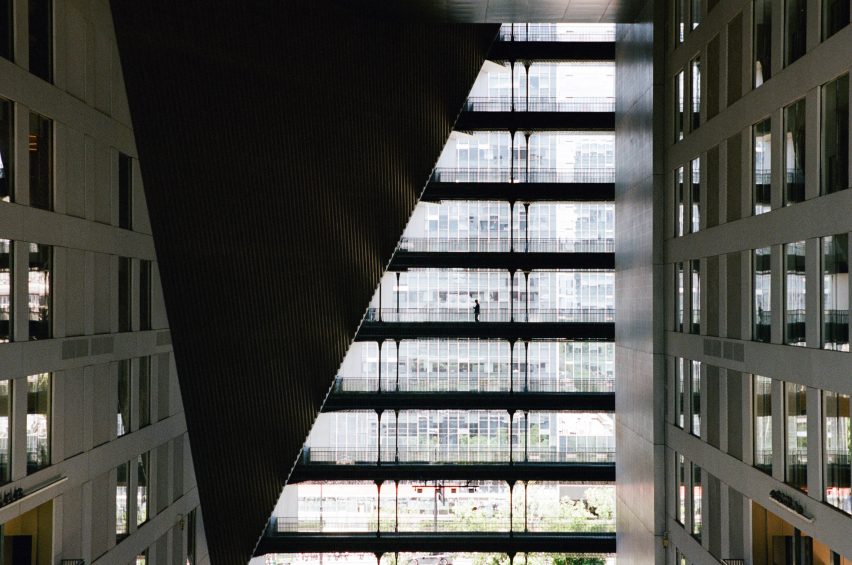
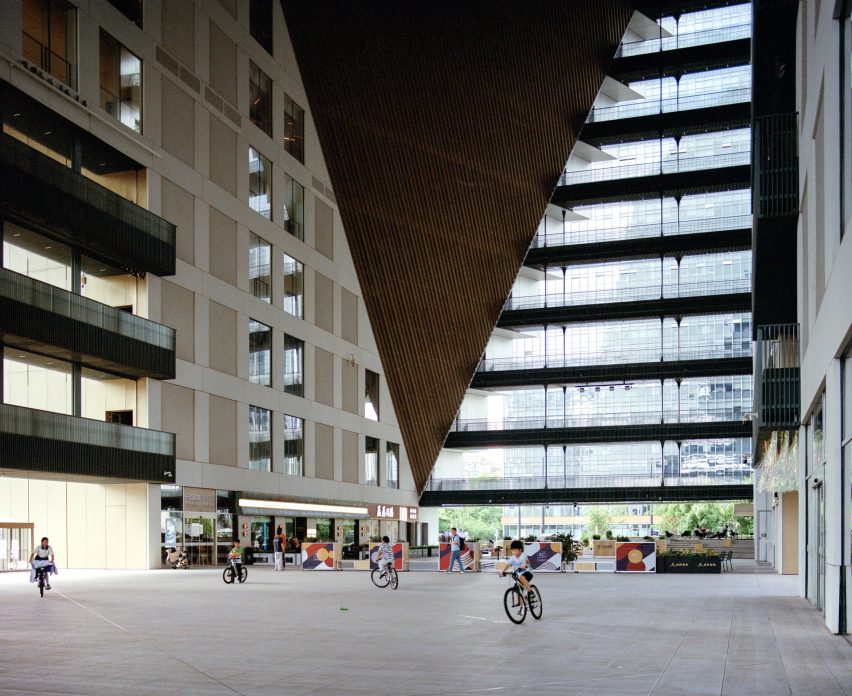
At the building's base is a large atrium, designed to function as a public square with links to the adjacent park. It is intended to be used for public events and is lined with windows and balconies.
OMA, officially known as Office for Metropolitan Architecture, was founded in 1975 in Rotterdam. Hangzhou Prism was led by its partner van Duijn and project architect Michael Hadjistyllis.
Elsewhere, the studio recently completed its expansion of New York's New Museum and created an incubator for mushroom production in Oaxaca.
The photography is by Tu Ximeng unless stated otherwise.