
Floating accommodation for London's key workers among projects by University of Westminster students
Dezeen School Shows: a proposal for floating living quarters to house key workers in London is among ten projects by architecture students at the University of Westminster.
Also featured is a project that fosters togetherness between fibre artists and the queer community, and a project detailing the speculative future of Trafalgar Square's National Gallery in the face of climate-related changes.
University of Westminster
Institution: University of Westminster
Courses: Architecture BA (Hons), Architecture and Environmental Design BSc (Hons), Interior Architecture BA (Hons) Master of Architecture RIBA Part II
Tutors: Arthur Mamou-Mani, Toby Burgess, Sean Griffiths, Matteo Sarno, Anthony Boulanger, Stuart Piercy, John Cook, Laura Nica, Ben Pollock, Richard Difford, François Girardin, David Scott, Alessandro Ayuso, Mary Konstantopoulou, Yara Sharif, Nasser Golzari, Paresh Parmar, Tabatha Mills, Sam Sam Hui, Ro Spankie, Allan Sylvester, Adam West, Paolo Zaide, Tom Budd, Dr Luz Navarro Eslava and Harry Charrington
School statement:
"Westminster's students are based at our vibrant Marylebone campus in the heart of London's dynamic architecture scene.
"Students benefit from project-based learning, coupled with expert environmental, technical and cultural studies, allowing them to develop their imaginative designs into reality.
"Our 110-metre-long, galleried, daylit architecture studios are on the upper levels of our Marylebone campus and foster a vibrant and innovative studio culture.
"Our Creative and Advanced Technologies Laboratory (CAT LAB) includes 3D printing, CNC cutting, routing and milling and robot fabrication."
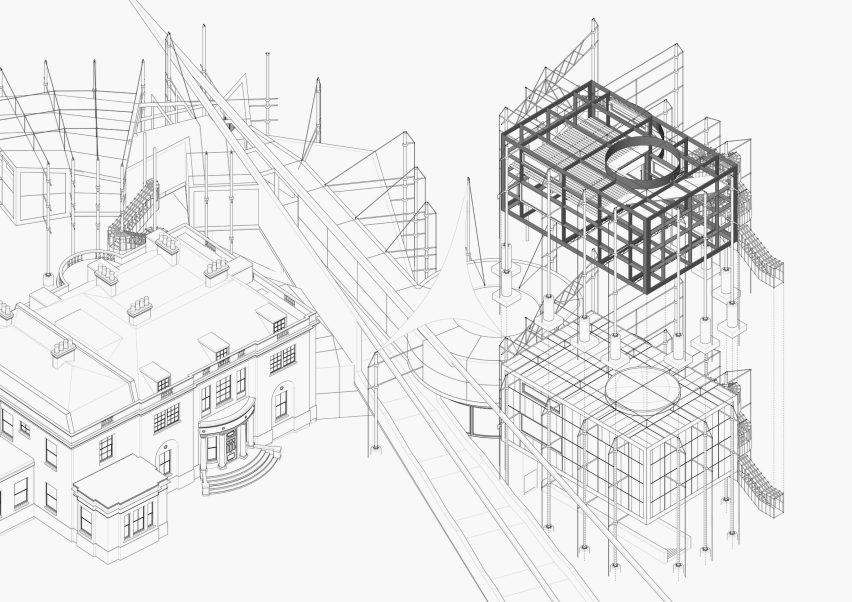
The Diasporic Centre, Southgate by Radmehr Jabbari
"The Diasporic Centre, Southgate, explores how architectural technology can make structure, assembly and environmental performance spatially legible rather than concealed behind finish.
"The project proposes a lightweight civic intervention suspended within an exposed external steel support system, using CLT infill panels, cable-supported framing and a non-combustible rainscreen envelope to separate structure, skin and occupation into distinct, readable layers.
"The building accommodates indeterminate and adaptable forms of occupation through open-plan spatial organisation, ramps and reconfigurable thresholds, with this flexibility enabled directly through the project's tectonic strategy.
"Developed through iterative technical studies, physical models, and detailed junction design, the scheme investigates how contemporary construction systems can support adaptability, thermal continuity, and low-carbon assembly while maintaining a strong architectural identity rooted in exposure, attachment and structural expression."
Student: Radmehr Jabbari
Course: Architectural Technology BSc (Hons)
Tutors: Paresh Parmar, Tabatha Mills and Sam Sam Hui
Email: w2027520[at]westminster.ac.uk
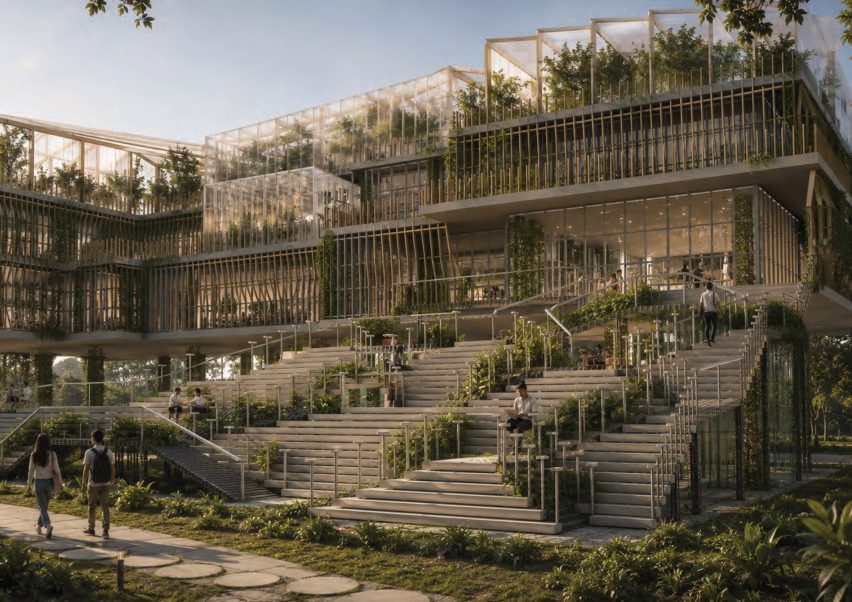
Terra Firma – Extension by Nouha Manai
"This project prepares for a future in which the ground will be rendered more hostile by environmental degradation and flooding, and architecture will no longer be able to rely on its terrestrial connection.
"Terra Firma – Extension conceptually and physically elevates the ground to transform it into a new productive surface.
"The project establishes a new 'working ground', a resilient strata designed for a future school in Deptford.
"Above it, a greenhouse preserving the local biosphere will also act as a learning space.
"Below is the new 'working ground': a vast, stepped landscape that provides a generous public space while connecting the building to the surrounding neighbourhood."
Student: Nouha Manai
Course: Architecture and Environmental Design BSc (Hons)
Tutor: Stefania Boccaletti
Email: w1788189[at]my.westminster.ac.uk
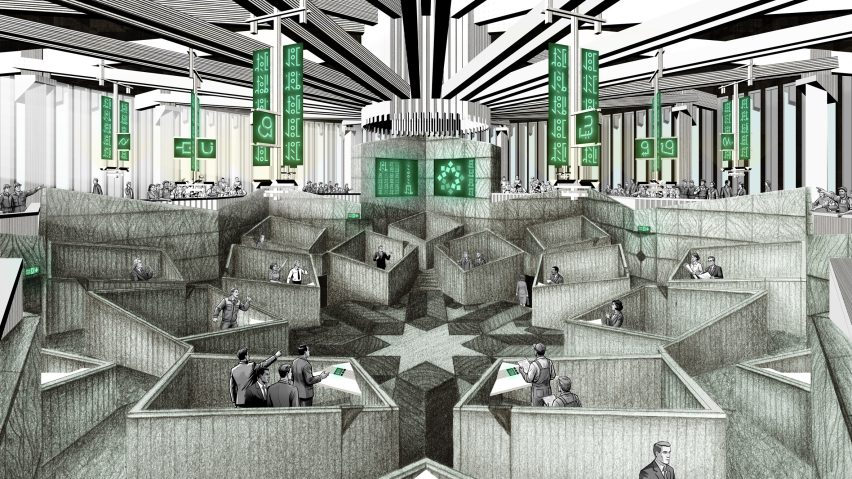
Peoples Direct Democracy by Alejandro Haidoulis Ocampos
"The People's Civic Centre is a physical manifestation of the studio's collaborative masterplan for a post-capitalist society on the historic Silvertown Royal Docks.
"The building supports a dual democratic system of local direct voting through information trees across the site and a centralised Exchange, alongside representatives from each studio programme.
"Cohort-developed alphabets and notations are embedded throughout, communicating democratic matters and public discourse.
"The Assembly Hall emphasises the new social hierarchy: the working class look down from above upon the representatives of each programme below, architecturally elevating their voice in local affairs and inverting traditional structures of power."
Student: Alejandro Haidoulis Ocampos
Course: Master of Architecture, MArch (ARB/RIBA Part 2)
Tutors: Sean Griffiths and Matteo Sarno
Email: alex1379[at]hotmail.co.uk
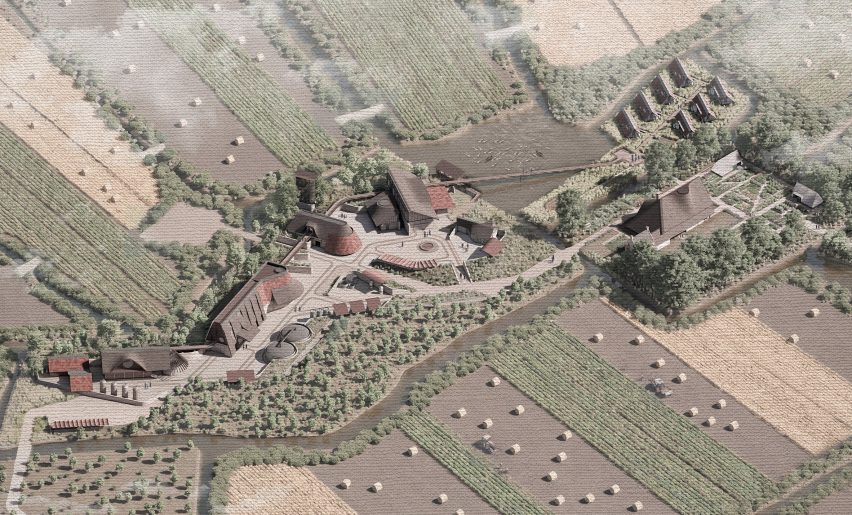
The Flax Co-operative by Angus Robinson
"The Netherlands' escalating nitrogen crisis is placing unprecedented pressure on rural agrarian communities.
"Government buy-out schemes, combined with growing private investment, are accelerating the conversion of agricultural land into data centres and fulfilment facilities, steadily eroding the countryside's productive and cultural identity.
"In Hijlaard, Friesland, an alternative model of construction-based activism is taking place in the form of the Flax Co-operative, establishing a civic hub for regional collectivism, developing on-site flax-based material applications, strengthening regional supply chains and facilitating the productive capture of local agricultural outputs.
"Through inhabiting and restoring the Westkleaster Farm, the Flax Co-operative serves as a pilot scheme for wider agricultural reform, while also reinstating the farmstead as a living centre for rural culture, craft and community ritual."
Student: Angus Robinson
Course: Master of Architecture, MArch (ARB/RIBA Part 2)
Tutors: Anthony Boulanger and Stuart Piercy
Email: angusrobinson7[at]gmail.com
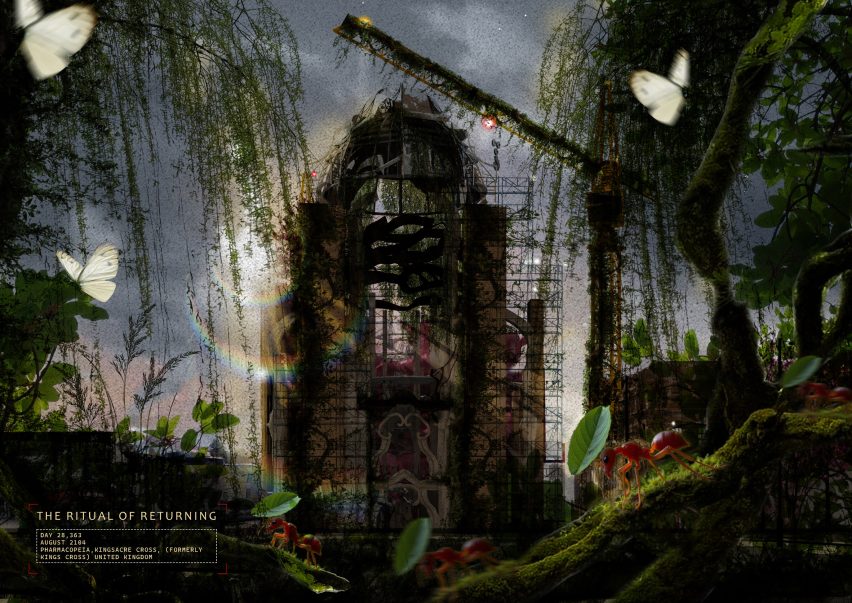
Pharmacopeia: The Willow Archive by Xhesika Rama
"This project explores willow trees and their medicinal properties, focusing on the presence of salicin beneath the bark – the compound that led to the development of aspirin.
"Located in King's Cross within London's Knowledge Quarter, near major biomedical research centres and universities, Pharmacopeia will offer a research facility dedicated to plant chemistry, a medicinal archive and willow weaving workshop.
"The project imagines a future in which natural systems are used responsibly rather than depleted.
"It considers the longevity of architectural design, and the impact that it will have on non-human life.
"Proposing a built environment that encourages ecological balance and a mutual relationship between humans and nature."
Student: Xhesika Rama
Course: Master of Architecture, MArch (ARB/RIBA Part 2)
Tutors: Alessandro Ayuso and Mary Konstantopoulou
Email: xhesikarama1[at]hotmail.com
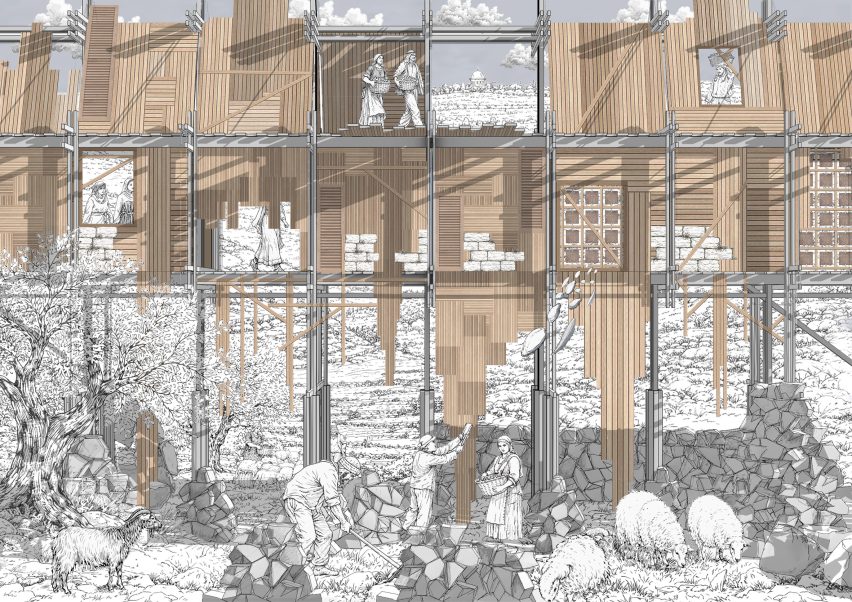
The Battle Between The Olive and The Pine: The Collapse of The Manufactured 'Perfect Park' by Nedal Harris Ghosheh
"This intervention proposes a reverse ecology situated across the slopes of the Mount of Olives in Jerusalem.
"Critiquing the Absentee Property Law, which renders Palestinians legally absent from their own land, the project examines how the Jewish National Fund's planting of pine forests across the landscape functions as a form of green colonisation, concealing erased villages beneath a constructed 'perfect park'.
"As soil erosion intensifies from the dense pine tree forests, buried village ruins rise back to the surface through the process of forensic botany, where fallen pine timber is harvested and reused to reconstruct inhabitable structures, restore terraces and support the return of Bedouin and Palestinian agricultural life.
"Through phased ecological transformation, olive groves re-root themselves within exposed fissures, reactivating water systems and stabilising the land once again.
"The project ultimately imagines the landscape itself as a form of resistance: a forensic reconstruction in which ecology, memory and architecture collectively reverse the mechanisms of erasure."
Student: Nedal Harris Ghosheh
Course: Master of Architecture, MArch (ARB/RIBA Part 2)
Tutors: Yara Sharif and Nasser Golzari
Email: nedalharris123[at]gmail.com
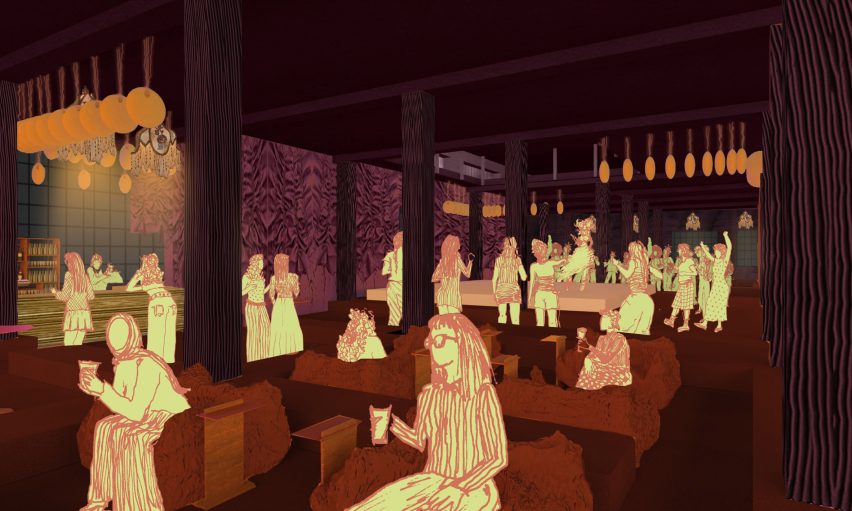
The Loom Weaving Spaces by Balkis Mortier
"This project is about creating a community of crafters interested in the fibre arts.
"It is centred around women and their place in the craft world.
"The stakeholders are thus fibre artists – mainly women from a range of age groups and experience levels – creating this community of crafters helping each other.
"The other part of the project is a drag club, showcasing the fibre arts via another art form.
"The stakeholders will thus be the drag queens and their audience including the fibre artists themselves and drag enjoyers, mainly people part of the queer community.
"The hidden stakeholders of this project are the workers in the craft centre and the drag club that represent a significant part of people using the space differently."
Student: Balkis Mortier
Course: Interior Architecture BA (Hons)
Tutors: Ro Spankie, Alessandro Ayuso, Allan Sylvester and Adam West
Email: w1905606[at]my.westminster.ac.uk
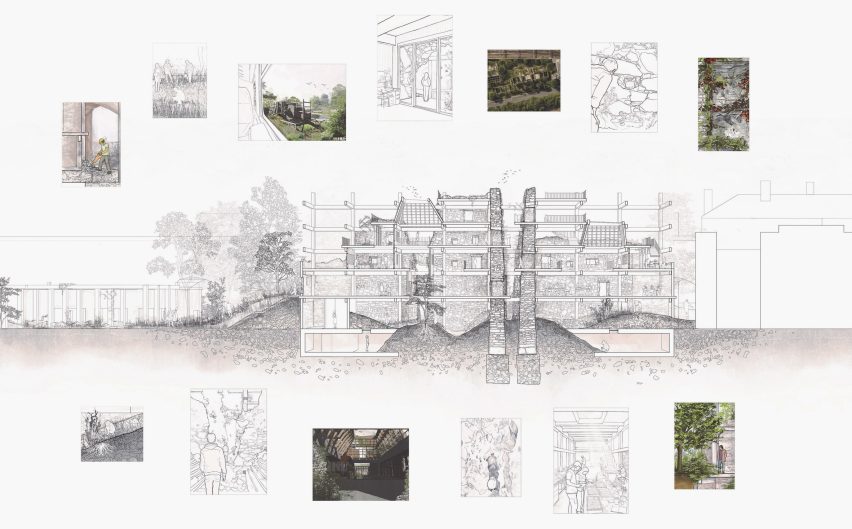
The Ecological Corridor by Khadijah Latif
"The Ecological Corridor investigates how the creative reuse of an existing office building facing Bethnal Green Gardens can nurture ecological and societal regeneration in this dense and fragmented area of London.
"An ongoing process of gradual and selective demolition of the building exposes and defines new environmental and soil conditions within the existing structure.
"Cracking, cutting and reorganising the rubble creates an inhabited vertical landscape that increases nature connectivity across the site.
"Within this architecture that is both built and grown, a research centre in urban ecology monitors the ecosystems and species inhabiting the diverse habitats."
Student: Khadijah Latif
Course: Architecture BA (Hons)
Tutors: Eric Guibert and Christopher Daniel
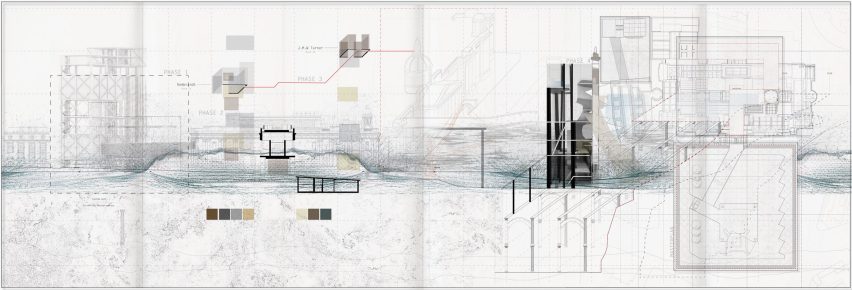
The Promenade Theatre of Weathering: A New Institutional System of Auctions by Yoana Bozhinova
"The project explores the future of the National Gallery in Trafalgar Square, London across a speculative 500-year timeline shaped by flooding, erosion and environmental instability.
"This premise follows the projected failure of the Thames Barrier during extreme climate change.
"Hence architecture is reimagined as a condition that gradually transforms through decay and sedimentation rather than a fixed and preserved entity.
"Through submerged galleries, exposed archives and elevated promenades, the proposal reframes environmental collapse as both a spatial and curatorial experience, allowing nature and time to continuously reshape the city and generate new forms of collective memory.
"The Theatre positions weathering and instability as active forces that inform and create systems of knowledge exchange within architecture and the future of the city."
Student: Yoana Bozhinova
Course: Architecture BA (Hons)
Tutor: Constance Lau
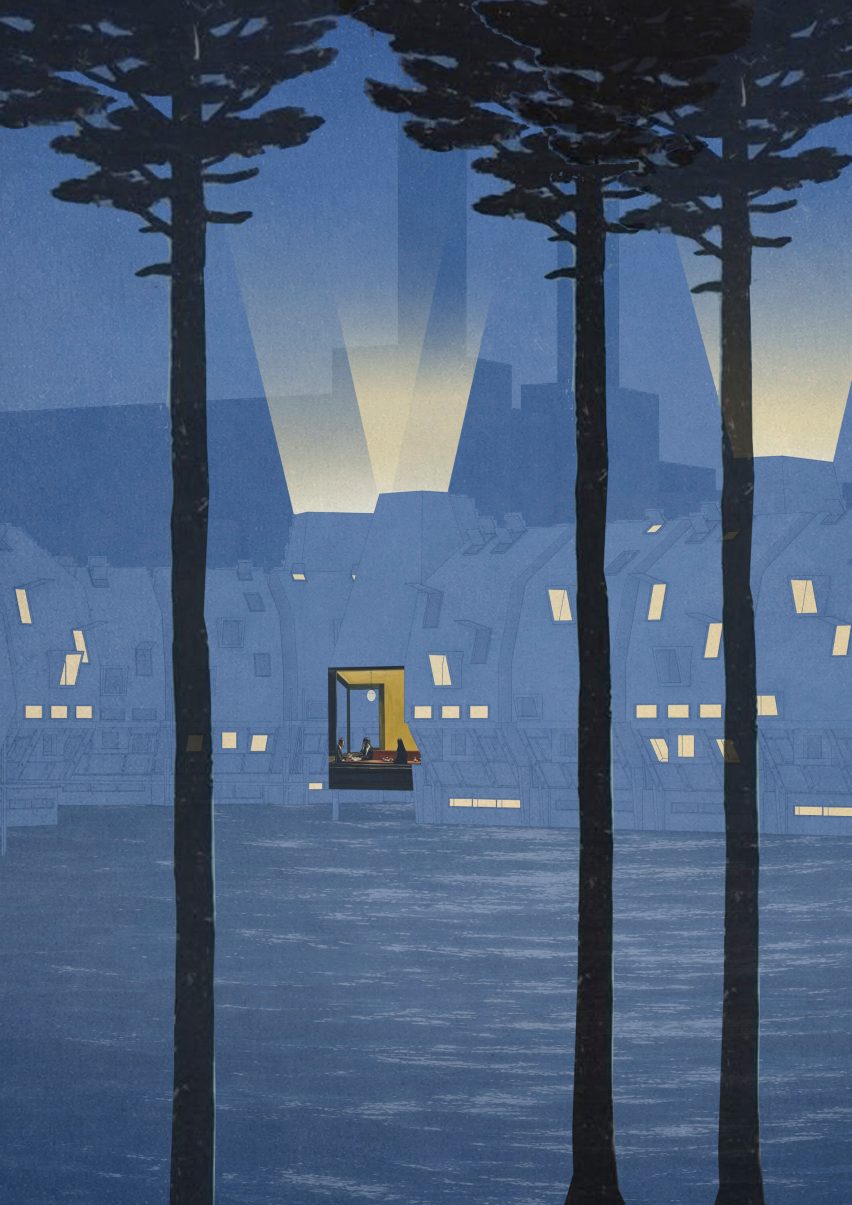
Floating Lives by Sofiia Bernovska
"The project reimagines living on the Thames against a context of change, both in how we form communities and how we live alongside a rising river.
"Reacting against the excess of unaffordable housing in Battersea, a new floating community of key workers from across London are given a sanctuary where shared spaces are flexibly adapted to suit different uses throughout the day, and the river becomes a nexus of leisure, transport and social space.
"The proposal draws on a tectonic developed from memories of World War Two aeroplane aesthetics and the incidental communities these machines created."
Student: Sofiia Bernovska
Course: Architecture BA (Hons)
Tutor: John Zhang
Partnership content
This school show is a partnership between Dezeen and the University of Westminster. Find out more about Dezeen partnership content here.