Mitre & Mondays creates forest installation to reveal the five stages of responsible timber production
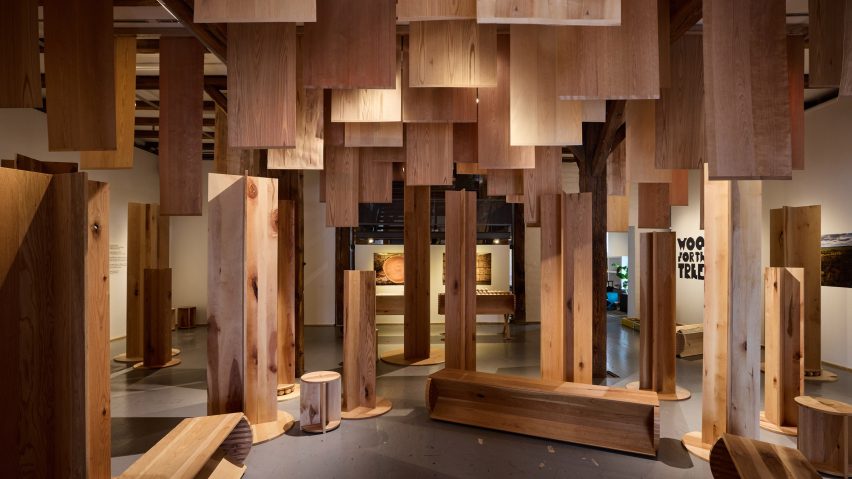
British studio Mitre & Mondays has collaborated with Benchmark and the American Hardwood Export Council on a 3 Days of Design installation revealing the value of sustainable forest management.
Presented in Copenhagen as part of the Material Matters design fair, Wood for the Trees aimed to recreate the experience of an American hardwood forest.
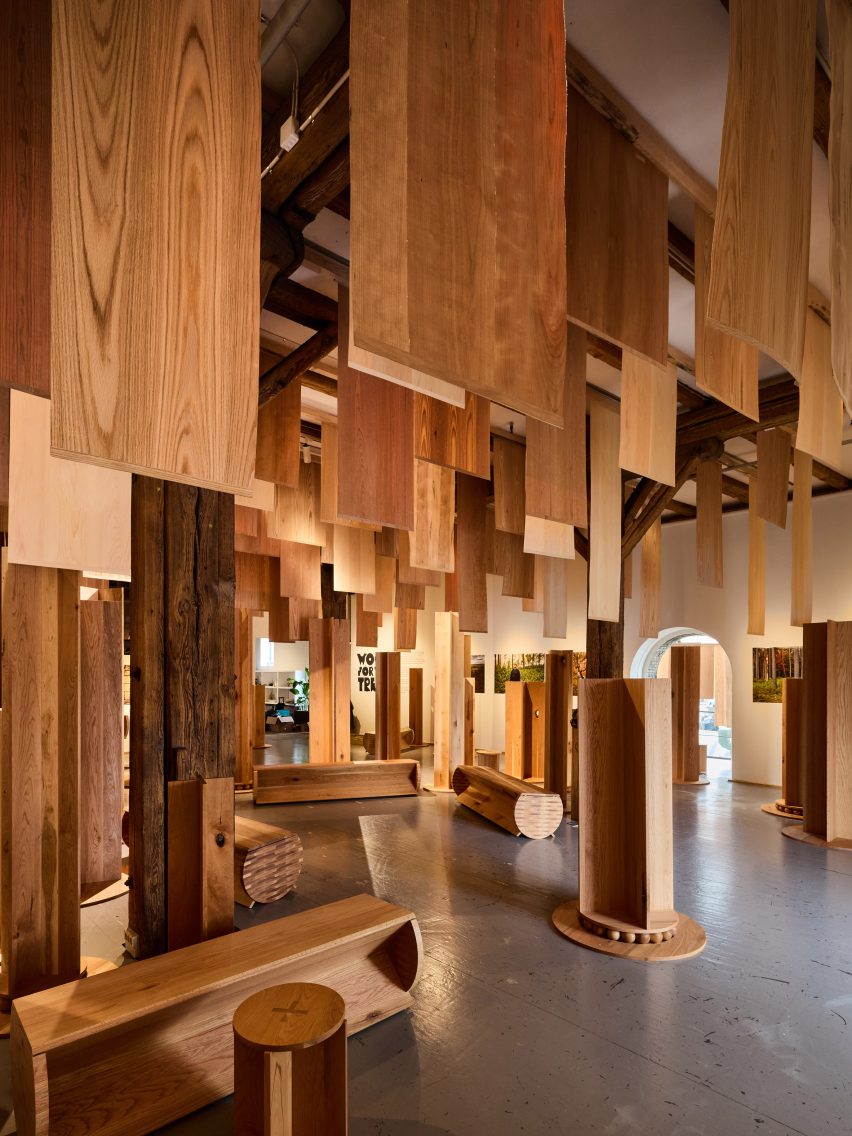
It featured a series of timber elements, from rotating trunk-like columns to log-like furniture, to represent five stages of responsible timber production.
The idea was to celebrate the material lifecycle, not just the product that comes out of it, to help people understand why growing and harvesting hardwood in forests, rather than plantations, is key to maintaining this resource for future generations.
"In a plantation, there are no seedlings on the floor; it's a monoculture with very little biodiversity," explained David Venables, European director for the American Hardwood Export Council (AHEC), during a tour of the show.
"But in a forest, you've got trees of all different ages and species living together. Some will be harvested, and some will be left to grow the next generation. That's what will give us more trees in the future."
The concept came after the trio of designer-makers who form Mitre & Mondays, Josef Shanley-Jackson, Freya Bolton and Finn Thomson, watched AHEC's feature documentary, Forested Future, directed by Petr Krejci.
The film spotlights the people, from landowners to loggers, who have contributed to the restoration of the USA's hardwood forests.
Covering over 40 million acres (16 million hectares), these forests are growing at twice the rate they are harvested, according to AHEC.
With the help of British furniture maker Benchmark, the trio crafted a series of elements that chart five processes involved in supporting this timber lifecycle: growing the trees, managing the forest ecosystem, selecting when and what to harvest, supporting renewal, and utilising the wood.
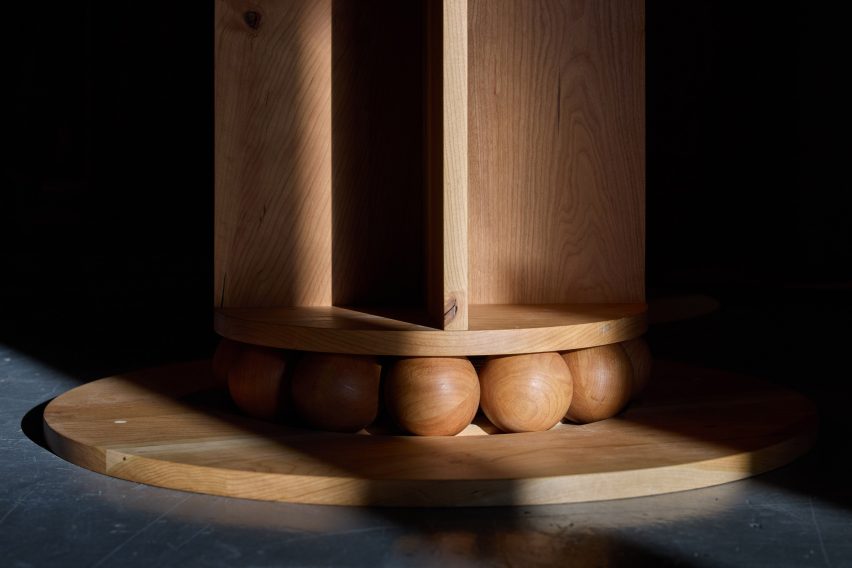
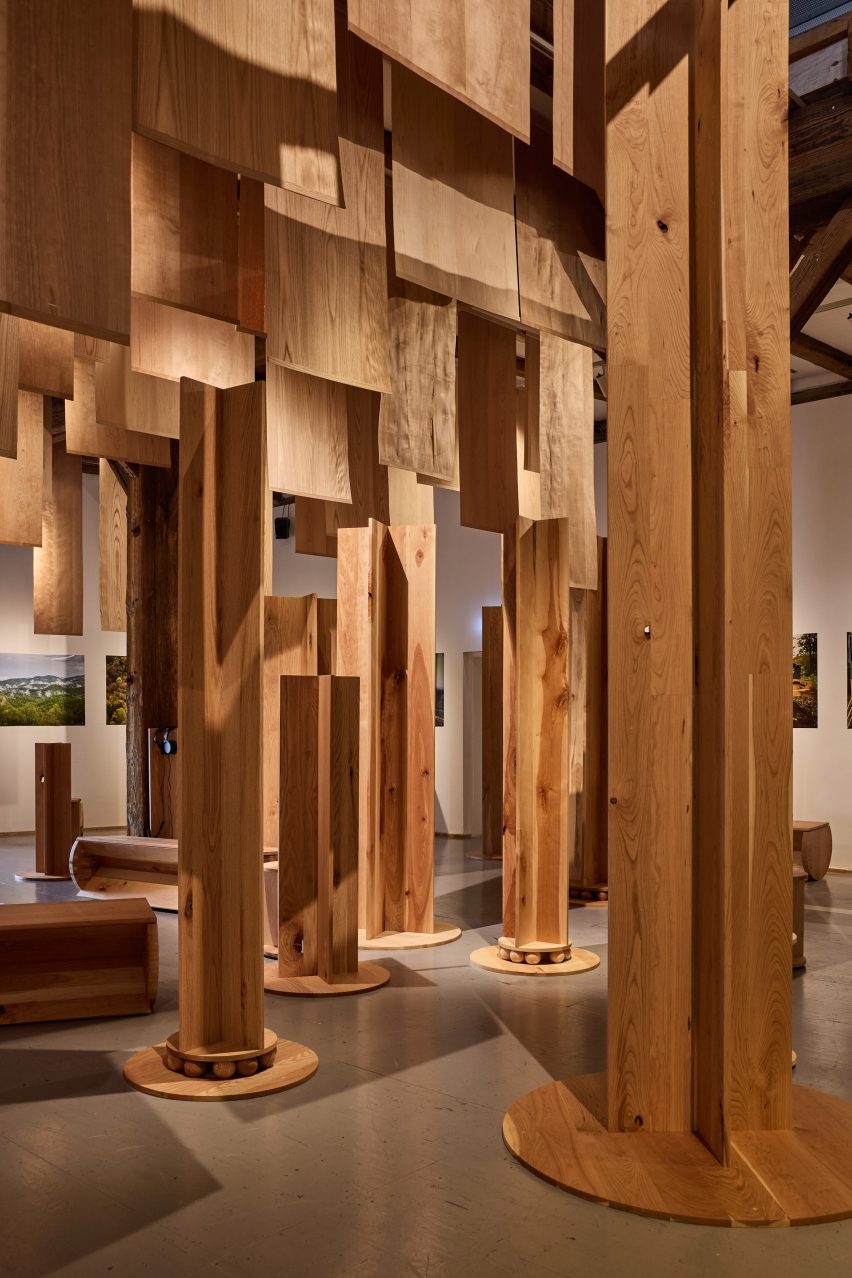
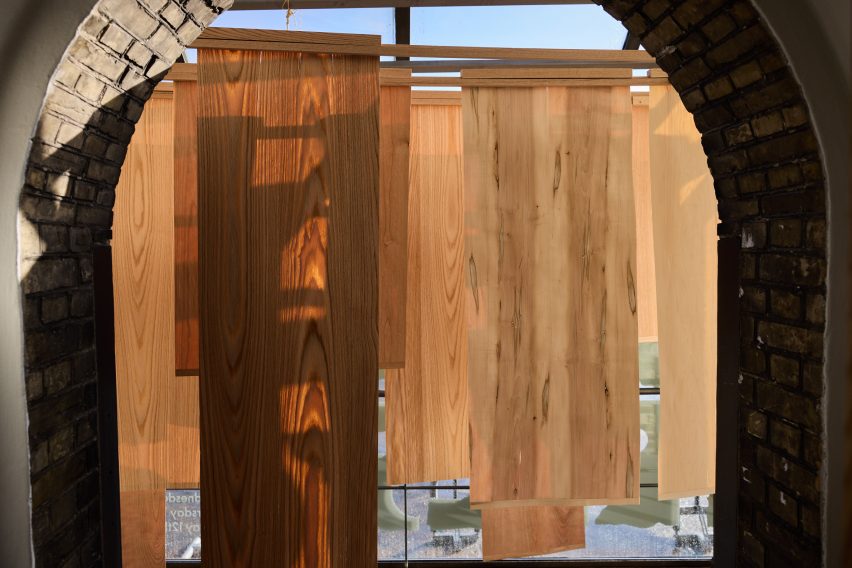
Sheets of veneer hung from the ceiling, offering the sense of a forest canopy, while cross-shaped columns were reminiscent of tree trunks.
Some of these trunks pivot on wooden balls, allowing them to rotate. These symbolised the longer forest harvest rotations in a healthy forest, thanks to selective harvesting rather than clear-felling.
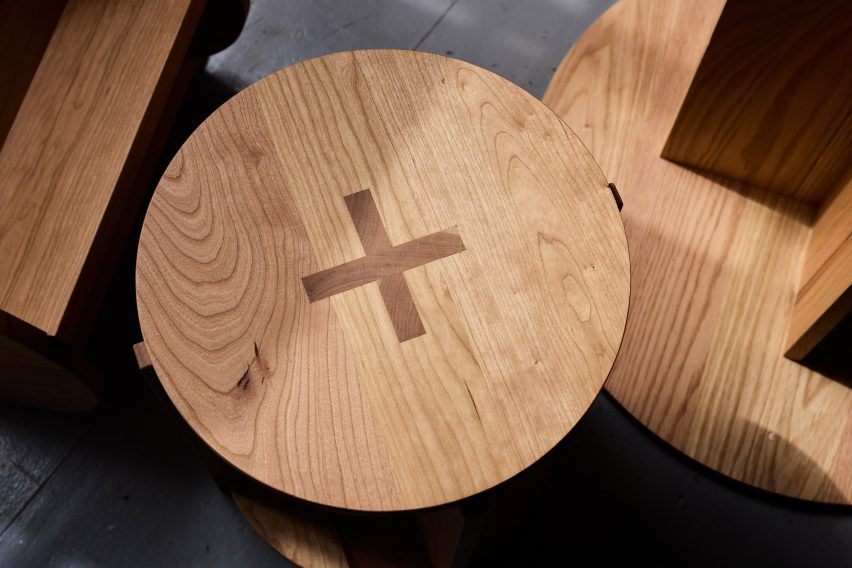
Wooden benches alluded to felled trees, which are milled into planks for later use. Stools represented the remaining stumps, which will either grow back from the active roots, or be naturally outgrown by new saplings sprouting up around them.
"We really wanted to bring the forest back to this timber, to spatially give people the understanding and some of the physical experience of navigating a forest as these foresters do," said Thomson.
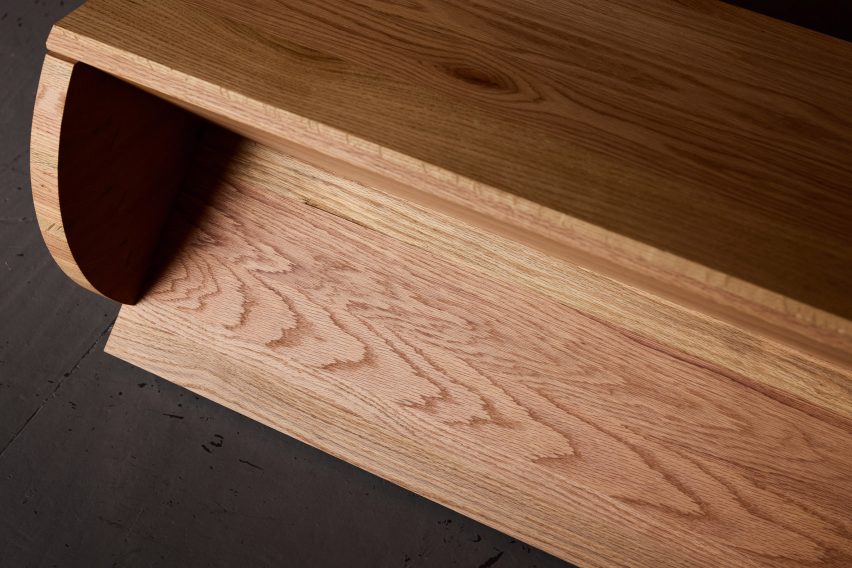
The exhibition featured four species of timber: American red oak, yellow birch, hard maple and cherry.
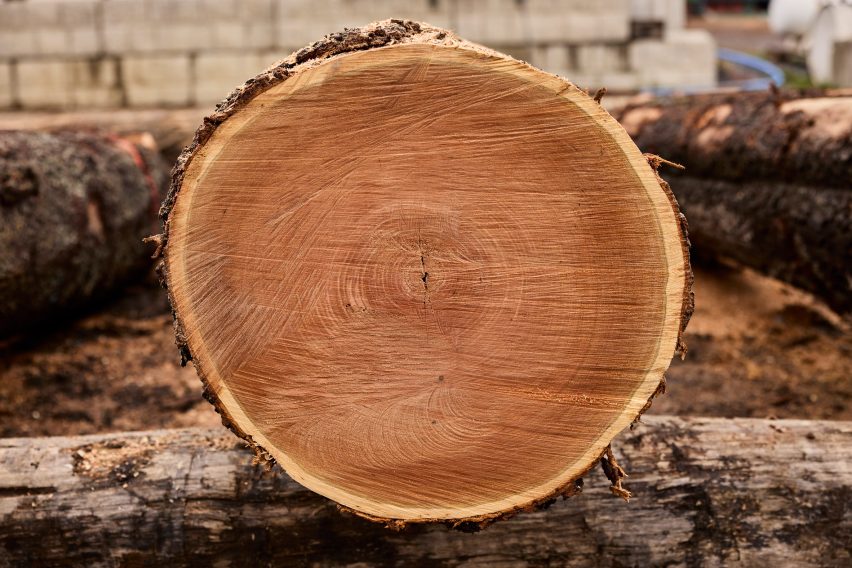
Donated by family-owned sawmills, the timber here falls under the grade category known as "number one common". It is typically considered too low-grade for application in design products, due to the number of knots and the variations in colour or grain.

With this show, AHEC hopes to encourage architects, designers and industry to adopt a more diverse approach to timber selection.
"If we only use 10 per cent of the tree, which is what is happening at the moment, we're not being responsible," said Venables.
"Hopefully it starts a conversation about how this is such an interesting selection of wood, and why people aren't specifying more of it," added Martin Penrose, head of design at Benchmark.
Wood for the Trees comes one year after AHEC presented the exhibition No. 1 Common, for which designers Andu Masebo, Daniel Schofield and Anna Maria Øfstedal Eng created furniture celebrating the qualities of this supposedly low-grade timber.
The photography is by Petr Krejci.
Wood for the Trees was on show as part of Material Matters from 10 to 12 June 2026, at Ukraine House, Gammel Dok, Strandgade 27B, 1401 Copenhagen, Denmark. See Dezeen Events Guide for more architecture and design events around the world.