


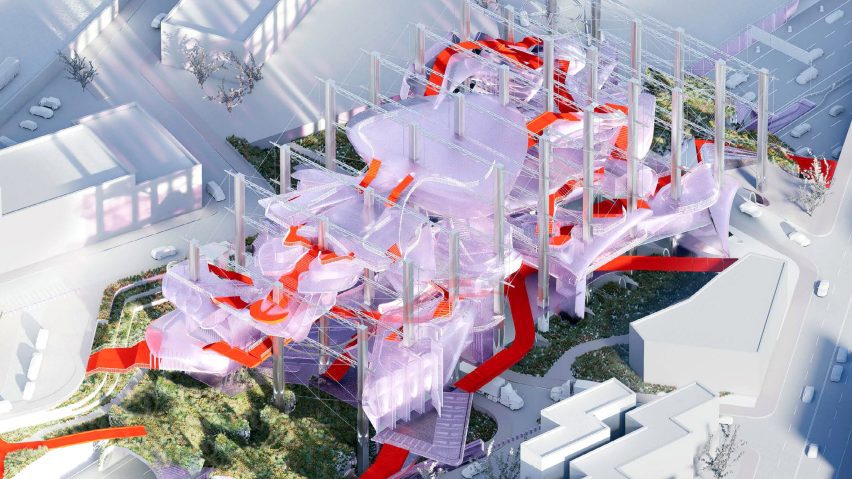
Dezeen School Shows: a Polish embassy located next to Chicago's Kennedy Expressway is among the student projects by The Bartlett School of Architecture.
Also featured is a London-based Latin American media agency for migrant communities and a centre dedicated to fishing on the island of Nkombo in Rwanda.
University College London
School: The Bartlett School of Architecture
Courses: Architecture BSc (ARB/RIBA Part 1), Architectural & Interdisciplinary Studies BSc, Engineering & Architectural Design MEng (ARB/RIBA Part 1, CIBSE & JBM), Architecture MSci (ARB Part 1 & 2) and Architecture MArch (ARB/RIBA Part 2)
Tutors: Farlie Reynolds, Chee-Kit Lai, Hannah Corlett, Sophie Read, Luke Olsen, Alicia González-Lafita, Sara Martínez Zamora, Colin Smith, Matthew Butcher and Kostas Grigoriadis
School statement:
"The Bartlett School of Architecture has been recognised as one of the world's leading institutions for architectural education.
"Renowned for its innovative and forward-thinking approach, the Bartlett consistently sets high standards in the field.
"Each year, its highly anticipated Summer Show presents the radical design thinking and architectural imagination of its students to a global audience – both online and in person.
"The breadth of projects and the depth of thematic exploration invite viewers to reflect on what architecture is – and what it has the potential to become."


Ni De Aqui, Ne De Alla by Sergio Lopez
"Migration is a constant throughout world history. It involves not only the movement of people, but of information, goods, media and tradition.
"As different migrant communities settle in a new urban space, they plant roots, adapt their culture and integrate, creating a blended, shared identity that transforms both themselves and the city around them.
"This project recontextualises the migrant worker, interrogating their presence and their absence within the UK's bureaucratic systems.
"Through Chucha.UK, a London-based Latin American media agency, storytelling becomes the primary architectural method; one that draws on direct, participatory access to community knowledge, lived spatial experience, and the decision-making processes of those who are most often left out of the room.
"'A child put her hand up to ask the puppets a question and that moment, unscripted and unrehearsed, was the clearest confirmation that the work had landed where it needed to.'"
Student: Sergio Lopez
Course: Architectural and Interdisciplinary Studies BSc
Tutors: Freddy Tuppen, Kevin Green and Pedro Gil
Email: sergio.borja.22[at]ucl.ac.uk

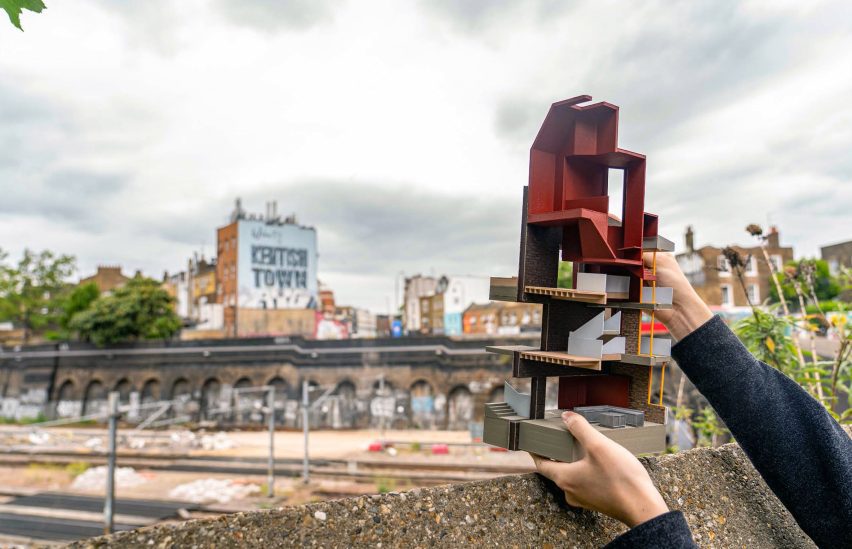
Ordinary Grounds: Mediating the Right to Remain by Parin Nawachartkosit
"Situated in Kentish Town, the project investigates how architecture can operate within ordinary urban conditions shaped by constraint, displacement, economic pressure and incremental change.
"Rather than treating the site as empty ground, it is understood as a field of existing relationships, material traces, local routines and social value.
"Grounded in an ethical reading of the As-Found, the project views constraint not as an obstacle but as evidence through which architecture can intervene with care.
"Through public engagement, iterative testing and close attention to everyday occupation, it develops a porous civic framework capable of supporting displaced local programmes, informal care networks and shared community use.
"Rejecting the public building as a fixed object, it proposes an architecture of calibrated openness: spaces that can be adapted, appropriated and reinterpreted over time.
"Architecture becomes a framework for sustaining social, cultural and civic life under pressure."
Student: Parin Nawachartkosit
Course: Architecture MArch, PG11
Tutors: Laura Allen and Mark Smout
Email: parin.nawachartkosit.18[at]ucl.ac.uk

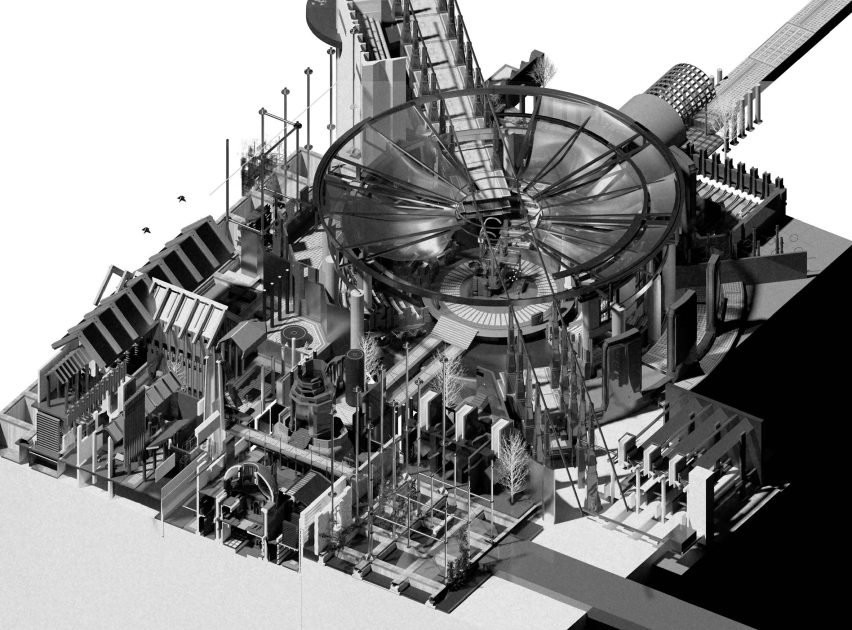
The People's Palace by Ioana Enache
"On Bucharest's Victory of Socialism Boulevard lie the abandoned foundations of a Civic Centre that was never built – a remnant of Ceaușescu's Systematisation programme, which erased both the city's urban fabric and its historical records.
"This project proposes a new People's Palace – a theatre that functions as a living archive. Because official records were instruments of erasure, the histories they removed survive primarily through spoken memory.
"The building collects, preserves and performs public testimony. By day, visitors contribute stories of displacement, loss and everyday life under the regime.
"By night, the archive stages these memories through performance. Spoken accounts are translated into sets and events, allowing memory to take architectural form.
"The result is an evolving civic monument whose history is authored collectively rather than imposed by the state. Memory enters as testimony, is retold through performance, and gradually becomes part of the building itself."
Student: Ioana Enache
Course: Architecture MArch, PG12
Tutors: Elizabeth Dow and Izabela Wieczorek
Email: ioana.enache.23[at]ucl.ac.uk

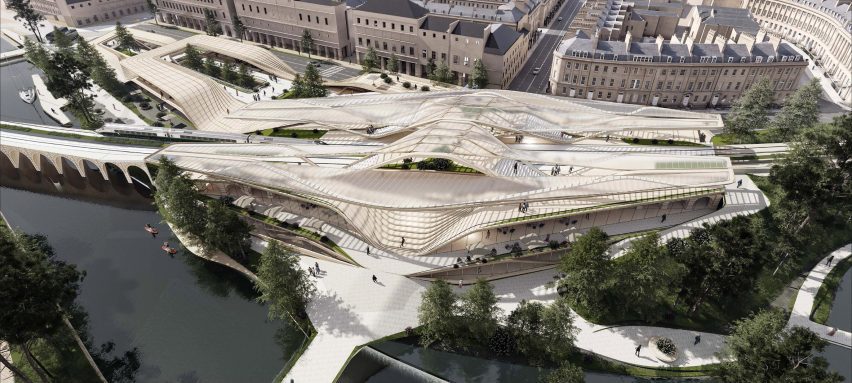
Bath Spa by Archie Koe
"Bath Spa Station proposes a civic mobility hub that combines Gothic constructional logic, Georgian civic order and landscape principles.
"The existing station severs Bath's limestone terraces from the riverbank, disrupting connections between the city and the water.
"The proposal re-establishes these links through a permeable civic threshold, with fragmented massing allowing movement from Dorchester Street to the river.
"The programme forms a civic spine: a bus terminal, covered market and station. Structurally, the project draws on the ribbed fan vaults of Bath Abbey, translating their logic into a timber – stone composite system in which stone resists compression and timber tension.
"The structure transitions from a heavy stone market hall to a lightweight ribbed network above, maximising daylight. Georgian urban principles and Bath's landscape traditions inform the architecture and its civic connection to the river."
Student: Archie Koe
Course: Architecture MArch, PG14
Tutors: Dirk Krolikowski and Jakub Klaska
Email: archie.koe.20[at]ucl.ac.uk

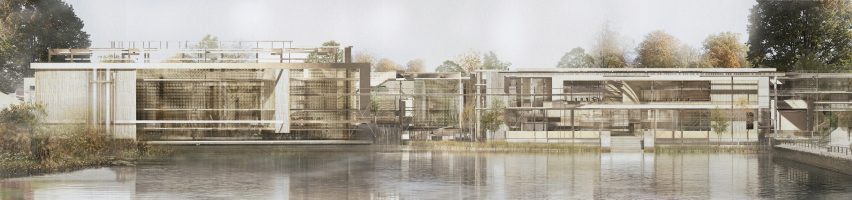
Anatomy of Hidden Rivers by Chanunchida (Pung Pung) Phonoi
"Water is often understood as a natural resource or a technical utility, yet the vast infrastructures that sustain it remain largely absent from public experience.
"Located beside Abbey Mills Pumping Station in London's Lower Lea Valley, this project explores how architecture might transform these hidden systems into places of collective encounter.
"The proposal reimagines water infrastructure as a civic landscape organised around the movement, treatment, and stewardship of water.
"Public baths, retention basins, monitoring facilities and volunteer programmes are woven together within a shared hydrological environment where operational processes remain visible through use and occupation.
"Rather than separating infrastructure from everyday life, the project brings maintenance, recreation, learning and environmental care into direct relationship, proposing a new civic role for infrastructure: one that is inhabited, understood and collectively maintained."
Student: Chanunchida (Pung Pung) Phonoi
Course: Architecture MSci, Studio 4C
Tutors: Rory James Sherlock and Francesca Romana Dell'Aglio
Email: pung.phonoi.22[at]ucl.ac.uk

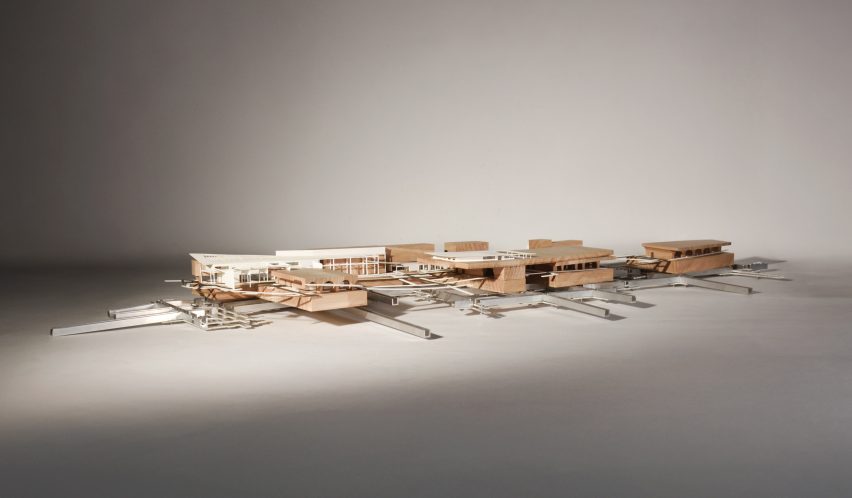
Bishopsgate Low Level: Between the Visible, Invisible and Possible by Lia Penela Failde
"Bishopsgate Low Level exists in a state of suspension, physically embedded within the city yet withdrawn from it. Hidden behind infrastructure and decades of neglect, the site has remained inaccessible for over half a century, accumulating traces and slipping from collective experience.
"Through drawing, reconstruction, modelling and speculation, the project explores the visible, invisible and possible as intertwined conditions through which architecture mediates.
"Routes, openings and landscapes encourage encounters, where framed views and thresholds reveal fragments rather than complete images, making access a process of discovery.
"A grid derived from existing structures and lines of sight organises these relationships, allowing landscape, architecture and infrastructure to coexist.
"The resulting masterplan forms a constructed terrain where civic spaces and programmes emerge, revealing relationships between memory and occupation, concealment and exposure, the existing and the possible."
Student: Lia Penela Failde
Course: Architecture MSci, Studio 4A
Tutors: Johan Hybschmann and Kevin Gray
Email: lia.penela.22[at]ucl.ac.uk

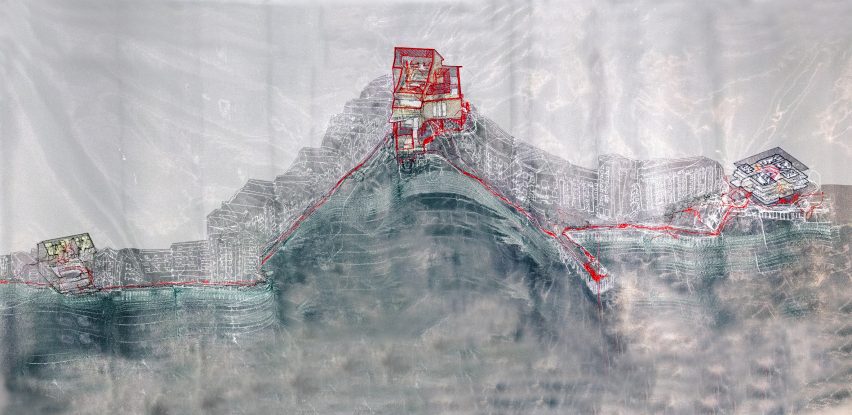
Stitching The Threshold by Hannah Bryce
"Stitching The Threshold investigates how domestic architecture can become a form of community health, cultural repair and ritual.
"Set in Limehouse, it responds to the erased histories of London's Chinese diaspora by asking how distributed domesticity might be reinstated across cultural, social and physical thresholds.
"Studies of Chinese protective design and objects inform a wider architectural strategy of movement and acupunctural care.
"Developed through research by design, the project uses stitching as a method; drawing, sewing, embroidering, modelling and mapping in fragments facilitated an iterative process of learning through making.
"The proposal centres on a community hub at Limekiln Wharf, supported by housing, communal kitchens, gardens, river-edge interventions, and smaller sites along Limehouse's Thames edge.
"Through stitched drawings, textile logic, models and fragments, the project proposes a domestic future where health is produced through movement and collective life."
Student: Hannah Bryce
Course: Architecture MSci, Studio 3A
Tutors: Murray Fraser and Michiko Sumi
Email: hannah.bryce.23[at]ucl.ac.uk

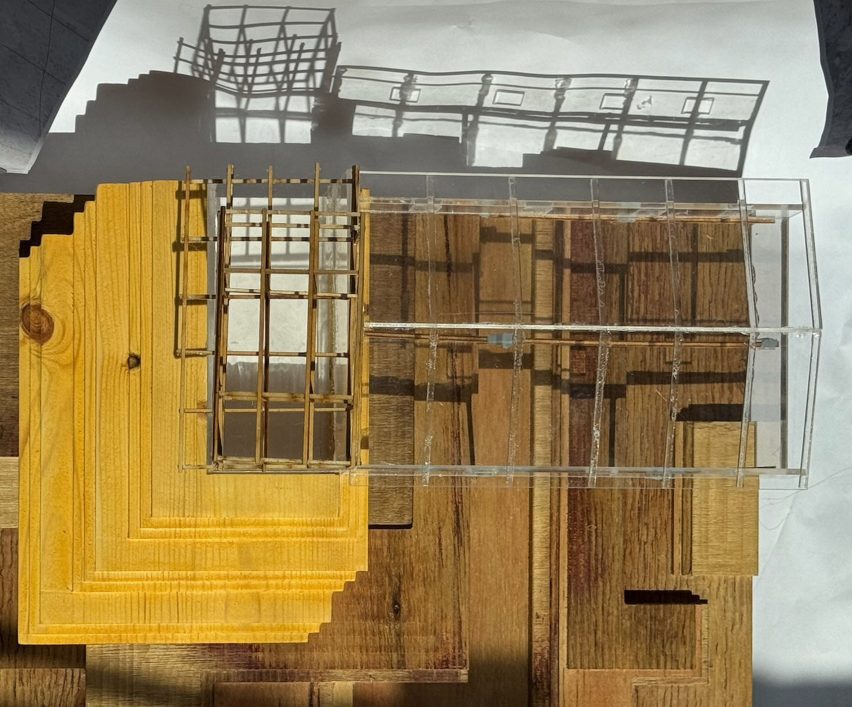
Fieldwork by Liisa Link
"Perception is never neutral. Every human builds their understanding of the world through observation (what is seen), and memory (what is recalled and imagined to fill what cannot be seen).
"From these two, a personal human perception emerges: a reconstruction of reality filtered through experience, bias and imagination.
"Today, much of what we observe has already passed through the filter of machine perception before reaching us. The machine interpretations become the foundation of our own observations.
"We do not see the world as it is. We see the world as it is remembered by us, and by our machines. Processing Villa in Venice is home to the digital and physical manifestations of a collective consciousness found in the region."
Student: Lisa Liink
Course: Engineering and Architectural Design MEng, Unit 3
Tutors: Graeme Williamson, Kirsty Sutherland, Martin Lema Trillo and Alun Hurman
Email: liisa.link.22[at]ucl.ac.uk

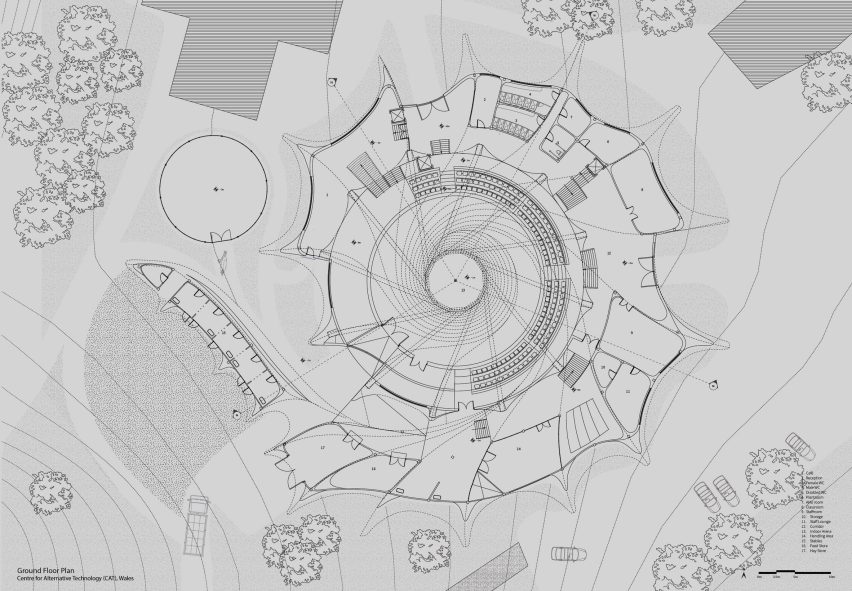
Cob Canopy: Equine and Forestry Institution in CAT, Machynlleth in North Wales by Emily Sturgess
"The Cob Canopy building for the Institute of Equine and Forestry Management is made of a 12-rib glulam dome with a secondary outer frame.
"The dome carries loads through compression in the curved ribs, while diagonal bracing and tension rings prevent twisting and spreading.
"The envelope uses a consistent timber-based strategy, with gold coloured standing seam metal forming the waterproof curved roof and continuing into the external wall fins and overhangs.
"Curved glulam primary beams, LVL rafters, create the geometry, while cellulose and wood fibre insulation keep the deep roof build up lightweight and low carbon.
"The curved metal rainscreen from the airtight insulated wall behind, using mineral wool for thermal, acoustic and fire performance.
"The final design reduces total modelled energy use and heating demand falls from 38 to 9.7 kWh/m2. The arena floor adapts a sand and fibre riding surface over a compacted shock layer, providing grip and cushioning for horses."
Student: Emily Sturgess
Course: Engineering and Architectural Design MEng, Unit 8
Tutors: Annarita Papeschi, David Hewlett and Michael Howarth
Email: emily.sturgess.22[at]ucl.ac.uk

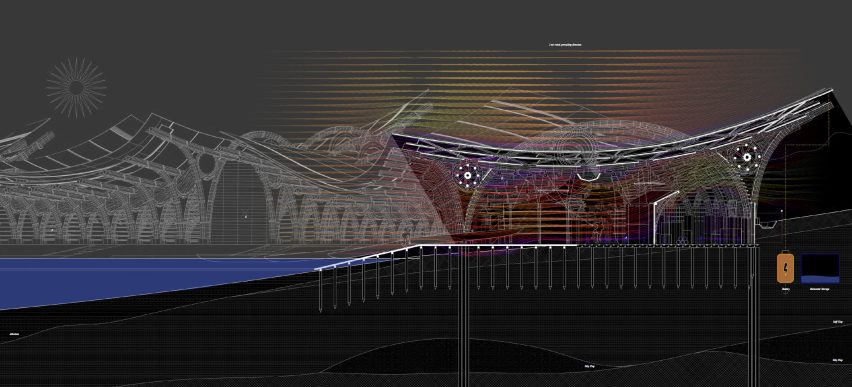
Trimaran Centre, Nkombo, Rwanda by Adam Bigas
"The forager is self-sufficient. The forager does not need anything except the forager's suit. The suit will amplify the senses of the forager. The forager and the suit become one.
"The design proposal is a Centre for Trimaran Fishermen, on the island of Nkombo in Rwanda. Celebrating a three-hulled indigenous fishing boat used for night fishing in Lake Kivu.
"Enhancing the island's self-sufficiency to preserve the beautiful, sustainable craft that has shaped the culture and landscape.
"The resulting building is at one with the landscape, inviting and embracing greenery within its translucent envelope.
"While the architectural intent leads throughout the design process, massing, form and detail were born from the structural and environmental design ideas underpinning the project.
"The building's distinct features – the articulated columns, the sculpturally porous roof, the modulated form – were not driven by aesthetics but are the integrated expressions of the forager."
Student: Adam Bigas
Course: Engineering and Architectural Design MEng, Unit 3
Tutors: Luke Olsen, Olivia Riddle and Aurore Julien
Email: adam.bigas.22[at]ucl.ac.uk

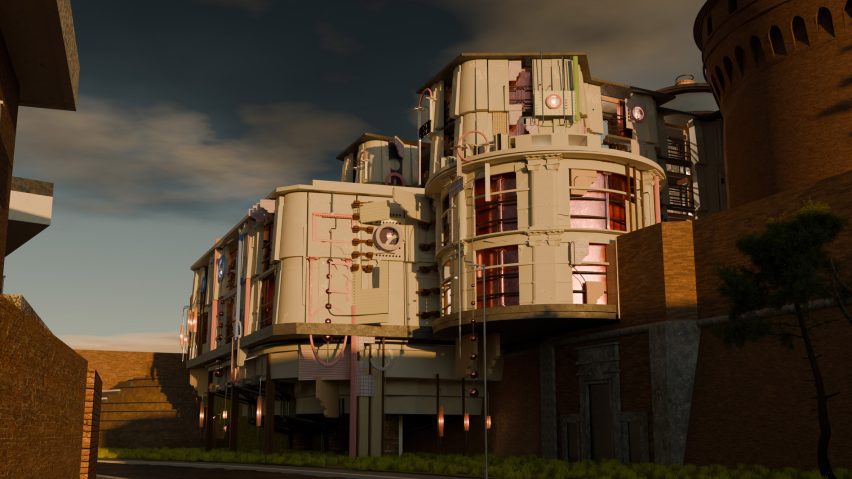
Recognise the Unrecognised by Syed Mahe Hussain
"This project proposes an open, modular embassy that recognises the unrecognised, designed as a platform to accommodate all, positioned across the boundary between Vatican City and Rome, where political and ideological conditions collide.
"It challenges the stability of borders by exposing how recognition shifts depending on position, turning the embassy into a spatial mediator between conflicting realities.
"Using Palestine as a continuous case, the project traces a condition of being widely known yet persistently denied, embedding this tension within the architecture.
"Drawing on The Little Lantern by Palestinian activist and writer Kanafani, it translates themes of justice, collective responsibility and unity into spatial form, where the building becomes a device that brings people together while holding unresolved political contradictions in place."
Student: Syed Mahe Hussain
Course: Architecture BSc, UG3
Tutors: Ifigeneia Liangi and Daniel Dream
Email: mahe.hussain.23[at]ucl.ac.uk

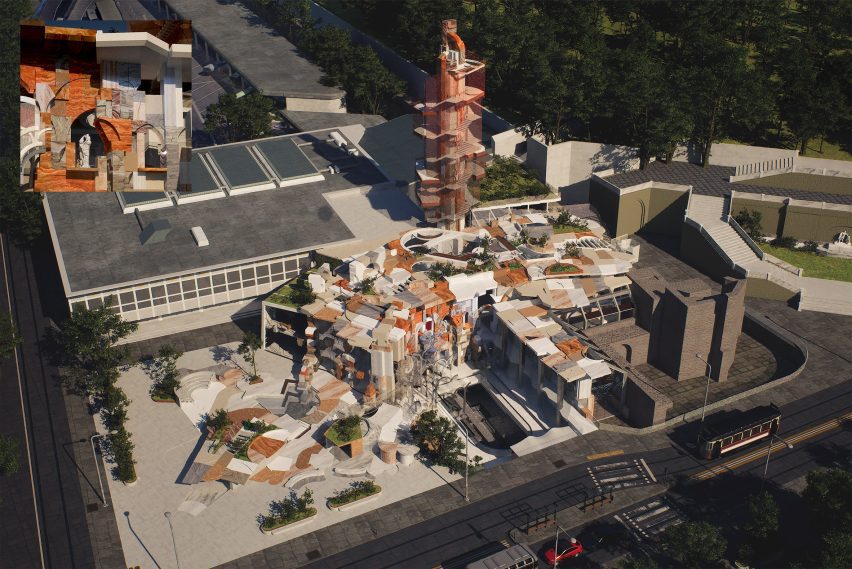
How to Curate Porticoes? by Sze Ho (Louis) Chan
"The Galliera Museum of Porticoes presents an architecture of AI co-authorship through forensic scanning of Bologna's porticoes – its defining urban framing device.
"Designed with a customised latent space, the project establishes a framework for curation where agency is shared between the designer's intention and AI interpretation.
"The museum combines exhibition spaces, artefacts and film restoration facilities, embedding a catalogue of porticoes throughout its architecture.
"Spatial and semantic logics are translated into stone fabrication strategies, blending vernacular spolia reuse cultures with contemporary construction methods.
"The project reinterprets Aldo Rossi's concept of the architect as a memory bearer by positioning AI as an active participant in architectural remembering.
"The resulting city-architect-machine dialogue translates collective memory into layered material expressions, transforming how we interpret big data to synthesise new urban forms across any metropolitan context."
Student: Sze Ho (Louis) Chan
Course: Architecture BSc, UG21
Tutors: Abigail Ashton, Tom Holberton and Andrew Porter
Email: louis.chan.23[at]alumni.ucl.ac.uk

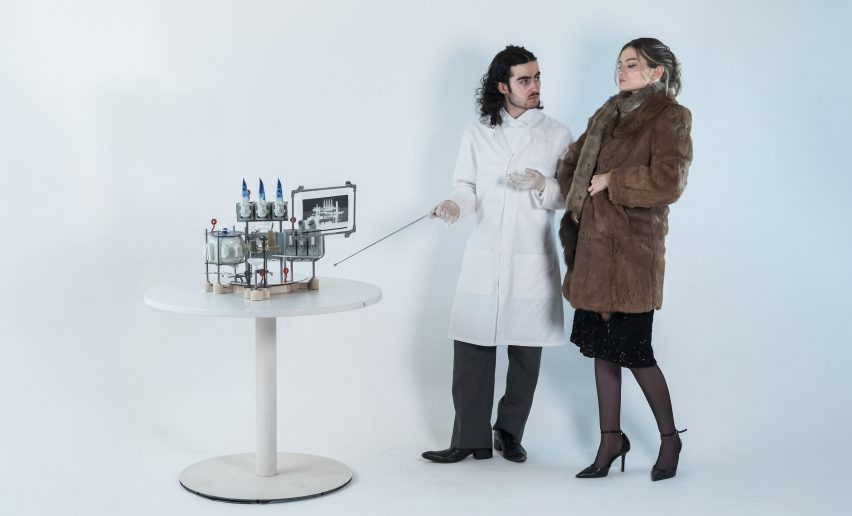
Zuppa alla Plastica: a surgery and soup Osteria for the Molinette hospital complex by Dominic Coles Saffirio
"The proposal is a speculation of alternative health infrastructure for a new Palatoplasty surgery department and soup Osteria for the Ospedale Molinette in Turin.
"Where the extension of the hospital becomes an integrated instrument of health, through both its porcelain materiality and its utilisation of the steaming process to sanitise its spaces.
"Through the creation of a reticent architecture, whose forms allure to a deeper function of hygiene, it dissolves the intimidation of the hospital surgery and recovery processes through the medium of communal soup consumption of both patients and the public."
Student: Dominic Coles Saffirio
Course: Architecture BSc, UG13
Tutors: William Victor Camilleri and Laurence Blackwell-Thale
Email: dominic.saffirio.23[at]ucl.ac.uk

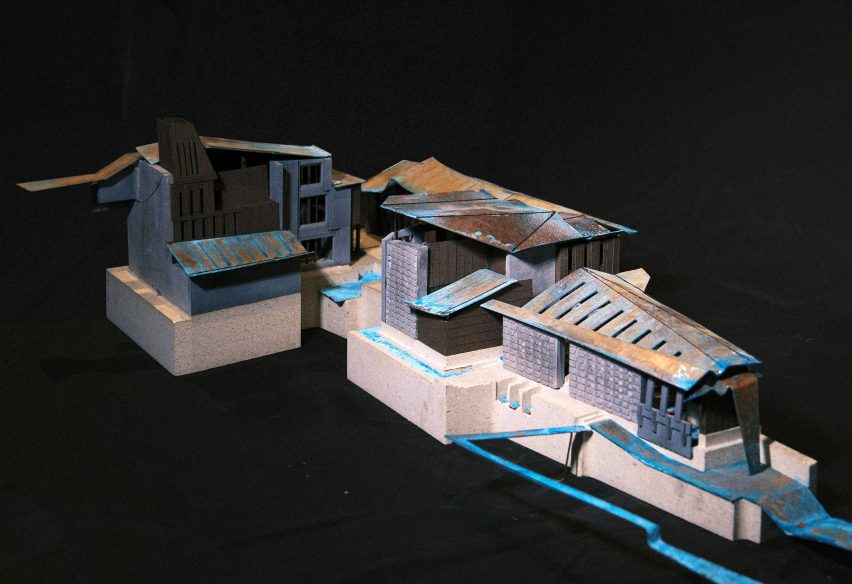
Rifugio dell'Acqua Alpina by Xiaojing (Nicole) Xu
"This project is situated in Longarone, Italy, along the Murazzi retaining wall terraces within the Alpine landscape.
"Shaped by steep topography and the lasting memory of the Vajont tragedy, the project explores themes of healing, recovery and environmental transformation within a landscape still marked by water and time.
"The proposal introduces a rehabilitation and support facility for hikers, integrating accommodation for rescue teams alongside spaces for physical and hydrotherapy.
"The design explores the relationship between architecture, landscape and environmental forces, with water acting as both a therapeutic element and a driver of form and atmosphere.
"Drawing from traditional Alpine construction, the project combines a stone base with lightweight timber structures and a copper roofscape, where rainwater runoff gradually forms a changing patina across the building over time."
Student: Xiaojing (Nicole) Xu
Course: Architecture BSc, UG8
Tutors: Maria Fulford and Jörg Majer
Email: nicole.xu.23[at]ucl.ac.uk

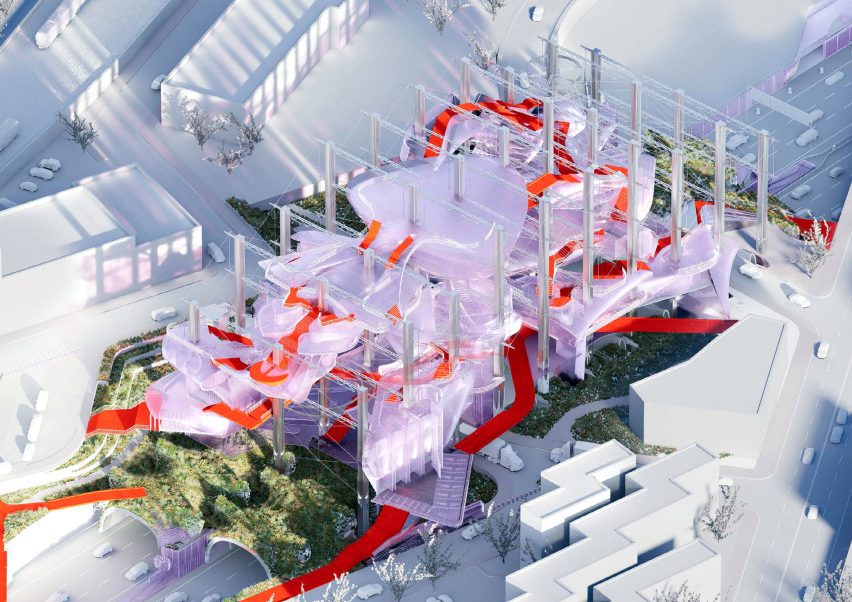
New Embassy for Poland by Matek Zwijacz
"The project proposes a new Polish Embassy for the United States, responding to a collective historical anxiety rooted in centuries of instability and occupation.
"As Poland was frequently governed by governments-in-exile, the embassy is designed to transform into a temporary seat of government during geopolitical crises, exploring how diplomatic architecture can respond to scenarios shaped by national memory.
"Located in Chicago, home to the world's largest Polish diaspora, the building spans the Kennedy Expressway, reconnecting communities separated by infrastructure.
"Acting as both a diplomatic institution and civic centre, it serves the global Polish community. Its architectural language reinterprets vernacular ornament through digital fabrication.
"Operating across multiple scales, from motifs to circulation, safety infrastructure and building form, ornament becomes both a cultural signifier and an organisational framework."
Student: Matek Zwijacz
Course: Architecture MArch, PG13
Tutors: Haden Charbel, Ivan Chan and Deborah Lopez Lobato
Email: mateusz.zwijacz.20[at]ucl.ac.uk
Partnership content
This school show is a partnership between Dezeen and The Bartlett School of Architecture. Find out more about Dezeen partnership content here.