


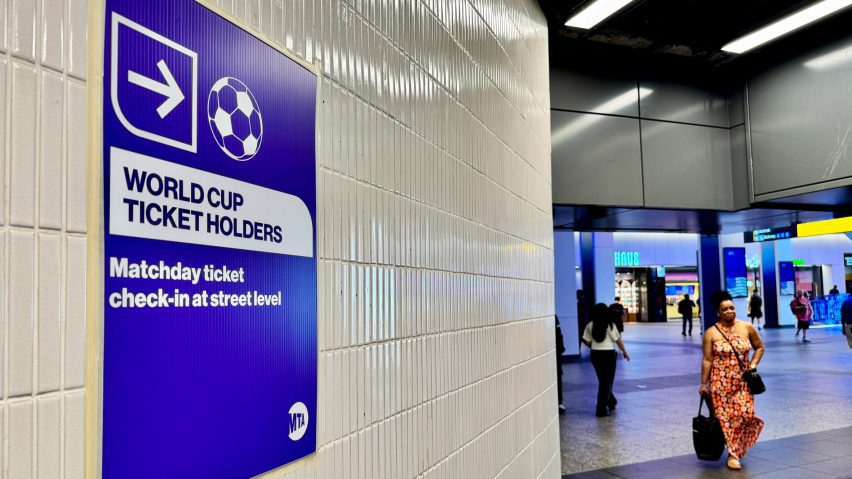
The World Cup has highlighted the strengths and weaknesses of public transportation in North America and provided cities with the opportunity to test and implement novel approaches, writes scholar Deb Chachra.
New urban transportation infrastructure is a triumph of imagination over loss aversion. Whether it's an enormous multimodal transportation hub or a humble bike path, residents are almost always happy with the change. But getting it built always involves a combination of effort, inconvenience, and money. So seeing that promise and making the commitment to create something new is always going to be a challenge, as is holding onto that vision through the long slog of actually building it out.
Enter the 2026 FIFA World Cup.
When North American cities signed on in 2018 to host the 2026 World Cup, part of the agreement with FIFA was that transportation to matches would be free for fans. Five years later, reality had set in. Recognizing what an enormous financial challenge this would be for many of the host cities, especially those with stadiums that were really only accessible by car, FIFA amended the agreement: "All Match Ticket holders…shall be able to access transport (public or additionally planned transport) at cost to allow travel to Stadiums on match days." In other words, FIFA mandated that all of the host cities provide some sort of game-day mass transit.
FIFA's mandate recognizes an essential truth of transportation: cars do not scale
Hosting the Olympics means that one city has to rise to the occasion. For the 2026 World Cup, sixteen wildly diverse cities are facing a month of grueling mobility demands. If the quotidian test of a city's transportation system is how well it works during rush hour, big sporting events like the World Cup turn that up to 11. Tens of thousands of people all needing to be in the same place at the same time is the gnarliest of personal mobility problems, and FIFA's mandate recognizes an essential truth of transportation: cars do not scale.
Stadiums designed around private cars don't give cities a lot of match-day transit options, so "additional planned transport" is typically a fleet of shuttle buses from park-and-ride hubs to the event. A stadium holds tens of thousands of fans and a full-sized bus holds less than a hundred, so the math is never going to be good, whether it's in cities like Miami that already have uncompromising traffic or in spread-out areas, like Kansas City, where a longer ride means more buses, more waiting, or – most likely – both.
Conversely, reports from early matches suggest that Dallas, with its hybrid service in which trains take fans to a station less than ten miles from the stadium and then shuttle buses go to the gate, fared much better. And for stadiums that offer both driving and transit options, the latter is shaping up as the preferred option for fans: even with thousands of parking lots within walking distance, the metro to Houston's stadium was at capacity for the first game.
Then there are transit-first cities like New York, New Jersey, Toronto, Guadalajara, Philadelphia, and Vancouver. In these cities, game-day transportation is mostly about amplifying what they're already doing in order to minimize disruption to regular users while absorbing the World Cup crowds.
Having the motivation (and deadline!) of a high-profile sporting event has often been the catalyst for permanent system upgrades, getting cities through the pain of major infrastructural improvements and to the promised land of improved personal mobility. Part of why the transit system in Vancouver, where I live, was so well prepared for the influx of World Cup visitors is because it's not its first rodeo; among other upgrades, the SkyTrain's Canada Line, which connects the airport to the downtown core, was constructed in time for the 2010 Olympics.
Big events give cities a good deadline to do even small but worthwhile improvements
Boston and Monterrey have used the World Cup as a deadline to build out new, needed facilities. The Boston games are at suburban Gillette Stadium, about 25 miles southwest of the city centre, in Foxborough. Return tickets on dedicated trains between the stadium and downtown are $80 and only available as an add-on to a match ticket. It sounds pricey, but the World Cup provided the impetus for a $35 million upgrade for the station in Foxborough, including a temporary platform to handle the crowds.
So the fare is entirely in line with FIFA's amended mandate of offering transit options 'at cost'.
The Foxborough Station platform upgrade was finished just days before the first game; Monterrey, with its much more ambitious plans of opening two new monorail lines, didn't make it, and the city is relying on its existing transit service for the World Cup while the new lines continue under construction. Mexico City used the World Cup as a deadline to upgrade and modernize Tasqueña, the multimodal hub in the south of the city that serves several hundred thousand passengers daily.
It isn't as flashy as a new rail line, but it'll make a big difference to everyday riders. Big events give cities a good deadline to do even small but worthwhile improvements, like wayfinding upgrades geared towards supporting visitors – but which end up serving everyone – and humble but necessary maintenance.
Part of what makes temporary, targeted public transit upgrades successful, especially for passengers new to the system, is two important advances in the last decade or so. The first is how much better buses work when you can get information on your smartphone, especially live tracking of GPS-equipped vehicles. While it gives local transit services the flexibility to add extra bus services for contingencies like the World Cup, it's not just for game day. No more waiting in limbo at the bus stop with no clue when yours will arrive, or accidentally getting on the wrong bus and ending up in an unfamiliar part of town with no easy way to get home.
The other big advance is open-loop, tap-to-pay systems that let passengers use any payment card or their phone to pay the fare, instead of a dedicated transit card. London, with its huge unified transport system and buy-in from British banks, was one of the first major cities to invest in the upgrade, completing the rollout in 2015. It's a clear win for the transportation authority, as it makes collecting fares more efficient, and for residents who can use the same payment methods they use for everyday purchases.
FIFA essentially forced American cities, even car-centric ones, to run month-long experiments in public transit
But where tap-to-pay really shines is for casual transit users and visitors. Its benefits are immediately apparent to anyone who's ever arrived, as I have, in an unfamiliar country, jetlagged, with the wrong kinds of payment cards, and had to puzzle out an automated ticket machine in another language just to get to the hotel. It's why the Los Angeles Metro launched its new tap-to-pay system in time for the World Cup.
Self-serving though its motives probably are, FIFA essentially forced American cities, even car-centric ones, to run month-long experiments in public transit. A whole bunch of people no longer have to only imagine an alternative to cars – they get to live it for a while. But more broadly, the World Cup matches across North American cities are a unique opportunity to make different approaches to urban transit visible to everyone in a way they would never be under normal circumstances
That means that residents and transit professionals have a chance to see not just the shortcomings of any given city, but also ways in which they can do better, with concrete examples to buttress our imaginations. Only one football team is going home with the World Cup, but lots of cities get to learn – or even demonstrate – how we can make them work better for everyone, and not just on game day.
Photo by Here Now / Shutterstock.com.
Deb Chachra is the author of How Infrastructure Works: Inside the Systems That Shape the World (Riverhead, 2023) and is a professor of engineering at Olin College of Engineering.
Dezeen In Depth
If you enjoy reading Dezeen's interviews, opinions and features, subscribe to Dezeen In Depth. Sent on the last Friday of each month, this newsletter provides a single place to read about the design and architecture stories behind the headlines.