


If the Glasgow School of Art cannot afford to rebuild the twice-destroyed Mackintosh Building it should transfer ownership to a trust that would enable a faithful restoration, writes Rory Olcayto.
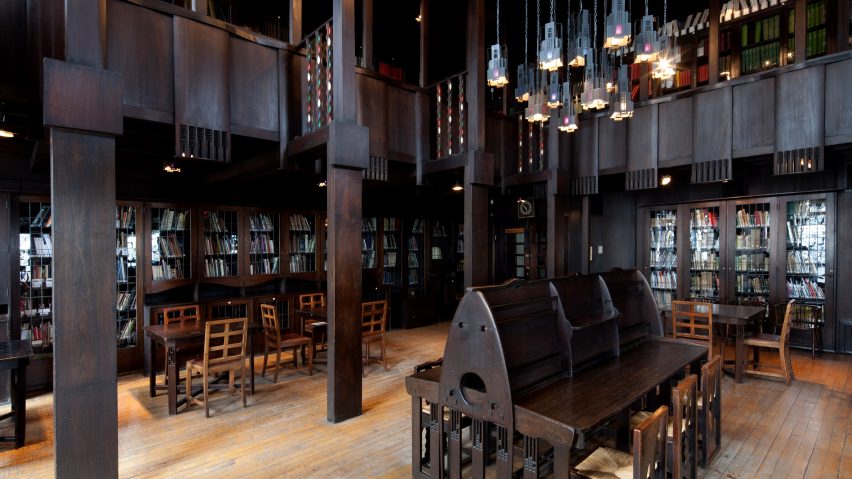
For a brief moment, before the second fire in 2018, Glasgow School of Art's Mackintosh Building was reborn. Johnny Rodger captured it beautifully in his book Glasgow Cool of Art, recalling how the faithfully reconstructed library (pictured) offered not a replica, but a renewal – a building, and a city, recovering their spirit through the knowledge, care and craftsmanship of many hands and minds.
Despite the school's recent declaration that it alone cannot afford a faithful reinstatement, we must return to that moment, and complete it.
This is one of the defining achievements of Scottish culture
Any future for the Mack must begin with an understanding of what has been lost. It should be obvious that preserving only the surviving shell while replacing the interior with a new building – a scenario the school says it is prepared to explore, and which many fear is now its preferred option – would fundamentally misunderstand Charles Rennie Mackintosh's achievement: a synthesis of space, light, structure, material and detail, rooted in Glasgow yet reaching far beyond it.
Comparisons with Notre-Dame or the Sagrada Família are understandable but ultimately misleading. Notre-Dame is a state-owned medieval cathedral and the symbolic heart of France; Gaudí's cathedral in Barcelona is a century-long collective endeavour sustained over generations.
The Mackintosh Building is something different: Glasgow's secular church, where the city's belief in creativity, learning and the transformative power of making is given architectural form. It was built on the conviction that art, craft and design could enrich not only manufactured objects, but the cultural life of the city itself.
It is also the fullest expression of The Glasgow Style – the world of Mackintosh, sisters Margaret and Frances MacDonald and Herbert MacNair, collectively known as The Four – where architecture, art and craft became inseparable. A door handle, a chair, a stained-glass panel and an entire building could all embody the same artistic idea.
In this respect, the Mack ranks alongside the Book of Kells and the Lewis Chessmen as one of the greatest works of art ever produced in Scotland. It should be faithfully rebuilt not because other countries reconstruct their monuments, but because this is one of the defining achievements of Scottish culture.
Precisely because of that status, the Glasgow School of Art's statement deserves close scrutiny. The task ahead is clearly daunting, but after eight years of reflection its language is strikingly managerial, describing the Mackintosh Building as a "heritage anchor for a wider creative innovation cluster".
The statement offers no explanation of why the insurance settlement is insufficient to fund rebuilding
Regeneration may follow from faithful reconstruction, but it is the consequence, not the purpose. Great works of architecture are preserved because they embody a civilisation's cultural values, not because they are economically useful.
The architecture profession's response has been similarly flat. A joint RIAS/RIBA statement welcomed the announcement but offered little challenge to a strategy that steps back from faithful reinstatement. Some caution is perhaps understandable: the RIAS President is a partner at Reiach and Hall, the practice appointed to undertake key preparatory work on the project – an excellent choice nonetheless.
Meanwhile, Stephen Hodder, who speaks for the school's board in the press release, was RIBA president when the first fire broke out in 2014, describing it then as "an international tragedy" and the library as "one of the great interiors of the world". Today, his emphasis is on an "updated business case" and a "gateway project".
The Mack now requires something more than professional endorsement of process: it requires an independent national voice arguing unapologetically for faithful reconstruction.
Other aspects of the statement stand out. The school claims it lacks the expertise to rebuild the Mack, despite having demonstrated after the first fire, under the guidance of Page\Park, that the library – the most delicate part of the whole building – could indeed be recreated. It also states that the school now "thrives" without the Mackintosh Building – an odd sentiment in a document intended to rally support for its reconstruction, unless, of course, it actively wants to relinquish ownership.
There are omissions too. The statement offers no explanation of why the insurance settlement is insufficient to fund rebuilding, despite asking others to help bridge the gap. Questions surrounding the second fire and the disparity between compensation and reconstruction costs deserve a full public accounting.
The time has come to transfer full responsibility, including ownership, to a dedicated national trust
Nor does the published timeline mention the abandoned architecture competition in which John McAslan + Partners were first declared winners, Hawkins\Brown later emerged as the preferred bidder, and the procurement was ultimately abandoned amid a reported potential legal challenge.
Most troubling of all is the proposal to create "museum-standard interpretations" alongside retained fragments of the building. The implication is that the experience of the Mackintosh Building can somehow be substituted by an interpretation of it.
There is another way. Carmody Groarke's rescue of Mackintosh's Hill House demonstrated how bold contemporary architecture can protect and reveal a masterpiece without diminishing it. The same spirit of invention should guide the Mackintosh Building. Faithful reinstatement is not an exercise in nostalgia but a demonstration of what Scotland can achieve when conservation, craftsmanship and architectural imagination work together.
We should rebuild the Mackintosh Building without the Glasgow School of Art – it has clearly exhausted its mandate as steward. Stewardship carries responsibilities as well as privileges, and after two fires, years of delay, a failed procurement process, a protracted insurance dispute and a public admission that the school neither needs nor can itself deliver the Mack's faithful reinstatement, confidence has inevitably been eroded.
The Mackintosh Building has outgrown the capacity of the institution it was built for. The time has come to transfer full responsibility, including ownership, to a dedicated national trust. The Glasgow School of Art should remain closely involved in the Mack's future – though as its friend, not its custodian.
Rory Olcayto is an architecture writer, editor and critic. He was formerly editor of The Architects' Journal and chief executive of Open City, the organisation behind Open House London. He studied architecture at the University of Strathclyde and previously worked in practice in Glasgow, Liege and Istanbul, and as a designer in the video-games industry.
The photo is courtesy of the Glasgow School of Art.
Dezeen In Depth
If you enjoy reading Dezeen's interviews, opinions and features, subscribe to Dezeen In Depth. Sent on the last Friday of each month, this newsletter provides a single place to read about the design and architecture stories behind the headlines.