


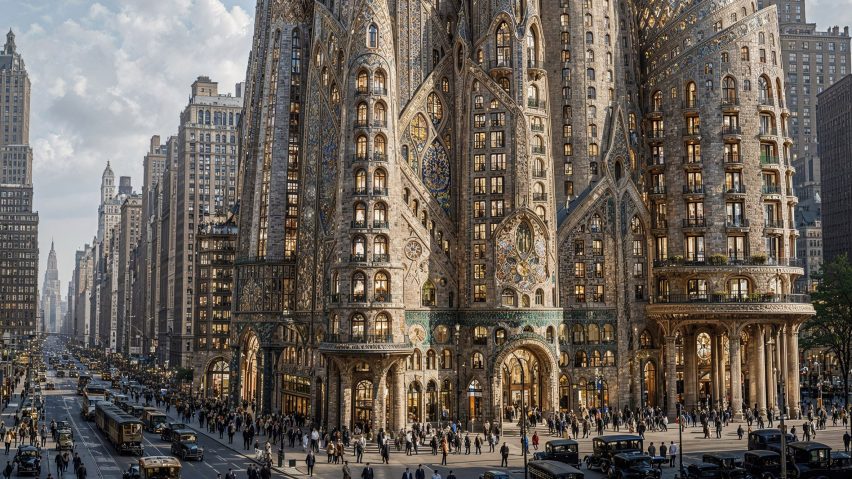
Artists and companies publishing realistic AI-generated architectural renderings in the European Union without labelling risk being fined under provisions in the EU AI Act that came into force last week.
The EU Artificial Intelligence Act Article 50, which came into force on 2 August, requires creators of realistic-looking images, audio or video to disclose if the content is AI-generated or modified to reduce incidences of harm through deception.
Many creative works are exempt from the provisions, but realistic AI-generated visualisations of buildings and interiors appear to fall under the act's categorisation of "deepfakes", according to Szymon Sieniewicz, a counsel at law firm Addleshaw Goddard.
"If it's realistic scenery with people walking around and it is AI generated, it will need to be labelled as AI generated," he told Dezeen.
Companies using AI to modify product photos, using chatbots on their homepage or publishing AI-generated text on matters of public interest will also face new obligations under the provisions.
Realistic renderings "likely" to come under deepfake definition
The EU AI Act was passed in 2024, but its Article 50 transparency provisions are the first section to come into force that affects all businesses using AI, not just those developing AI systems.
The subsection expected to have the most impact is Article 50(4), which requires creators of images, audio or video content constituting a deepfake to disclose that the content has been artificially generated or manipulated.
While architectural visualisations might not be what most people think of as deepfakes – a term most commonly used to refer to synthetic media of real people saying or doing things they've never done – Sieniewicz told Dezeen that they are "likely" to be swept up in the act's definition.
Under this definition, an image is a deepfake if it resembles existing persons, objects, places, entities or events and would falsely appear to a person to be authentic or truthful.

This includes situations where the depicted subject is fictional but realistic, as in the case of an unbuilt building or a non-existent person.
Sieniewicz said the video games industry would be facing a similar situation to architects in the case of games with realistic environments resembling cities.
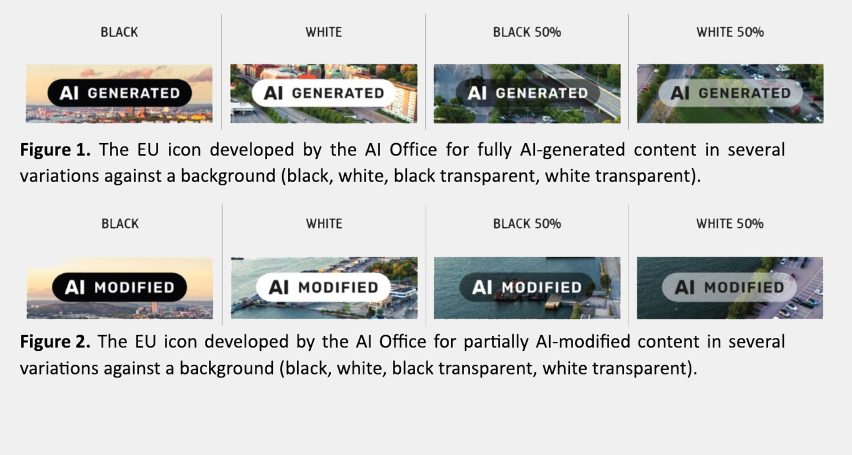
The act does not dictate how AI content should be labelled beyond that it should be clear and distinguishable and relayed at the latest at the time of the first interaction or exposure. But guidelines in the European Commission's accompanying Code of Practice on Transparency of AI-generated Content call for the use of an icon with the text "AI generated" or "AI modified".
Violation of the act can attract fines of up to €15 million or up to 3 per cent of a company's annual turnover, but Sieniewicz stressed that he does not expect regulators to impose severe fines right away.
Product imagery and public-interest text also affected
Designers and companies showcasing their products through photography will also need to be aware of the new obligations, as any AI-made material alterations to an image will also require labelling.
For instance, Addleshaw Goddard advises that using AI to make a product appear more attractive, of higher quality or of a different colour will trigger the obligation to disclose AI modification.
Mere retouching with AI – such as cropping, colour correction, compression or replacing a background – is exempt from the rules.
There is also an equivalent obligation to disclose AI generation or manipulation for text, but only where it is published "with the purpose of informing the public on matters of public interest".
General web copy is therefore unlikely to require labelling, but text related to matters such as sustainability, consumer rights and Environmental, Social and Governance (ESG) strategy will, unless it has been substantially reviewed by a human.
The disclosure obligations also affect the provision of AI chatbots, such as for the purpose of customer service on a brand homepage, which is covered by Article 50(1).
Sieniewicz advises that there is no one definitive way to do this, but that the safest choice is to advise that the interaction is with an "AI-powered tool" or an "AI bot" and to make it clear in the first communication with the customer.
Other subsections in the provisions impose obligations on tech companies making tools such as ChatGPT and Nano Banana to embed machine-readable markers of AI generation into synthetic content, which users are now allowed to remove.
Provisions come at time of controversy about AI in architectural visualisation
Addleshaw Goddard advises that a lighter disclosure regime applies for artistic, creative, satirical or fictional works, but that is unlikely to apply where content is made in part for promotional purposes, such as architectural renderings and advertisements.
"There are some exemptions for artistic works, and that requires less direct transparency, but for the standard businesses in the architecture and design space, and also for product pictures, it will be the case that they need to be labelled as AI-generated," said Sieniewicz.
The implementation of Article 50 is likely to be welcomed by architectural visualisation artists, who have argued that using AI generation in place of professional 3D rendering diminishes their craft and produces error-filled results.
There has also been anger over perceived copyright violations in the training of AI systems, which are fed vast quantities of human-authored work, usually without permission, as well as worries that the use of generative AI tools may render output unprotectable and so able to be copied with impunity by others.
Top image: Hotel Attraction by AI artist Thierry Lechanteur.