MIT researchers engineer bacteria that could program plants for self-defence
Researchers at MIT have found a way to grow bacteria to function as signal-senders that might allow plants to "sense and respond to environmental conditions such as drought or attack by pests".
The study was published in the journal Nature Chemical Biology and details a novel way to design synthetic biology circuits that uses individual cells to send messages, similar to a transistor in technology.
Transistors use simple on/off mechanisms to send signals and are a building block of much contemporary digital technology.
Here, individual cells are programmed to respond to certain impulses, taking advantage of cellular communication that already occurs.
"There's nothing that your iPhone can do that these circuits couldn't do"
"This work shows that we can get toward more complicated functions by linking up simpler functions in individual cells," said the paper's senior author, Christopher Voigt, head of MIT’s Department of Biological Engineering.
"Computationally, there's nothing that your iPhone can do that these circuits couldn't do."
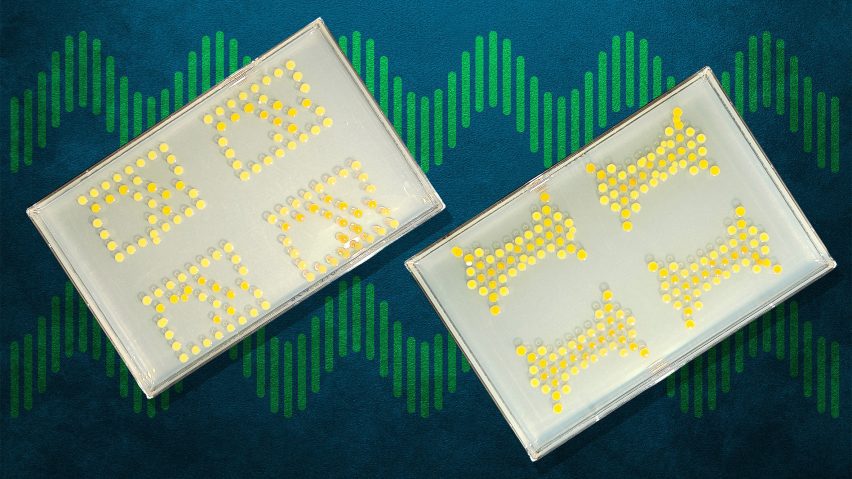
Using a common bacterium, Pantoea agglomerans, which often grows on the surface of plants, the researchers position cells on a petri dish in a growth medium. The cells detect certain molecules and then turn them "on" or "off", sending messages up a chain.
According to MIT, the largest of the circuits contained 24 living bacterial colonies, which can combine two inputs. Also developed was a multi-directional path that allowed for the sending of a single signal to multiple different locations.
The team said the research could be used to make plants more responsive to environmental factors. If a factor was detected, the plant could be signalled to produce a response.
"Using this approach, the researchers hope to develop circuits that one day could coat plant leaves or roots, where they could compute to sense and respond to environmental conditions such as drought or attack by pests," said MIT in a release on the study.
"We're not trying to replace computers"
Based on these building blocks, the researchers believe they could create almost any kind of circuit, though they noted that the process takes much longer than the computations done by synthetic computers.
"We're not trying to replace computers, but rather put computational control into biology," said Voigt.
"If you have bacteria on the root of a plant, or the plant itself is doing the computing, running a simple calculation overnight is fast enough relative to a growth season."
MIT postdoctoral researcher Hamid Doosthosseini was the lead author, and former MIT postdoctoral researcher Haorong Chen was also named.
The study was funded in part by the US Defense Advanced Research Projects Agency (DARPA) and by the US Intelligence Advanced Research Projects Activity.
Other uses of biological components for technological processes include the University of Cambridge's development of algae-based batteries.
The imagery is courtesy of MIT.