


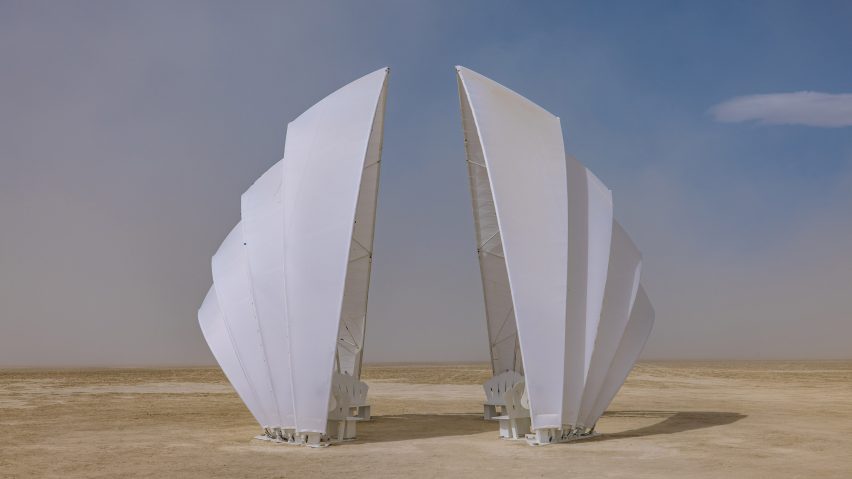
Photographer Gurpreet Chawla has captured this year's architectural installations at the annual Burning Man festival in Nevada, from a broken Eiffel Tower to a chapel made from nylon panels.
Teams of artists, architects and volunteers installed creative installations for the yearly gathering in Nevada's alkaline desert.
The installations and pavilions need to be relatively lightweight, as they must be shipped in and completely shipped out in line with Burning Man's leave-nothing-behind policy.
Many of the volunteer teams that build the structures choose wood, and several of the installations are burned at the end of the festival alongside the yearly temple and effigy – or Man Base pavilion – the only structures organised directly by the Burning Man team.
Burning Man draws intense emotions from participants. For the designer of this year's Man Base Pavilion, Alexander Rose, it marked his 30th trip to the temporary Black Rock City.
Rose said he was designing the pavilion at the same time as his mother was on her deathbed.
"My submission for the Man Base Pavilion came about while I was sitting with my mother in her last weeks of life," he told Dezeen.
"My mom finding out that we had won the design award just days before her passing makes this design one of the most important projects I have ever worked on."
On top of the emotional aspect of the event, the weather in the desert, called the Playa by festival-goers, can be unforgiving. This year, high winds and concern over local fires gave the builders an extra dimension of complication.
Read on for 10 installations from Burning Man 2026 photographed by Chawla.

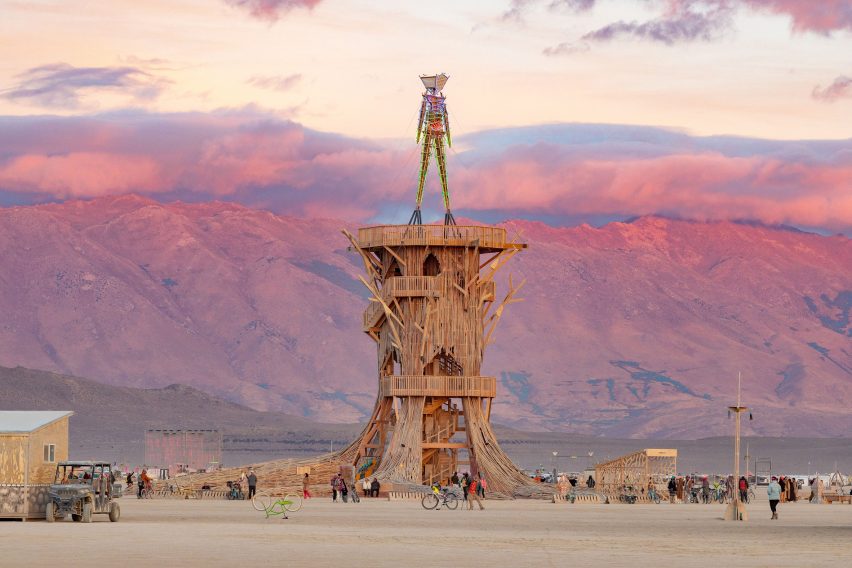
Cryptomeria by Alexander Rose
This year's Man Base pavilion was informed by the Jōmon Sugi tree of Japan, which hides its age and gender, a trait that gave the pavilion its cryptic name.
The result was a tree-like platform with a double-helix staircase at its core that allowed festivalgoers to travel up the structure. Recycled wood clad the outside and the structure itself was made from Douglas fir.
"I wanted to use simple materials repeated in organic assemblies to give it a natural feel and create seating nooks among the roots," said Rose.
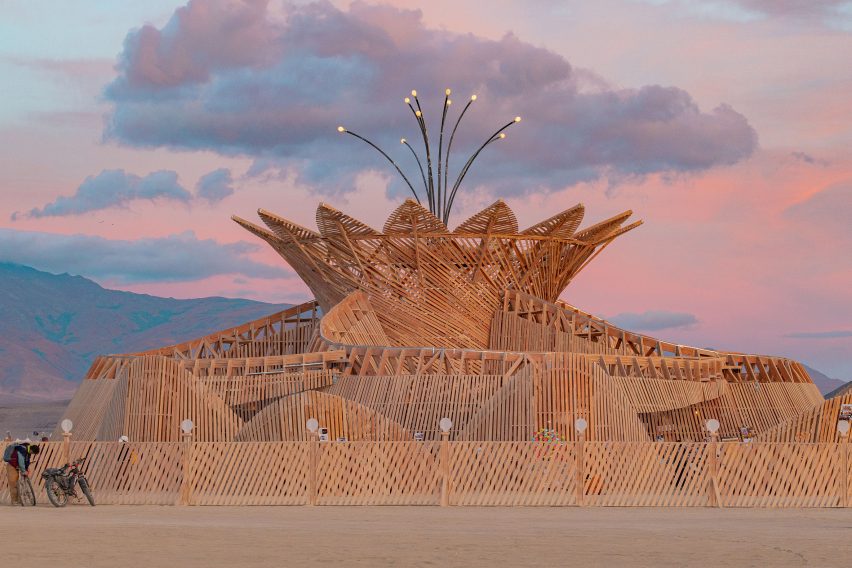
Temple of the Moon by Moonlight Collective
Led by tech-CEO-turned-artist James Gwertzman, the Moonlight Collective designed the yearly Temple based on the Queen of the Night desert cactus.
From above, the petals of the rare cactus flower can be seen radiating from a central structure made from slats of wood. The core featured a stamen that rose through the top of the structure at its highest point and ended in lights.
Smaller petals were placed around the structure to provide shade and seating. Throughout the week, people hung up memorabilia on the slatted walls of the temple.

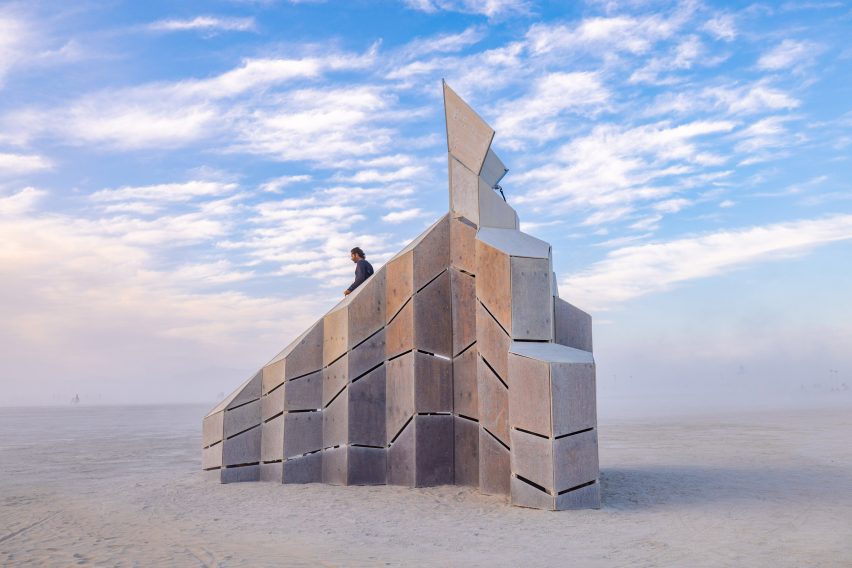
On High by Jessy Cusack
Cusack used wood arranged in simple panelling to create "a big, unexpected pulpit" in the desert.
Steel brackets held it together and frosted acrylic gave the doors a glow at night. At the top was a microphone.
"For those who had something they wanted to tell from a mountaintop, we brought the mountain, and then burned it down," said Cussack.
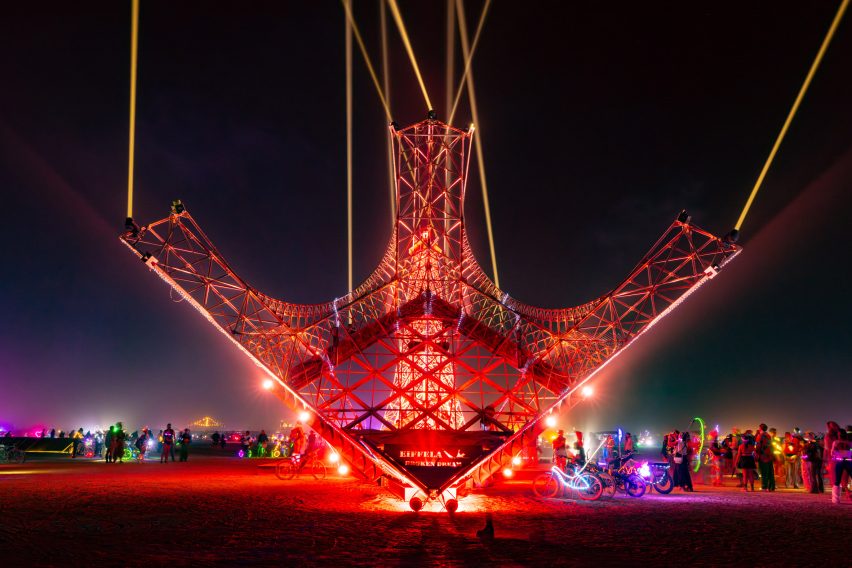
Eiffela Broken Dream by Philippe Maindron
French artist Philippe Maindron transported a large-scale model of the Eiffel Tower to the desert, with the tower broken in half and lying on its side.
The top and bottom of the structure stuck out of the desert at an angle, with lights and a flamethrower attached.
"I chose to fracture the Eiffel Tower in two to explore the tension between collapse and hope," said Maindron. "The lower section evokes the remains of a lost civilisation, while the soaring upper section reaches toward the sky as a symbol of resilience and the possibility of a brighter future."
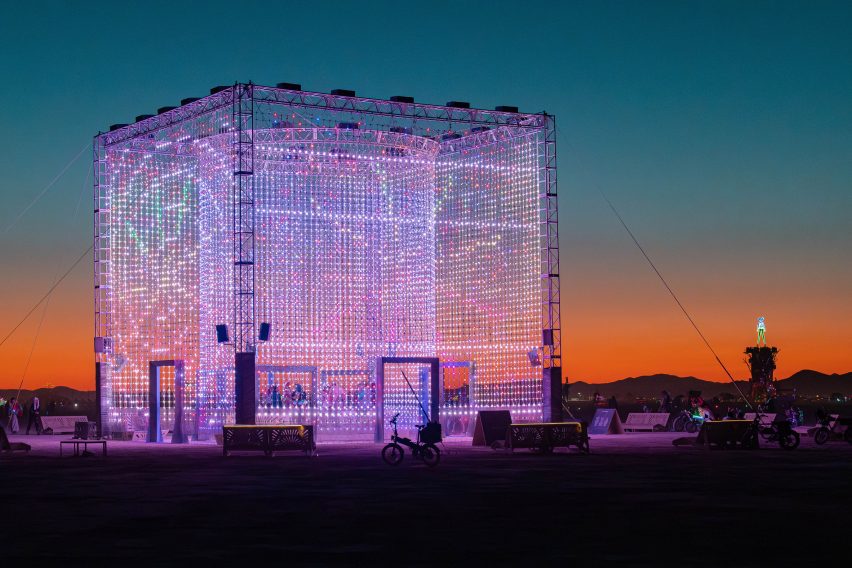
Apotheneum by Anthony Fieldman & Mark Slee
A "building-scaled multi-sensory visual, sonic, and haptic instrument", Apotheneum was designed with an exterior cube and inner chamber made from string lights.
In total, the installation featured 26,560 lights with integrated sound systems.
The project debuted at Burning Man 2025 before coming back this year, and has since featured at other events, such as Art Basel Miami.
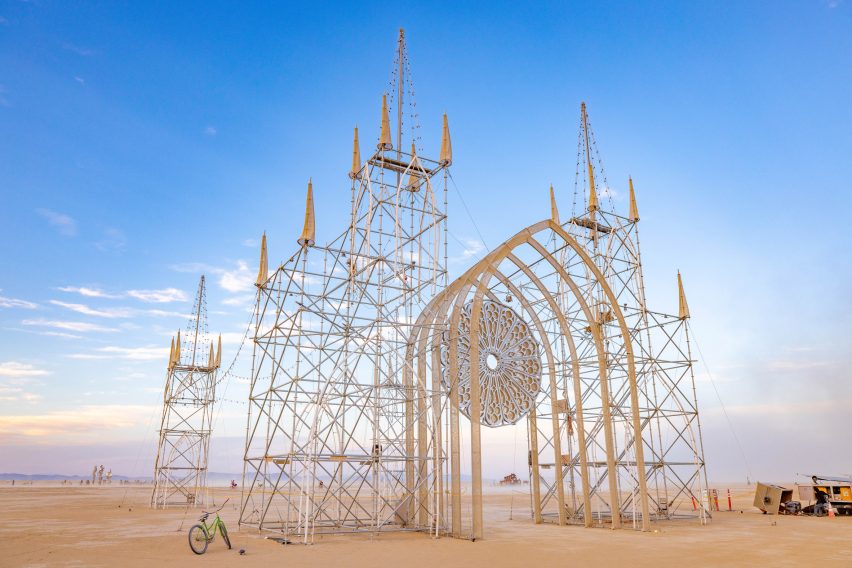
The Gothic Folly by Alex Noerpel and Hunter Keene
This 60-foot-tall structure has the outline of a cathedral complete with stained-glass windows and spires.
Its metal skeleton was fabricated in New York and transported to the desert, where lights were integrated to create an illuminated nighttime display.
Noerpel and Keene said the project was designed to play on "the relationship between weight and presence".
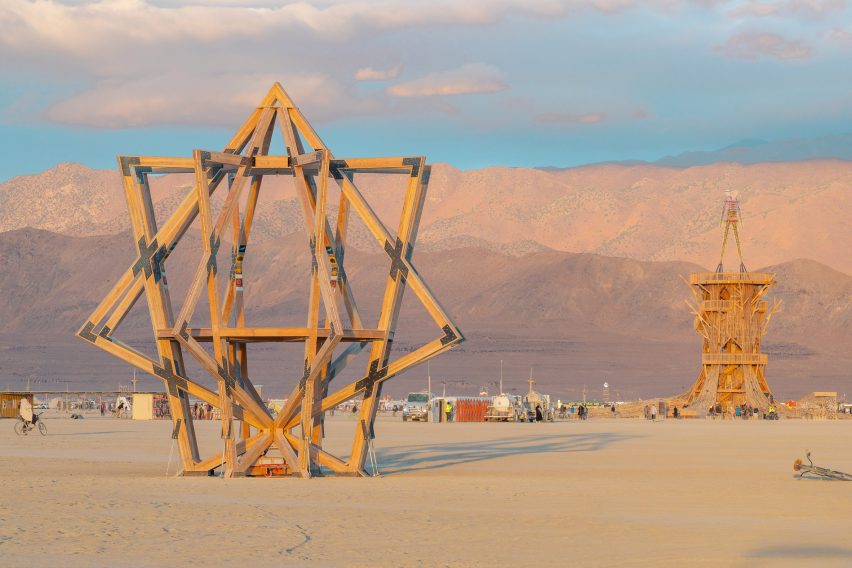
Septima Stella Lux by Dave Ray and Michael Jacob
Glued-laminated timber beams were combined using custom metal joints for this geometric installation on the Playa.
It features four interlocking seven-pointed stars and was designed to be a minimalist approach to the art at Burning Man, according to builder Michael Jacob.
The team is currently seeking a permanent home for the installation.
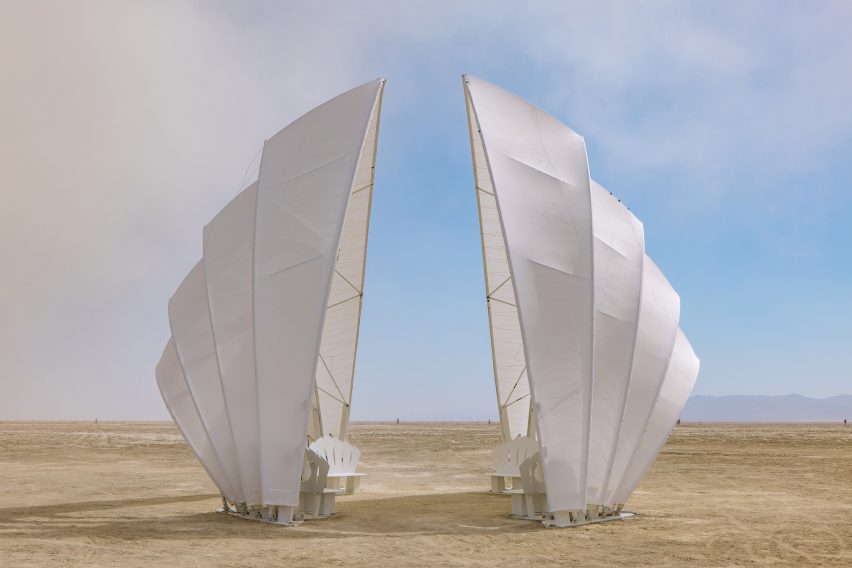
Chiton Chapel by D'Milo Hallerberg
Engineer and artist D'Milo Hallerberg used 27-foot steel frames to create two facing shells deep in the desert.
The frames were covered with white nylon and the builders included seats around the base. The space, which resembles a mollusc, was used for ceremonies.
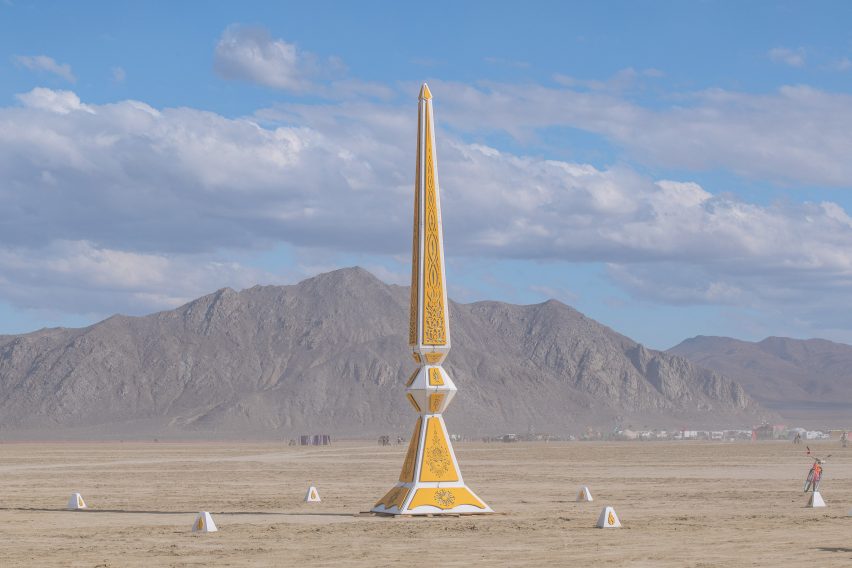
The Point Being by Jordan Tenney
This 30-foot-tall timber-framed spire features CNC-carved graphics panels embedded with LEDS.
Steel brackets were used to keep the vertical structure steady in the face of the region's winds.
"Its form deliberately echoes architectural traditions that have long been used to address questions of meaning, transcendence and humanity's place in the cosmos – obelisks, temples and other monumental structures," said Tenney.

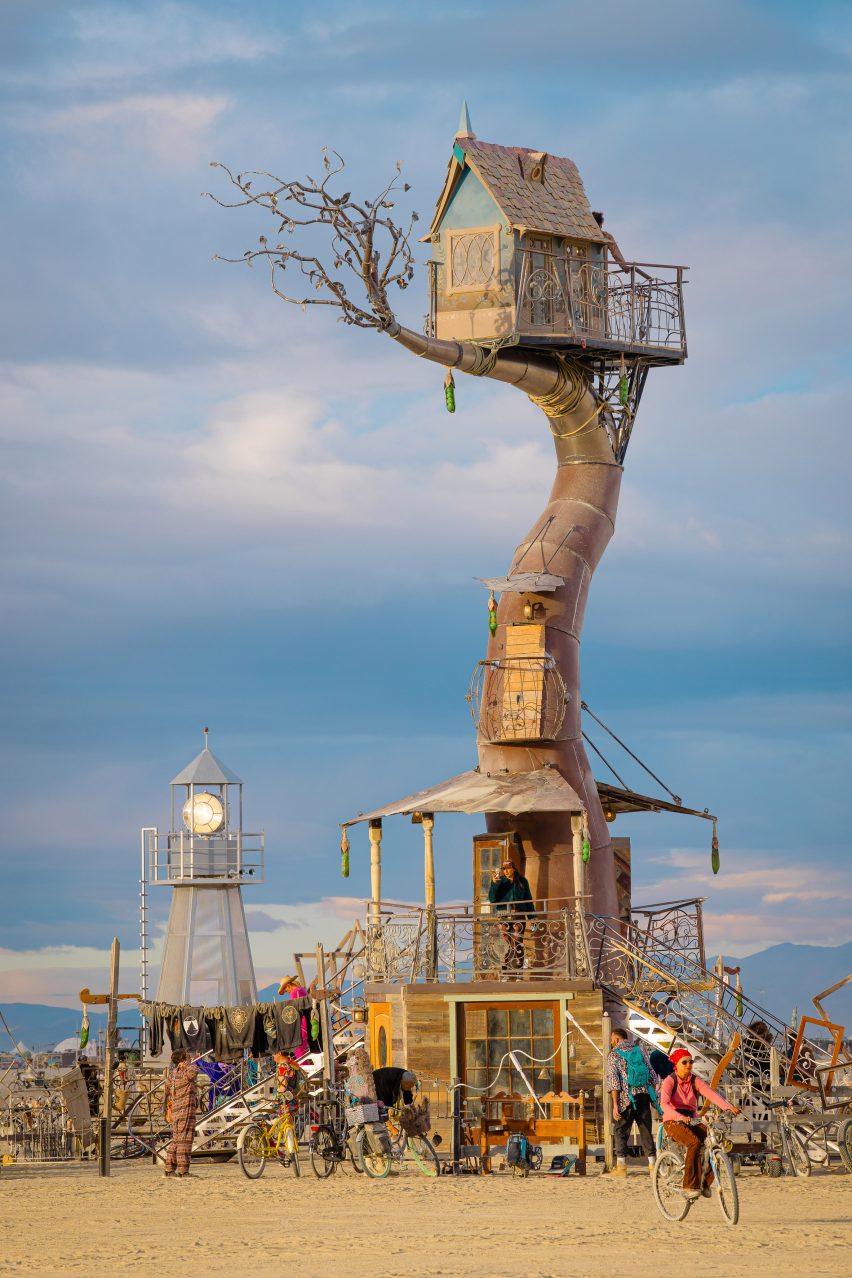
Above and Below by Sean Orlando
Orlando worked with Five Ton Crane Arts Collective to suspend a Victorian Cabin 40 feet above the ground on top of a tree-like sculpture.
The fantastical metal tree also had a home at its base with an internal stairway that allowed festivalgoers to climb to the top.
The photography is by Gurpreet Chawla.