All 23 stadiums set to host the 2030 World Cup

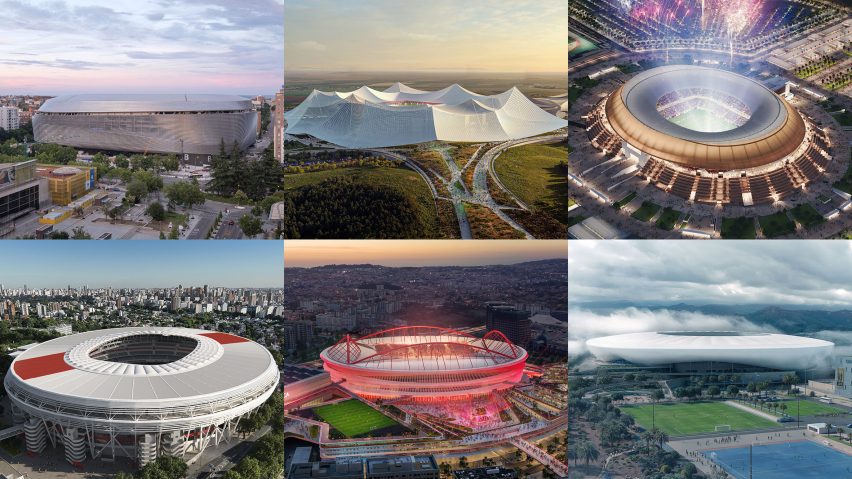
With the 2026 FIFA World Cup reaching its conclusion and in keeping with our Future Stadium series, we’ve rounded up all the stadiums set to host matches at the 2030 World Cup, which will be played across three continents.
The next World Cup will be unlike any previous, with more stadiums on show than ever before.
Eleven venues in Spain are expected to host matches at the tournament, as well as six in Morocco and three in Portugal.
In addition, Uruguay, Argentina and Paraguay will each host one of the three opening games in honour of the centenary of the inaugural World Cup, held in Uruguay in 1930.
Four of the 23 stadiums will be entirely new, with 11 undergoing renovations ahead of the tournament – including some major overhauls. Of the eight stadiums not set to have any major works before 2030, most were either constructed or renovated within the past decade.
Several common themes emerge among the ongoing projects, highlighting current trends in stadium architecture.
These include moves to bring stands closer to the pitch, the addition of roofs, the introduction of VIP areas and “hospitality zones”, adaptability measures to enable the venues to host cultural events as well as sports, and the integration of LEDs into the facades.
Read on to find out more:

Camp Nou, Barcelona, Spain
Opened in 1957, FC Barcelona’s iconic home ground is in the midst of a €1.5 billion renovation led by Japanese architecture firm Nikken Sekkei in collaboration with Spanish architecture studios IDOM and B720 Fermín Vázquez Arquitectos.
It will see the Camp Nou expanded to become the largest stadium in Europe with a capacity of 105,000 seats.
Work began in 2023 and is currently targeting a 2027 completion, though the project has faced some delays.
The final phase involves the addition of a new roof that will collect rainwater to irrigate the pitch, and will require the team to temporarily move out of the stadium for a second time during construction.
Gran Canaria Stadium, Las Palmas, Spain
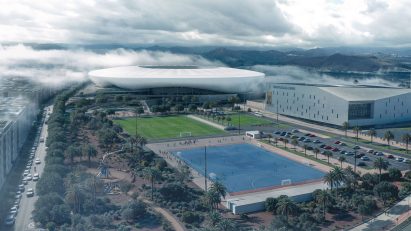
International architecture studio L35 Architects is working with Madrid-based firm Estudio 0710 on an overhaul of Gran Canaria Stadium, which first opened in 2003 and is home to Las Palmas.
The ongoing project is titled La Nube – The Cloud – and will feature the addition of a continuous membrane roof structure.
Capacity will also increase from 32,000 to more than 44,000.

Estadio La Cartuja, Seville, Spain
Originally built as an athletics venue in 1999, La Cartuja was designed by Spanish architecture firm Cruz y Ortiz Arquitectos.
The studio is currently leading a two-phase remodelling of the building set to complete in 2028, which has already increased its capacity to become Spain’s third-largest stadium with 71,000 seats.
As well as an expansion of the stands, the project will include the removal of the athletics track, the addition of a glass roof over the stands, and a modernisation of the facade.
Metropolitano Stadium, Madrid, Spain
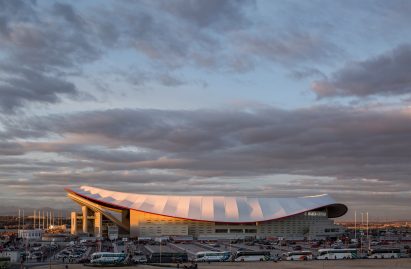
Cruz y Ortiz Arquitectos was also responsible for the Metropolitano Stadium, originally completed in 1993 as an athletics venue.
Following an extensive rebuild that took its capacity from 20,000 to 70,000, it became the home of Atlético Madrid football club in 2017.
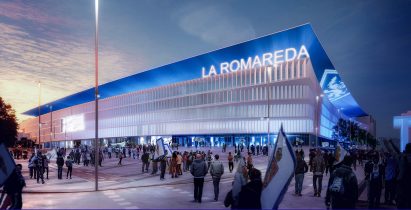
Nueva Romareda, Zaragoza, Spain
Nueva Romareda will replace Real Zaragoza’s original La Romareda stadium, which stood on the same site and was demolished in 2024.
Designed by IDOM, the new stadium is planned to open in 2027 with a capacity of 43,000.
According to the studio, its form was heavily influenced by Zaragoza’s famously strong winds, with concave elevations to the north and south and convex to the east and west.

Anoeta, San Sebastián, Spain
Anoeta is the home stadium of Real Sociedad. First constructed in 1993, it underwent a redevelopment overseen by local studio Izaskun Larzabal Arquitectura that completed in 2019.
The project saw the removal of a running track to move fans closer to the pitch, an increase in capacity to 40,000 seats and the addition of a translucent blue ETFE skin around the exterior.
Following the rebuild, the stadium beat Tottenham Hotspur Stadium and the Puskás Aréna to win the sports architecture category at the prestigious Prix Versailles in 2020.
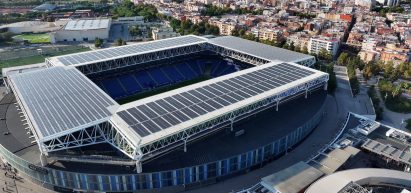
RCDE Stadium, Barcelona, Spain
Spanish studio Fenwick Iribarren Architects, which worked on multiple venues for the 2022 Qatar World Cup, collaborated with Barcelona-based studio Gasulla Arquitectura Integral on the design of RCDE Stadium, completed in 2009.
Located on the outskirts of Barcelona, it serves as the home of RCD Espanyol and has a capacity of 40,000.
Notable architectural features include a roof covered in photovoltaic panels and a translucent curtain wall finished in the team’s colours, which illuminates at night.
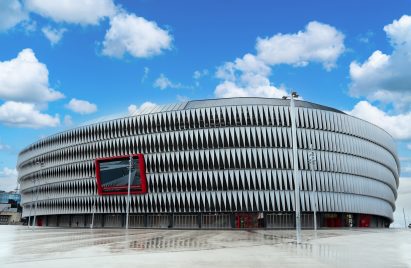
San Mamés, Bilbao, Spain
Another IDOM project, the 53,000-seater San Mamés stadium was completed in 2013 for Athletic Bilbao.
The building’s facade is made up of more than 2,700 identical louvres, giving it a variable appearance depending on the viewing angle.
At night, the facade can be lit up in solid colours or to display moving graphics.
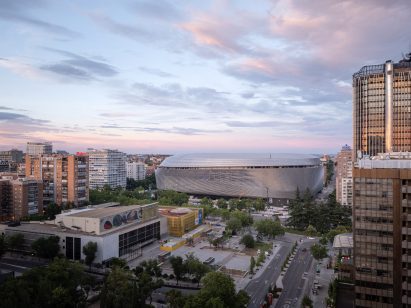
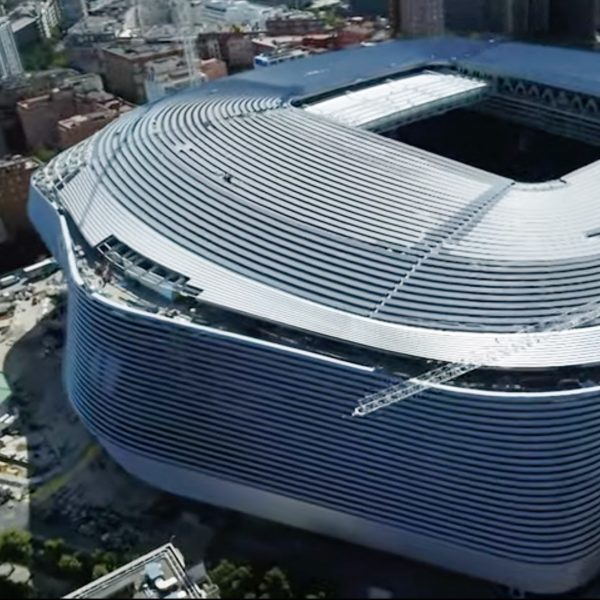
Santiago Bernabéu, Madrid, Spain
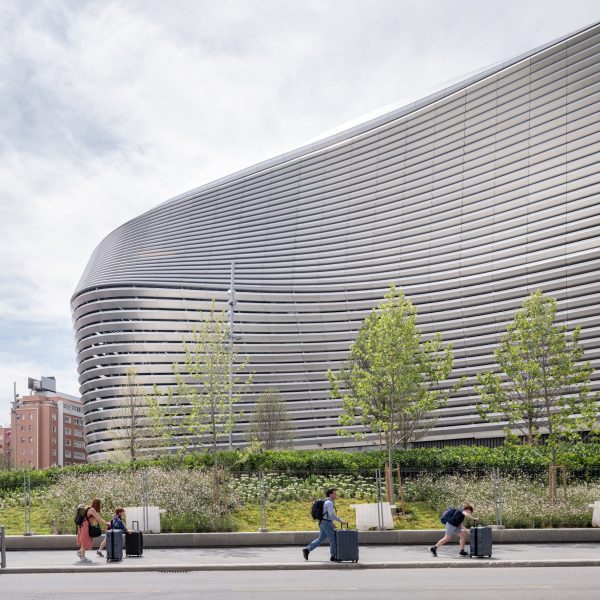
Real Madrid‘s fortress of a home ground completed a major renovation in 2024, designed by German firm GMP Architekten in collaboration with L35 and Ribas & Ribas.
As well as increasing its capacity to 83,000, it saw the structure’s concrete exterior wrapped in sinuous steel louvres.
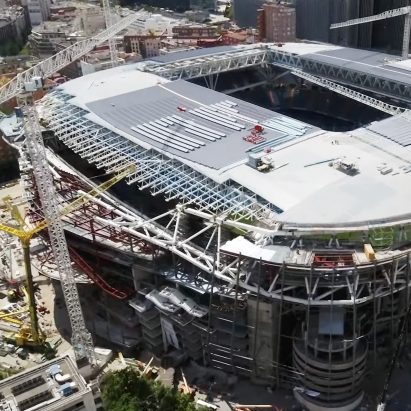
Other changes included the addition of a retractable roof and a literally groundbreaking system for separating the pitch into six sections and storing them across six underground levels.
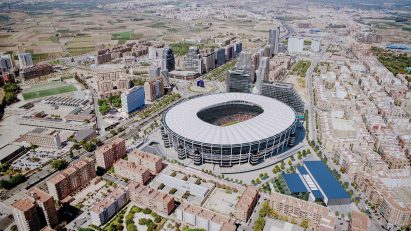
Nou Mestalla, Valencia, Spain (not yet confirmed)
Fenwick Iribarren Architects has designed a replacement for Valencia CF’s legendary Mestalla Stadium.
The project has been decades in the making, with construction begun on a different architect’s design in 2007 but halted two years later due to financial issues at the club.
Building recommenced per Fenwick Iribarren Architects’s design in early 2025, and is expected to complete in 2027.
The new 70,000-seater stadium will have a retractable membrane roof and a building envelope defined by what the studio describes as “a series of flowing, open promenades that connect with the city”.
Football’s global governing body is currently considering a proposal for the stadium to be a venue at the tournament, with a final decision expected in late 2026.
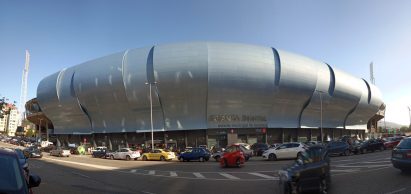
Balaídos Stadium, Vigo, Spain (not yet confirmed)
Originally opened in 1928, the home of Celta Vigo has undergone multiple renovations over the years, most recently between 2015 and 2021.
This major modernisation project saw the structure sheathed in shimmering metal fronds, designed by local architecture and engineering firm Capitel.
However, to be eligible to host games at the 2030 World Cup, the Balaídos’s capacity will need to be significantly expanded in order to meet FIFA’s 40,000-seat requirement.
As with the Nou Mestalla, FIFA is expected to make a decision on the stadium’s involvement at the 2030 World Cup later this year.

Adrar Stadium, Agadir, Morocco
Originally conceived as part of the planning for Morocco’s failed 2006 FIFA World Cup bid and then revived as part of its failed 2010 bid, Adrar Stadium was completed in 2013 and will now, after almost 25 years, host World Cup football.
Designed by Italian studio Gregotti Associati International and Moroccan architect Sâd Benkirane, the unique stadium appears to be embedded in the ground. The seating bowl is entirely surrounded by a stepped pyramid clad in orange stone that was informed by the surrounding hills.
The first stage of a renovation was completed ahead of the African Cup of Nations in 2025, with a giant roof structure planned ahead of the 2030 World Cup as the second phase in the stadium’s upgrade.
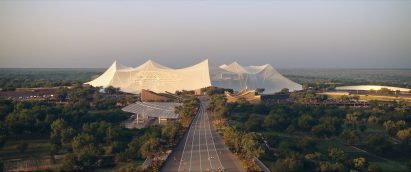
Grand Stade Hassan II, Casablanca, Morocco
Sports architecture juggernaut Populous is working with Moroccan architecture studio Oualalou + Choi on a brand new stadium being constructed specifically for the 2030 World Cup around 40 kilometres outside Casablanca.
Named after the former king of Morocco, it is planned to have 115,000 seats, which would make it the world’s largest football stadium.
The stadium will sit below a giant tented roof – a reference to traditional Moroccan cultural festivals known as moussem.
It is currently competing with the Santiago Bernabéu to host the World Cup final in 2030, with no venue yet confirmed.
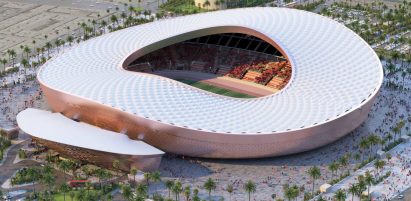
Fez Stadium, Fez, Morocco
Opened in 2007, Fez Stadium is the oldest facility in Morocco set to host games at the upcoming World Cup. Designed by state-owned National Society for the Management and Rehabilitation of Stadiums, the 35,000-seat stadium has a pragmatic form distinguished by four inward-leaning, concrete flood-light towers.
The stadium opened with a playing surface surrounded by an athletics track. A renovation led by French studio BMF Architects updated the stadium ahead of the African Cup of Nations in 2015, and – like many of the stadiums in Morocco – there are plans to remove the running track ahead of the World Cup.
The second phase of the renovation will also see the entire stadium wrapped in a new facade.

Grand Stade de Marrakech, Marrakesh, Morocco
Mother stadium designed by Italian studio Gregotti Associati International and Moroccan architect Sâd Benkirane, the 45,000-seat Grand Stade de Marrakech was opened in 2011 as the city’s main football venue.
With a distinctive square form that bears a striking resemblance to Stadio Luigi Ferraris in Genoa, also by Gregotti Associati International, the stadium has the distinction of being the world’s only rectangular stadium to include a running track. One key criticism of this arrangement is that it pushes many spectators far away from the pitch.
The stadium was renovated ahead of the 2025 African Cup of Nations and further planned works before the World Cup will see the running track removed and stands reconfigured.
Prince Moulay Abdellah Stadium, Rabat, Morocco
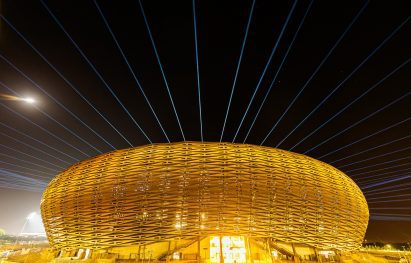
Built on the site of a previous stadium with the same name, the 69,000-capacity Prince Moulay Abdellah Stadium opened in September 2025 after a construction time of just two years.
Now the home of the Moroccan national football team, it hosted the opening game and final of the 2025 Africa Cup of Nations.
Designed by Populous, its parametrically designed facade is made up of 19,2000 champagne-coloured aluminium triangles, intended to be a reference both to the interlaced palm leaves that line Rabat’s boulevards and traditional Moroccan embroidery.
After sundown, the facade transforms into a giant animated screen thanks to a huge array of LED pixels.
Ibn Batouta Stadium, Tangier, Morocco
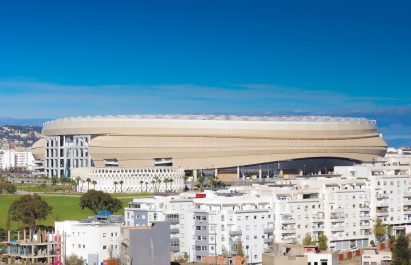
Also known as Tangier Grand Stadium, Ibn Batouta Stadium was designed by Moroccan studio JK Architecture as the home of the national football team.
The concrete stadium opened in 2011 with a capacity of 45,000, but was designed to be expanded with both end sections of the round bowl only built up to the first tier. In 2022, upper tiers were added to these sections, increasing the capacity to 65,000 and making it the country’s biggest stadium at the time.
A recent overhaul to the stadium by Cabinet Anouar Amaoui has seen the capacity increased again to 75,000 by removing the athletics track and lowering the pitch level to allow for another tier of seating. This renovation also saw the entire stadium clad in a unifying facade and a lightweight PTFE roof added.

Estádio da Luz, Lisbon, Portugal
Populous is working with Lisbon studio Saraiva + Associados on an update to SL Benfica’s stadium in the Portuguese capital.
Populous designed the original 68,000-seater stadium, which opened in 2004 and was the site of Portugal’s shock defeat to Greece in the UEFA European Championships final that year.
The renovation will take its capacity to 80,000, with the stands reshaped to bring fans closer to the pitch and the introduction of safe standing and premium hospitality areas. On the outside, there will be a new programmable LED facade.
As well as changes to the stadium, work is underway on a regeneration of the surrounding site, with the masterplan including a new 10,000-capacity indoor arena, a swimming pool, a theatre and events space, two indoor sports halls, a rooftop football pitch and running track, a large new fan plaza, and commercial and residential buildings.
Estádio José Alvalade, Lisbon, Portugal
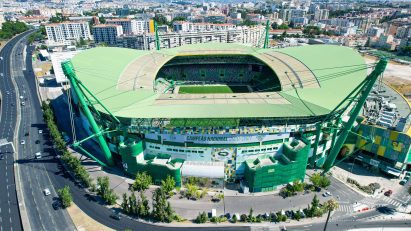
Just three kilometres from Estádio da Luz, Estádio José Alvalade is the home of top-tier side Sporting CP. It was designed by Portuguese architect Tomás Taveira in the early 2000s as one of three new stadiums he designed to host games at Euro 2004.
The 52,000-seat stadium is topped with a roof supported by four 60-metre-high masts. Originally bright yellow to match the brightly coloured patchwork facade, both been changed to club-colour green in recent years.
Ahead of the 2030 World Cup, the stadium has been undergoing a series of renovations led by Fenwick Iribarren Architects to increase capacity and improve facilities. The first stage of this renovation, which recently completed, saw the removal of a moat around the pitch and the reconfiguring of the stands to move spectators closer to the action.
Estádio do Dragão, Porto, Portugal
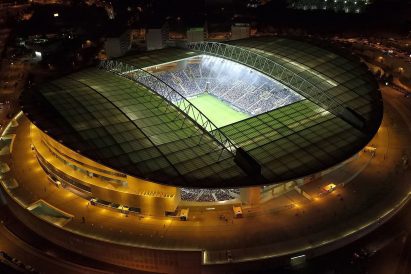
Designed by Portuguese architect Manuel Salgado, FC Porto’s home stadium has a capacity of 50,000 people.
It was inaugurated in November 2003 with a friendly match against Barcelona, in which a 16-year-old Lionel Messi made his professional debut.
The club has been carrying out modernisation work on some of the stadium’s amenities, and in February announced that it had start evaluating the “future intervention needs” of the polycarbonate roof, which is supported above the stands with two huge lattice arches spanning 178 metres.
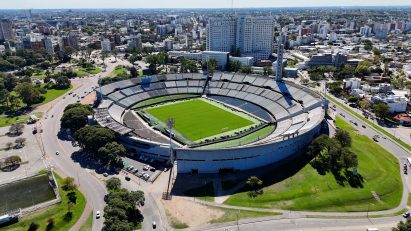
Estadio Centenario, Montevideo, Uruguay
As part of the celebrations to mark the tournament’s 100th birthday, the opening match of the 2030 World Cup will be hosted at the Estadio Centenario in Montevideo.
Fittingly named – although centenario refers to the 100th anniversary of the Uruguayan constitution not the World Cup – the stadium was built in 1930 for the inaugural tournament where it hosted 10 games, including the final.
Built within a year, the reinforced-concrete stadium was designed by Uruguayan architect Juan Antonio Scasso. It consists of four curved, multi-tier stands that together form a bowl along with a distinctive 100-metre-high tower, which is accessed from the football museum within the main stand. Perhaps uniquely in world football, this stand also includes a primary school.
The stadium has undergone several renovations, but its form and structure remain largely as they were in 1930 and in recognition of its significance to world football, Estadio Centenario was declared the first, and only, Historical Monument of World Football by FIFA in 1983.
Current plans to renovate the stadium ahead of the World Cup by SB Arquitectos and Vigliecca & Asociados include replacing a stand, lowering the pitch level and adding a roof.
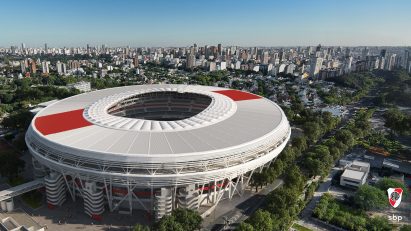
Monumental Stadium, Buenos Aires, Argentina
River Plate’s home ground, the Monumental Stadium, will host the second match of the 2030 World Cup.
German firm Schlaich Bergermann Partner is working with Brazilian studio Fernandes / Arquitetos Associados on an expansion of the stadium that will see it become one of the world’s largest, increasing capacity from 85,000 to 101,000.
The project includes the introduction of a new standalone upper tier of seating around the entire bowl, as well as a new roof.

Osvaldo Domínguez Dibb Stadium, Asunción, Paraguay
As part of the World Cup centenary celebrations, Paraguay will play its opening match on home soil in a brand new stadium.
The intended venue is the Osvaldo Domínguez Dibb Stadium, currently under construction in Asunción. It will replace Club Olimpia’s previous home ground on the same site, demolished in 2025.
Designed by Argentinian architecture studio Path Urban and Nicole Hellmers Arquitectura, the 46,000-seater new stadium will be Paraguay’s largest.
Some reports have raised concerns about whether the project will be ready in time, with the initial target completion date of 2027 now pushed back to 2029 amid construction delays. Meanwhile, the stadium has undergone a dramatic redesign from the original vision unveiled in 2024.
Additional reporting by Tom Ravenscroft.

Future Stadium
This article is part of Future Stadium, our series exploring the growing role of monumental sports buildings in architecture and urbanism around the world.
Read more
Recommended stories
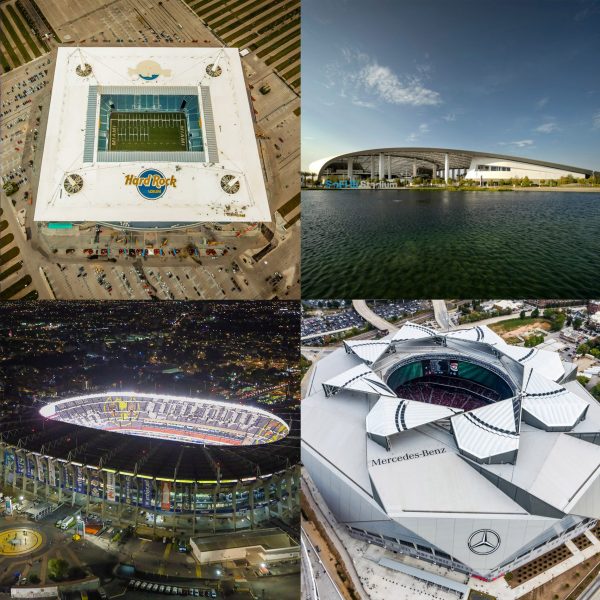
Sixteen stadiums hosting games at World Cup 2026
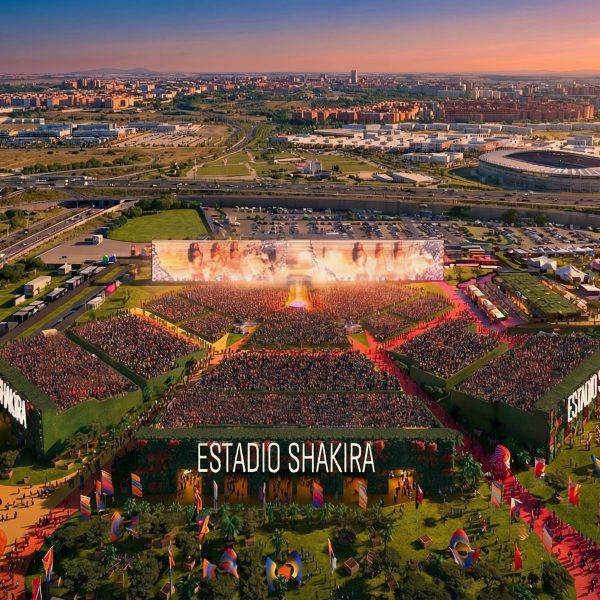
BIG unveils design for pop-up stadium for Shakira
GMP Architekten renovated the Bernabéu for “full-time use”
This week Neom planned a bid to host the 2034 World Cup
Video shows underground retractable pitch being constructed at Real Madrid stadium
Custom furniture created for Azteca Stadium’s interior revamp
Real Madrid reveals revamped Santiago Bernabéu stadium