Why stadium design is getting more outlandish
Stadiums are becoming more distinctive with clubs and countries using them to attract attention. As part of our Future Stadium series, we look at why stadium design is becoming more icon-focused.
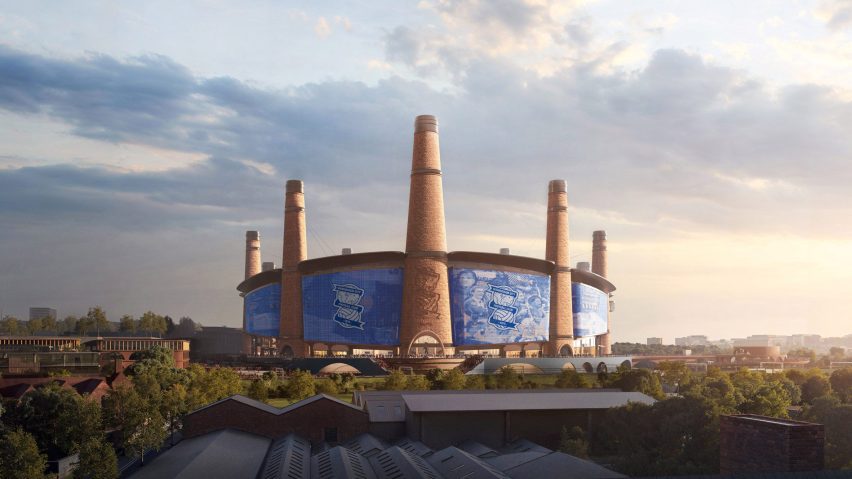
UK-based Heatherwick Studio had never designed a stadium before, so its recent win in the competition to design Birmingham City's stadium – along with its design, which will see the stadium encircled in 12 giant chimneys – surprised many.
"As someone who bid for the Birmingham City stadium, it's fair to say I didn't imagine it as a Victorian factory," ZHA director Jim Heverin told Dezeen in a piece for this series.
The Heatherwick Studio-designed stadium will undoubtedly be distinctive, and it represents a growing trend where the owners of the world's best-known sports teams demand an aesthetically striking, unique structure.
"That's why we were put on the shortlist," Heatherwick Studio partner Eliot Postma told Dezeen.

"They probably knew what they were going to get from a lot of the competitors, and we were a bit of an unknown quantity."
"I haven't seen all of the other designs in the competition, but I wouldn't be surprised if ours was the boldest in its explicit landmark nature."
Increasingly, major sports clubs are huge global brands. Building this brand, along with the commercial capabilities that go with it, is a major part of a club's focus.
"Most clubs nowadays see themselves more as a brand than just as a sports entity, which may have been the situation like in the 70s or 80s when the focus was really 'we gotta win' and 'we're gonna have the greatest team'," GMP Architekten director Martin Glass told Dezeen.
"Nowadays, it's much more multifaceted, so they have to become like lifestyle brands. They earn as much money selling T-shirts as they earn from TV rights."
Real Madrid "wanted to have a statement"
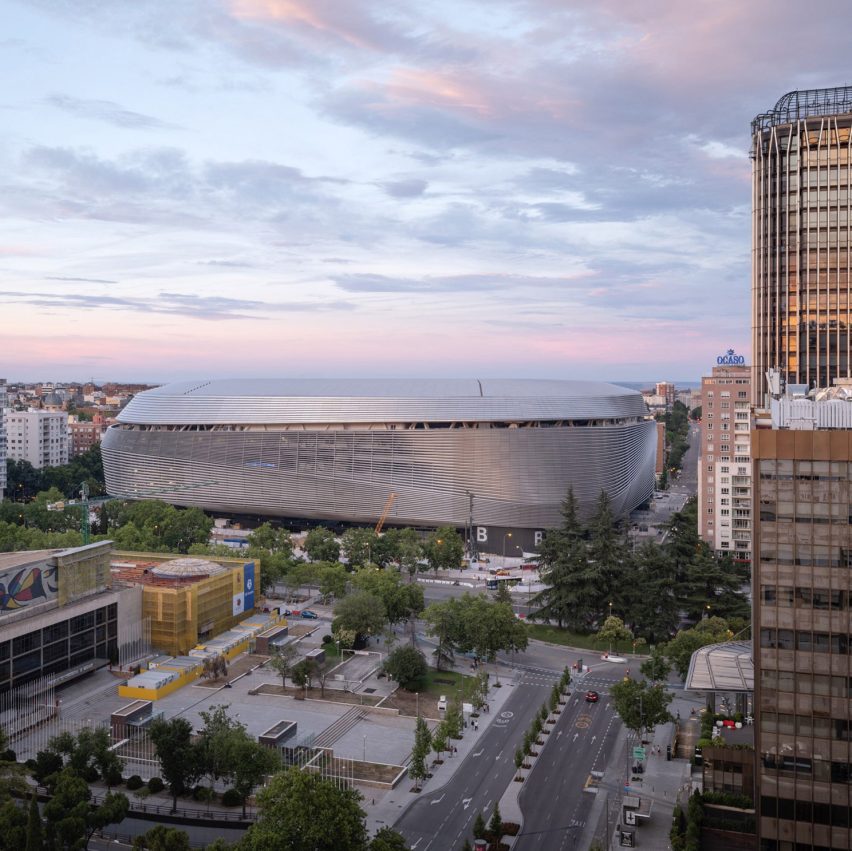
According to Glass, who recently led the €1 billion overhaul of Real Madrid's Estadio Santiago Bernabéu, this change in thinking is having a marked impact on stadium design. While fan experience is still a priority, the need to create an iconic, eye-catching structure is a key part of the brief.
"Real Madrid has a very, very clear vision about the development of their brand, the possibilities and their whole future outlook," he continued.
"For them, it was absolutely clear that they wanted to have a statement that visually reflects their own visions, and so that was, of course, also an important task for us."
UK studio Foster + Partners, which is currently designing stadiums for three of the world's biggest football clubs – a 100,000-seat venue for Manchester United and a joint stadium for AC Milan and Inter Milan to replace the iconic San Siro, echoed this thought.
"The club's aspiration is to have an iconic, never-seen-before, timeless, you know, classic," Foster + Partners senior partner Angus Campbell told Dezeen.
"There's a bit of me that misses the 60s, 70s, 80s stadia"
Historically, many stadiums developed ad hoc over time. This resulted in unique forms, often with stands of different heights and eras surrounding the pitch.
However, throughout the 1980s and 90s, more and more stadiums were developed and built all at once, resulting in cohesive, aesthetically similar bowls. While these stadiums gave all fans consistent, unobstructed views of the pitch, they sometimes lacked the character of older venues.
"There's a bit of me that misses the 60s, 70s, 80s stadia that evolved over time," said Heatherwick Studio's Postma.
"In old stadiums you'd get like the South Stand and Tilton Road End – they'd be built in different periods and would have different characters, so you wouldn't get this completely homogenous appearance," he continued.
"From around the 80s through to now, there's often an incredible internal environment that gets slickly skinned with this sort of contemporary architecture that all too often does feel like a bit generic."
"You can't just copy-paste anymore"
With contemporary stadiums, studios are aiming to retain the high-quality viewing experience, but also create an iconic silhouette without becoming farcical.
"I don't think people are striving for a gimmick, as such," said Populous senior principal Maria Knutsson-Hall. "The fan has more expectations, but the owners also have more expectations, so you know you can't just copy-paste anymore and be the same as others."
"The identity of the building needs to be much more about placemaking than just creating a home for that club."
According to Foster + Partners' Campbell, the key to creating an iconic stadium is going beyond wrapping the stadium in a bright or colourful facade and really pushing engineering to be part of the form.
"Many stadiums try to create a unique identity," he said. "But if you try and do it in cladding and materials only, does that have the gravitas to stand the test of time?"
GMP Architekten director Glass gave Wembley Stadium, designed by Foster + Partners and Populous, as an example where "structural necessity" led to the creation of an iconic structure.
"Good architecture should be able to marry the aesthetic quality and the visual iconisation of a building with the actual technical requirements."
"[At Wembley] on one hand, it's a giant arch that holds a bit of roof, some floodlights, but being quality architects, of course, they were able to combine the two features," he continued.
"This is also something that for us as GMP is very important to have – structural necessity solved in a creative way to give it an aesthetic quality."
"We're not designing a jacket that's just arbitrary"
Campbell explained that the innovation seen at Wembley was part of Foster + Partners' design ideology, which is currently being developed in its design of Manchester United's stadium.
"We're not designing a jacket that's just arbitrary," he said. "It comes from an expression of how the stadium is accessed, used and sits within the city."
"With Manchester United, the whole reason is obviously that it has elements of the club's identity in the trident form, but it [the stadium's planned tent-like canopy] also has a functional role of making the stadium bigger than a stadium – extending the envelope to embrace the precinct."

Even though Heatherwick Studio's design for Birmingham City appears at first viewing to be slightly gimmicky, Postma explained that the design also came from a series of "quite logical decisions".
He explained that the fans had already responded to the design and were adopting it into chants.
"The second game after we released the design, there was a new chant going around the stadium of 'we are the chimney boys' – so for us, that's sort of the dream."
"Backlash in using branding or naming rights"
The focus on brand identity is also having another impact, not on the design, but on the naming of stadiums.
As clubs focus more on building their own brand, Populous' Knutsson-Hall predicts that we may see fewer stadiums named after sponsors as clubs consider naming rights as part of a wider branding strategy.
"There's a lot of fatigue, and also a backlash against using branding or naming rights," she said.
"What you do see now, particularly here in the UK, you see Tottenham Hotspur Stadium not a branded name, Fulham Riverside not a branded name, because they have many brands underneath that umbrella," she continued.
"So, the key thing in placemaking is to create an umbrella destination."
While football clubs are utilising stadiums to enhance their brand reach, countries are also commissioning stadiums with the direct aim of drawing attention to their country.
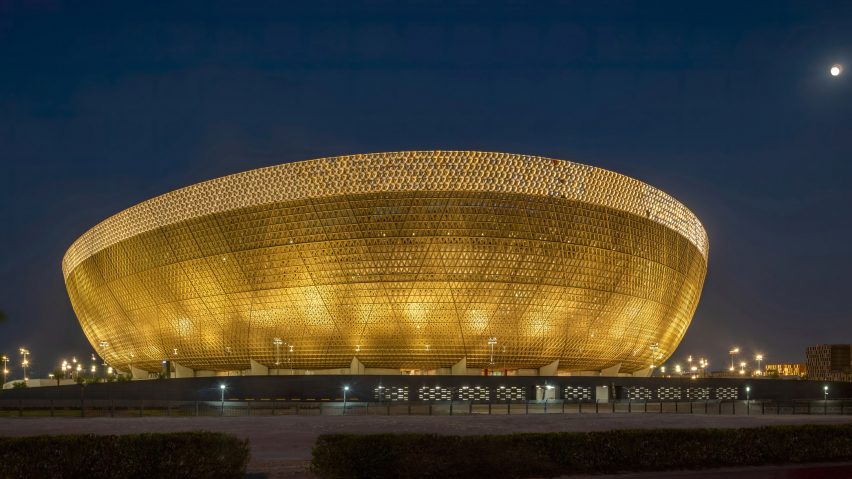
Foster + Partners drew attention to how the stadiums that hosted the past two World Cups provide an insight into how thinking is changing. The 2026 final was hosted in the relatively unrecognisable MetLife Stadium, which opened in 2010, while in 2022 Lusail Stadium, which was built specifically as a symbol for Qatar, hosted the final.
"The World Cup final has just been held in a stadium that I didn't even know what it looked like while the tournament was happening – I had no idea," said Campbell.
"[Whereas] Lusail is an instantly recognisable image," he continued. "The tournament was four years ago and probably no one could tell you what the other stadiums look like – they've forgotten."
Campbell explained that Lusail Stadium was designed not only to host games, but to be a recognisable icon for the tournament.
"Lusail was about creating an identity for a country and a tournament," he said. "Suddenly you've got an audience of three billion watching the World Cup, if you're lucky, over the 10 games, maybe a million people actually got to visit it," he continued.
"We set out to create an emblem for a country and something that could be seen on the TV cameras for the global audience and become something that was identifiable for Lusail as a contemporary city and for the country of Qatar."
This trend looks to be continuing in Saudi Arabia, where a whole host of distinctive-looking stadiums are being built ahead of the World Cup in 2034.
Future Stadium
This article is part of Future Stadium, our series exploring the growing role of monumental sports buildings in architecture and urbanism around the world.