October 8th, 2007

stratocruiser2sq.jpg

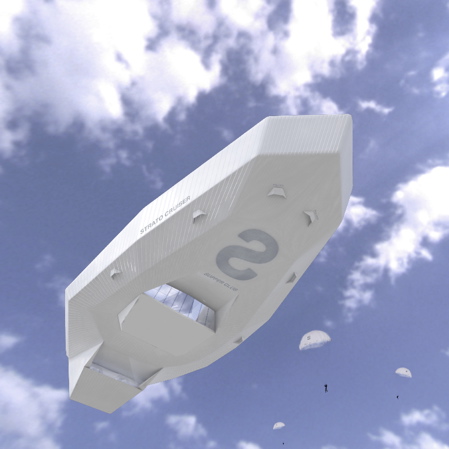
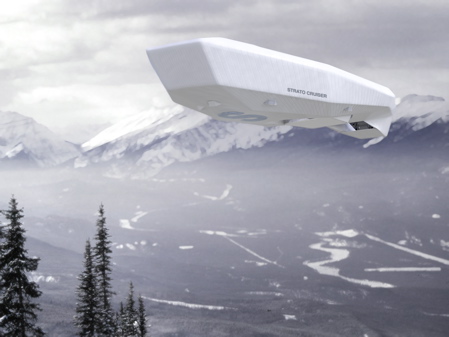
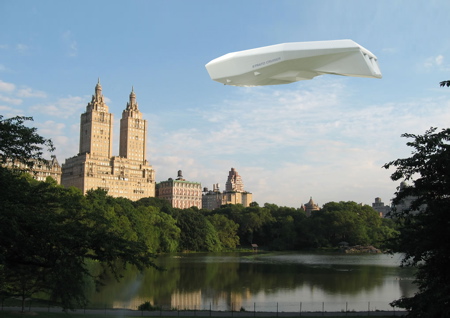
Strato Cruiser is a concept for a “lifestyle zeppelin” developed by art director Tino Schaedler and Michael J Brown.
glacier.jpg

The luxury helium-filled airship contains a gourmet restaurant, a spa, a swimming pool, a resident DJ and so on.

interior.jpg

See also our stories on the Aeroscraft ML866 hybrid airborne vehicle; and Jean-Marie Massaud’s Manned Cloud airship.

Details from the designers:

STRATO CRUISER
concept for a lifestyle zeppelin
by tino schaedler and michael j brown
central.jpg

STRATO CRUISER

Concept:
Merging the soothing ride of an ocean cruise with Richard Branson’s futuristic visions of space travel, the Stratocruiser offers short, regenerative journeys for the cosmopolitan traveler. The project aims to bring lifestyle and health into travel routines, which have become increasingly compacted and frenzied. Like modern nomads we can again enjoy travel, arriving more refreshed than we left, thanks to incredible views of the worlds most exciting landscapes and cities.

skyterrace.jpg

Experience:
As a fictional partnership with the SupperClub, Stratocruiser adds a new experience to the chain’s clubs, restaurants, ‘On location’ and ‘Cruise’ boats. Guests depart for a full day of spa treatments—massage, personal trainers, yoga classes and beauty care are on offer. The Stratocruiser offers “medium-haul” transits between the Supperclub hubs: transatlantic, transpacific, trans-american or Europe-Middle East routes. With spa, library, and private mini-offices available, the contemporary traveler who seldom has time for a cruise can transform an otherwise exhausting and ordinary journeys into a positive experience.
stratocruiser4.jpg

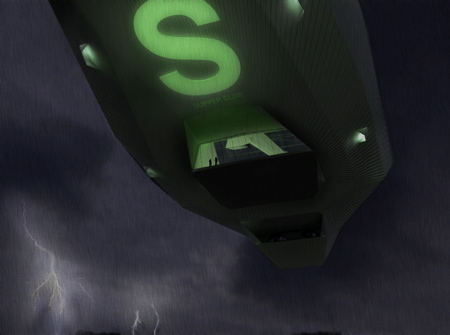
As the zeppelin approaches its lookout destination at sunset, travelers then sit down to a healthy gourmet dinner overlooking glaciers, tropical jungles or Mayan ruins. New locations and star chefs are rotated weekly to ensure that no experience is the same.
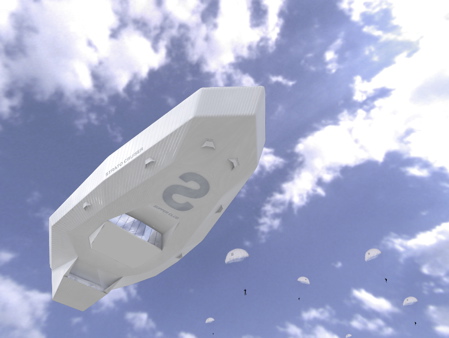
stratocruiser2.jpg

As one would expect from the SupperClub, guest DJs inject a club flare after dinner with the option to party the night through or retire to ones private cabin to awake refreshed in the morning at ones origin.

Structure:
With its carbon fiber skin, sectional helium chamber design and photovoltaic cells, the Stratocruiser’s construction brings new levels of safety, speed and ecology to travel. Its “doughnut hole” atrium reinvents the zeppelin concept with a sky lounge on top, the earthward viewing restaurant on the underside and a recreational climbing wall in between. Private suites are sheltered away from public spaces on the ship’s belly, while an advanced propulsion system more than doubles the cruising speed of conventional blimps.

longsec.jpg

1. Rigid Airship Frame with Helium Chambers
2.Photovoltaic Cell Network
3.Retractable Polycarbonate Roof
4.Terraced Deck with Lap pool
5.SkyView Lounge
6.Main Atrium with Climbing Wall
7. EarthView Restaurant & Bar
8. Spa Treatment & Library
9. Private Suites
10.Kitchen & Staff Rooms
11. Captain’s Bridge
12.Gantryway
13.Propulsion
14. Bungee Jumping Platform


Posted by Marcus Fairs

Subscribe to our Newsletter: Dezeen Mail

29 Responses to “Strato Cruiser airship concept by Tino Schaedler and Michael J Brown”

  1. jasper Says:

    basically the most amazing thing ive seen in some time. thank you

  2. JJ Says:

    Yeah where can I rent this thing for my next birthday bash?

    ps. What does the S / Supperclub logo do on this thing ?

  3. AEROCRAT Says:

    For other airshipworld themes welcome to Russian LJ-blog or read it blogs via web-translater as SO.
    By the way, it’s time to discuss Russian airships and other aeronautical complexes…
    For ex. ‘FGUP DKBA’ - that means ‘Federal Unitary State Enterprise, “Dolgoprudniy Design
    Bureau of Automatics” (”DIRIZHABLESTROI SSSR” in 1932-1940)’

  4. Crosius Says:

    As beautiful a concept as this is, it has a serious drawback - it is dependent on helium, and helium is a non-renewable resource.

    It comes out of the ground with natural gas, when that natural gas spends millions of years in close proximity to radioactive ores. All the helium in the world comes from within 250 miles of Amarillo Texas - the only spot on earth where these specific geological requirments are met.

    At our current consumption rates of helium for balloons, welding and cryonic cooling, the US only has about 10 to 25 years of helium stockpiled, and the global supply will be exhausted by the end of this century.

    Once it’s out of the ground, it slowly leaks away and is gone forever.

  5. Nenad Katic Says:

    If this thing doesn’t get you high, nothing will… So if all the helium is going to be wasted in a decade or so anyway, throwing a few parties in a sky wouldn’t hurt so much, right ? Cheer up, thumbs up, sign me in, what’s the dress code ?

  6. Mike Harrop Says:

    Maybe start by reducing weight ?
    Are water-filled pools, tiled spas, resin climbing walls, supperclubs and other weight-inducing yuppy toys really necessary ?
    With all that gourmet cooking, you could build a compost heap on the lower deck and use methane for lift.
    Or could you use all that gas that’s flared in the Middle East or Siberia ?
    What else could provide lift ?
    Other gases ? Heat ?
    Photovoltaic paint driving a few propellers ?
    Surely the design community can do better than this ?
    Dubai’s Burj Al Arab hotel would probably fly better.

  7. corey Says:

    its a fun idea, I would like to go on a cruise over a continent, rather than miles of ocean as far as you can see.

  8. Chairman Mo Says:

    utter nonsense

  9. rog Says:

    Mike,

    Methane is combustible. Remember the Hindenberg? That’s why the ship would use helium, which doesn’t burn.

  10. lyle Says:

    This is a fantastic idea, but I am surprised that it has taken so long to start thinking about the potential uses of lighter than air technology. I have been watching the california fires and the pathetic attempts to affect the blaze with helicopters and planes. I have been reading about airships with a payload of 500 tons! Could we not make it rain with such a craft? We could deliver vast amounts of food and clothing to dissaster sites anywhere in the world- deserts, flooded areas, earthquake zones- anywhere that has had it’s infrastructure destroyed or where it never existed.
    While the military uses are obvious, the more positve aspects of this exciting technology is much more interesting. Floating cities, personal flying “motor homes”, wildlife protection, evacuation platforms…..this all good stuff.

  11. jonboris Says:

    please, please please just hurry up and BUILD IT!!!!! Then sell one to me which I will live in and cruise round the world :)

  12. Eric Hunting Says:

    I’ve been writing about imminent airship technology recently for the TMP2 wiki project (a revision of Marshal Savage’s futurist book The Millennial Project) and the discussion here brings up some things I was writing about. We think of them as fanciful or antiquated, but airship very neatly fill certain gaps in the spectrum of aircraft capability of that the developers of fixed wing aircraft have long overlooked. With current technology, we now can make VTOL solar-hybrid airships which will allow one to travel non-stop at 60mph around the globe at a zero fuel cost and twice that speed in combination with renewable-sourced fuels. One might consider that a laughably slow speed, but bear in mind most of all goods shipped around the world today by container ship only travel at about 20mph and at a tremendous diesel fuel cost. (airship enthusiasts often point out that the average jumbo-jet consumes as much fuel taxiing on the runway as zeppelins of the past would have consumed traveling from New York City to Los Angeles)

    Lyle brings up a good point, though, about the non-renewability of helium gas but modern airships can potentially be engineered using air ballast systems to eliminate the discharge gas and modern materials can eliminate the issue of leaking, giving an airship a potential life-time supply of gas. And though the legacy of the Hindenburg probably dooms its use for passenger transport (despite the fact that today we know the cause of that legendary disaster was, in fact, a waterproofing paint made from a compound similar to that used in the Space Shuttle’s solid rocket boosters…), hydrogen gas would still be suitable for cargo vessels and would perform better than helium.

    By the time the projected reserves of helium are depleted, we should also be able to replace the use of lift gas altogether by the use of nanofiber or nanomembrane materials which would allow the creation of vacuum-lift cells based on a sort of tensegity membrane cell with integral compression struts. Thus airships would function essentially the same as a submarine in air using vacuum cells made to last a lifetime, allowing for permanent airborne structures -high altitude aerostats or inhabitable ‘aerostadts’. This vacuum-lift principle cannot be demonstrated at sea level with today’s materials but it would work with current materials at high altitude, allowing for the creation of dirigible structures designed to ‘float’ on the edge of the atmosphere by transitioning from gas lift to vacuum as they are launched. And structural concepts could be simply demonstrated and explored in water with the construction of membrane-based submersible tents. Texlon is probably tough enough to make a compelling transparent underwater membrane structure.

  13. mehmet yalim eryigit Says:

    very very interesting

  14. David A. Young Says:

    Regarding helium supplies: the only place it’s in short supply is Earth. The solar system has plenty of it. And using one of these as transport to a low-level crawler-station on a space elevator would be pretty cool.

  15. jayrtfm Says:

    Crosius and Eric Hunting are just WRONG.
    Helium is in short supply right now, but it is available in MANY places, not just Texas. Its production is a byproduct of natural gas processing. Science Friday just did an interview with an owner of a helium supply company http://podcastdownload.npr.org/anon.npr-podcasts/podcast/510221/15242863/npr_15242863.mp3

    As far as vacuum lift, it would require far more exotic materials than we can produce, and, more importantly, the difference in lift between helium and a vacuum id negligible. This issue pops up on various space/rocketry forums and is quickly shot down.

  16. Anonymous Says:

    As far as vacuum lift, it would require far more exotic materials than we can produce,

    Well yes, currently

    and, more importantly, the difference in lift between helium and a vacuum id[sic] negligible.

    Infinity percent is negligible in what respect?

  17. mehmet yalim eryigit Says:

    yuuhh

  18. Alexandre Weber Says:

    About the gas filling the airship, there is an interisting experience developed by Germans with super heat steam, they just flow a prototype and it fly as it was filled with helium.

  19. Alan Henderson Says:

    I have actually had a very similar idea for a home/office in the sky. I was probably 9 years old and saw pictures of the luxury liners that had their breif moments in the sky and instantly imagined a modernized and open architechture bridge. Ofcourse at that age I had no idea what it was that I was imagining. I just took what I could see of other forms of aviation. If a 747 can be a home for a few days at a time, why can’t a zepplin be one permanently.

    More recent thoughts have protected the controls while making them a fixture of a grand crentral hall. I would buy small plots in Alaska and Texas for mooring points. Ultimately I would like to spend the better part of my time just wandering around.

    There is a company making a thread called Spectra which is modeled off spider silk. The idea is to maintain a contigious molecular bond rather than a series of compounds with loose mechanical bonds. They can make the thread at varrying degrees of consistency. Fewer breaks in the molecules means greater strength, but it also becomes less elastic. So the key is to find the longest molecules that will also be flexible enough to absorb some stresses. Even if you go horribly wrong, you still get a stonger, lighter airship than even the best carbon fiber and polycarbonates.

    What is the area of the floor plan you have proposed here?

    And might I also suggest you read up on recent developements with the various ionic eltromotive propulsion systems. At this stage they are completely ridiculous for use on traditional aircraft, but for this…..no moving parts, low maintenance, and for once the large surface area would actually be a benefit and not just a side effect of concept.

  20. Michaela And Romany Says:

    haya wat air craft is this?

  21. david Says:

    build it and they will come

  22. Akram Shaikh Says:

    Great design. I am also designing the same thing.

  23. sofus Graae Says:

    Cool to see that the dirigble concepts are getting popular - reminds me of one I saw here http://s3.amazonaws.com/projectionist/future_dirigible.jpg dont know the creator of it but if anyone does please reply.

  24. Jesper Says:

    This is the way to go! Airships could and should be the more democratic way to move around the planet as it’s more energy efficient and cheaper per air-mile. Imagine lift capacity of 500 tons! That’s theoretically 7 000 persons per flight… Evacuation suddenly became realistic.

  25. Herbert Wang Says:

    Thank you for enlight us with a wonderful design!
    As an airship fan from China,I hope to make friends with you and see more of your outstanding design!

  26. Goodspeed Says:

    Goodspeed Machine Skydiving !!!

  27. Henry Says:

    How much

  28. lyle Says:

    There are a couple of disaster stories currently in the news, the typhoon in Burma and the earthquake in China, for which the concept of these large airships offer a particularly good solution. The destruction of the access to these hard hit areas and the enormous level of devastation, require that large amounts of supplies be delivered, but without roads or adequate airports, helicopters offer the only solution.
    The concept of an airship that could deliver 500 tons of food, clothing and medical supplies to one area, at one time, would transform these kinds of rescue operations.
    At the same time, whole hospitals could be located on one of these ships, or thousands of people evacuated at once.
    The issue here, with the idea of the modern airship making a comeback, is getting an airship into the air, developing a reliable track record, and demonstrating that these ships can actually do what we think they can do.
    For this to happen, we must get the airship concept out of these blogs and into more conventional media, if we are ever going to get over the kind of ” Hindenberg Syndrome ” that still holds this idea back.

  29. Akhmeteli Says:

    I have reasons to believe that vacuum lift can be demonstrated with today’s materials. You may wish to look at our US patent application 20070001053 (11/517915). We propose an evacuated sandwich spherical shell with two thin face sheets and a light core between them. Finite element analysis confirmed that the structure using commercially available materials (e.g., boron carbide face sheets and aluminum honeycomb core) can be light enough to float in air and strong enough to withstand the atmospheric pressure with decent safety factors for strength, buckling, and intracell buckling. Actual manufacturing, while definitely possible, is not easy.
    I agree that vacuum balloons cannot provide more lift than helium balloons, but they may significantly simplify altitude control.

Leave a Reply