January 30th, 2008

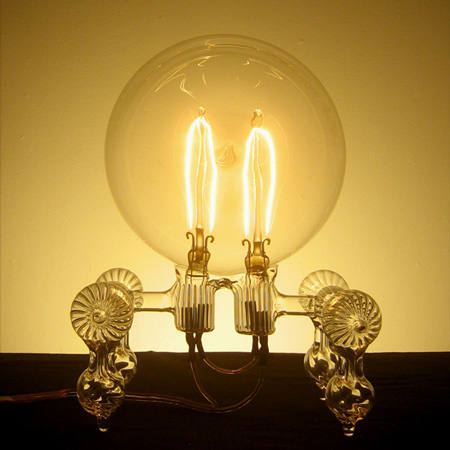
Sculptor Dylan Kehde Roelofs has created a range of functioning incandescent light-bulbs made of hand-blown glass.
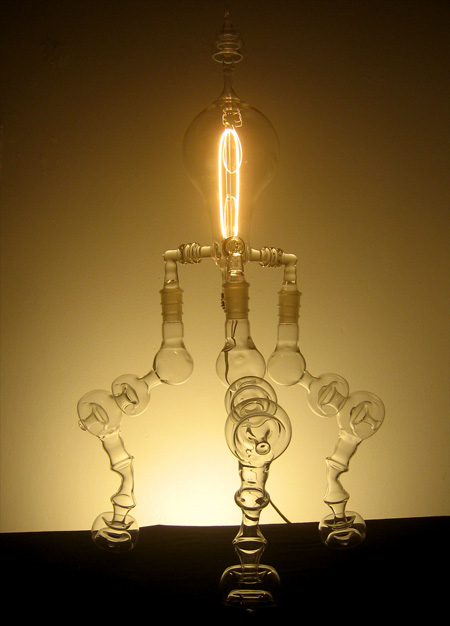
Describing them as the “restoration of dialogue between filament and bulb,” Roelofs created the lights partly as a reaction against the soulless glow of low-energy bulbs.
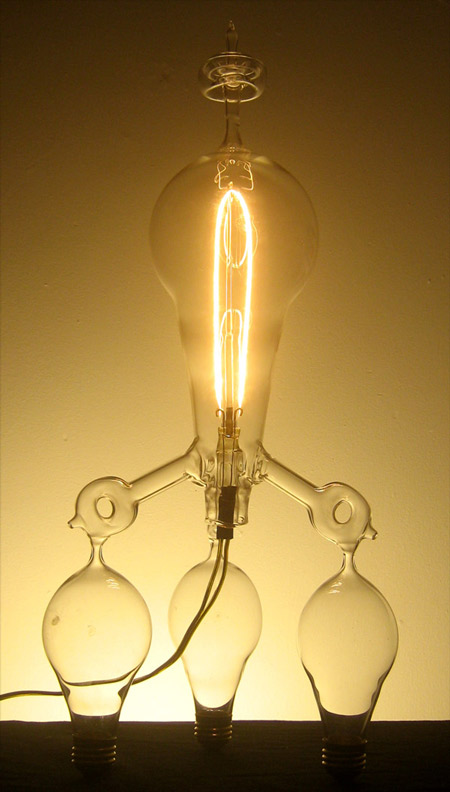
The filament can be replaced when burnt out and the bulb re-sealed.
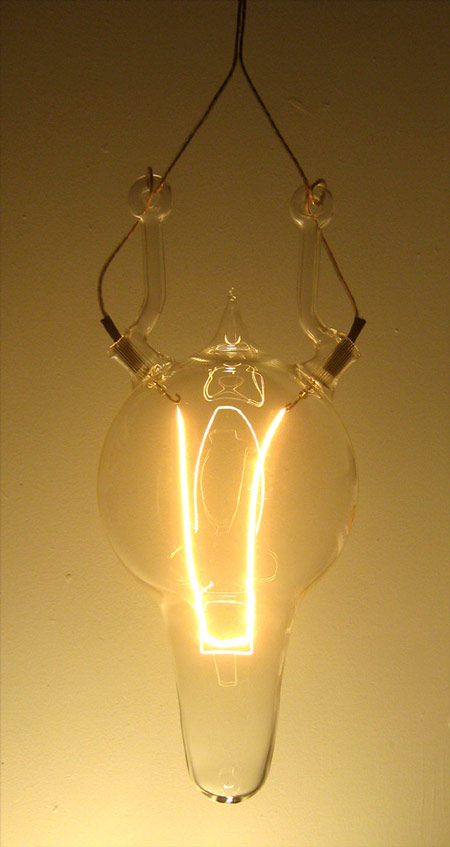
Here is some info from Roelofs:

These works represent a singular new topography, situated between the familiar clichés and tropes of lighting design, scientific glassblowing and sculpture.
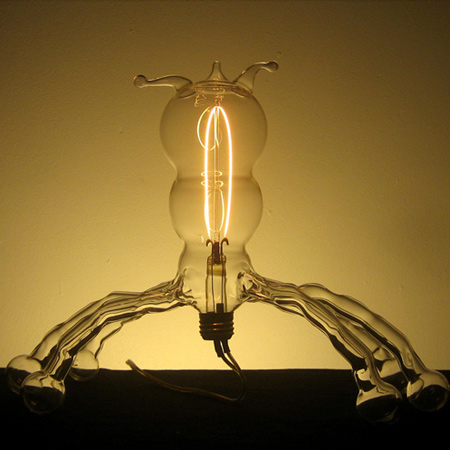
They herald the creation of the poetics of the filament: the delicate interplay of the incandescent arc with chimerical vacuum envelopes of Modernist and Surrealist paradigms. Each is a piece of lighting history, evocative in colour of candles and candelas past, and of a paradigm shift in the quality of light.

They are, additionally, for a nominal fee, after burnout, re-fillable, capable of being rewired and hermetically re-sealed.

Each is unique, hand blown by Dylan Kehde Rolofs, whose glassworks have graced the Burning Man and reside in collections and institutions worldwide.

Technical details:

Life span: The emphasis of these art objects is on their sculptural form and lighting quality, not quantity. If you are content with the wan, soulless light provided by compact fluorescence, read no further.

This being said, the filament temperature is slightly lower than that of bulbs rated for 25,000 hours, and about the same as other famously long-lived bulbs. The filament thickness is at least 10 times that of a standard 2000-hour bulb. The initial inrush of current from being switched on, and vibration are the worst enemies of these sculptural filaments, since the rate of evaporation is several orders of magnitude lower that a standard bulb. Test bulbs approaching 2500 hours of age are not even beginning to show signs of darkening from this evaporation.

Approximate wattage: Each bulb draws about 1 amp at either 12v or 24v, thus about 12 or 24 watts.

The envelope is baked out under vacuum at 400 Centigrade for 1 hour before tip-off.

The filaments are fully replaceable, once, upon return of the lamp, ideally in the original packaging, for the cost of shipping and handling. Additional filament replacement is available for a nominal fee.


Posted by Rose Etherington

Subscribe to Dezeenmail

12 Responses to “Hand-blown light bulbs by Dylan Kehde Roelofs”

  1. fBot Says:

    Well done

  2. Clifford Says:

    Rare!

  3. Jodi Says:

    Really love these, gorgeous and sensitive work.

  4. ben Says:

    these look expensive

  5. K. Rimane Says:

    sweet. designed for Futurama Professor Farnsworth?
    Good news everyone!

  6. Axe Says:

    While very cool, I do like the art & life of these. and the fore thought of replacement.

    is there not a place for this sort of art in the modern compact light?

    if the traditional give ur this freedom of art,

    where can the compact forecent take you?

    while the industral bend & share for life & brightness, the artist can use these paramitors for freedom.

    but you may lose the replacement abilty of the light.

    a cost of the modern day, cost now V cost over time.

    I think that is some thing that is only answered on a personal level.

    (while every one’s meter tick’s the same)

    these are beatiful, but read this as the modern can not be.
    I hope to see both, pratical & art.
    enjoy
    Axe

  7. edward g. Says:

    They’re beautiful but a little sad.

  8. Matt Bentley Says:

    Yes yes, fluorescent bulbs are soulless, just as filament bulbs were soulless in contrast to the flickering flame of the oil flame burners that came before them, which were probably ‘the devils flames’ in comparison the wood burners that came before…
    The bulbs themselves are pretty, but save the ‘new = bad’ shlack for a time when getting rid of the older bulbs isn’t critical to the survival of the species please.

  9. Don Says:

    Here is some reading for anyone interested in facts regarding the supposed advantages of compact fluorescent globes.
    Matt Bently you could do worse than to read the article and get some dispassionate facts on board.

    These light globes are beautiful and rebuild able. Makes sense to me to conserve resources and have something beautiful.

    http://sound.westhost.com/articles/incandescent.htm

  10. Matt Bentley Says:

    Those are -not- dispassionate or unbiased ‘facts’. That’s an opinionated article, with a fair amount of scare-mongering. God forbid anyone should have UV coming out of a lightbulb, like it does out of the sun, of all things.
    Flourescent bulbs have gone from strength to strength, and while the colouration of the earlier ones was harsh, in modern ones it is similar, if not indistinguishable, from a standard bulb. I have no time for nostalgia.
    If everyone made their own bulbs, and hence replaced the parts, that would indeed be a wonderful thing - and like I said, these bulbs are pretty-
    but don’t go pretending that standard bulbs aren’t manufactured in china, as that article does.
    m@

  11. Andrew Says:

    “They herald the creation of the poetics of the filament: the delicate interplay of the incandescent arc with chimerical vacuum envelopes of Modernist and Surrealist paradigms. Each is a piece of lighting history, evocative in colour of candles and candelas past, and of a paradigm shift in the quality of light.”

    Jeepers Creepers ! Who wrote this stuff ?

    They are very beautiful though. It’s just the description that’s a bit much.

  12. Architecture Nowadays... Says:

    I don’t know why they even wrote about flourescent bulbs. The idea behind this stuff has nothing to do with the idea of fourescent bulbs. One is a necessary item to everyday life, competing only with standard bulbs and gaining in almost every aspect to them. The other is a luxury car. It’s like comparing a bus with a coupé.

    What we should discuss here is the artistic value of this items, wich in my opinion is high. Of course art is not dissociated with society, economy and ecology. That’s why, even if this bulbs are beautiful, there are other better, or more adequate, directions in wich ilumination research should focus on.

    Probably what this bulbs (and their description) try to tell us is that the way we are leading our research is focusing too much on functional aspects of ilumination, forgeting about other, subjective and less consensual ones.

Leave a Reply