May 12th, 2008

img_0836pm_sq.jpg

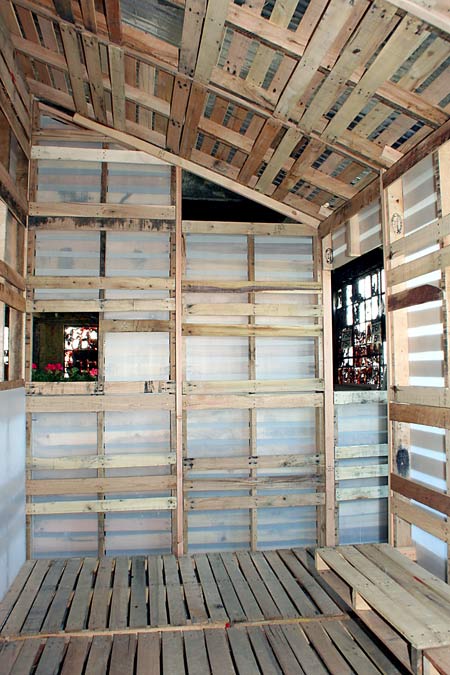
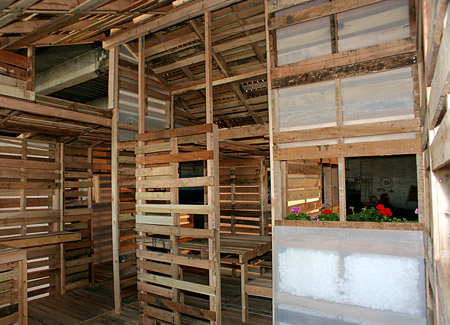
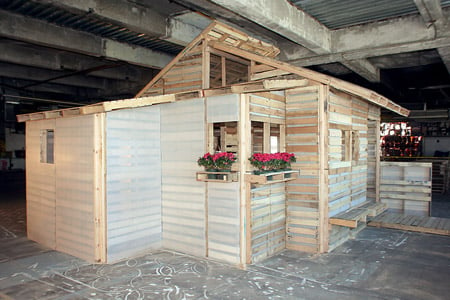
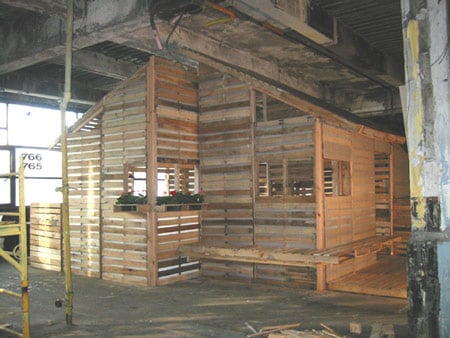
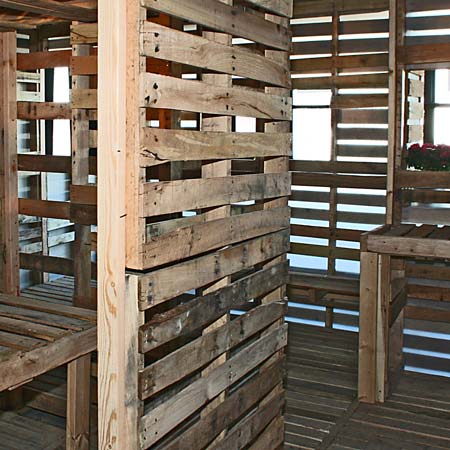
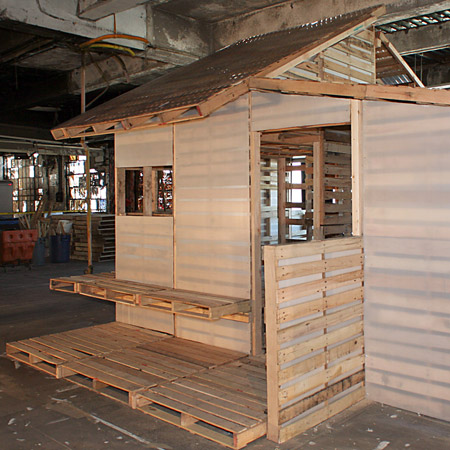
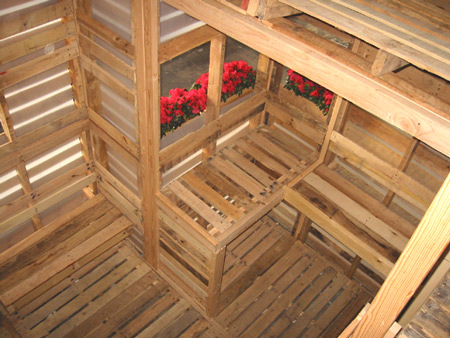
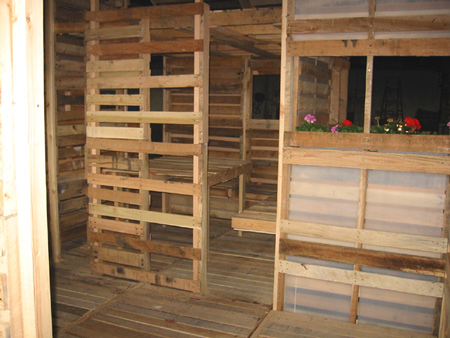
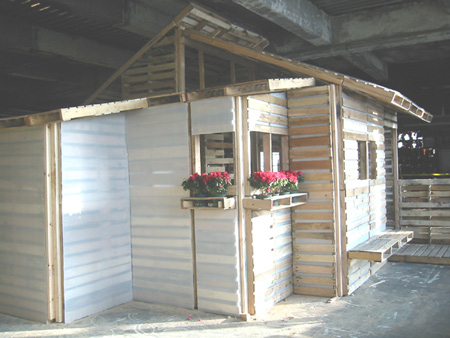
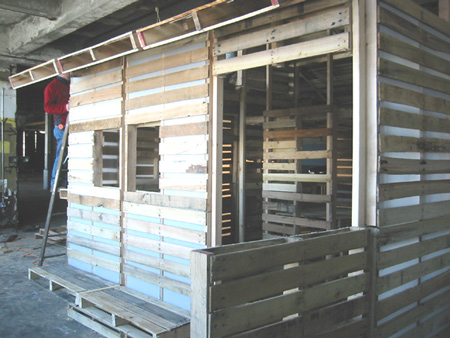
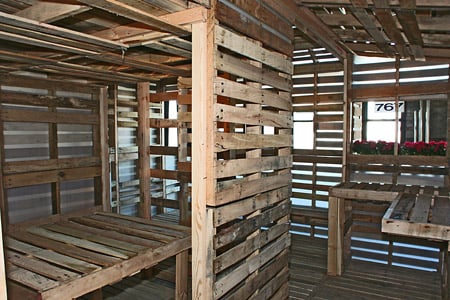
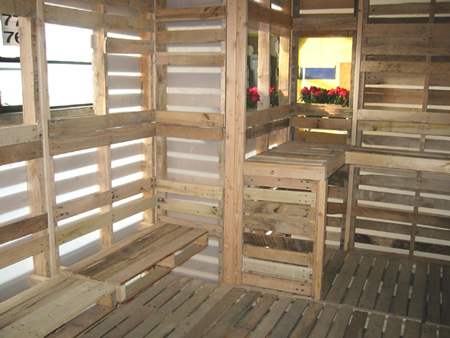
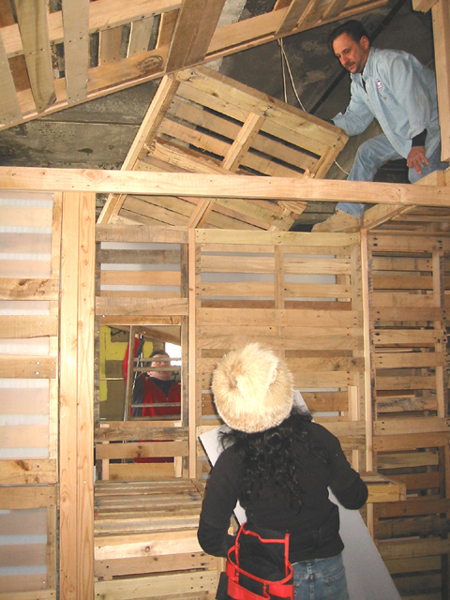
Architects I-Beam Design constructed a house for refugees made from wooden shipping pallets in a New York warehouse last month.
squarepallet14.jpg

Designed for refugees, the house can be quickly assembled and needs no extra materials transported as pallets are used to deliver supplies of food, clothing and medical supplies to disaster areas.
pallet13.jpg

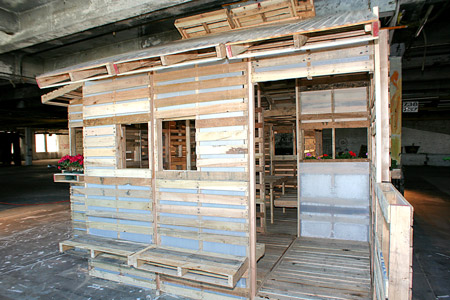
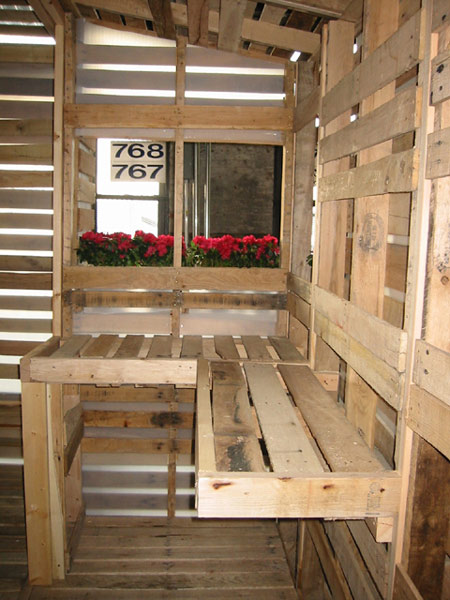
Houses made from pallets would not only provide temporary shelter but could be adapted using locally available materials into permanent housing.
pallet4.jpg

The following information is from I-Beam:

Refugee Housing comes to 57th Street

The nondescript warehouse on the corner of West 57th street at the entrance to the Henry Hudson Parkway is usually home to the assorted boxes, crates and old furniture you would expect to find in a warehouse. But for the past week it has been home to an entirely different type of inhabitant; a full-scale house built entirely from castaway shipping pallets.
pallet6.jpg

For the past week New York Architect firm I-Beam Design has been building a prototype of their award-winning refugee Pallette House in preparation for its premiere at the Milan Architecture Triennale. The Triennale entitled, ‘A Home For All’ promotes research into emergency housing in order to collect and compare plans for a different constructive, social and economic model of the home and of communities.
pallet8.jpg

I-Beam’s Palette House is made of wooden shipping palettes. Palettes are versatile, recyclable, sustainable, and easily assembled. Their transportation cost is negligible because they are used to carry shipments of clothing, food, and medical supplies to disaster areas.
pallet19.jpg

Although most disaster housing is temporary, the Palette House easily evolves naturally from emergency shelter to permanent house with the addition local materials like rubble, stone, earth, mud, plaster and concrete.
pallet10.jpg

Architects Suzan Wines and Azin Valy built the Pallete House with the generous support of Douglas and Helena Durst and the Chashama Performance group who donated the space for construction. Pallets were donated by Dominick Davi of Pallets Unlimited. Jimmy Di Domenico and Mario Denucci where the contractors that donated their time, tools, skills and generosity to make this project happen.
pallet12.jpg

Additionally, I-Beam Design is looking for a home for their Pallette house. They are looking to donate the house to any worthy organization looking to exhibit it or use it for humanitarian housing.
pallet-5.jpg

pallet-11.jpg

pallet3.jpg

pallet2.jpg

pallet1.jpg

palet7.jpg


Posted by Rose Etherington

Subscribe to our Newsletter: Dezeen Mail

22 Responses to “Pallet House by I-Beam”

  1. K. Rimane Says:

    poor little red flowers. the house makes them look terribly cheap.
    Rule #01 = “houses” aren’t meant to be build indoors.

  2. Olivier Says:

    it’s quite ironic…

  3. chachito Says:

    Is there any problem that most pallet wood is treated with arsenic and copper-chromium as a preservative so that it becomes poisonous when wet? Other than it being a potentially poisonous house, nice idea. Oh, and cute flower boxes too.

  4. lgg Says:

    @K. Rimane
    I’m not agree. This is not Milan Design Fair, this is a good idea for disaster areas, architecture is more serious than simply aesthetics, it must solve real problems, and this does it.
    I like the project very much, greetings!

  5. Bonzo Says:

    I believe that the use of a pallets is a fairly common approach for shanty building

    http://materialicio.us/tag/sheds

    Nevertheless, it needs more information: what makes it revolutionary? the jointing of the pallets? the type of pallets?
    It also does not address the infrastructural complexities and challenges posed by refugee housing communities which are typically of very high density - a shanty is a shanty, pallets, bin liners, tents — whatever. What is key is the management of a transient population and the drainage and fresh water issues leading to disease, etc.

  6. Michael Says:

    Completely unimaginative. The pallets merely act as a surface, as a way to skin a wooden frame built of new lumber. You might as well strip the boards from each pallet and make a slat sided “house”. This is nothing more then a quick art piece. They forgot to orient the roof pallets so the slats would run parallel to the water runoff.

  7. michael.r.h Says:

    could be a very smart idea, but any relief worker will tell you the amount of pallets needed to create one house would yield hundreds of kilos of food/supplies. it’s unlikely a ‘refugee’ will have access to so many boxes. it’s a bit ironic.

  8. Urban Says:

    Alright look, I’m completely for the creative use of mass produced waste and rethinking how and what we build with, but I must agree with Michael and michael here. It’s just not enough anymore to say look I made a house using pallets. Perhaps these projects make important statement’s and draw people to see things differently, however, to make it a real idea, and not just a picture, it must have real solutions and real details that are innovative and fresh. We know about reclaiming materials, now lets see how we can do that most effectively, and to the greatest outcome. This just isn’t there yet and I think the fact that it is within a warehouse is somewhat telling…

  9. roadkill Says:

    this is not a serious proposal… guys get real…

  10. Michael Says:

    To add to my first post above: Just look at images coming out of Burma, with people using real solutions because they WANT to survive. In a few hours using what was destroyed, they have built simple framed houses again from the rubble. Houses in Southern Asia need to serve two purposes: keep you elevated above the wetness and induce passive cooling while protecting you from rain. Its tropical for pete’s sake, a house with flowers is not necessary, shade and dryness is. It is a shame that we, as designers, spend so much time designing what is ideal for people without listening to them. ie Make it Right for the 9th Ward in New Orleans.
    Just because you draw in a black couple in traditional African clothing doesnt mean they will enjoy your art house. Maybe taking into account someone’s income level before designing a house that will be a nightmare to maintain financially is how to Make it Right.
    That same notion applies to building for a pallet house for refugees. Stop designing for your selfish ideas and start designing for those who need your help. It is like we all up and forgot Pruitt-Igoe.

  11. Arch Says:

    this is cuteness!
    disaster housing doesn’t have to look ‘disaster-ish’

  12. FBot Says:

    In da ghetto, wo wo

  13. gandy gallery Says:

    danubians dreams……

  14. cp Says:

    …there’s no toilet or clean running water for you poor refugees - but its all good - you get red flowers!!!!

    what a joke

  15. leandro locsin Says:

    pigeon house

  16. SamuelC Says:

    In a disaster situation people act to serve their basic needs and living requirements because they have to - I think such a situation will naturally yield pure and unrefined vernacular solutions. It might be more useful to study what is born from this type situation rather than design for it.

  17. gandy gallery Says:

    Danubians Dreams at Bratislava

    http://www.gandy-gallery.com/danubiansdreams

    matali crasset,medusagroup,peter cook …..

  18. edward Says:

    OK, you’re marooned on this desert island, see. And all you have for building materials is this huge pile of wooden pallets…

  19. raven sati Says:

    well - not very elegant eventhough quite resourceful

    since very little of what appears in this magazine is free of being driven by greed and selfishness, these guys have to be give a lot of credit for being compassionate

    keep it up guys - there are so many disasters and refugees these days - and mostly designers and architechs care not even a little bit

  20. Morgan Says:

    I imagine a bum’s rush at the loading dock of every warehouse superstore.

  21. cretton Says:

    I like recieve more details about this house..
    possibile ?

  22. sharon hayes Says:

    this is ingenous!I’d like to see them all over the U.S. instead of cardboard boxes and shopping carts

Leave a Reply